Kazakhstan is seeking a place in the next phase of the Iran nuclear dispute, not as a direct mediator between Washington and Tehran, but as a possible technical partner if talks turn to the handling of enriched uranium.
President Kassym-Jomart Tokayev has said Kazakhstan is ready to assist if international agreements are reached. The offer reflects Astana’s long effort to turn its Soviet nuclear legacy, disarmament record, and nonproliferation infrastructure into diplomatic capital.
The dispute has become more urgent as U.S.-Iran talks come under growing strain. According to Iran’s Fars News Agency, Washington has demanded the transfer of approximately 400 kilograms of enriched uranium and major restrictions on Iran’s nuclear infrastructure. Tehran, in turn, has insisted on sanctions relief, the unfreezing of foreign assets, compensation for wartime damage, and security guarantees.
U.S. President Donald Trump has described Iran’s demands as “unacceptable.” He later said he had postponed a possible military strike on Iran following appeals from the leaders of Qatar, Saudi Arabia, and the United Arab Emirates, citing what he called ongoing “serious negotiations.”
Against that backdrop, Tokayev said during a May 11 meeting with Brazilian Foreign Minister Mauro Vieira that Kazakhstan was ready, “as a gesture of goodwill,” to help resolve the Iranian nuclear issue. He said any such role would depend on relevant international agreements being reached and carried out in practice. According to Akorda, Tokayev also reiterated Kazakhstan’s commitment to the peaceful use of nuclear energy under International Atomic Energy Agency oversight.
The statement did not amount to an offer to mediate directly between Washington and Tehran. It was narrower and more practical. Kazakhstan is presenting itself as a state with broad international trust, technical experience, and nuclear infrastructure to support a settlement should the main parties agree on one.
Tokayev placed that argument directly into the Iran debate at the Antalya Diplomacy Forum in April. “The core issue is the proliferation of nuclear technologies and nuclear weapons. This must remain the central subject of negotiations in the context of the situation surrounding Iran,” he said.
For Kazakhstan, that distinction is central to the way it presents itself internationally. The country has built much of its post-Soviet foreign policy identity around nuclear nonproliferation.
The Times of Central Asia previously reported that Kazakhstan’s anti-nuclear stance is not only a diplomatic position, but part of the country’s modern national identity. The Soviet Union conducted 456 nuclear tests at the Semipalatinsk test site between 1949 and 1989, leaving long-term environmental and public health damage in eastern Kazakhstan. After independence, Kazakhstan transferred its inherited nuclear warheads to Russia and joined the Treaty on the Non-Proliferation of Nuclear Weapons as a non-nuclear-weapon state.
Kazakhstan has direct technical experience with sensitive nuclear material. In 1994, under Operation Sapphire, roughly 600 kilograms of highly enriched uranium were removed from the Ulba Metallurgical Plant in Ust-Kamenogorsk and transferred to the United States. TCA previously reported that the operation remains one of the strongest examples of Kazakhstan’s role in practical nonproliferation work.
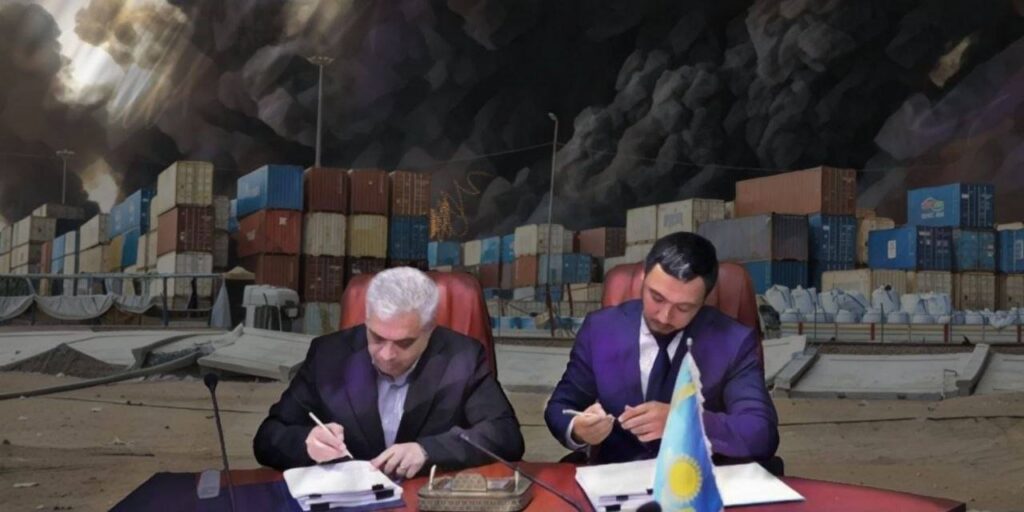
Kazakhstan has been involved in diplomacy over Iran’s nuclear program before. In 2013, Almaty hosted two rounds of talks between Iran and the P5+1 group comprising the United States, Britain, France, Russia, China, and Germany. Those meetings did not produce a final agreement, but they formed part of the diplomatic process that led to the 2015 Joint Comprehensive Plan of Action.
Under the JCPOA framework, Kazakhstan supplied Iran with 60 tons of natural uranium in exchange for the removal of low-enriched uranium from Iran. That history gives Astana credibility in any future discussion about the handling, transfer, or oversight of Iranian nuclear material.
Kazakhstan is also home to the IAEA Low Enriched Uranium Bank, located at the Ulba Metallurgical Plant. The bank was designed as a reserve of nuclear fuel for countries pursuing peaceful nuclear energy programs if regular commercial supplies are disrupted. It remains the only facility of its kind in the world.
Astana’s nuclear diplomacy has also become more visible in multilateral forums. At the 2026 Review Conference of the Parties to the Treaty on the Non-Proliferation of Nuclear Weapons in New York, Kazakhstan’s Permanent Representative to the United Nations, Kairat Umarov, is serving as chair of Main Committee II, which covers nonproliferation, regional issues, and IAEA safeguards.
In March, Kazakhstan also called for renewed dialogue among nuclear powers during a session of the Comprehensive Nuclear-Test-Ban Treaty Organization. The Kazakh Foreign Ministry said the country would continue contributing to the CTBTO verification system, including through five International Monitoring System stations on its territory.
Political analyst Gaziz Abishev has argued that Kazakhstan is trying to maintain neutrality while strengthening ties with Gulf states and Western partners. “As a country that voluntarily renounced nuclear weapons and promotes nuclear disarmament, it has a special position,” he wrote.
Abishev said Iran’s nuclear ambitions remain the central issue in its confrontation with the United States. “Kazakhstan maintains neutrality and is not going to fight for someone against someone else,” he wrote. “In the current international environment, there is no room for emotion. Everyone must defend their national interests within the framework of realpolitik.”
Kazakhstan is currently expanding its own civil nuclear sector, a shift that adds weight to Astana’s claim that it can combine technical expertise with a commitment to peaceful nuclear use. In April, Tokayev approved the country’s Nuclear Industry Development Strategy through 2050. The policy calls for at least three nuclear power plants by mid-century, the creation of a national nuclear industry cluster, expanded uranium processing, workforce training, and stronger nuclear safety systems. The first plant, with a projected capacity of 2,400 megawatts, is being developed in the Almaty region.
The strategy also emphasizes cooperation with the IAEA, localization of equipment production, and the development of a high-tech nuclear industry ecosystem. That creates a dual role for Kazakhstan: as the world’s largest producer of natural uranium, it is now building a domestic nuclear power industry.
Kazakhstan is unlikely to become a primary negotiator in the Iran dispute. The decisive choices will be made in Washington, Tehran, and other major capitals. But if the talks move from threats and public demands to practical arrangements over enriched uranium, Kazakhstan could become relevant in a narrower but potentially important way.
Its role would not be to solve the political conflict. It would be to offer a trusted technical platform if a political deal comes.