The Shanghai Cooperation Organization (SCO) renewed calls for a development bank at its October 20 heads of government meeting in Dushanbe, but the institution remains under negotiation more than a year after members reached political agreement on its creation.
Participants adopted a joint communiqué and decisions on economic cooperation, including joint manufacturing and transportation. Financing those ambitions remains a central challenge.
Members backed the bank at their September 2025 summit in Tianjin. A year later, the Bishkek summit ended without a founding agreement or capital commitments, and no launch date was set.
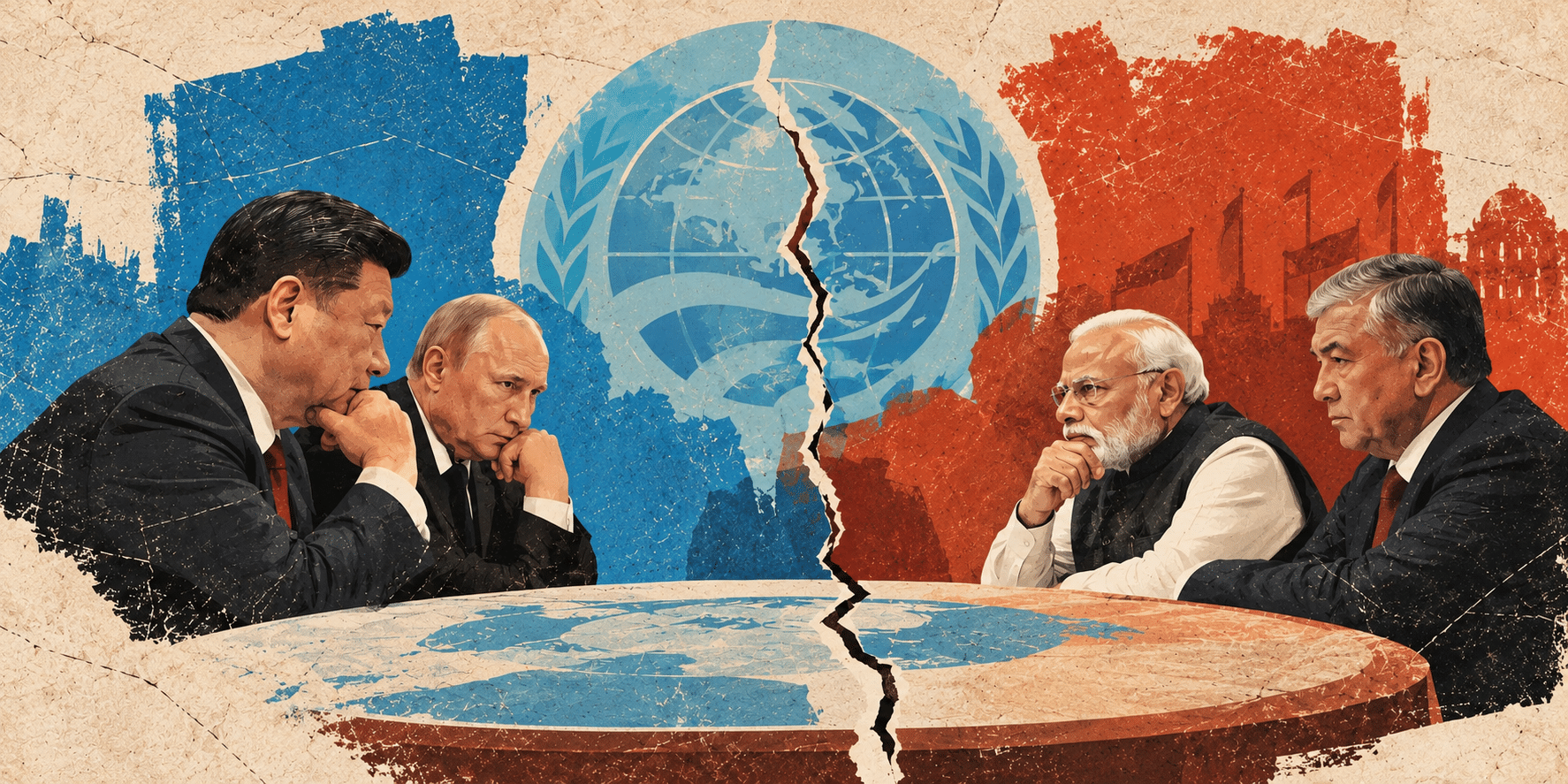
The SCO brings together ten countries whose economic priorities differ sharply. China and India are among the world’s largest economies, while Russia and Iran face Western sanctions. For Central Asian members, the organization offers another route to investment, but agreement on shared goals has yet to produce a common financing institution.
Different Priorities
Tajik Prime Minister Kohir Rasulzoda reported that SCO countries accounted for 70% of Tajikistan’s foreign trade turnover in January–August 2026. Meanwhile, foreign direct investment from member states amounted to just $350 million for the whole of 2025.
“These figures demonstrate the enormous untapped potential of our investment cooperation, which significantly lags behind the dynamics of trade relations,” Rasulzoda said.
Iran has different concerns. First Vice President Mohammad Reza Aref called for wider use of national currencies in trade, alongside export insurance and investment protection.
Tehran has long sought to reduce its foreign trade dependence on Western financial infrastructure. Sanctions make this an urgent priority, but Iran’s interests in international settlements differ considerably from those of India or China, for example. Beijing and New Delhi conduct extensive trade with Western countries, so a single financial model for all SCO members is unlikely to satisfy everyone.
Russian Prime Minister Mikhail Mishustin encouraged joint manufacturing projects using Russia’s special economic zones and investment protection agreements.
Kyrgyzstan, meanwhile, is seeking investors for the Tamchy special investment and financial territory, established in July 2025 in the Issyk-Kul region. First Deputy Chairman of the Cabinet of Ministers Daniyar Amangeldiev invited SCO partners to develop joint projects there.
Financing the Bank
A development bank could provide a common source of funding for such projects. In Dushanbe, Belarusian Prime Minister Alexander Turchin renewed calls to accelerate its establishment.
“We consider it fundamentally important that this institution become a multilateral development bank with a unique mandate, providing access to long-term investment financing without political conditions,” he said.
Kyrgyzstan also supported establishing the bank. Amangeldiev urged members to draw on existing financing channels, including the SCO Interbank Consortium, while negotiations continue.
Kazakh Prime Minister Olzhas Bektenov confirmed Astana’s willingness to host the bank’s headquarters. Bishkek had already put forward its candidacy at the September summit.
Choosing a headquarters is only part of the task. Members must agree on their financial contributions and how the bank will operate, including who decides which projects receive loans.
China has far greater financial resources than most of its SCO partners, giving it the potential to become the bank’s principal source of capital. Its role in funding the institution would make the distribution of voting power particularly important. For smaller members, the terms would determine how far the bank broadens their financing options.
Central Asian governments have reasons to seek a wider choice of lenders. China is already a major source of investment and credit, while Russia remains important for trade and labor migration. The region is also developing economic ties with partners outside the SCO.
Kazakhstan, Kyrgyzstan, Tajikistan, and Uzbekistan are cultivating relations with the European Union and the U.S., as well as Turkey, the Gulf states, and international financial institutions. An SCO bank would enter a region where governments already have competing offers and their own investment priorities.
Why the SCO Is Not Becoming an Economic Union
The difficulty of establishing the bank reflects the limits of the SCO as an economic institution. Over a quarter of a century, it has built an extensive system of meetings and agreements, but it has no single market or common customs territory.
The organization emerged out of security cooperation. Unlike the European Union, its members have not transferred authority over economic policy to supranational institutions.
All major decisions are made by consensus. This principle allows every member’s position to be taken into account, including those of smaller states. But serious disagreements can also stall decisions.
Political tensions also persist among SCO members. India and Pakistan have a long history of conflict, while India and China have unresolved border disputes. Sanctions on Russia and Iran affect their foreign trade and banking operations, while Central Asian countries are pursuing their own multi-vector foreign policies.
Joint projects can still proceed without agreement across the entire organization. A railway or industrial facility needs an arrangement among the participating countries and their financiers, rather than approval from every SCO member.
Such arrangements can deliver investment, but they leave the SCO primarily as a forum for negotiations. A development bank would give it a more direct role in financing projects across its membership.
For now, political support for the bank has yet to translate into an agreed institution. How much members will contribute, and what influence those contributions will confer, remain central questions.