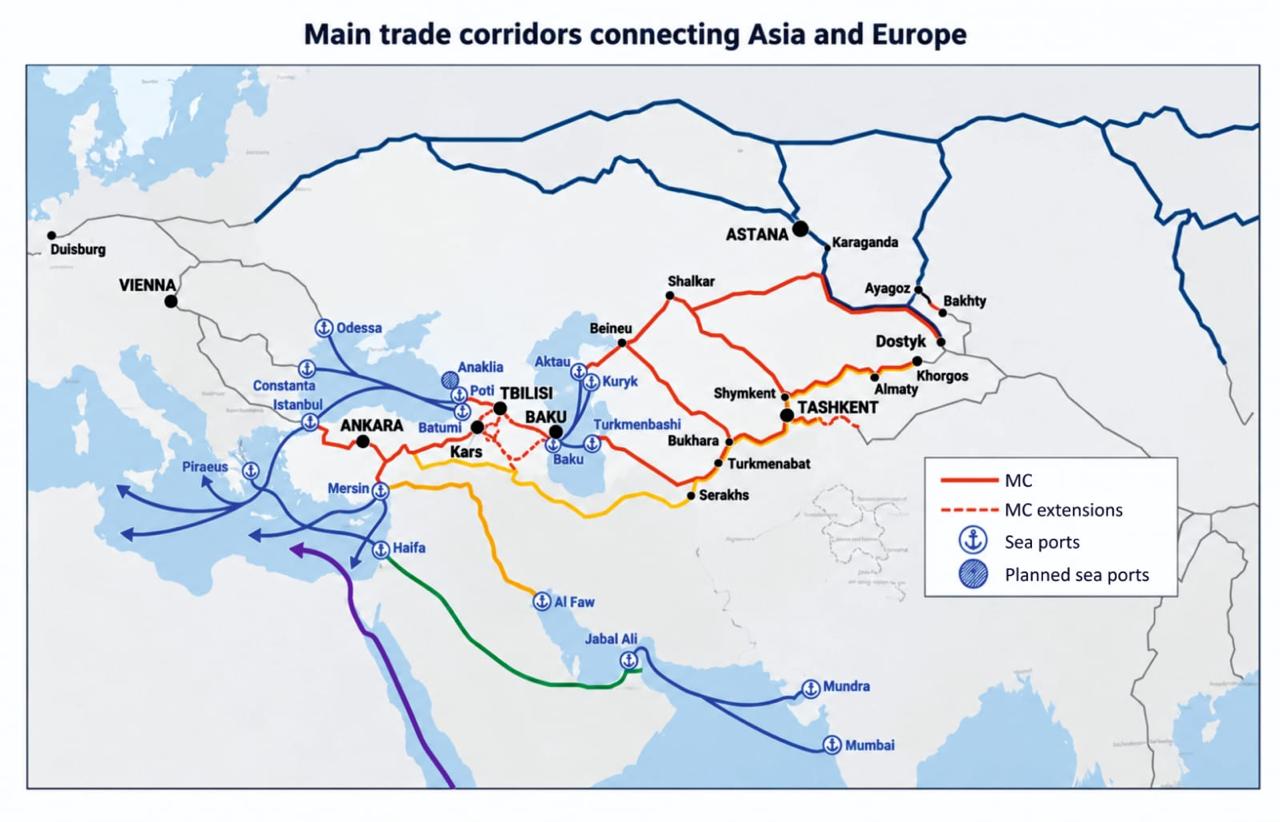
Developing the Middle Corridor, a transport route connecting China and Europe through Central Asia, the Caspian Sea, and the South Caucasus, will require at least $25 billion in infrastructure upgrades by 2040. The World Bank estimates that another $30.5 billion will be needed for complementary investments in logistics centers, industrial zones, and other projects capable of generating economic benefits for countries along the route.
These estimates are presented in the World Bank study Integration: World-Class Trade Logistics Along the Trans-Caspian Transport Corridor.
According to the bank’s projections, if the necessary investments and reforms are implemented, freight volumes crossing the Caspian Sea could more than triple by 2040. In the long term, participating countries could see an average additional increase of 3.3% in GDP and 2.9% in employment, equivalent to approximately two million additional jobs.
The study covers nine countries in Central Asia, the South Caucasus, and Turkey. For Central Asian countries without direct access to the world’s oceans, developing the route offers an opportunity to reduce transportation costs and expand access to foreign markets. For China and Europe, it provides an additional trade route that could help diversify supply chains.
Why Transit Alone Is Not Enough
The study’s findings were discussed on October 15 in Astana at the eighth New Silk Way International Transport and Logistics Business Forum.
Andrei Mikhnev, the World Bank’s Country Manager for Kazakhstan and Turkmenistan, highlighted the difference between increasing transit volumes and generating economic benefits for countries along the route.
“Turning connectivity into economic value, and transit flows into broader development opportunities, is not easy. That is why the Eurasian corridor is so important. It is not merely a transport and transit route, but a foundation for economic integration,” he said.
Countries are already investing in railways, roads, ports, and logistics infrastructure while simplifying trade procedures. According to Mikhnev, further development will require closer cooperation among governments and transport operators.
The World Bank projects that by 2040, trade among Middle Corridor countries could increase by approximately 50% in value and 60% in physical volume. Kazakhstan and Turkey are expected to see the greatest economic gains in absolute terms because of the size of their economies and their positions within the transport network.
Countries located away from the main transit routes could also benefit. For Tajikistan, for example, improved transport connections would mean lower shipping costs and better access to regional markets.
However, developing the corridor alone will not transform the structure of exports. Oil, metals, and other raw materials will continue to dominate freight flows. The share of machinery, electronics, and processed goods will grow more slowly.
$25 Billion for Infrastructure and $30.5 Billion for Complementary Investments
The World Bank estimates the cost of priority infrastructure projects at at least $25 billion. The funds are needed to modernize railways and ports, increase maritime transport capacity, and eliminate bottlenecks along the route.
Of the 16 most important projects, 12 are already underway. Together, they account for approximately 85% of the estimated costs.
Luis Blancas, a senior transport and logistics specialist at the World Bank, said at the forum that the remaining four projects had not yet entered the implementation phase but were included in government plans and expected to proceed.
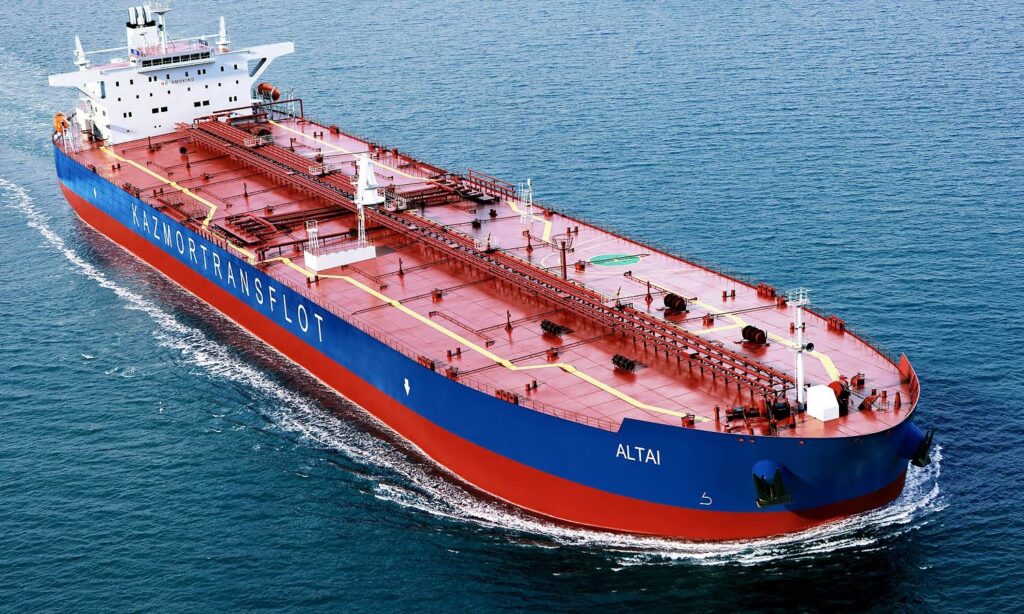
Separately, the researchers estimate a need for approximately $30.5 billion in additional investment. This includes logistics hubs, access roads, industrial zones, agricultural processing facilities, transport equipment, and digital systems.
These investments are intended to help businesses along the route use improved transport connections to expand their own production and exports. Without them, increased transit traffic may generate transportation revenue for governments while delivering limited benefits for industry and employment.
The World Bank recommends implementing projects in stages through 2030 and 2040, with their commercial viability and demand assessed in advance.
A significant share of the additional financing is expected to come from private investors. Attracting that capital will require predictable regulations, transparent tariffs, and more effective management of state-owned transport companies.
Along most sections of the Middle Corridor, railway networks, ports, and cargo fleets are controlled by state-owned enterprises. Their financial condition, quality of management, and operational coordination directly affect shipping costs and delivery times.
How the Middle Corridor Can Compete with Maritime Shipping
Shippers moving goods between China and Europe can choose northern overland routes or maritime transport. Rail freight generally costs more per unit of cargo than shipping by sea.
According to Blancas, the Middle Corridor’s competitive advantage should be speed combined with comparable reliability.
“It must be significantly faster than alternative maritime routes while remaining competitive in terms of speed with other overland transport options,” the expert said.
This is particularly important for container shipments of electronics, machinery, and other high-value goods. Faster delivery allows companies to reduce inventories and associated costs, offsetting higher transportation expenses.
According to World Bank estimates, by 2040, delivery times on the fastest Middle Corridor route between Chongqing, China, and Budapest, Hungary, could fall to 18–19 days, compared with 47–50 days on the route today. For comparison, the study estimates average maritime delivery times between the same cities at approximately 45 days.
Achieving these targets depends on the performance of border crossings, ports, and terminals where containers are transferred between different modes of transport. Delays at these points can erase the time savings gained from faster train journeys.
Fifteen Documents for a Single Container
One of the Middle Corridor’s most serious problems is the paperwork required when freight crosses borders and changes carriers.
According to the World Bank, transporting a container between China and Europe along the route can require approximately 15 different documents, including waybills, customs declarations, permits, and other paperwork. Much of the information they contain is duplicated.
A typical shipment may also involve up to ten entries into and exits from customs transit procedures, each requiring additional documentation.
“All of them essentially contain the same information. It would be much better to replace them with a single digital document. We call it T3 – a universal document for transport, transit, and trade,” Blancas explained.
The proposed T3 system would consolidate cargo information into a single digital document accessible to carriers and regulatory authorities along different sections of the route. This would reduce repetitive paperwork and speed up border crossings.
Another World Bank proposal is to establish a joint venture to organize container rail and maritime services across the Caspian Sea. Such an entity could coordinate schedules, tariffs, container transfers, and responses to delays.
Currently, shipping goods along the Middle Corridor requires dealing with several national railway companies, port operators, maritime carriers, and customs authorities. Every transfer of a container between them creates a risk of additional costs and delays.
The World Bank proposes integrating transport management and data exchange so that shippers can book deliveries across the entire route under coordinated terms, without responsibility for the shipment becoming fragmented as it moves between countries and modes of transport.