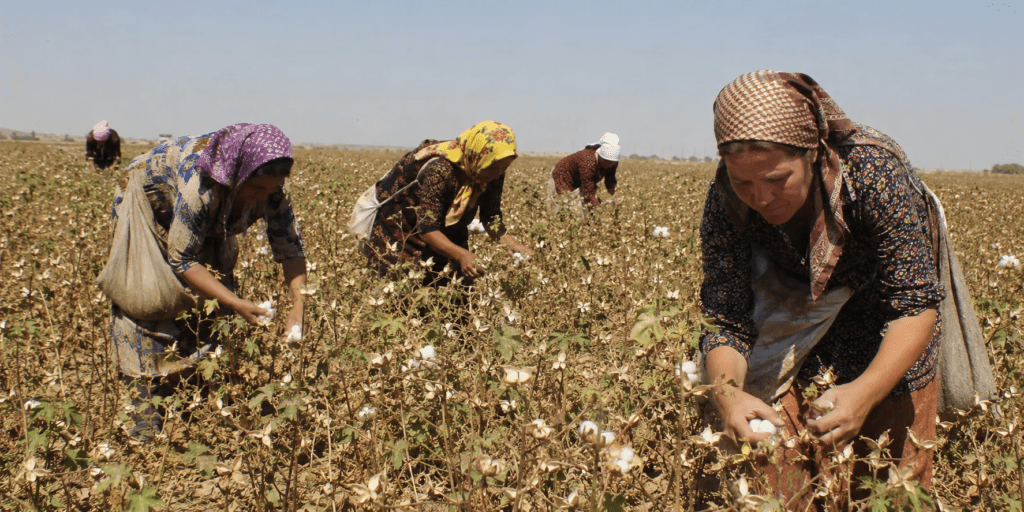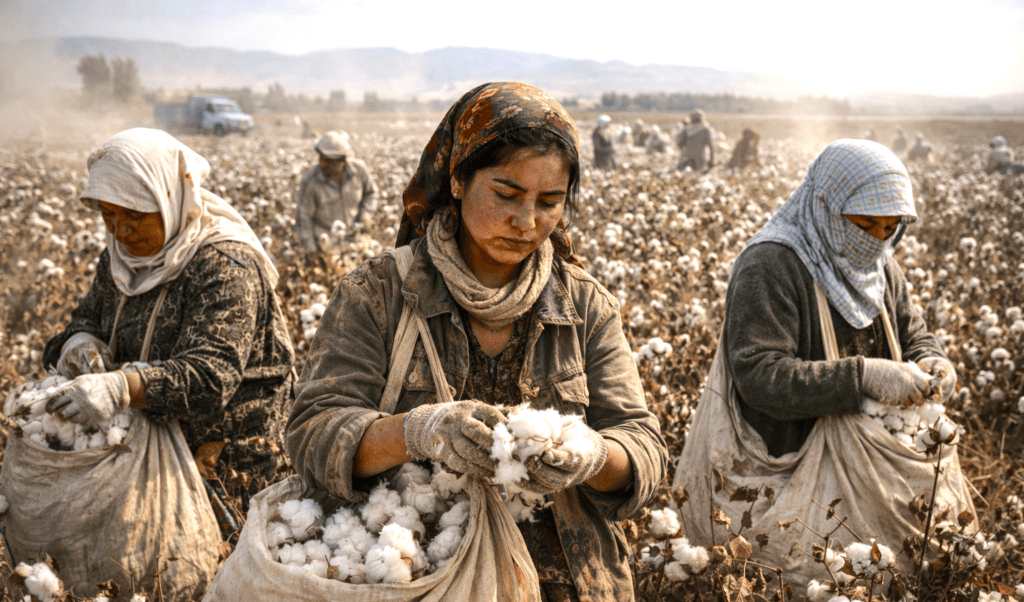
In Turkmenistan, teachers, healthcare workers, and employees of state-owned enterprises continue to pay from their salaries to avoid being forced to pick cotton, according to independent reporting.
The independent news outlet Turkmen.news reported in October that employees of an oil depot in the Dashoguz region paid approximately $19 a month despite earning around $110. Bank employees paid $3.50 three times a week, while school employees in Turkmenabat paid $1.50 up to 10 times a month. These dollar amounts are approximate, based on an unofficial exchange rate of around 19–20 manat to $1, compared with the official rate of 3.5 manat.
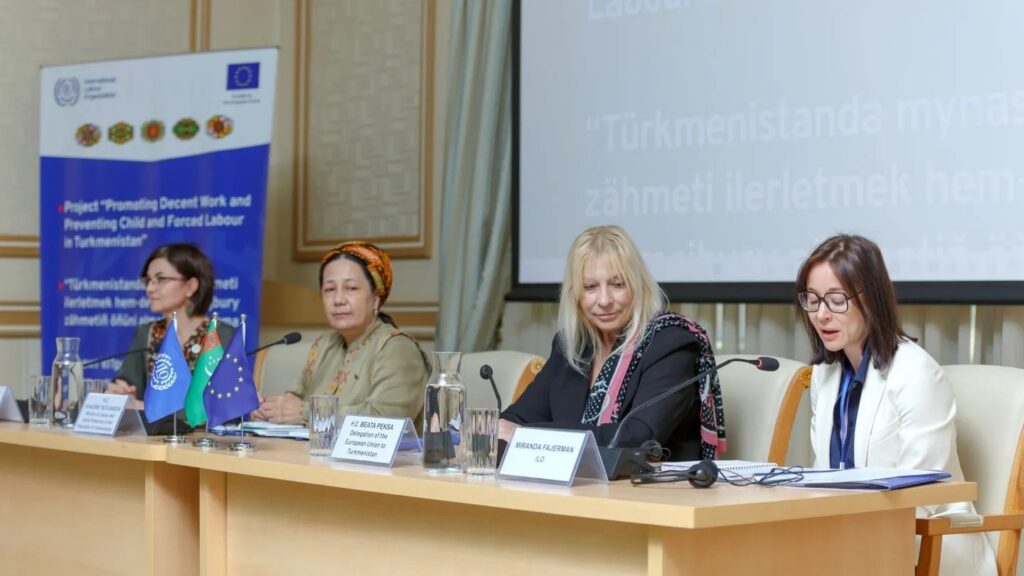
The government is discussing measures to combat forced and child labor with the International Labour Organization (ILO) and the European Union (EU). At an international conference in Ashgabat on November 4, representatives of the ILO, United Nations agencies, and trade unions discussed the protection of labor rights. The government’s account of the meeting made no mention of the cotton harvest or the forced mobilization of workers.
Public Employees and Soldiers Sent to Cotton Fields
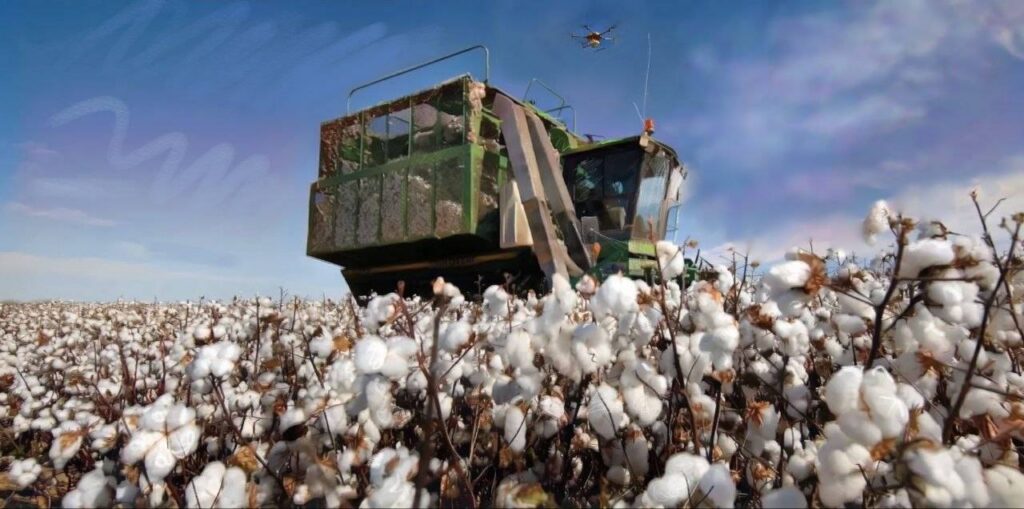
The cotton harvest officially began on September 9, with a national production target of approximately 1.25 million metric tons of raw cotton, including 275,000 metric tons from the Dashoguz region.
Public-sector employees were reportedly being assigned to fieldwork before the official start. On August 20, the independent outlet Chronicles of Turkmenistan reported that cleaners and maintenance staff from public institutions in the Lebap region would work 15-day shifts in cotton fields. Doctors, nurses, and teachers were to participate on weekends.
Turkmen.news documented forced mobilization in four of the country’s five regions: Ahal, Dashoguz, Lebap, and Mary. Workers from municipal services and road maintenance organizations were among those required to pick cotton or pay for replacements. The outlet reported that some replacement pickers were children as young as 12.
In a separate October 22 report, it described military conscripts harvesting cotton in the Mary and Lebap regions, with daily quotas of 40–50 kilograms. A conscript said soldiers were supposed to receive one manat (about $0.05) per kilogram, but that the unit commander took the money.
The accounts involving soldiers and minors rely partly on anonymous sources. The reports contain no response from the authorities to these allegations.
What ILO Monitors Found
Since 2023, Turkmenistan has allowed ILO observers to monitor cotton harvests. Cooperation is conducted under agreed road maps, the latest of which covers 2026. In May, the ILO and the EU launched a joint project for 2026–2027 to prevent child and forced labor in cotton production.
At consultations in Ashgabat on October 27–28, participants discussed hiring cotton pickers under simplified labor agreements that would include insurance against workplace injuries.
The ILO’s 2025 monitoring report found that observers saw children in the fields during 38% of visits, up from 23% in 2024. Among farmers interviewed, 34% reported the presence of children, compared with 17% a year earlier. In the Dashoguz region, observers saw children in 59% of fields visited.
Observers reported interference during 35% of field visits and 34% of visits to public institutions and state-owned enterprises. Among public-sector employees interviewed, 12% reported participating in the cotton harvest. The ILO cautioned that its findings were not statistically representative and could not be used to estimate the prevalence of these practices nationwide.
The Cotton Campaign coalition’s report on the 2025 harvest, published in May 2026, found that all categories of public-sector employees were required to pick cotton or contribute money. Payments to avoid fieldwork averaged approximately 1–2.50 per day. Its authors said authorities had reversed some of the limited exemptions introduced in 2024 for certain doctors and teachers.
Farmers Lose Around Half Their Cotton Payments to Deductions
The government sets cotton delivery quotas and purchase prices. The same monitoring report found that official prices for medium-staple cotton in 2025 were approximately 233–256 per metric ton at the unofficial exchange rate. After mandatory deductions for agricultural inputs and services, many farmers reported receiving only 123–128 per metric ton.
Pests caused further crop losses in 2026. Farmers in the Mary region told Turkmen.news that fields yielded 1–1.5 metric tons per hectare, compared with 3–3.5 metric tons a year earlier. Despite these losses, the government’s procurement target remained unchanged.
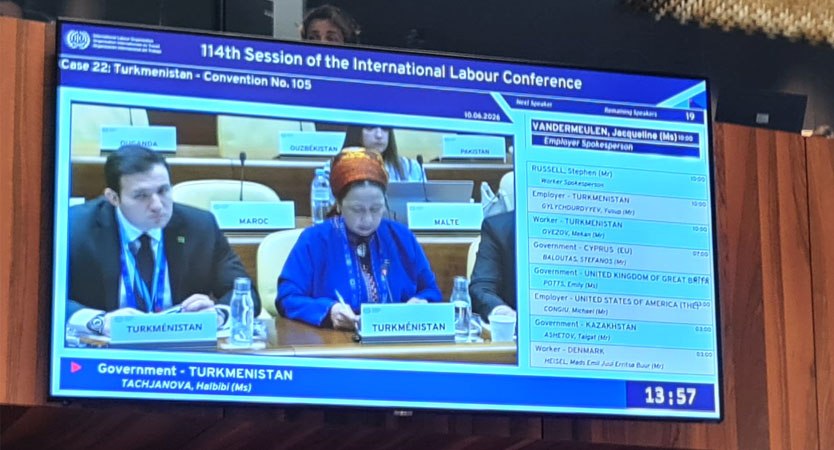
In June 2026, the International Labour Conference’s Committee on the Application of Standards examined Turkmenistan’s compliance with the Abolition of Forced Labour Convention, 1957 (No. 105), for the fifth time. The committee called for an end to the forced mobilization of workers and the abolition of mandatory cotton quotas. It also asked Turkmenistan to report on its progress by September 1.
U.S. Upgrades Turkmenistan’s Ranking Despite Forced Labor
The United States has restricted imports of Turkmen cotton and products made wholly or partly from it since May 18, 2018. U.S. Customs and Border Protection issued the restriction, known as a Withhold Release Order, under legislation prohibiting imports made with forced labor.
The U.S. Department of Labor also includes Turkmen cotton on its List of Goods Produced by Child Labor or Forced Labor.
In its 2026 Trafficking in Persons Report, the U.S. Department of State upgraded Turkmenistan to Tier 2 from the Tier 2 Watch List, a category subject to additional monitoring. The country had previously been classified in Tier 3, the lowest category.
However, the report said authorities continued to mobilize adults and children for cotton harvesting in 2025 and failed to investigate officials involved in the practice.
Turkmen Cotton and the European Market
According to the Cotton Campaign’s analysis of cotton trade, Türkiye accounted for an average of 84% of Turkmenistan’s cotton product exports between 2020 and 2023. In 2024, Pakistan’s imports of cotton and semi-finished cotton goods from Turkmenistan reached approximately $29 million. Turkmen fabrics were also exported to Italy, Poland, and Portugal.
On December 14, 2027, Regulation (EU) 2024/3015 will begin to apply, prohibiting the sale on the EU market and export from the EU of products made using forced labor. The prohibition applies regardless of a product’s country of origin.
Unlike the U.S. restriction on Turkmen cotton, the EU rules do not automatically ban all products from a particular country. Removing goods from the market will require an investigation and a finding that forced labor was used.