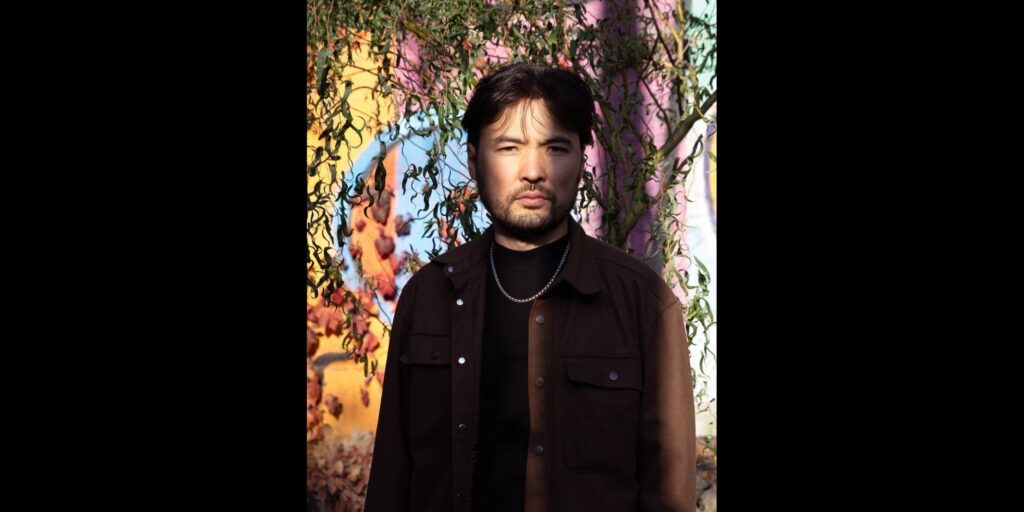
“Am I allowed to swear a little during the interview?” the artist Islam Doorov jokingly asks me in perfect French. Thrown by the flawless accent of this Kyrgyz artist in a country where the second language is Russian, I can’t help but nod as I take out my recorder.
One thing is certain about the art scene in Kyrgyzstan. From the language to the landscape, from urban planning to artistic practices, nothing is as you would expect. That is, assuming you have any expectations at all, because this small Central Asian country remains largely unknown to many Europeans and Americans.
But ask a Turk or a Russian, and they will describe the capital, Bishkek, as a pleasant Central Asian city in which to spend a weekend. And rightly so. Numerous cafés and bars dot the tree-lined boulevards, the fountains along the broad avenues perform elaborate water ballets, and you can breathe in the calm and tranquility. Unfortunately, along with that calm, you also breathe in an enormous amount of smog, a subject, incidentally, that many artists explore in their work.
Smog aside, the city center is full of architectural wonders, from a neoclassical theater to the brutalism of the modern art museum and the Soviet eclecticism of the national circus. There is also the monumental Ala-Too Square, embraced by rhythmic colonnades, with the angular national museum on one side and the statue of Manas, hero of the national epic, in the middle.
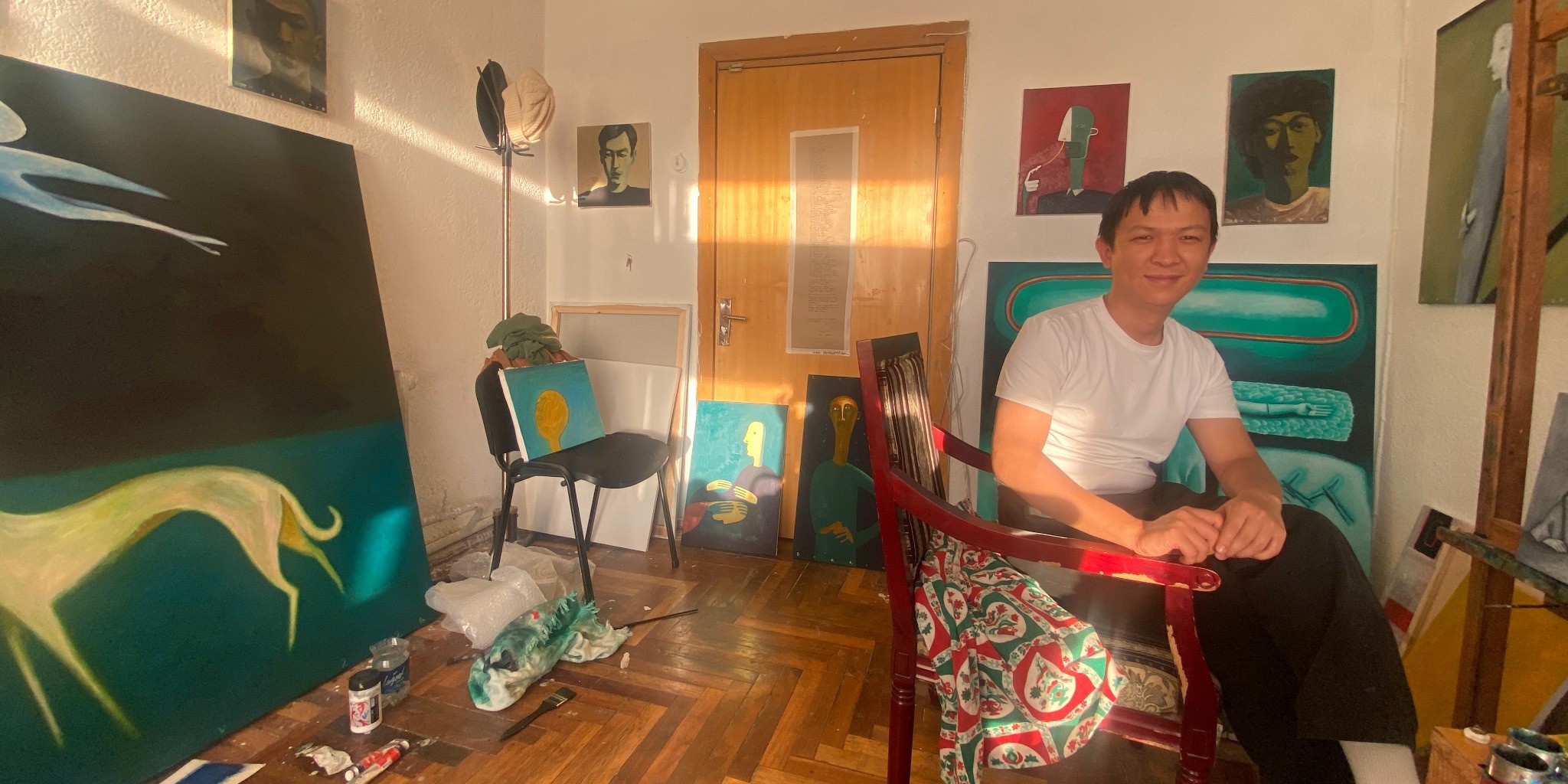
Islam Doorov’s studio, a few steps from the square, is no less surprising. You reach it through a neoclassical doorway, connected to an adjacent Soviet complex by a labyrinth of stairs, corridors, and balustrades. At the end of a long, dark corridor, a door like many others opens onto a small room crowded with canvases, lit by clear autumn light.
Originally from Kyrgyzstan’s Batken region, Doorov trained at the Turgunbai Sadykov Art School and College before spending several years teaching. He published his first collection of poetry in 2017 and has exhibited internationally. In October 2025, the Gapar Aitiev National Museum of Fine Arts in Bishkek hosted his third solo exhibition, Paragraph, showcasing his expressive and surrealist paintings.
“I’m the only artist here. The rest are offices,” explains the artist. “I love studios, the smell of paint. When I have very little time and can’t go home, I stay and sleep here, on the canvases. The view is beautiful when it gets dark.”
The swear word he had on his lips, Islam explains, was aimed at one of his critics, who had labeled him narcissistic and egocentric. “A friend of mine, a writer who was living with me at the time, came to see me one day, a little drunk, and confessed that he had met a painter who said she didn’t like me,” recounts Islam.
“According to her, I was selfish, someone who pays too much attention to himself, because I made so many self-portraits. So I told my friend: go and tell her I want to make a hundred more.”
TCA: You did, in fact, create a series of a hundred paintings, all produced during the Bulbul residency, established by the Bishkek School of Contemporary Art (BiSCA). Can you tell me how you developed the idea within that space?
Doorov: The idea lived in my head for a while. I had no studio then, so I wrote to Syinat Zholdosheva, who runs Bulbul, and asked if I could do a residency there. She said yes, with pleasure, and it was a great help. I decided to treat it as research into narcissism and selfishness. The project is called Я, which is “I” in Russian.
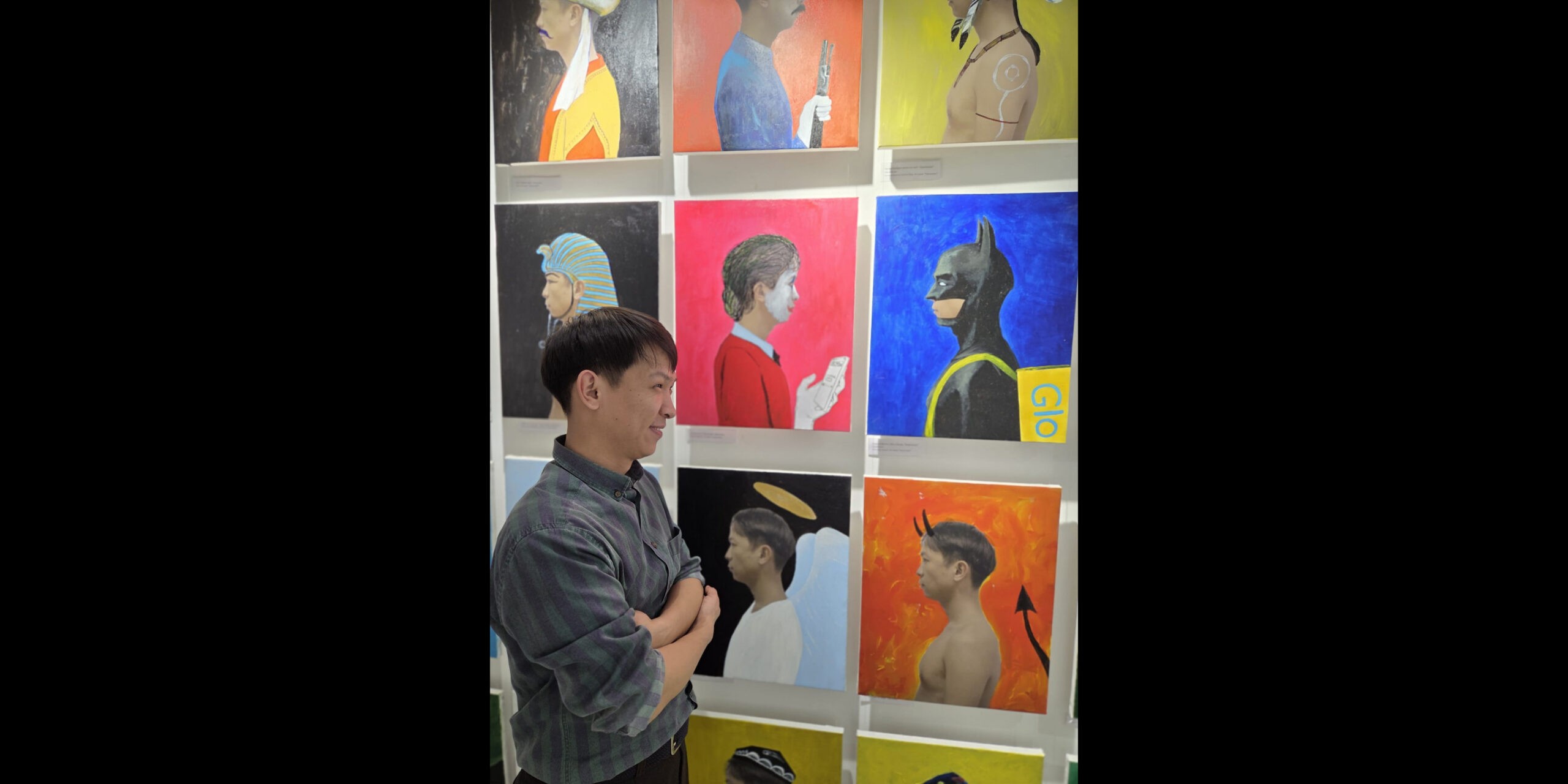
Works from Doorov’s series of 100 self-portraits, Я (I); Image: Islam Doorov.
TCA: What perspective did hiding away at a residency in the mountains give you?
Doorov: There you can have some solitude. Normally, I drink, meet friends, and kill time in a bar. Or rather, I waste it. So, I told myself I had to hide in the mountains and work. I told myself I needed someone with money who could help me. I found a patron and asked him to support my project. He agreed in exchange for a painting. I said, ‘OK, but you pay me first, and don’t rush me. I have to work in peace.’ He agreed, gave me the money, and I started working. That’s how it went down.
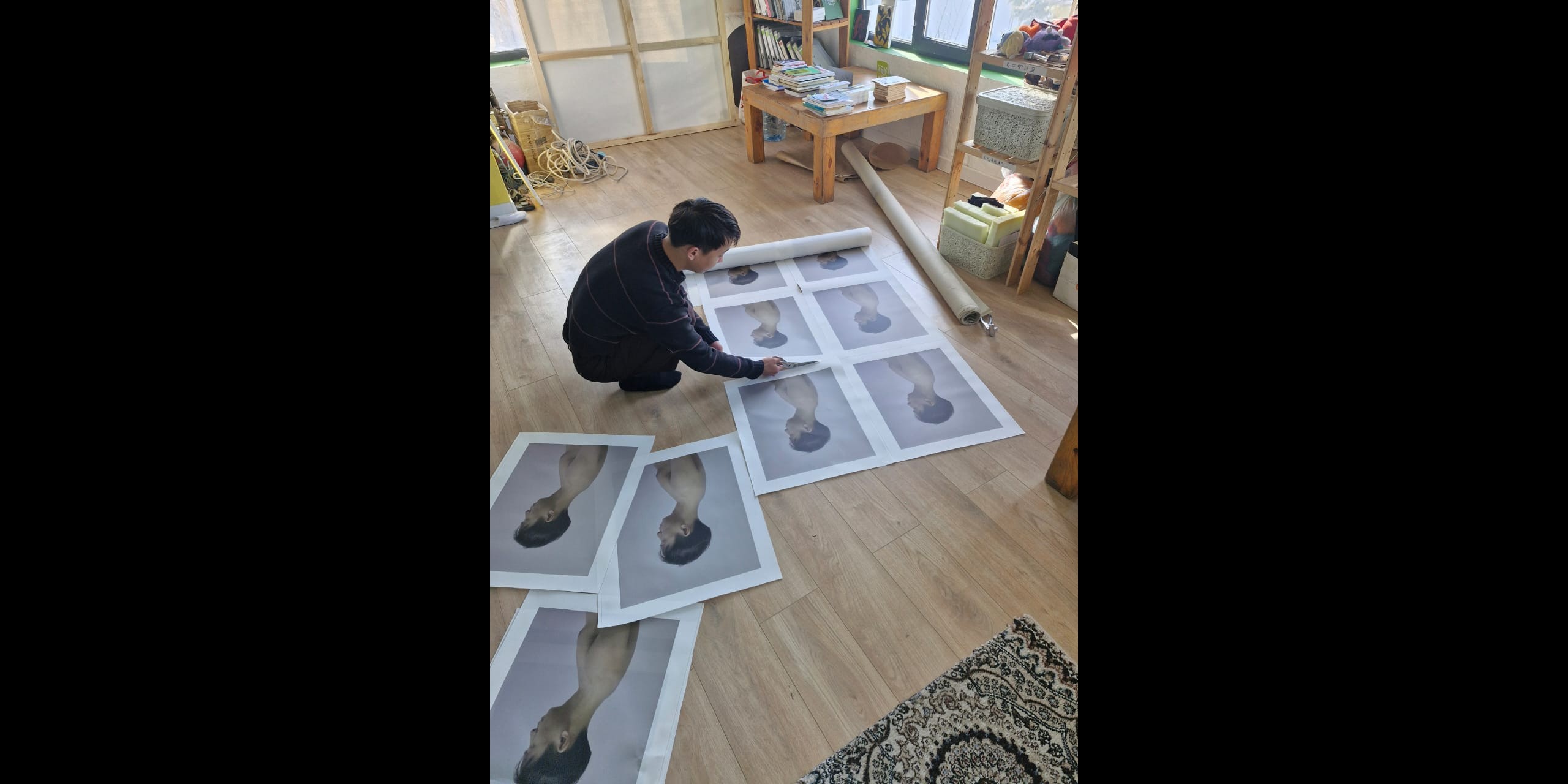
Doorov preparing photographic material for his mixed-media self-portraits; Image: Islam Doorov.
TCA: It seems to me that this experiment is as much about the process as it is about the final result. Did you come to any realizations while painting these portraits?
Doorov: Of course, after the fifteenth portrait I was already fed up! I was tired. After twenty I hated myself, and after thirty-five I wanted to vomit. I began to see all my false features, the bad ones, and I told myself it was no accident. It was good that she met my friend, because without her remark I would never have tried this. And maybe it cured my narcissism. I had a month-and-a-half residency, which is very short, and I wasn’t sleeping. The residency organizers told me to do just thirty portraits, or fifty, but not so many. I said no, it has to be a hundred. So, I made a hundred: ninety-nine small ones, and the last one, one big painting.
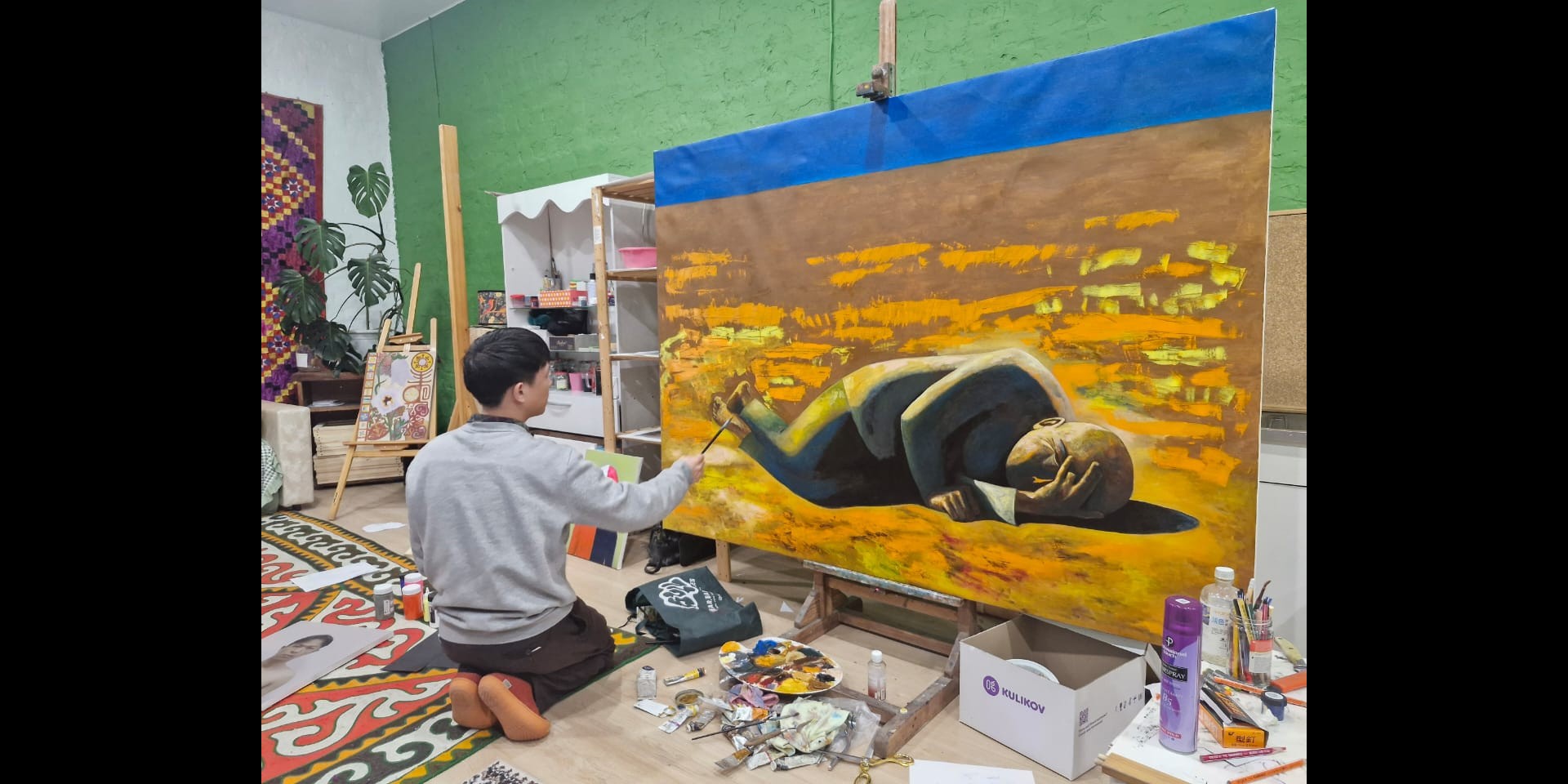
Doorov at work during the creative process; Image: Islam Doorov.
TCA: You painted over the final, large self-portrait several times before returning to the first version. Why?
Doorov: At first it was one thing, and then I had doubts. I thought maybe it wasn’t good. A friend of mine also told me that it wasn’t good, that I could do better. So, I tried again and again, and it changed completely, like another man hiding behind the first. In the end, I said no, this is rubbish, and went back to the first version. Sometimes the process means you have to go back in order to move forward.
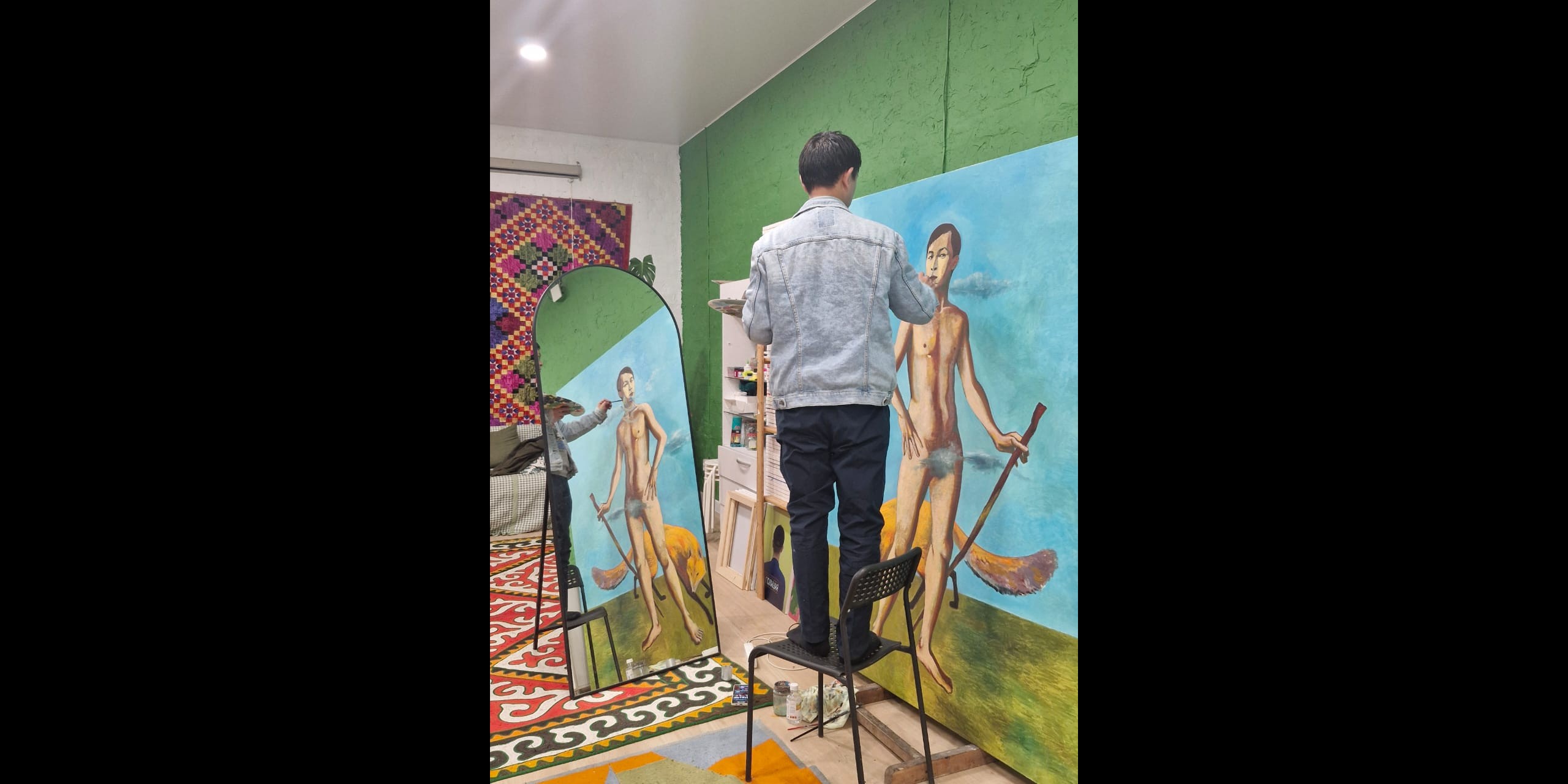
Doorov working on a large-scale self-portrait; Image: Islam Doorov.
TCA: You also wrote a poem to accompany this series of paintings.
Doorov: Yes, instead of the curatorial text, I wrote a poem. It is called “Ya, moi.” It says “I am a pirate,” “I am a painting,” “I am Rome,” “I am Paris,” and so on. It’s in Russian.
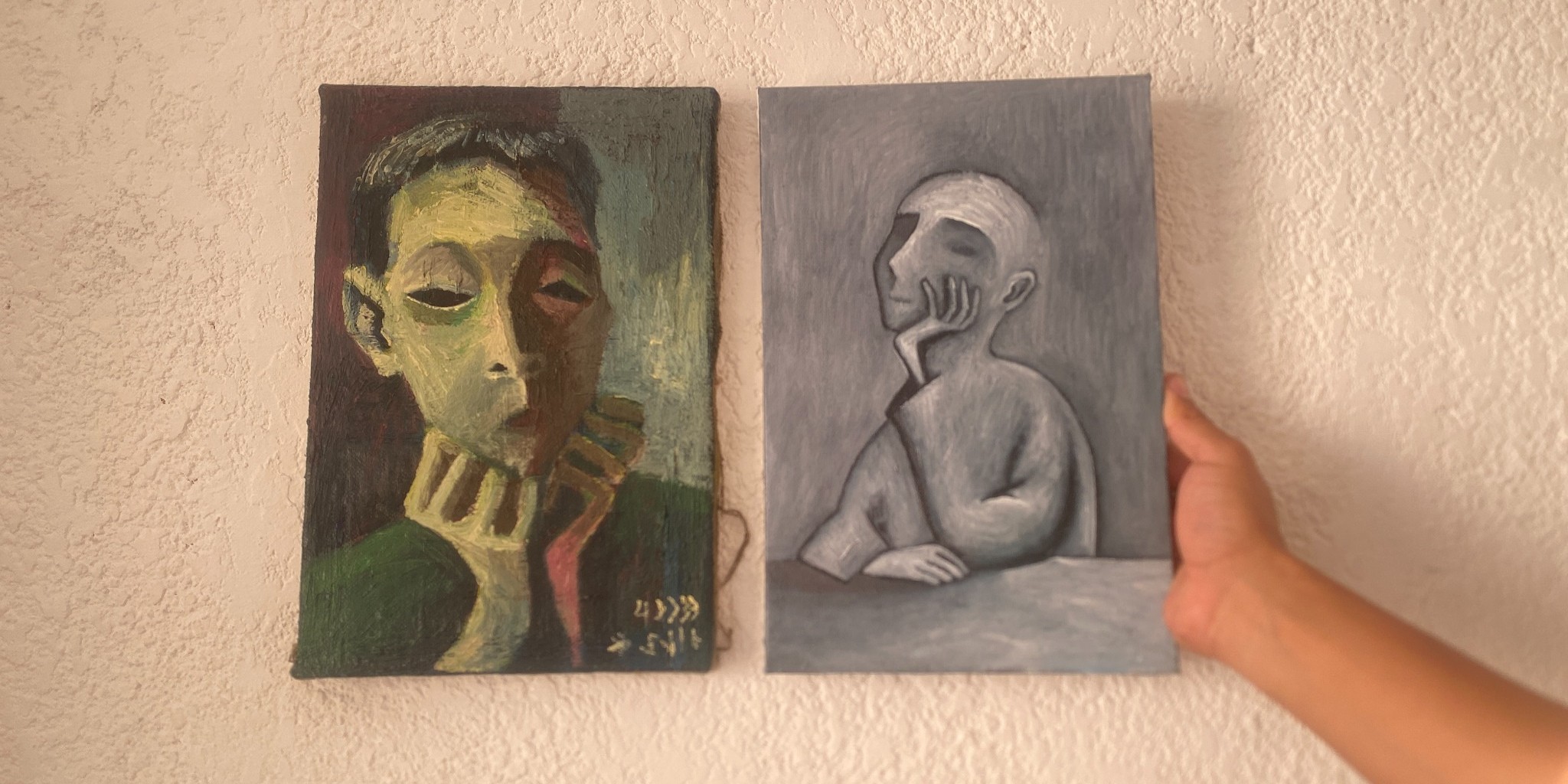
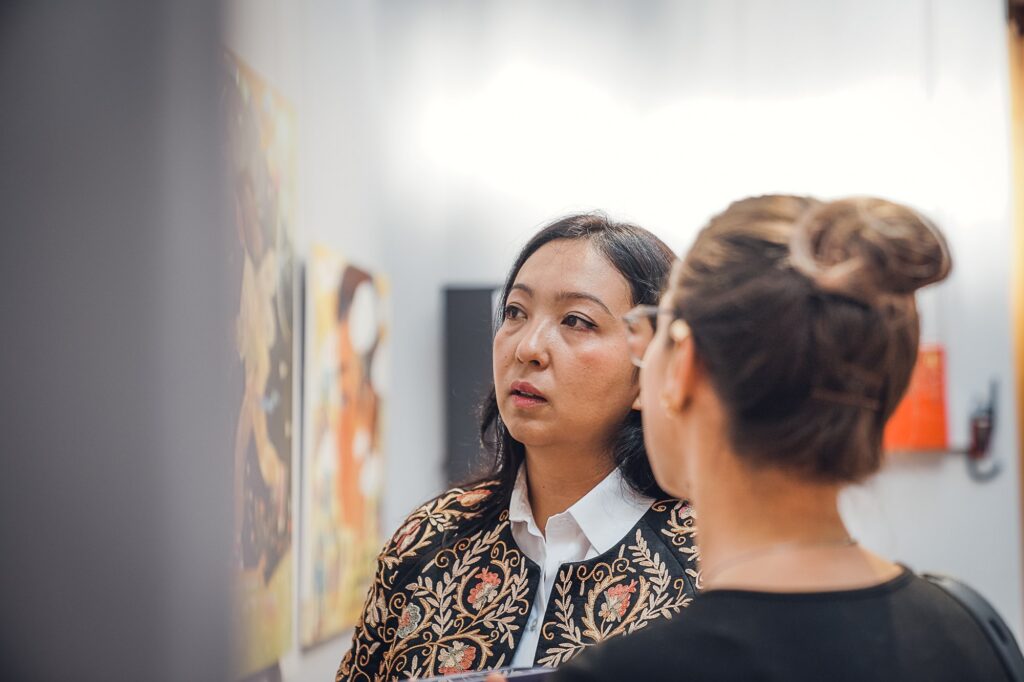
Contrasting approaches to portraiture in Doorov’s Bishkek studio; Image: TCA, Naima Morelli.
TCA: Some of these self-portraits are very loose. One canvas is titled, in Russian, “in love up to the mustache.” Where does that come from?
Doorov: In Russian, there is an expression, to fall in love up to the ears, so I said up to the mustache. It’s a mixed-media work, and it was the first one I made. The stars on the depicted body come from Russian mafia tattoos: two stars represent the lords of the Russian mafia. It means I never bow before a policeman.
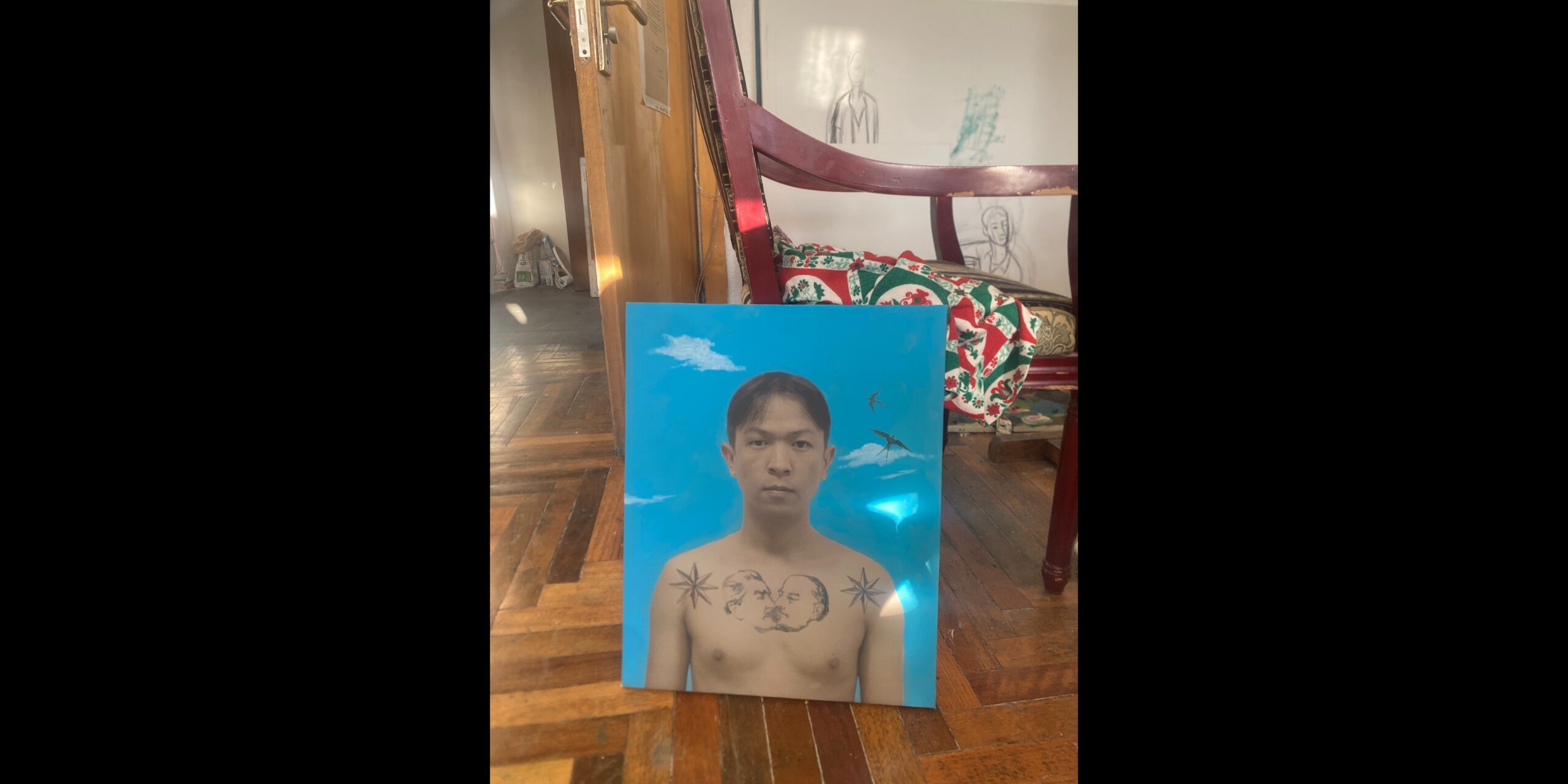
A self-portrait incorporating Russian prison tattoo symbolism; Image: TCA, Naima Morelli.
TCA: Another work has a prisoner, then policemen facing migrants. What are we looking at?
Doorov: For a prisoner, the most important thing is freedom: the birds, the sky, and the sea too, a horizon where you can escape. Then there are the Russian policemen, and in front of them, migrants from Moscow. I was a migrant myself, and it was a very hard experience. I experienced a lot of racism.
In the metro, I played a game, “find the policeman”: if you don’t find him, he finds you. You have to see him first to hide. In the painting, there are five policemen and five migrants, and the five migrants look at a policeman who stands just behind. Migrant number one is a doctor, but also a teacher, a musician, a father. Because being a migrant is not a profession. It’s a destiny. And the policeman is a system without a face that doesn’t really look at you or care about you.
TCA: Can you say that, in the end, the experiment cured the egocentrism that you have been accused of?
Doorov: I think, I hope, that this experience changed me. If I had some selfishness, some narcissism, maybe it changed. Well, thinking about it, maybe not. Maybe I’m still selfish. It was a moment. We always come back to ourselves, really. It’s hard to be someone else.