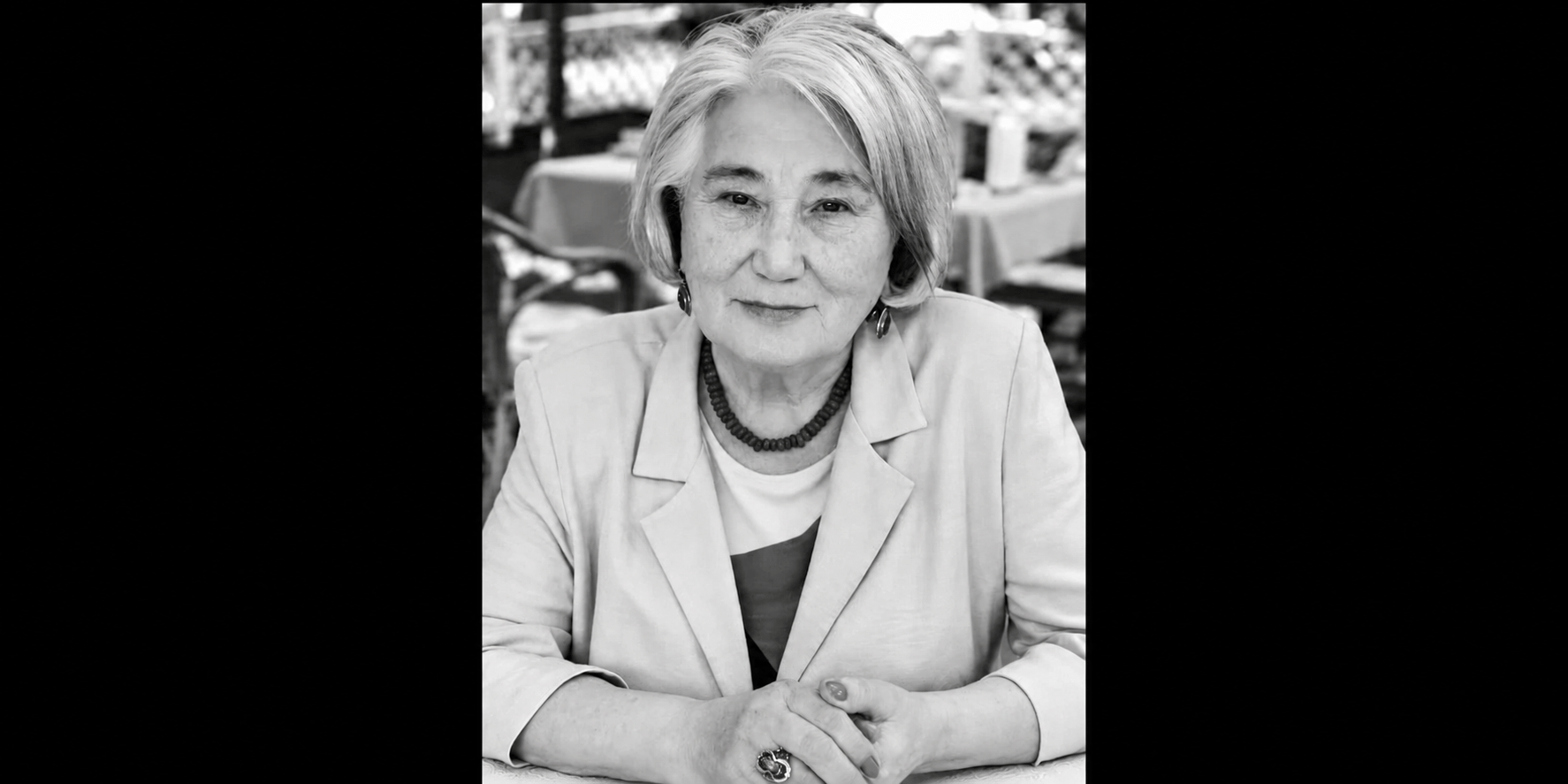
Roza Aitmatova died on October 26, 2026, at the age of 89. She was the younger sister of Chingiz Aitmatov, one of the most important writers of the 20th century. With her death, Kyrgyzstan has lost an invaluable witness to its history. She succeeded in turning the tragedies endured by her family into part of her nation’s collective memory.
Roza was born in Moscow on March 8, 1937. She was just six months old when her father, Torekul Aitmatov, a prominent political figure who had played a role in establishing the state institutions of the young Kyrgyz Republic, was arrested during Stalin’s purges. He was executed in November 1938, but his family remained unaware of his fate for decades. His wife, Nagima Abduvalieva, left alone with four children, continued to hope that her husband was still alive, somewhere in a distant Soviet labor camp.
Roza grew up alongside her brothers and sister, Chingiz, Ilgiz and Lyutsiya, in an atmosphere of hardship and uncertainty. As the children of an “enemy of the people,” they faced discrimination and financial difficulties. During the war, the family lived in modest homes in the Talas region, relying on the support of relatives and fellow villagers. Chingiz, the eldest child, had to take on adult responsibilities at an early age: while still a teenager, he worked as secretary of the village council.
For Roza, her elder brother had been a source of support and a role model since childhood. It was Chingiz, then a young agronomist, who told the family in 1953 that they might be able to move to the capital, Frunze, now Bishkek. Before leaving, Nagima wanted to have a photograph taken with all four of her children. As Roza later recalled, this seemingly simple gesture symbolized the end of their most difficult years and the beginning of a new life.
In the years that followed, Chingiz gained international recognition with works such as Jamila, The First Teacher and Mother Earth. Roza had by then devoted herself to the natural sciences, having studied physics and mathematics. She followed her brother’s literary achievements closely. Yet their relationship remained, above all, a deeply personal family bond, built on intimate conversations, shared memories and boundless love for their mother.
One episode recounted by Roza reveals just how closely the writer’s work was connected to his family history. In 1962, following a severe deterioration in Nagima’s health, Roza went into her brother’s study to tidy his desk. Among the pages of a new manuscript, she discovered a dedication to their parents: to their father, whose burial place was still unknown, and to their mother, who had raised four children on her own. It was the first draft of Mother Earth, a novella in which Roza recognized many aspects of Nagima’s life, her courage and her resilience.
When their mother died in 1971, Roza saw her brother, by then a celebrated writer, weeping inconsolably in a hospital corridor. Behind the image of a man known throughout the world was still the boy who had lost his father and feared losing the last remaining link to his childhood.
A turning point came in 1991, when a mass grave containing victims of Stalin’s purges was discovered at Chon-Tash, near Bishkek. Among those buried there was Torekul Aitmatov. After more than half a century, the family finally learned the truth. Chingiz took part in the ceremony to rebury the remains and proposed naming the site Ata-Beyit, meaning “Grave of the Fathers.” For Roza, who had never had the chance to truly know her father, the discovery marked a new mission. She sought to reconstruct his life and restore the names and personal histories that the years of terror had sought to erase.
The result of this work was the book White Pages of History, first published in 2009. Other books and memoirs followed, devoted to her parents and to her brother, who had died in 2008. Alongside this work, Roza made a significant contribution to education and women’s rights, heading Kyrgyzstan’s Women’s Assistance Center.
In the final years of her life, she continued to collect memories and personal accounts, including in collaboration with her nephew, Asan Akhmatov. In a work published in 2024, by which time she was the last surviving child of Torekul and Nagima Aitmatov, Roza recalled her brother Chingiz’s words: “You can always come to an understanding with another person, whoever they may be. But there is one thing you cannot negotiate with. That is time.”
While Chingiz used literature to tell the stories of his people’s suffering and hopes, Roza devoted much of her life to reconstructing her family’s history and preserving the memory of those who had been consigned to oblivion. She gathered documents, photographs and testimonies so that future generations, too, could know their past. Now that she, too, is gone, the responsibility of keeping her memory alive falls to others.