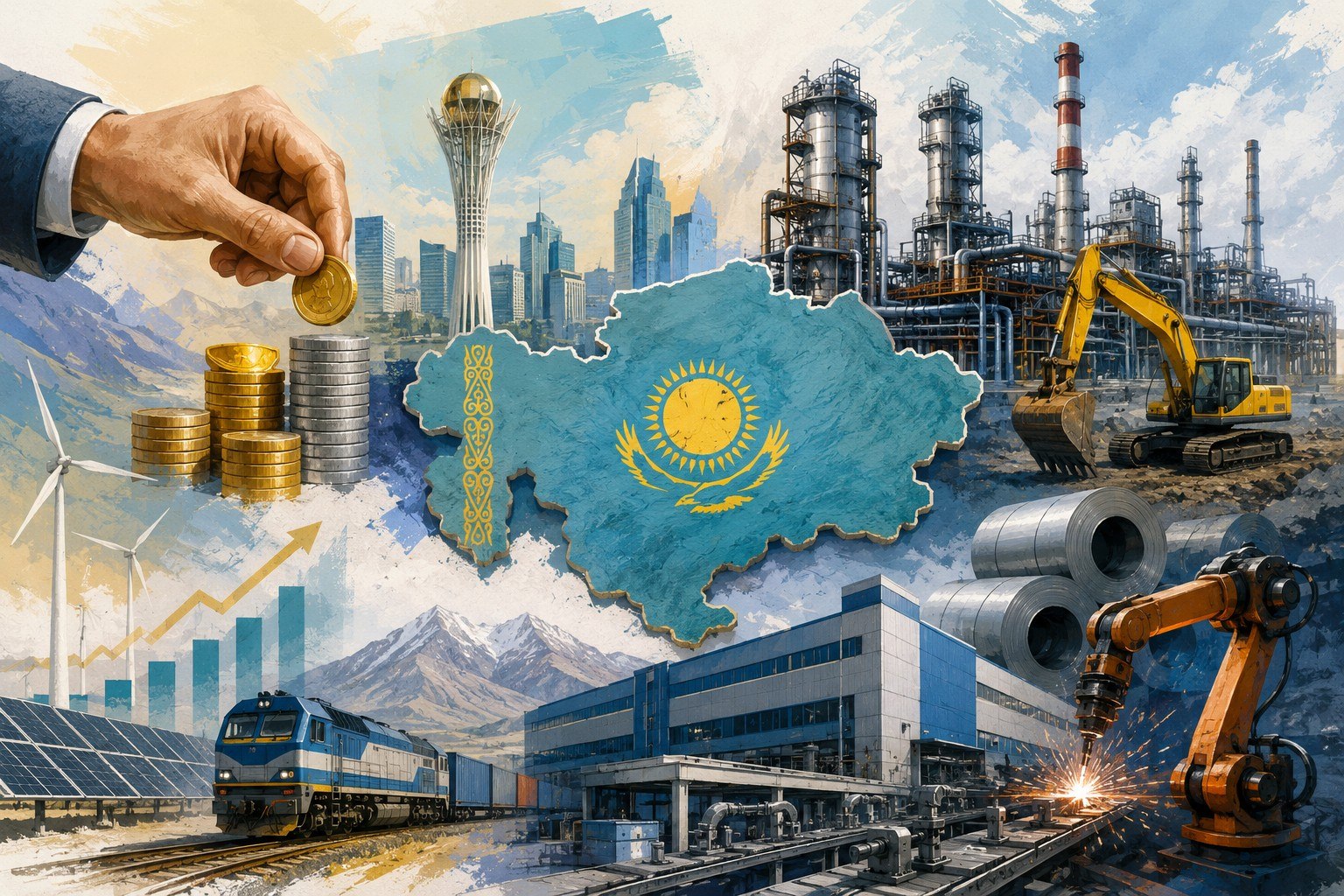
Kazakhstan is trying to change not only how much investment it attracts, but where that money goes, directing more capital toward manufacturing, deeper processing of raw materials, and high-tech projects. The main test will be whether announced projects and memorandums turn into financing, construction, and production.
Kazakhstan has assembled an investment portfolio of 215 projects worth a combined $78.6 billion, seeking to attract capital into raw-material processing, new manufacturing, and digital infrastructure. However, almost 60% of the announced amount is tied to projects still under development, while about $30 billion – more than a third of the entire portfolio – is associated with the planned Data Center Valley in Ekibastuz.
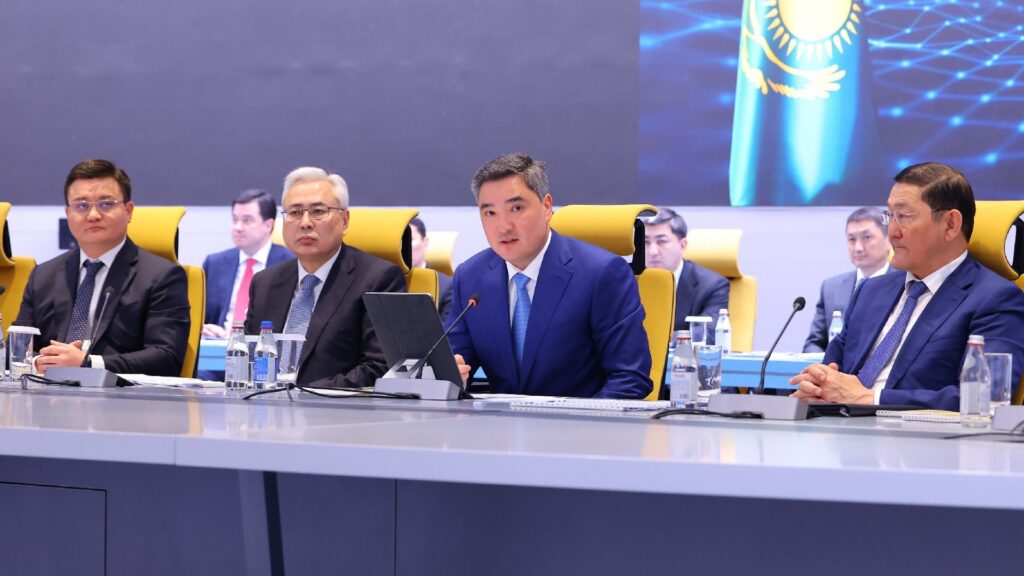
The government presented the new investment cycle on August 31. If all the projects are implemented, they are expected to create more than 88,000 jobs.
But the full $78.6 billion is far from guaranteed. Of the 215 projects, 93 worth $32.2 billion are under implementation, while another 122 worth $46.4 billion are still under development. The government has not specified the extent to which either category has already received financing or investment.
A separate investment-agreement mechanism is available for major projects worth more than 32 billion tenge (about $69 million). Since its launch in 2021, Kazakhstan has signed 66 such agreements worth more than 17.8 trillion tenge ($38.5 billion), including 25 worth approximately 4.4 trillion tenge ($9.5 billion) as of August 2026. An investment agreement and inclusion in the Kazakh Invest portfolio therefore do not mean the same thing.
AI Project in Ekibastuz Tops Investment Ladder
The largest component of the new portfolio is far removed from Kazakhstan’s traditional investment projects. Data Center Valley is being developed near the Ekibastuz GRES-1 power station to accommodate large-scale computing capacity, cloud services, and artificial intelligence infrastructure. The authorities estimate expected investment at about $30 billion. That represents roughly 38% of the entire $78.6 billion portfolio.
The area allocated for the future zone has been expanded from an initial 200 hectares to 1,400 hectares, while available power capacity is expected to increase gradually from 300 MW to 1 GW.
The $30 billion figure, however, represents expected investment rather than the cost of projects that have already secured financing.
The largest specific package announced so far came in June, when the Kazakh government, U.S.-based Firebird, and NVIDIA signed agreements on artificial intelligence and digital infrastructure worth $10 billion. Firebird is the investor and NVIDIA the technology partner.
The plan calls for a computing cluster of around 100,000 advanced GPUs. The first phase is scheduled to launch in 2027. The authorities expect the complex, once fully operational, to generate at least $3 billion in annual export revenue.
Another potential participant emerged in late August. Singapore-based Energy Capital Global is considering a separate AI campus with an initial IT load of about 100 MW and the potential to expand to 1 GW. The project’s cost has not yet been disclosed.
Petrochemicals Remain Second Center of Gravity
Despite the emphasis on technology, Kazakhstan’s largest industrial projects remain closely tied to the country’s natural-resource base. One of the most capital-intensive is an integrated gas chemical complex for polyethylene production in the Atyrau region, valued at about $7.4 billion.
The project is being implemented by Silleno. KazMunayGas holds a 40% stake, while China’s Sinopec and Russia’s SIBUR each own 30%. The plant is designed to produce 1.25 million tons of polyethylene annually in more than 20 grades. It is expected to reach full capacity in 2029.
Separately, KMG PetroChem plans to build a polyethylene terephthalate plant, at an estimated cost of $1.5 billion. A gas separation complex needed to supply feedstock to petrochemical facilities is valued at another approximately $2.7 billion. Together, these projects illustrate what the government means when it says it is moving away from raw-material exports: not abandoning hydrocarbons, but processing more of them inside Kazakhstan.
Processing Coal and Food at Home
A similar model is being applied to coal. Among the major projects cited by the government, China’s CHN Energy has been working on a coal-chemical project expected to involve more than $4 billion in investment. The project envisages deep processing of Kazakh coal to produce higher-value products.
China Pingmei Shenma Holding Group is also considering another integrated coal-chemical complex worth up to $1.5 billion. For now, however, the project is covered by a memorandum on strategic cooperation, meaning it cannot yet be considered a confirmed investment.
A metallurgical coke plant with annual capacity of 1 million tons and an investment value of 63.6 billion tenge (about $138 million) is also under development in the Karaganda region.
The logic remains the same: instead of exporting unprocessed raw materials, Kazakhstan wants to retain more stages of production domestically and export higher-value products.
Another significant part of the new investment cycle is taking shape in agriculture. China’s Dalian Hesheng Holdings plans to invest about $739 million in a complex in the Akmola region that would turn wheat into higher-value products including gluten, starches, amino acids, and bioplastics rather than simply selling the grain. Once fully operational, it is expected to process up to 3 million tons annually. Turkey’s Tiryaki Agro, together with a Kazakh partner, is developing a $320 million complex in Astana to process wheat and peas into products including starch, gluten, lysine, animal feed, and protein isolate. Both projects fit the government’s model of using Kazakhstan’s raw-material base to produce higher-value exports domestically.
Fufeng: $800 Million or $340 Million?
Figures for some individual major projects, however, require clarification. In April 2025, Kazakh Invest announced the start of construction of a Fufeng Group industrial park for deep corn processing in the Zhambyl region. As recently as January 2026, the project was valued at $800 million, with annual processing capacity of 1 million tons of corn and 1,500 jobs.
Yet the government’s August 31 review puts Fufeng’s investment at just $340 million, with the government offering no explanation for such a substantial revision. The discrepancy illustrates why the overall value of the investment portfolio should be treated with caution: project parameters can change substantially as they move from initial agreements into construction.
Investment Is Growing, but Manufacturers Report Difficulties
Official statistics indicate a degree of structural change. Between 2019 and 2025, Kazakhstan’s fixed capital investment rose from 12.6 trillion tenge (about $27.3 billion) to 23.5 trillion tenge ($50.8 billion). In manufacturing, it tripled from 1 trillion tenge ($2.2 billion) to 3 trillion tenge ($6.5 billion).
Manufacturing’s share of total investment increased from 8.1% to 12.7%, while its share of industrial investment rose from 13.1% to 31.3%.
Changes are also visible in foreign investment. Gross FDI inflows reached $20.5 billion in 2025, up 14.4%. FDI inflows into manufacturing increased by 47.4%, or $1.4 billion, while investment in the extractive sector fell by 47%, or about $3 billion.
But higher capital investment has not yet translated into an equally rapid improvement in conditions for existing businesses.
Commenting on the July PMI in a report published by the Kazakhstan Stock Exchange in August 2026, Saltanat Mukhambetaliyeva, head of economic research and analytics at Freedom Holding Operations, noted a deepening downturn in manufacturing. New orders fell particularly sharply in the food industry, while manufacturers’ expectations for the year ahead dropped to their lowest level in more than six years.
Among the constraints, Mukhambetaliyeva highlighted working-capital financing amid tight bank lending conditions. She said lower policy rates would not bring immediate relief because changes in monetary policy take time to feed through into financing conditions for companies.
This creates a notable disconnect: the government is trying to build a new multibillion-dollar manufacturing investment pipeline at a time when some existing producers are facing expensive capital and weak demand.
Who Will Finance the Next Stage?
Access to capital is particularly important given the way investment is financed domestically. In January-July 2026, companies’ own funds accounted for about 67.7% of Kazakhstan’s fixed capital investment, while bank loans accounted for just 5.6%. Other borrowed funds represented another 12.7%.
In its August survey of financial market participants, the Analytical Center of the Association of Financiers of Kazakhstan expected any reduction in real interest rates to be gradual.
For the new portfolio, this has practical implications. The central question is not only how many potential investors are interested in Kazakhstan, but also on what terms projects will be able to obtain long-term financing.
International competition for capital is also intense. Azamat Konratbayev, managing partner at PwC Kazakhstan, noted in a 2026 interview with Forbes Kazakhstan that more than 70% of investors surveyed by PwC did not expect global economic growth to exceed 2% this year. Under such conditions, investment strategies are becoming more selective, with greater emphasis on management teams’ ability to combine innovation with risk management.
For Kazakhstan, this makes the transition from memorandums and preliminary agreements to secured financing and construction all the more important.
Transition from announced projects to actual businesses remains key
The portfolio suggests that Kazakhstan is not abandoning its resource specialization so much as trying to move up the value chain, while Data Center Valley offers a new route by turning Ekibastuz’s electricity into computing capacity. But with almost $30 billion of the $78.6 billion portfolio tied to that single site and $46.4 billion of the overall portfolio still at the development stage, the central question remains whether the announced projects can be turned into operating businesses.