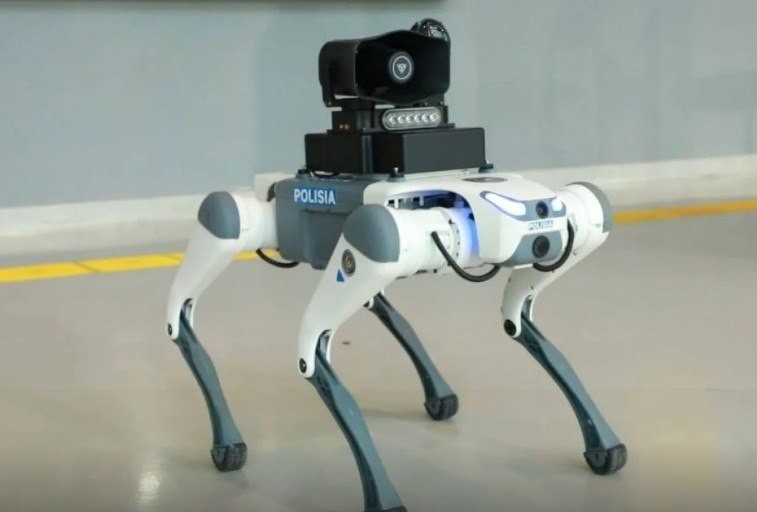
Kazakhstan’s police used a mobile facial-recognition robot to scan crowds during Metallurgist Day celebrations in Karaganda Region, saying the machine helped identify four people sought over legal or administrative violations. The deployment extends the country’s rapidly expanding surveillance network beyond fixed cameras, allowing police databases to be accessed through a platform that can move through crowded public spaces.
The four-legged robot was used during celebrations held on July 17-18 in the industrial cities of Balkhash and Temirtau, which attracted more than 115,000 visitors. More than 1,000 police officers were also deployed to maintain public order, according to the Karaganda police.
Robot dogs equipped with facial-recognition cameras have also been deployed at Astana’s railway stations in January, and by police in Aktau since May.
Karaganda’s robodog carries surveillance cameras and is connected to police databases. Authorities say it can scan faces within its field of view and compare them with records of people sought by law enforcement.
Its main advantage over a fixed facial-recognition camera is mobility. During the earlier trial at Astana’s Nurly Zhol railway station, a robot moved through waiting rooms, escalators, and other public areas while transmitting live video to a police command center. The system was also able to compare images with police wanted lists and broadcast warnings through an onboard speaker.
Police said the Karaganda robot helped identify one person wanted for evading child support payments, two people owing debts under enforcement proceedings, and a previously convicted man who had breached a court order requiring him to remain at home during specified hours. Officers took legal measures against all four.
The authorities did not explain how the facial-recognition matches were verified by officers, how many false alerts the system generated, or how many people were scanned before the four matches were produced.
The robot dog forms part of a much larger surveillance system operating across Kazakhstan. The country has approximately 1.6 million surveillance cameras, according to figures provided by the Interior Ministry to the independent outlet Vlast.kz. Around 545,000 are connected to police command centers, while more than 24,000 use artificial intelligence capable of recognizing faces.
Vlast’s investigation found that Kazakhstan’s surveillance infrastructure has expanded rapidly, with facial recognition, biometric identification, and networked cameras becoming central elements of the government’s smart-city programs.
Supporters argue that such systems can help police locate wanted people and respond more quickly to emergencies. Critics warn that the same infrastructure can be used to track activists, protesters, and other members of the public.
Kazakhstan-based digital-rights specialists have called for tighter safeguards governing facial recognition. The Eurasian Digital Foundation has recommended restrictions on mass and indiscriminate surveillance, alongside greater transparency and clearer rules on how government agencies process biometric information.
The organization has also argued that Kazakhstan needs stronger independent oversight of the collection, storage, and use of biometric data, as well as procedures allowing people to challenge the processing of their information by law enforcement agencies.
The Interior Ministry’s account of the Karaganda deployment did not disclose the cost or the manufacturer of the robot, the accuracy of its facial-recognition software, where the collected footage was stored, or how long images of people who did not produce a match would be retained.
Kazakhstan is continuing to expand the machines’ possible uses. In Aktau, police have said the platforms will patrol public spaces and may also be used to detect suspicious objects, smoke, or fire. Officials have proposed eventually using upgraded versions to inspect hazardous sites and move potentially dangerous objects.
The Karaganda operation provides an early example of how mobile facial recognition may be used at large gatherings. Four reported matches alone offer little basis for assessing whether the system is accurate or cost-effective. That would require information about the number of people scanned, the frequency of false matches, the role of human verification, and the rules governing the storage and use of biometric data – none of which the authorities have so far disclosed.