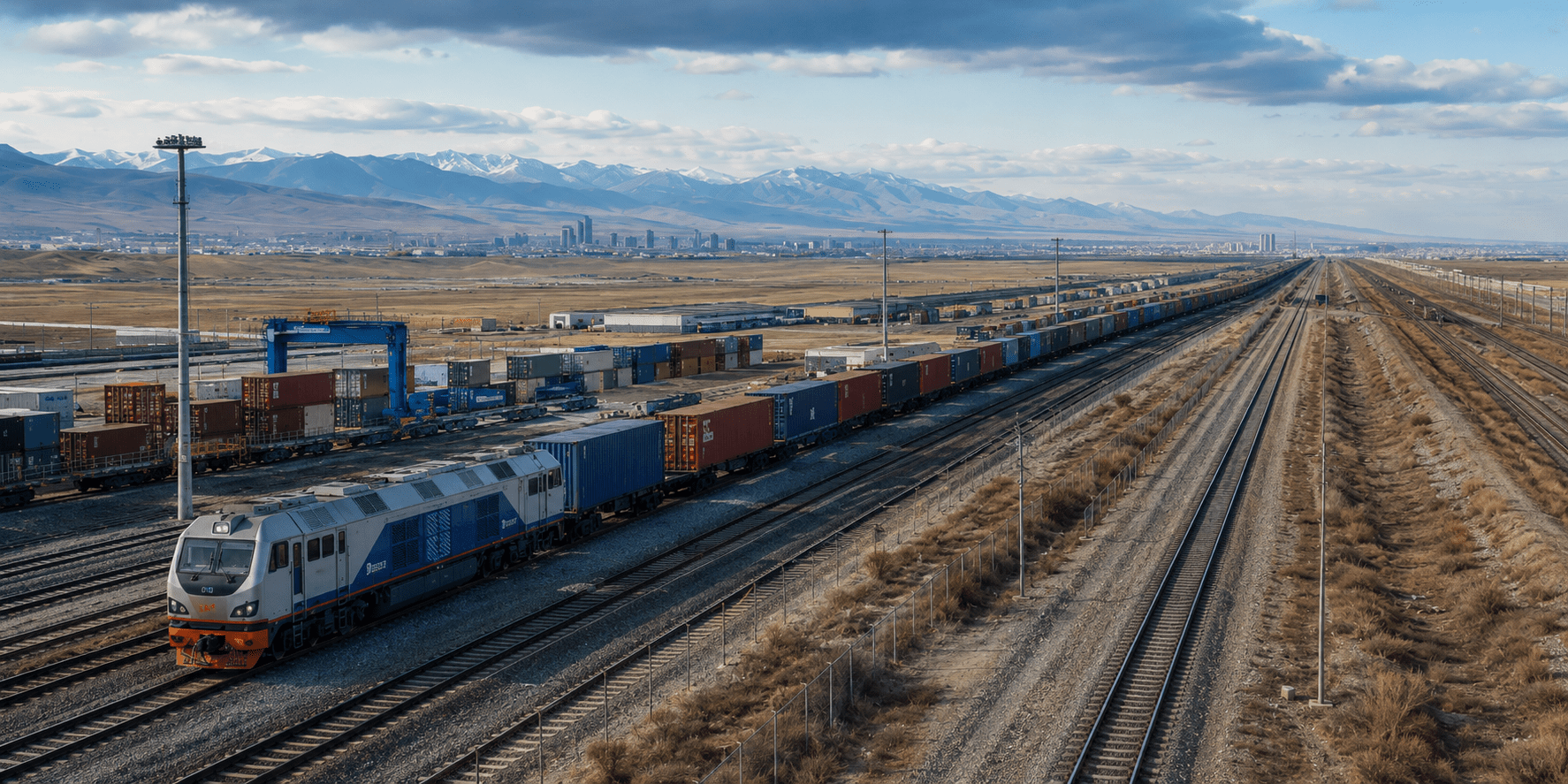
Kazakhstan Temir Zholy, Kazakhstan’s national railway operator, plans to launch an initial public offering in 2026 with a proposed triple listing in London, Hong Kong, and Kazakhstan.
Kazakhstan Temir Zholy, or KTZ, is wholly owned by Kazakhstan’s sovereign wealth fund, Samruk-Kazyna.
On May 23, Samruk-Kazyna and KTZ announced plans to proceed with the IPO. The offering also comes as KTZ faces rising debt and major capital needs linked to railway modernization and corridor expansion.
The sovereign wealth fund said Kazakhstan government resolution No. 894, adopted on October 24, 2025, provides for KTZ’s IPO to take place in 2026.
“Samruk-Kazyna and KTZ are currently carrying out active preparations for an international IPO, which is expected to involve a triple listing on the London Stock Exchange, the Hong Kong Stock Exchange, and a local stock exchange in Kazakhstan,” the statement said.
The IPO is expected to be conducted exclusively through the issuance of new shares by KTZ itself, rather than through the sale of existing shares held by the sovereign wealth fund on the secondary market.
“As a result, the funds raised through the IPO will remain at KTZ’s disposal for its own operational and investment needs,” the fund stated.
The proceeds are expected to be used to repay part of the company’s debt obligations and finance a large-scale investment program aimed at modernizing Kazakhstan’s railway infrastructure, expanding the capacity of transport corridors, renewing rolling stock, and strengthening the country’s overall transit potential.
The IPO comes as KTZ faces a heavier debt burden linked to rolling stock purchases, infrastructure upgrades, and Kazakhstan’s efforts to expand its transit capacity. The Times of Central Asia previously reported that KTZ’s nominal debt rose from about $5.7 billion in early 2024 to roughly $8 billion in 2025, before reaching 4.7 trillion tenge, or about $10.4 billion, by April 2026. Official estimates put borrowing for rolling stock renewal at about $4.9 billion and railway infrastructure modernization at about $2.3 billion.
Samruk-Kazyna said preparing KTZ for an IPO requires extensive preliminary work, including efforts to improve the company’s attractiveness to international investors.
“Such preparatory activities are currently being carried out jointly by the fund and KTZ in coordination with the government. At this stage, it is not yet possible to disclose further details,” the statement said.
The fund added that a detailed assessment of market conditions will be conducted closer to the IPO date by investment banks engaged by KTZ.
The final timing and parameters of the IPO will depend on market conditions, KTZ’s readiness, and the level of investor interest.
KTZ’s main investment case is likely to center on Kazakhstan’s role in the Trans-Caspian International Transport Route, also known as the Middle Corridor. The route links China and Europe through Kazakhstan, the Caspian Sea, Azerbaijan, Georgia, and onward routes through Turkey or the Black Sea. But the corridor also requires heavy spending on infrastructure, equipment, coordination, and the removal of bottlenecks.
That means the IPO may be viewed both as a transit-growth story and as a way to ease pressure on the balance sheet of a state-owned operator with large capital needs.