BISHKEK (TCA) — The Kyrgyz Government plans to allocate soft loans worth seven billion soms to agrarians this year, which is 2.2 billion soms more than last year. The processors and farms whose products will be exported will enjoy the most favorable conditions for obtaining loans.
Since 2013 when the Government started crediting of agricultural producers, more than 53.5 thousand people, mostly processors and livestock farmers, have received preferential loans worth 17.1 billion soms.
Focus on agricultural processing
Kyrgyzstan’s entry into the Eurasian Economic Union (EEU) in August 2015 forced the Government to think about changing its agrarian policy. First, it decided to focus on the processing of agricultural products, increasing lending to this sphere by half.
Agricultural processing enterprises enjoy tax benefits which have recently been extended until September 1, 2018. The Government approves the list of enterprises and the criteria for their selection. The listed food and processing enterprises are exempt from the income tax.
The processors can obtain loans at 6% per annum for three years and farmers at 10% for two years. Cattle breeders will receive loans at 10% for a longer period.
Thanks to these measures, the Government hopes to increase annual crop production by 25% which will help increase the exports to the EEU and other countries. It is planned to achieve the sector’s growth due to the development of cooperative movement, breeding farms and expansion of crop areas.
Wrong direction?
However, the results of the last two years have shown that the export of livestock products cannot be increased without creation of a modern system of veterinary control including laboratories and livestock identification.
Many countries have shown interest in meat produced in Kyrgyzstan but local livestock farms cannot provide the required volume and obtain veterinary certificates. There is a great gap between the potential of the meat industry and its real capabilities.
For instance, Iran has ordered a thousand tons of meat but Kyrgyzstan cannot fulfill the order. Last year Kyrgyzstan supplied 150 tons of cooled mutton to Iran, and this year will export 350 tons.
The EEU markets are the main direction of Kyrgyzstan’s exports but the imperfect system of veterinary control is hindering the access. The Government intends to solve the problem during this year by allocating 190 million soms for the construction of four new laboratories and the repair of 12 existing ones.
In the meantime, it is very difficult for Kyrgyz farmers to enter the markets of neighboring countries. According to the Ministry of Agriculture of Kazakhstan, in March Kazakhstani inspectors found violations of the legislation of Kazakhstan and the EEU related to the plant quarantine when inspecting products from Kyrgyzstan. As a result, 61.4 tons of cabbage, rice, apples, beans and nuts have been returned to Kyrgyzstan.
Identification of cattle
The Government has allocated 40 million soms for the identification of animals, which is now 55% complete in the country, the State Veterinary and Sanitary Inspectorate said.
All data on identified animals have entered the electronic information base. The first stage of identification of animals is over, and the second one will begin in September 2017, officials said.
Identification and vaccination of animals will significantly improve the animal health situation in the country. As a result, 24 domestic enterprises will be able to obtain permission to export their products to Kazakhstan and Russia. Currently, 18 Kyrgyz companies have such permits.
Dairy production
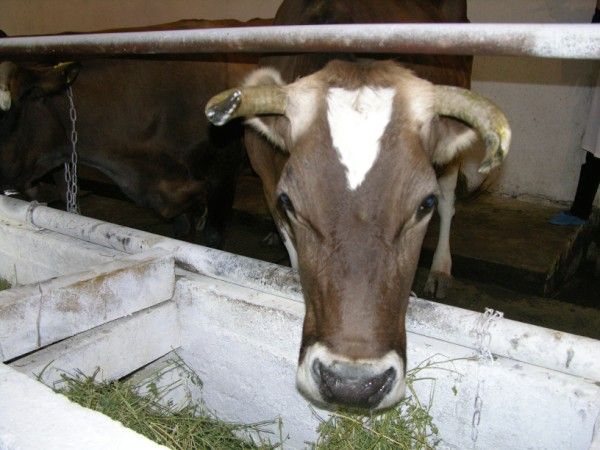
Since Kyrgyzstan‘s joining the EEU, the export of dairy products has increased more than four-fold, from 5 thousand up to 22 thousand tons.
The dairy sector needs long-term financing, experts say. There are risks related to unstable epizootic situation and as a result, bans on exports of milk products. Therefore, it is vital to have healthy cattle.
Investors have not yet decided to participate in long-term projects in Kyrgyzstan’s dairy industry. Besides identification of the milk cows and modern veterinary, the dairy production sector lacks good veterinarians and animal feeding specialists. It is also necessary to build a production and marketing chain.
In 2016, Kyrgyzstan’s milk production exceeded the level of 2015 by 44 thousand tons (2.9% growth) and amounted to 1.5 million tons, the National Statistics Committee said. The milk production increased by 340 thousand tons (28.7%) in 2016 compared with 1990 (pre-reform period before the collapse of the Soviet Union).
Over the past years, the production growth has been achieved mainly by increasing the number of cows but not their productivity. In 2016, there were 769.9 thousand cows, 50.7% of the total number of cattle (1.5 million heads) in the country.
The main indicator of the quality of dairy cattle is the average milk yield from a cow which was 1,978 kilograms in 2016, though some farms had a yield of 2,592 kilograms. In 2016, the average milk yield from one cow decreased by 460.3 kg (18.9%) compared to 1990 due to worsened feeding.