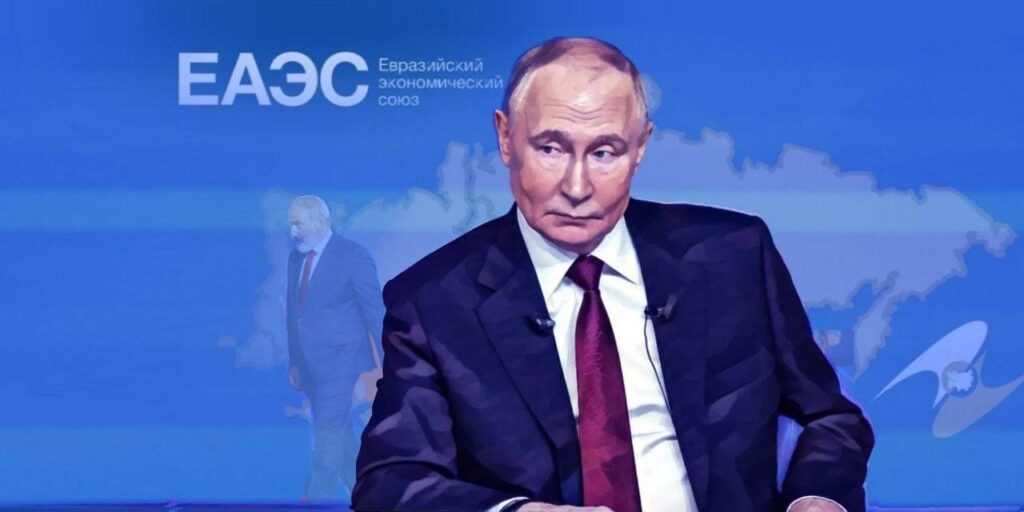
At the 4th Eurasian Economic Forum in Minsk, marking the 10th anniversary of the Eurasian Economic Union (EAEU), Kyrgyzstan highlighted ongoing internal barriers that continue to hinder its development. Chief among them are trade delays, logistical bottlenecks, and persistent challenges in labor migration.
Deputy Minister of Economy Sultan Akhmatov reaffirmed Kyrgyzstan’s commitment to Eurasian integration and strengthening economic ties with other EAEU member states. According to the ministry’s press office, Akhmatov emphasized the need for deeper investment cooperation and expressed confidence that enhanced integration would bolster regional stability and mutual economic growth.
He also advocated for expanded academic exchanges, the development of digital and vocational education, and the creation of joint research platforms across the EAEU.
Yet, alongside these ambitions, Akhmatov pointed to systemic obstacles. He urged the removal of trade and customs barriers that burden importers and exporters at border checkpoints. He also emphasized the importance of mutual recognition of quality certifications and ensuring labor mobility within the Union.
Labor Migration: An Economic Lifeline
Labor migration remains a crucial pillar of Kyrgyzstan’s economy. In 2024, remittances from Kyrgyz migrants, most of whom live and work in Russia, reached $3 billion, equivalent to 24% of national GDP. This figure nearly matches the country’s total exports of $3.8 billion during the same period.
However, the number of Kyrgyz labor migrants in Russia has been steadily declining. First Deputy Prime Minister Daniyar Amangeldiev attributed this trend to both domestic economic improvements and new restrictions introduced by Russian authorities, including changes to migration law. As of 2024, foreign workers in Russia are required to sign one-year contracts with employers, a condition that has created legal uncertainty and discouraged long-term employment.
“I Left Moscow Because the Rules Changed”
Aziret Abdiev, a Kyrgyz welder who worked in Moscow for nearly a decade, shared his reasons for leaving:
“I didn’t leave because I disliked the work. I spoke fluent Russian, had a steady job, and was valued for my skills. But over the past year, the pressure increased, inspections, bureaucracy, hostility. It became clear I couldn’t continue. Now I’ve applied for a Schengen visa and will be heading to Lithuania to work in a metal factory.”
Expert Opinion: Migration as a Core Integration Priority
Kyrgyz experts argue that labor migration is central to the country’s national interest. Raising the issue at the Minsk forum, they contend, was both pragmatic and necessary.
“For Kyrgyzstan, labor migration is more than an economic category. It is a matter of social stability, foreign currency inflows, and the future of entire generations,” political analyst Bakyt Baketaev told The Times of Central Asia.
According to official statistics, up to one million Kyrgyz citizens work abroad, primarily in EAEU member states. This makes mutual recognition of qualifications, access to social protections and healthcare, and the safeguarding of migrant rights critical priorities for Kyrgyz policymakers.
Baketaev believes progress is possible, if Kyrgyzstan acts consistently and professionally while building coalitions within the EAEU. He notes that other member states face similar challenges:
“There is room for alignment with Armenia, and even Tajikistan which holds observer status in the EAEU, as well as host countries like Russia and Kazakhstan. After all, their economies also need qualified and legal labor.”
He proposes several institutional reforms to improve labor mobility:
- Establishing a Eurasian Migration Coordination Center
- Expanding the Digital Migrant Portfolio to simplify legal compliance
- Signing a multilateral agreement on mutual recognition of diplomas and professional certifications
“This is the kind of integration capital that Kyrgyzstan can offer. We may lack heavy industry, but we have human capital and deep experience in mobile work and adaptation.”
Baketaev concluded by quoting Jean Monnet, one of the architects of European integration: “We are not uniting states, we are uniting people. Kyrgyzstan is consistently reminding its partners that the human dimension must be at the heart of Eurasian integration. And that is a strong position.”