• KGS/USD = 0.01144 0%
  • KZT/USD = 0.00211 0%
  • TJS/USD = 0.10460 0.19%
  • UZS/USD = 0.00008 0%
  • TMT/USD = 0.28490 0%
  • KGS/USD = 0.01144 0%
  • KZT/USD = 0.00211 0%
  • TJS/USD = 0.10460 0.19%
  • UZS/USD = 0.00008 0%
  • TMT/USD = 0.28490 0%
  • KGS/USD = 0.01144 0%
  • KZT/USD = 0.00211 0%
  • TJS/USD = 0.10460 0.19%
  • UZS/USD = 0.00008 0%
  • TMT/USD = 0.28490 0%
  • KGS/USD = 0.01144 0%
  • KZT/USD = 0.00211 0%
  • TJS/USD = 0.10460 0.19%
  • UZS/USD = 0.00008 0%
  • TMT/USD = 0.28490 0%
  • KGS/USD = 0.01144 0%
  • KZT/USD = 0.00211 0%
  • TJS/USD = 0.10460 0.19%
  • UZS/USD = 0.00008 0%
  • TMT/USD = 0.28490 0%
  • KGS/USD = 0.01144 0%
  • KZT/USD = 0.00211 0%
  • TJS/USD = 0.10460 0.19%
  • UZS/USD = 0.00008 0%
  • TMT/USD = 0.28490 0%
  • KGS/USD = 0.01144 0%
  • KZT/USD = 0.00211 0%
  • TJS/USD = 0.10460 0.19%
  • UZS/USD = 0.00008 0%
  • TMT/USD = 0.28490 0%
  • KGS/USD = 0.01144 0%
  • KZT/USD = 0.00211 0%
  • TJS/USD = 0.10460 0.19%
  • UZS/USD = 0.00008 0%
  • TMT/USD = 0.28490 0%

Kazakhstan Accelerates Shift Away from Cash Payments

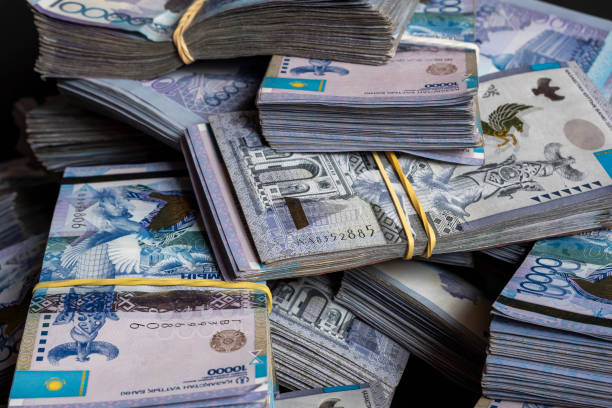
Kazakhstan is rapidly embracing cashless payments, with the share of cash withdrawals in card transactions continuing to decline each year, according to data from the National Bank. While the country has not yet reached the levels seen in leading digital economies, recent trends suggest Kazakhstan is closing the gap.

A recent study by analysts at Finprom.kz compares Kazakhstan’s transition to cashless payments with global trends. It highlights the persistent divide between countries where cash is nearly obsolete and those where it remains dominant.

The global variation is illustrated by the Cash Index, compiled by FOREX.se, which ranks 122 countries based on the share of daily transactions made with cash. Using data from Statista, Numbeo, central banks, and other global sources, the index offers an average estimate of cash usage across the world.

According to the Cash Index, countries with the lowest rates of cash use, just 10%, include South Korea, Norway, China, Iceland, and Australia. Similarly low figures are reported for Scotland, England, and Denmark (12% each). Analysts attribute this to strong fintech ecosystems, widespread broadband internet, high smartphone penetration, and robust consumer protection frameworks.

In contrast, cash remains dominant in countries where poverty, limited banking access, and weak infrastructure prevail. In Myanmar, daily cash transactions account for 98% of all payments, followed by Ethiopia and Gambia at 95%. Other high-cash-use countries include Albania, Cambodia, Laos, Lebanon, Nepal, and Pakistan, all averaging around 90%.

While Kazakhstan is not included in the Cash Index due to its tourism orientation, National Bank statistics provide insight into local trends. From January to October 2025, cash withdrawals via Kazakhstani and foreign payment cards totaled $44.37 billion, an 8.6% increase compared to the same period in 2024.

Yet the overall trend favors non-cash transactions. The share of cash withdrawals in total card turnover fell from 13.5% to 12.9% over the year, comparable to figures seen in developed economies. By contrast, in 2019, cash accounted for more than half of card-based transactions. This dropped to 34.1% in 2020 and has continued its steady decline.

Regional data reveal that the shift to cashless payments is uneven across the country. In January-October 2025, the share of cash withdrawals in total card transactions ranged from 8.3% to 27.4%, depending on the region.

The lowest shares were recorded in the Almaty region (8.3%), Almaty city (9%), and the Turkestan region (9.4%). Astana and the Atyrau region followed with 14.4% and 14.8%, respectively. The North Kazakhstan region reported the highest share of cash withdrawals.


Alcohol and Tobacco Lead Kyrgyzstan’s Excise Tax Revenues

Alcohol and tobacco products continue to be the primary sources of excise tax revenue for Kyrgyzstan’s state budget, according to the Ministry of Finance’s final report on budget revenues for the first 11 months of 2025.

The report highlights excise taxes as one of the most stable and predictable sources of state income. From January through November 2025, total excise tax revenues exceeded $222 million.

Alcohol producers remain the top contributors. During the reporting period, they transferred $38 million to the budget. Vodka producers accounted for the largest share at $25.5 million, while breweries contributed approximately $9.4 million. Producers of brandy, wine, and other alcoholic beverages paid significantly less. As a result, the alcohol sector continues to lead all industries in excise tax contributions.

Despite reduced domestic production, tobacco companies dominate excise revenues from imports. In the same period, excise taxes on tobacco products imported from Eurasian Economic Union (EAEU) countries brought in $101 million, with an additional $4.4 million from imports originating outside the EAEU.

Revenue is no longer limited to traditional cigarettes. The report notes contributions from heated tobacco products and electronic cigarettes. While their current share remains modest, steady annual growth in excise payments for these categories points to shifting consumer habits.

Kyrgyz authorities consider excise taxes on alcohol and tobacco not only a fiscal mechanism, but also a tool of social policy. Gradual increases in tax rates are intended to simultaneously boost revenue and, according to government projections, reduce consumption of harmful products.

The state’s role in the alcohol sector warrants particular attention. In early 2023, the country’s largest alcohol producer, Ayu, along with its distilleries and vodka factories, was voluntarily transferred to state ownership. Since then, smaller industry players have voiced concern that the government may incrementally tighten its grip on the sector and effectively establish a monopoly.

Overall, the data confirm that so-called “harmful” goods, alcohol and tobacco, remain the most lucrative sources of excise tax revenue for the Kyrgyz budget.

Beshbarmak, Pilaf, and Olivier Salad: What Will Be Served on New Year’s Eve Tables in Central Asia

New Year remains one of the most significant holidays in Central Asia. While its scale and prominence have gradually declined due to rising religiosity, many residents still regard it as the foremost secular and ideology-free celebration of the year. Across the region, households prepare their most beloved dishes to ring in the occasion.

No New Year Without Olivier Salad

For many families, traditional fare is an essential part of New Year’s Eve. Olivier salad has long been a staple of the holiday table. Originally created in the 1860s by a French chef in Russia, the dish once featured ingredients such as hazel grouse and seafood. Over time, particularly during the Soviet era of shortages, the recipe evolved.

Today, Olivier salad typically includes beef, chicken (or boiled sausage), potatoes, green peas, pickled cucumbers, and mayonnaise. It is usually prepared in large batches to ensure there is enough for all guests.

Other popular salads include herring under a fur coat, vinaigrette, and “Tenderness”, hearty dishes that can leave guests too full for main courses. Even in modest households, red caviar often finds its way to the table, adding a touch of festivity and indulgence.

Kazakhstan: Beshbarmak with a Twist

In Kazakhstan, beshbarmak remains the centerpiece of the New Year’s feast, as it is for most major celebrations. Traditionally, the dish combines three cuts of horse meat, kazy, karta, and zhay, served with flat noodles and onions. However, some families are adapting their menus in line with the Chinese zodiac. As the Year of the Red Horse approaches, online advice has suggested avoiding horse meat out of respect for the symbolic animal. A vegan version of beshbarmak, featuring mushrooms and pumpkin, is gaining traction.

Baked koktal fish is another showpiece dish, while kuydak (lamb with potatoes and onions) and khan syrbaz (a rich stew of lamb, vegetables, barley, and broth) are popular additions. Desserts often include traditional fermented milk products such as zhent, katyk, and irimshik, and the table is rarely without kumys, a fermented mare’s milk beverage.

Uzbekistan: Pilaf Reigns Supreme

In Uzbekistan, New Year is celebrated with great enthusiasm. According to folklore, Korbobo, a local version of Santa Claus, arrives on a donkey with his granddaughter Korgyz to distribute gifts to well-behaved children.

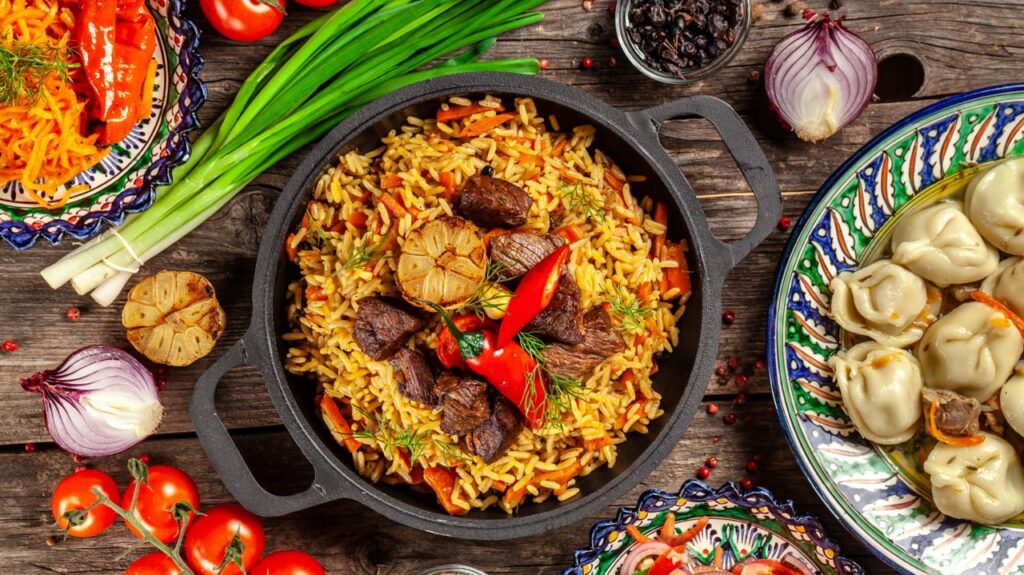
Pilaf, or plov, is the dominant holiday dish. Made with rice, carrots, onions, meat, and spices, regional variations might include raisins or quince for added sweetness. Each area boasts its own version of the national favorite.

Samsas, meat-filled pastries baked in a tandoor, are also served, as are manti, large, steamed dumplings filled with lamb, beef, or pumpkin. Other popular dishes include kazan-kabob (fried meat and potatoes). For dessert, chak-chak (fried dough with honey) and halva (made from sesame, semolina, or nuts) are perennial favorites.

Kyrgyzstan: Boorsoki and Beshbarmak

In Kyrgyzstan, beshbarmak, prepared with either horse meat or lamb, is also a central dish. Families commonly serve manti, baked chicken, and boorsoki (known in Kazakhstan as baursaki), fried dough balls that are a holiday staple.

Other meat-based specialties such as kabyrga (lamb rolls), asip (lamb sausages), chuchuk (horse meat sausages), and offal dishes like karta and karyn are also featured. Preparations often take place communally, with Soviet-era films playing in the background.

In Tajikistan, pilaf, referred to in its festive form as Oshi Milli, is also the dish of choice. While Olivier salad, herring under a fur coat, and holodets (jellied meat) remain popular, appetizers are often led by Shakarob, a fresh salad of greens, tomatoes, and cucumbers.

Turkmenistan also upholds culinary traditions, with Olivier salad offering a cultural link to its Soviet past. Pilaf dominates the table, prepared with meat, rice, vegetable oil, onions, and carrots. Elengi rice, prized for its size and juiciness, is typically used for festive meals. In many households, the New Year’s table is set directly on the carpet, on a large tablecloth, around which families gather. As in years past, children write letters to Santa Claus with their holiday wishes.

Turkmen Scientists Develop Plan to Extinguish the Darvaza Gas Crater

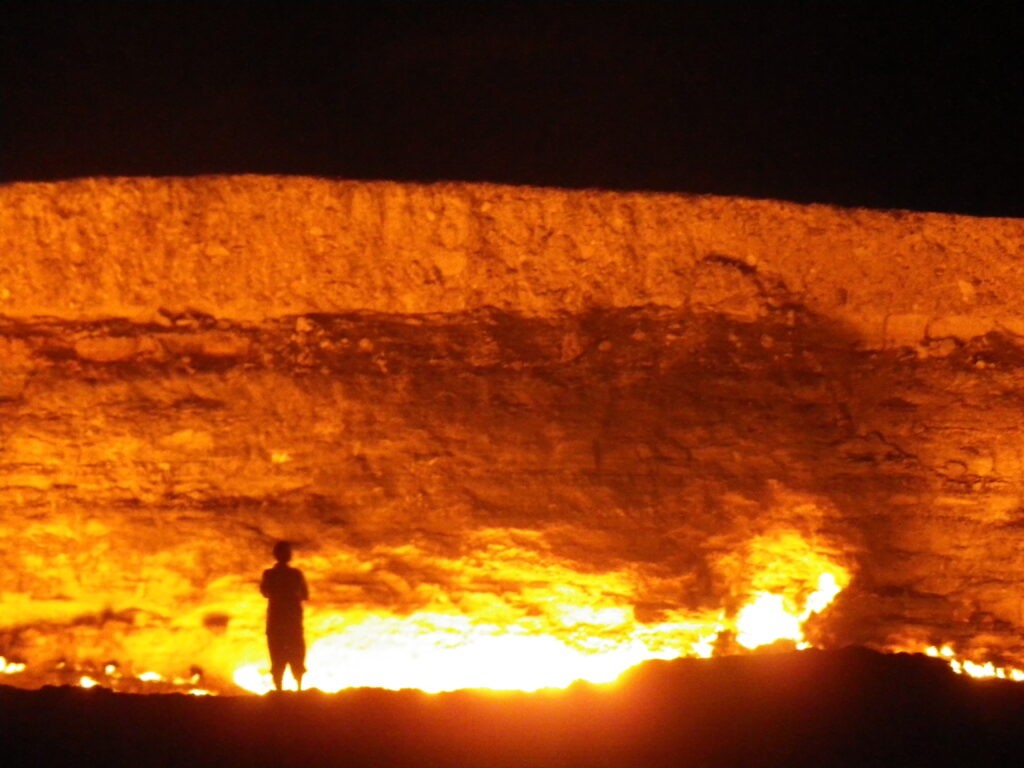
Scientists from the Scientific Research Institute of Natural Gas, under the state concern Turkmengaz, have proposed a method to extinguish the Darvaza gas crater, an uncontrolled fire that has been burning for decades in Turkmenistan’s Karakum Desert. The development was reported by Nebit-Gaz.

The proposed solution involves drilling a new well to divert natural gas away from the crater. Researchers believe this strategy could significantly reduce, and eventually halt, the gas flow fueling the fire. If successful, the plan would allow Turkmenistan to mitigate environmental damage and conserve valuable energy resources.

Turkmen officials have increasingly framed the Darvaza fire as both an environmental liability and an economic loss. Burning methane contributes to greenhouse gas emissions, while the continuous flare represents wasted natural gas in a country heavily dependent on energy exports for revenue.

Located roughly 270 kilometers north of Ashgabat, the crater, officially named the “Glow of the Karakum”, sits atop the Chaljulba structure of the Zeagli-Darvaza group of gas fields. It measures approximately 60 meters in diameter and is 20 meters deep. The formation resulted from the collapse of an exploratory gas well. To prevent methane from harming local populations and wildlife, scientists ignited the gas, expecting the fire to burn out within days.

However, the blaze has continued uninterrupted. Gas has been burning at the site since 1971, making the crater one of Central Asia’s most unusual natural and industrial spectacles. Researchers at the institute have conducted in-depth studies of the region’s geological structure, identifying a complex network of thin gas-bearing layers between 200 and 950 meters underground. These layers are interspersed with water-bearing and dense rock formations and are often hydrodynamically connected, enabling gas migration between them.

Experts caution that extinguishing the fire has never been straightforward. The crater is fed not by a single reservoir but by multiple interconnected gas pockets, complicating efforts to isolate and shut off the fuel source.

This interconnectivity explains why the fire persists despite the initial reservoir being relatively modest. Previous attempts to extinguish the fire included examining the crater floor to locate the original wellbore.

Turkmengaz safety teams descended into the crater in hopes of installing flow-control equipment, but gas was found to be leaking from multiple surface outlets, rendering those efforts ineffective.

Engineers found that sealing individual outlets risked increasing pressure elsewhere in the field, raising concerns that poorly planned interventions could trigger new leaks rather than resolve the problem.

Now, using updated geological and production data, scientists have proposed drilling an operational and appraisal well in the Chaljulba field. By intensively extracting gas from the most productive reservoir, they aim to alter subsurface pressure conditions and redirect the gas away from the crater. According to Nebit-Gaz, this scientifically grounded approach offers a realistic path toward halting the fire and minimizing its environmental impact.

If successful, the strategy could also allow some of the diverted gas to be captured for industrial use, potentially turning a long-standing liability into a limited economic resource.

The Darvaza fire has drawn global attention for decades. The site became infamous after Soviet scientists ignited escaping methane in an effort to prevent contamination, inadvertently creating a long-burning blaze and a potent symbol of resource loss.

Often dubbed the “Gate to Hell,” the crater has featured prominently in documentaries and social media, increasing international scrutiny of Turkmenistan’s handling of methane emissions and industrial legacies.

In January 2022, then-President Gurbanguly Berdimuhamedov ordered renewed efforts to extinguish the fire, citing environmental concerns and economic waste. Despite multiple attempts over the years, the fire has proven resilient. Despite official optimism, experts note that success will depend on precise geological modeling and careful execution. Until drilling begins and pressure changes can be measured, the fate of the Darvaza crater remains uncertain — as it has for more than half a century.

NoMad Nights: Celebrating Kazakh Identity at New Year in New York

There’s no party like a New Year NoMad Kazakh Party. Staged slightly ahead of New Year’s Eve to align with the weekend, the glamorous event marked a welcome to the incoming 2026 as well as a celebration of Kazakh culture in New York City. The Sky Wise Lounge, a fashionable Asian fusion venue with regular live entertainment, is located in Brooklyn’s Sheepshead Bay. The neighborhood has a sizable Central Asian population rooted in the former Soviet diaspora and sustained by post-Soviet migration.

Events like this one are part of an expanding series of multi-city gatherings across the United States hosted by ATB Promotions, led by Kazakhstani entrepreneur, Talgat Abdrakhmanov. A rotating group of about half a dozen DJs brings high-energy sets that fuse their own mixes with crowd-favorite Kazakhstani hits.

Talgat Abdrakhmanov (right) at NoMad Nights

Abdrakhmanov, originally from Karaganda, has achieved the American dream. Like other successful immigrants, he has built a business by adopting, adapting, and commercializing the enterprising customs of the U.S. After arriving in New York City in 2012, Abdrakhmanov worked his way up from a dishwasher and a waiter to a customer service representative. He later worked as an IT quality assurance analyst and in the competitive worlds of Wall Street and Silicon Valley. But it was not all work. While navigating employment and IT studies, Abdrakhmanov also embraced the play element of his American life, particularly nightlife and dance music, where he began to notice an unmet demand within his community.

During this time, he developed an idea rooted in his own downtime preferences and a desire to cater to fellow immigrants from Kazakhstan. Initially, he organized small meetups with friends at restaurants and sports bars, as well as group outings to soccer games and boxing matches, including bouts featuring former Kazakhstani middleweight world champion Gennady Golovkin, widely known as GGG.

“That was the initial spark that gave me an idea to make parties and events in the future,” Abdrakhmanov told The Times of Central Asia. “That’s how ATB Promotions came up.”

The Kazakhstani community in the U.S. was receptive to Abdrakhmanov’s first networking foray, KazCommunity USA.

“I started KazCommunity USA back in 2016, because I had held many jobs and gained a lot of experience, and people were often asking me for advice, where to find a job, where to find a place to live, how to do this, how to do that. Based on those questions, I decided to create chats and groups on Facebook, Telegram, and WhatsApp, so they exist across different social media platforms.

“KazCommunity USA is really about the community. I never charged any money for it. It’s more like a nonprofit initiative that helps people find work, find a place to live, and connect with each other. That includes organizing meetups and events, some of which I later did through ATB Promotions. But KazCommunity itself is free and focused on helping people and building connections within the community.”

Abdrakhmanov’s efforts to connect U.S.-based Kazakhstani communities evolved from casual meetups and unofficial parties into a structured, for-profit business. ATB Promotions, named after the initials of Abdrakhmanov and his father, officially launched on June 27, 2018. ATB Promotions has brought Kazakh-themed nightlife events and major Kazakh artists to U.S. audiences, including Kalifarniya, The Limba, Irina Kairatovna, and RaiM, through concerts held in New York, Los Angeles, Chicago, and Miami.

“As the organizer and main event manager, I handle everything from start to finish, from logistics and basic needs to working directly with the artists. Organizing concerts requires a significant budget, so I also have to attract sponsors, investors, and potential partners. I tried to do that as much as possible, but most of the work was done by me personally.

“Concerts are much larger and more complex than parties, but they gave me valuable experience. Between 2022 and 2025, I organized a total of 14 concerts.”

Abdrakhmanov has observed that both audience size and musical atmosphere vary by city. While New York and Chicago draw the largest crowds, he notes that the overall feel of events and music preferences differ from place to place, with smaller Kazakh communities spread across cities such as Houston, Boston, Washington, DC, Seattle, and parts of North Carolina.

Abdrakhmanov notes that his events increasingly draw both first- and second-generation Kazakhstani Americans. While younger attendees often navigate hybrid identities, he points out that first-generation migrants tend to adapt pragmatically to American life while maintaining cultural ties. In his view, the events function less as entertainment alone and more as shared cultural spaces that ease the tension of living between identities. In some cases, the use of “NoMad” in the event series name even inspires guests to arrive in party attire, referencing Kazakhstan’s historic nomadic traditions.

“It’s a flexible, pragmatic balance, integration without full cultural abandonment, but also without strong resistance to Americanization.”

Looking at the community today, Abdrakhmanov believes that many Kazakhstanis who have spent several years in the U.S. now treat the country as their main base. He adds that while ties to Kazakhstan remain, they are “more emotional and cultural than practical, nostalgia, language, family ties, and periodic visits rather than concrete plans to return.”

Japarov Outlines Development Priorities at Fourth People’s Kurultai

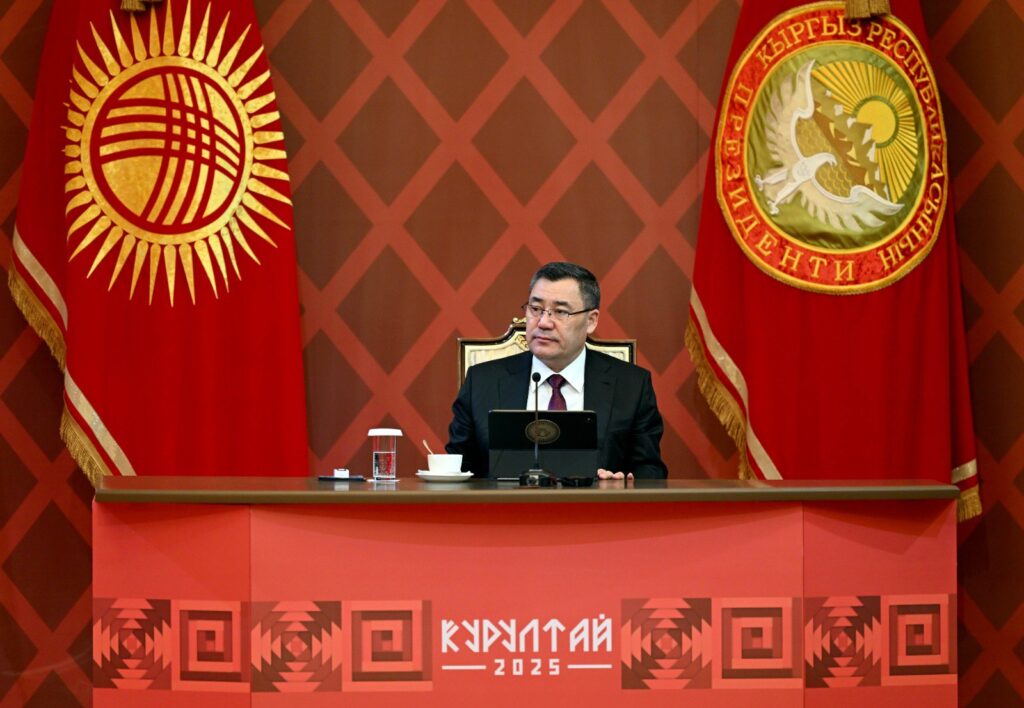
Kyrgyzstan’s fourth People’s Kurultai, a national forum for direct dialogue between citizens and state leadership, was held in Bishkek on December 25-26. Addressing delegates, President Sadyr Japarov outlined the government’s economic, social, and environmental priorities for the coming years.

Sustained Economic Growth

Japarov described the past three years as a period of strong economic performance, with average annual GDP growth of 9.8%. Real GDP grew by 10.2% in the first 11 months of 2025. GDP per capita in 2024 reached approximately $2,513. Unemployment dropped to 3.7%, while the poverty rate declined from 29.8% to 25.7% year-on-year.

Small and medium-sized enterprises (SMEs) have emerged as the backbone of the economy, with their contribution to GDP rising from 42.6% to 51.7% during the first nine months of 2025.

National Development Program Through 2030

Japarov presented the government’s National Development Program through 2030, which is centered on four key pillars: industrialization, transformation into a regional transport and logistics hub, agricultural and tourism development, and expansion of green energy.

The industrialization strategy includes the creation of industrial and technology zones and the construction of new production facilities to double industrial output by 2030. Large-scale investments in railways, highways, logistics centers, and warehouses are expected to bolster Kyrgyzstan’s role as a regional transit corridor.

Tourism is also a major focus. Japarov emphasized efforts to modernize the sector in line with international standards, citing the construction of new hotels, roads, airports, tourist routes, and recreational infrastructure. By 2030, the tourism sector is projected to contribute 7% to GDP.

Agricultural Development and Food Security

With nearly 58% of the population living in rural areas, agriculture remains a strategic priority. Japarov stated that Kyrgyzstan is currently self-sufficient in six of nine key food products, milk, potatoes, vegetables, meat, eggs, and sugar.

Agricultural reform centers on the development of agro-industrial clusters that bring together farmers, processors, logistics providers, and financial institutions to create integrated value chains. The goal is to shift from raw-material exports toward higher-value-added production.

Climate Change and Water Resources

Japarov also warned of worsening climate-related challenges, particularly declining water resources. Over the past 70 years, Kyrgyzstan has lost around 16% of its glacier area, endangering river flows, irrigation systems, and hydropower production.

Lake Issyk-Kul is of particular concern. Since the mid-19th century, the lake’s water level has dropped by nearly 14 meters. The number of rivers feeding into the lake has declined from more than 100 to approximately 30-35. The president cautioned that continued degradation could have serious environmental and socioeconomic consequences.

Water scarcity, he noted, also threatens food security, with 95% of national water consumption tied to agriculture. He called for more efficient irrigation, glacier protection, and expanded reforestation efforts.

From Social Spending to Development Focus

Japarov’s remarks were echoed by Chairman of the Cabinet of Ministers Adylbek Kasymaliev, who addressed parliament a day earlier.

Kasymaliev stated that the state has shifted from a “social economy” to a “development economy.” In 2025, 35% of government spending was allocated to the production sector, compared to 23% for social expenditures.

According to the cabinet, 102 new enterprises were launched in 2024, attracting investments totaling $796.8 million and creating more than 8,300 jobs. In 2025, a further 119 enterprises opened, backed by $715.6 million in investment and generating over 8,400 jobs.

Taken together, the speeches offered a vision of a government aiming to convert rapid economic growth into long-term structural transformation, while confronting enduring challenges in rural development, food security, and climate resilience.