• KGS/USD = 0.01144 0%
  • KZT/USD = 0.00193 -0%
  • TJS/USD = 0.10876 0.55%
  • UZS/USD = 0.00008 0%
  • TMT/USD = 0.28490 0%
  • KGS/USD = 0.01144 0%
  • KZT/USD = 0.00193 -0%
  • TJS/USD = 0.10876 0.55%
  • UZS/USD = 0.00008 0%
  • TMT/USD = 0.28490 0%
  • KGS/USD = 0.01144 0%
  • KZT/USD = 0.00193 -0%
  • TJS/USD = 0.10876 0.55%
  • UZS/USD = 0.00008 0%
  • TMT/USD = 0.28490 0%
  • KGS/USD = 0.01144 0%
  • KZT/USD = 0.00193 -0%
  • TJS/USD = 0.10876 0.55%
  • UZS/USD = 0.00008 0%
  • TMT/USD = 0.28490 0%
  • KGS/USD = 0.01144 0%
  • KZT/USD = 0.00193 -0%
  • TJS/USD = 0.10876 0.55%
  • UZS/USD = 0.00008 0%
  • TMT/USD = 0.28490 0%
  • KGS/USD = 0.01144 0%
  • KZT/USD = 0.00193 -0%
  • TJS/USD = 0.10876 0.55%
  • UZS/USD = 0.00008 0%
  • TMT/USD = 0.28490 0%
  • KGS/USD = 0.01144 0%
  • KZT/USD = 0.00193 -0%
  • TJS/USD = 0.10876 0.55%
  • UZS/USD = 0.00008 0%
  • TMT/USD = 0.28490 0%
  • KGS/USD = 0.01144 0%
  • KZT/USD = 0.00193 -0%
  • TJS/USD = 0.10876 0.55%
  • UZS/USD = 0.00008 0%
  • TMT/USD = 0.28490 0%
11 December 2025

Attacks on Doctors Surge in Kyrgyzstan Amid Systemic Failures

A recent spate of violent assaults on doctors in Kyrgyzstan has sparked growing concern within the healthcare sector. Over the past week alone, multiple incidents of medical staff being physically attacked have been reported at the National Hospital in Bishkek, with relatives of patients identified as the primary perpetrators.

The first major incident involved a young resident doctor who was providing emergency treatment to a patient suffering from a severe nosebleed. According to local media reports, the patient’s relatives attempted to interfere during the treatment and later assaulted the doctor as he accompanied the patient to a hospital ward. The doctor sustained a concussion, and his uniform was torn during the altercation.

In a controversial move, police officers responding to the scene did not detain the attackers. Instead, they arrested the injured doctor, citing his use of obscene language. A court later sentenced him to three days of administrative detention.

Human rights advocates say the doctor was denied legal counsel. Despite mobile phone video footage recorded by the doctor and corroborating statements from hospital staff, law enforcement agencies reportedly ignored this evidence.

“The patient is much better, he received the necessary treatment and has been stable since. His relatives, however, acted with arrogance and cruelty toward medical personnel, seemingly convinced of their own impunity,” said Barmet Baryktabasova, chair of the Medical Trade Union.

Just days later, a second assault occurred at the same hospital, this time targeting an emergency department physician. Although the attack was captured on CCTV, police again refrained from detaining the perpetrators, issuing only vague statements.

The Medical Trade Union has announced plans to file formal appeals to the President’s Office, the Ministry of Health, the Prosecutor General, and the State Committee for National Security. The union argues that violence against medical professionals is becoming systemic and poses a threat to the integrity of Kyrgyzstan’s already strained healthcare infrastructure.

Health Minister Erkin Checheibaev condemned the assaults in a public Facebook post:

“There is lawlessness against doctors! The man who attacked the doctor must be punished. This sets a dangerous precedent when attackers face no consequences.”

He emphasized the urgent need to protect the dignity and physical safety of medical personnel, warning that failure to act could lead to a severe staffing crisis in the coming years.

This is not the first wave of violence against healthcare workers in Kyrgyzstan. In 2023, following several incidents, the National Hospital briefly enhanced security by installing panic buttons, surveillance cameras, and hiring private guards. However, these measures were later rolled back due to budget constraints.

Currently, the average salary for public sector healthcare workers in Kyrgyzstan ranges from $300 to $400 per month. Combined with long hours and frequent high-stress situations, poor compensation is prompting many experienced professionals to exit the system. The government has pledged to implement healthcare funding reforms over the next three to four years, but many in the medical community fear those changes will come too late.
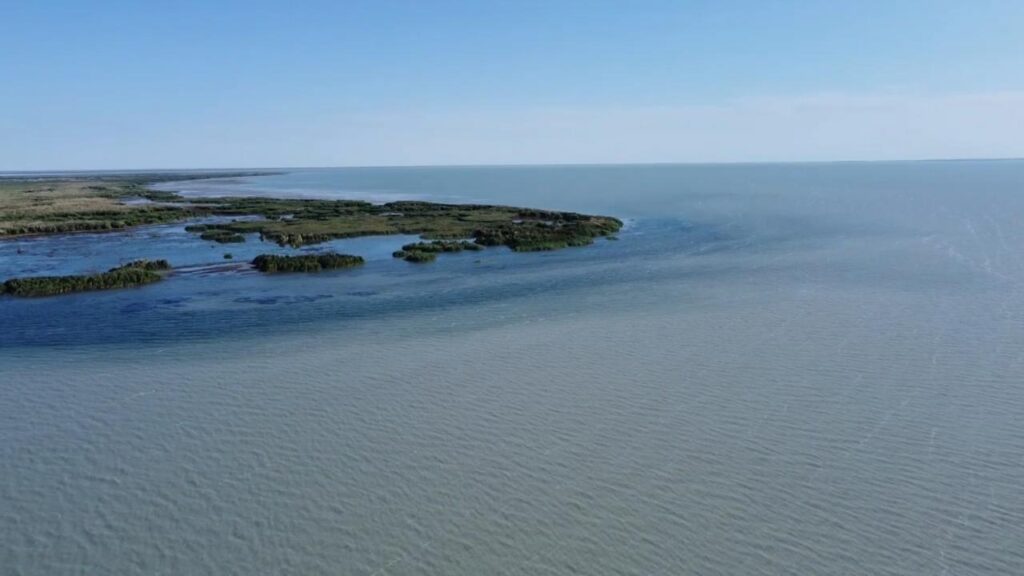

Water Level in Lake Balkhash Continues to Rise

The water level in Kazakhstan’s Lake Balkhash has increased by 32 centimeters during the first half of 2025, rising from 341.55 to 341.87 meters above sea level, based on the Baltic height system, according to data released by Kazakhstan’s Ministry of Water Resources and Irrigation.

Located approximately 280 kilometers northwest of Almaty, Lake Balkhash is one of Asia’s largest inland bodies of water and ranks as the fifteenth-largest lake in the world by surface area.

Since the beginning of 2025, 8.52 billion cubic meters of water have been discharged from the Kapchagay Reservoir in the Almaty region into Lake Balkhash. This marks an increase from 8 billion cubic meters over the same period in 2024. Officials expect total inflow from the reservoir to reach approximately 12 billion cubic meters by year-end.

The lake’s hydrological health is closely tied to the transboundary Ili River, which originates in China and supplies nearly 70% of Lake Balkhash’s total inflow. The Ili’s flow is regulated by the Kapchagay Reservoir, which in 2025 is at full capacity for the second consecutive year, a milestone not seen in over a decade. The reservoir had previously reached full capacity in 2024 for the first time in ten years.

In December 2024, Kazakhstan signed a cooperation agreement with the French Development Agency (AFD) and the French Geological Survey (BRGM) to support a long-term conservation effort for Lake Balkhash. The agreement outlines a comprehensive study of the lake basin and the development of a sustainability strategy through 2040, aiming to safeguard one of Central Asia’s most ecologically and economically significant water bodies.

Tajikistan to Supply Rogun Hydropower to Uzbekistan at 3.4 Cents per kWh

Tajikistan and Uzbekistan have agreed to a new phase of energy cooperation that will see electricity from Tajikistan’s Rogun Hydropower Plant (HPP) exported to Uzbekistan at an initial price of 3.4 US cents per kilowatt-hour, according to Tajikistan’s Ministry of Justice legal information portal.

The price, which includes a zero-rated VAT, will increase by 1% annually starting in the second year of supply. Deliveries are scheduled primarily during periods of planned shortages in Uzbekistan’s energy system and will follow an approved schedule coordinated by the countries’ respective system operators.

The volume and technical details of the supply arrangement will be formalized in a separate electricity purchase agreement between Rogun HPP and Uzbekistan’s Uzenergosotish company. Electricity will be transmitted via interstate power lines, supplementing ongoing exports from Tajikistan’s national utility Barki Tojik.

Regional Energy Integration

The Rogun HPP, a key component of Tajikistan’s long-term energy strategy, is also drawing interest from Kazakhstan, which recently announced its intent to purchase electricity from the plant. The price for Kazakhstan is likewise set at $0.034 per kWh, excluding VAT, and subject to an additional transit fee based on seller-incurred costs. Payments are to be made within 35 days of each delivery period.

During the plant’s current construction phase, electricity exports will occur only during the vegetation season (April 1 to September 30). Once Rogun reaches full operational capacity, deliveries will expand to year-round.

Agreement Terms and Project Outlook

The bilateral agreement will enter into force once both governments complete their domestic legal procedures and confirm implementation via diplomatic channels. The initial agreement term is 20 years, with automatic 10-year extensions, unless one party opts out by notifying the other at least six months prior to expiration.

Tajikistan has exported electricity to Uzbekistan every summer since 2018, strengthening energy ties in a region historically marked by infrastructure fragmentation.

Upon completion, Rogun HPP will be the largest hydropower facility in Central Asia, with an installed capacity of 3,780 megawatts (MW) and estimated annual output of 14.4 billion kWh.

Currently, two of the plant’s six turbines are operating at partial capacity, having come online in 2018 and 2019. Full commissioning of the sixth unit is expected by 2029. In 2024, Rogun generated 1.22 billion kWh, contributing 5.5% of Tajikistan’s total electricity production, according to the Ministry of Energy.

Uzbekistan Faces Criticism Over Charvak Tourism Project

As previously reported by The Times of Central Asia, a major tourism development project on the shores of Uzbekistan’s Charvak Reservoir has sparked public criticism and environmental concern. The proposed resort complex, Sea Breeze Uzbekistan, has come under fire for proceeding without open public consultation, prompting a wave of backlash on social media. The hashtag #SaveChorvoq has emerged as a rallying cry for those demanding transparency and environmental accountability.

Local Discontent and Environmental Concerns

According to climatologist Erkin Abdulakhatov, preliminary construction activity has already begun along the reservoir’s shoreline. He warned that large-scale development near the water could negatively impact the local ecosystem and alter weather patterns.

“If these promises are not fulfilled, the public has the right to organize a petition against mega construction based on the Aarhus Convention,” Abdulakhatov stated.

His comments were later shared by Rasul Kusherbayev, an adviser to the Minister of Ecology, on his Telegram channel. However, Kusherbayev added that no official confirmation of construction has been released.

Investor Response and Environmental Commitments

Investor Emin Agalarov, the driving force behind the Sea Breeze brand, attempted to reassure the public during a press event in Baku. He emphasized that no construction would begin until full public consultations, environmental impact assessments, and technical planning are completed.

“We will carry out construction only after these steps,” Agalarov said.

During a joint press tour to Azerbaijan on July 8-9, Uzbek officials and journalists visited the Sea Breeze complex near Baku to observe the project’s environmental safeguards. Hosted by Uzbekistan’s Ministry of Ecology and the State Center for Environmental Expertise, the visit aimed to assess compliance with international standards for water, soil, and engineering practices.

“I want Sea Breeze to become the most environmentally friendly project in any country, whether Azerbaijan, Uzbekistan, Montenegro, or Kazakhstan,” Agalarov told the delegation, noting the project’s planned infrastructure, clean beaches, and green public spaces.

Project Specifications and Safeguards

Sea Breeze Baku was connected to a centralized sewage system in 2024, replacing more than 100 small treatment plants with a modern collection network that serves a 50-kilometer coastal area. A similar system is now proposed for Charvak.

To protect the reservoir’s shoreline, project planners intend to shift the development zone 400 to 500 meters away from the water, significantly exceeding the legal minimum buffer of 50 meters. The area in between would feature parks, walking paths, public beaches, and recreational infrastructure.

Agalarov also proposed a ring collector system for wastewater treatment along the entire Charvak coastline, a move he said would benefit both the resort and the wider ecosystem.

Government Oversight and Expert Involvement

Uzbekistan’s Minister of Ecology, Aziz Abdukhakimov, has expressed cautious support, stating:

“Partners must follow Green-Based Solutions. We will fully support projects that meet ecological standards. Special attention must go to protecting water resources. All risks must be assessed by qualified experts.”

To ensure accountability, the ministry has announced the formation of an International Environmental Council for Charvak, which will include independent specialists tasked with overseeing public dialogue, environmental assessments, and project monitoring.

Dr. Firuze Sultan-Zade, head of EcoSphere and founder of Azerbaijan’s Green Network, praised the model:

“Involving foreign specialists will ensure transparency and accountability. If fully implemented, this project could set the standard for green tourism in Central Asia.”

The proposed zoning plan includes measures to map and relocate existing trees, plant new vegetation, and build green corridors. Eco-certified building materials and energy-efficient technologies will be used, while ecological trails, boulevards, and promenades are intended to link the resort with neighboring communities.

Kazakhstan to Host Third Future Games in 2026

Kazakhstan will host the third edition of the international Games of the Future tournament in the summer of 2026, combining traditional sports with their digital counterparts in a unique “phygital” format. The event will take place in Astana from July 18 to August 1, Deputy Minister of Tourism and Sports Serik Zharasbayev announced at a recent briefing.

The Games of the Future is an annual global competition where athletes compete in both physical and digital disciplines, with overall scores determined by performance in both categories. The inaugural tournament was held in Kazan, Russia, in early 2024. The second edition is scheduled for December 2025 in the United Arab Emirates, while Kazakhstan will host the third installment in 2026.

Over 1,500 athletes from nearly 100 countries are expected to participate in the event, which will feature 13 phygital disciplines. Competitions will be held at several of Astana’s premier sports venues, including the Qazaqstan Sports Complex, Barys Ice Arena, Saryarka Velodrome, Zhekkpe-Zhek Martial Arts Palace, Alaou Ice Palace, Beeline Arena Tennis Center, and the Inclusive Sports Center.

The tournament is being organized by the government of Kazakhstan in partnership with Phygital International, a global organization representing 98 member countries.

Diverse Disciplines and Substantial Prize Pool

Disciplines confirmed for the 2026 tournament include: Phygital Football (soccer), Phygital Fighting (martial arts), Phygital Basketball, Phygital Dancing, Phygital Hockey, Phygital Shooter (tactical combat), Phygital Battle Royale (multiplayer battles), two MOBA disciplines (team esports games), Phygital Drone Racing, Battle Bots (robot battles), Phygital Boxing, and Cybathletics (competitions involving technology-enhanced athletes).

The total prize fund will amount to $10 million. According to Alibek Khasenov, president of Kazsportinvest JSC, “The funds will be distributed among the 13 disciplines, some will receive more, some less. All funding, including organizational costs and prize money, will be provided exclusively through sponsorship.”

Khasenov noted that several Kazakhstani companies have already shown interest in sponsoring the event. The first edition of the tournament in Kazan reportedly garnered over 3.5 billion views across digital platforms.

Rescheduled Due to Flood Recovery Efforts

Originally, Kazakhstan was set to host the second Games of the Future in 2025. However, in the aftermath of unprecedented spring floods in 2024, the government reprioritized spending to address recovery efforts.

As previously reported by The Times of Central Asia, this led to the postponement of several high-cost and image-driven events, including the Future Games, which have now been rescheduled for 2026.

Tajikistan Launches National Food Reform to Boost Nutrition

A large-scale food reform program titled “Changing the Food System to Improve Nutrition” has been launched in Tajikistan, aiming to improve dietary practices and enhance national food security. The initiative is a collaborative effort between the Tajik government and several United Nations agencies, including the Food and Agriculture Organization (FAO), the United Nations Children’s Fund (UNICEF), the World Health Organization (WHO), and the World Food Programme (WFP).

Sustainability and Coordination at the Core

With a budget of $2 million, the program targets over 2.8 million people across both urban and rural areas. The central goals include fostering sustainable agricultural practices, promoting healthy eating habits, and strengthening food governance systems.

Parvati Ramaswamy, the UN Resident Coordinator in Tajikistan, described the project as a unifying platform for agencies, donors, and international partners. “Changing the food system is one of the government’s priorities for achieving the Sustainable Development Goals,” she stated.

The program is implemented in coordination with the Tajikistan Food Security Committee and various national ministries. “By transforming food systems through innovation, inclusiveness, and sustainability, we can raise a healthy generation,” added Mahmoud Shirindjonzoda, First Deputy Chairman of the Food Security Committee.

Four Pillars of the Program

The initiative is structured around four main components:

  1. National Nutrition Standards ($650,000): This includes training seminars, updated dietary guidelines for schools and hospitals, and the introduction of comprehensive nutrition standards.
  2. Building a Culture of Nutrition ($300,000): Funds will support mass awareness campaigns, educational programs, and regional outreach to encourage healthy dietary habits.
  3. Sustainable Agriculture and Green Products ($850,000): Efforts will focus on training farmers, developing school gardens, and promoting eco-friendly local products. Support will also be extended to women and youth in agribusiness, with a new certification system for environmentally sustainable goods.
  4. Monitoring and Strategic Planning ($200,000): This component will develop a national nutrition assessment system and data-driven policy frameworks.

Support for Vulnerable Populations and Local Production

A key objective of the program is to strengthen state mechanisms for supplying nutritious food to vulnerable population groups. It also includes the preparation of policy recommendations and methodologies to enhance national food security.

Promoting local, eco-friendly alternatives to imported goods is another major element of the project, aimed at reducing reliance on external supplies while supporting domestic producers.

With its comprehensive approach, the program aspires not only to improve nutrition but also to establish a long-term foundation for sustainable development in Tajikistan, where food security and public health remain pressing concerns.