• KGS/USD = 0.01144 0%
  • KZT/USD = 0.00210 0%
  • TJS/USD = 0.10553 0.19%
  • UZS/USD = 0.00008 0%
  • TMT/USD = 0.28530 0%
  • KGS/USD = 0.01144 0%
  • KZT/USD = 0.00210 0%
  • TJS/USD = 0.10553 0.19%
  • UZS/USD = 0.00008 0%
  • TMT/USD = 0.28530 0%
  • KGS/USD = 0.01144 0%
  • KZT/USD = 0.00210 0%
  • TJS/USD = 0.10553 0.19%
  • UZS/USD = 0.00008 0%
  • TMT/USD = 0.28530 0%
  • KGS/USD = 0.01144 0%
  • KZT/USD = 0.00210 0%
  • TJS/USD = 0.10553 0.19%
  • UZS/USD = 0.00008 0%
  • TMT/USD = 0.28530 0%
  • KGS/USD = 0.01144 0%
  • KZT/USD = 0.00210 0%
  • TJS/USD = 0.10553 0.19%
  • UZS/USD = 0.00008 0%
  • TMT/USD = 0.28530 0%
  • KGS/USD = 0.01144 0%
  • KZT/USD = 0.00210 0%
  • TJS/USD = 0.10553 0.19%
  • UZS/USD = 0.00008 0%
  • TMT/USD = 0.28530 0%
  • KGS/USD = 0.01144 0%
  • KZT/USD = 0.00210 0%
  • TJS/USD = 0.10553 0.19%
  • UZS/USD = 0.00008 0%
  • TMT/USD = 0.28530 0%
  • KGS/USD = 0.01144 0%
  • KZT/USD = 0.00210 0%
  • TJS/USD = 0.10553 0.19%
  • UZS/USD = 0.00008 0%
  • TMT/USD = 0.28530 0%

Digital Tenge: Kazakhstan Becomes a Testing Ground for Programmable Money

While developed economies from the Federal Reserve to the European Central Bank, continue to debate the risks of introducing central bank digital currencies (CBDCs), Kazakhstan has already moved into large-scale commercial deployment. By early 2026, the volume of the digital tenge in circulation had reached 336.6 billion KZT (about $700 million), positioning Central Asia as a significant testing ground for programmable money for international investors and the global fintech community.

The digital tenge is already being used in tax administration, subsidy distribution, and other state-backed financial operations, extending its role beyond a purely technical innovation.

This is not merely a technological upgrade of the financial system, but a fundamental shift in the interaction between the state, business, and capital.

Algorithms Instead of Bureaucrats

For international businesses and investors, bureaucracy has long been a major barrier in emerging markets, often freezing liquidity for extended periods. The introduction of the digital tenge aims to address this by enabling faster transactions through smart contracts.

One of the most notable pilot cases in 2025-2026 was the implementation of a “digital VAT” mechanism. Traditionally, exporters waited up to 90 days for value-added tax refunds, often relying on short-term borrowing to bridge cash flow gaps. With the integration of the digital tenge into tax administration, the VAT refund period has been reduced to five business days.

A smart contract analyzes the digital supply chain and, if no discrepancies are identified, initiates payment automatically without the involvement of tax officials. For multinational companies, improved liquidity enhances Kazakhstan’s attractiveness as a manufacturing destination. Similar mechanisms have also been introduced for distributing government business subsidies through development institutions.

Financial Bridge: The Digital Silk Road Bypassing SWIFT

The current international money transfer system remains relatively slow and costly, as transactions pass through multiple intermediary banks, each charging fees. Under sanctions pressure, such transfers may also carry additional risks.

In this context, the role of the digital tenge extends beyond the domestic market. Kazakhstan is positioning its CBDC as a tool that could reshape the architecture of Eurasian trade. Research by the Bank for International Settlements suggests that digital currencies can significantly accelerate cross-border payments.

Given Kazakhstan’s substantial trade with China, which is advancing its digital yuan (e-CNY), the creation of direct digital payment corridors between the two countries appears increasingly plausible.

For global markets, this could enable near-instant, round-the-clock settlements between Asia and Europe, reducing reliance on traditional systems such as SWIFT. Kazakhstan is thus seeking to position itself as an emerging digital financial hub, with the potential to lower transaction costs and mitigate certain external risks.

The Flip Side of the Digital Coin

One of the most debated aspects of Kazakhstan’s digital currency initiative is the level of transparency enabled by “coloring” (or marking) technology. This system allows authorities to track how funds are used and ensure they are spent for their intended purpose.

If budget funds are allocated for infrastructure or agricultural equipment, their use can be limited accordingly. At the macroeconomic level, this could help reduce Kazakhstan’s shadow economy, estimated at approximately 22.8 trillion KZT (about $47.5 billion).

However, experts point to potential risks to financial privacy. Advanced analytics and AI systems could enable real-time monitoring of individual financial behavior, raising concerns among international observers and rights advocates.

Technological Foundation and Challenges for Commercial Banks

From a technical perspective, the digital tenge infrastructure is being developed with international compatibility in mind. Kazakhstan’s adoption of the ISO 20022 financial messaging standard is intended to facilitate integration with global financial systems.

At the same time, the expanding role of the state in financial transactions presents challenges for commercial banks. The introduction of the digital tenge increases the risk of disintermediation, a reduction in the role of banks as financial intermediaries.

Previously, state funds passed through commercial bank accounts, providing a source of short-term liquidity for lending. With the shift toward direct transactions in digital currency, banks may need to adapt their business models by focusing more on value-added financial services and technology-driven solutions.

A Delicate Balance

By 2027, the digital tenge is expected to move beyond the pilot phase and become a core component of Kazakhstan’s financial system. Internationally, the project may serve as a case study demonstrating how programmable money can improve efficiency, reduce administrative burdens, and facilitate trade.

For Kazakhstan, however, the transition marks the beginning of a new phase requiring a careful balance between increased financial transparency, seen as a tool to combat corruption, and the protection of citizens’ financial privacy.

How effectively this balance is maintained will be a key factor in determining the long-term sustainability of the country’s digital transformation.


Central Asia Recalculates as the Iran War Enters a New Phase

Central Asia’s first response to the Iran war was public and urgent. Governments organized evacuations, welcomed a ceasefire, and watched the Strait of Hormuz because the region’s trade routes, fuel costs, and food prices were already under pressure. The next phase looks different. Following the April 12 collapse of U.S.-Iran talks in Islamabad, Washington moved to block maritime traffic entering and leaving Iranian ports. That step does not formally close Hormuz to all shipping, but it pushes the crisis into a more serious phase for any country or company still treating Iran as a viable corridor.

That distinction is important in Central Asia because the region does not need a formal legal closure of Hormuz to feel the shock. It only needs insurers, banks, freight forwarders, airlines, and traders to decide that the southern option has become too risky for routine planning. That process was already underway. The route through Iran had come under strain in southern corridor traffic, food systems, and in the wider pricing of regional connectivity. A U.S. move against Iranian ports is likely to reinforce that view.

Official statements across Central Asia still reflect the ceasefire moment more than the latest escalation. On April 8, Kazakhstan’s President Kassym-Jomart Tokayev welcomed the truce and said he hoped it would support global trade and prosperity. Kyrgyzstan’s Foreign Ministry also welcomed the ceasefire and praised efforts to reduce tensions. Uzbekistan’s Foreign Ministry did the same, calling the truce an “important step toward de-escalating tensions,” and stressing that it should serve as a pathway to a broader political settlement. Tajikistan’s Foreign Ministry also welcomed the ceasefire agreement between Iran and the United States. Turkmenistan, meanwhile, had already taken a practical line, saying on March 4 that it was keeping all international checkpoints open and providing passage for foreign citizens, vehicles, and rail stock across the Turkmen-Iranian border.

Since then, public messaging has lagged behind the latest escalation. By April 13, Qazinform’s foreign news flow had shifted to the failed Islamabad talks and Trump’s blockade order, while the latest publicly visible official positions elsewhere in the region still reflected the April 8 ceasefire. That does not mean backchannel diplomacy has stopped, but it does suggest that Central Asian governments prefer caution in public as the conflict shifts from direct strikes to pressure on shipping and trade.

For the region, the economic logic is now clearer than the politics. Approximately 20% of global oil supplies and one-third of global fertilizer trade move through the Strait of Hormuz, while urea prices surged by almost 46% between February and March 2026. The World Bank’s April Europe and Central Asia Economic Update said growth in the developing economies of Europe and Central Asia is expected to slow to 2.1% in 2026, down from 2.6% in 2025, as the Middle East conflict, wider geopolitical tension, and trade fragmentation weigh on the region. Those pressures were already significant. The collapse of the main post-ceasefire diplomatic effort, followed by oil rising back above $100 a barrel, has made them harder to absorb.

Across Central Asia, higher prices do not bring gains for most of the region. Kazakhstan can benefit from stronger crude prices at the export level, and there is already discussion of whether it can supply more petroleum products to Asian markets. However, the broader regional picture is far tighter. Uzbekistan, Kyrgyzstan, and Tajikistan are all exposed to imported inflation through fuel, transport, and fertilizer channels. Even where shortages do not appear, margins tighten and household budgets worsen, turning a foreign war into a domestic economic problem.

Air routes show the same structural shift. On April 9, the European Union Aviation Safety Agency extended its conflict-zone bulletin for the Middle East and Persian Gulf through April 24. That leaves airlines with fewer safe and efficient corridors between Europe and Asia. Russian airspace remains unavailable to most Western carriers, and Iranian airspace remains extremely high risk. Therefore, traffic keeps moving toward the northern arc through the South Caucasus and Central Asia. That has already increased the strategic importance of Kazakhstan and Azerbaijan, and the latest escalation makes this shift look less temporary.

Central Asian governments have spent years trying to widen access to world markets through Iran, the South Caucasus, and, in some cases, Afghanistan and Pakistan. That strategy was meant to reduce dependence on northern routes and give the region more paths to global markets. With its 1,148-kilometer border with Turkmenistan, Iran still matters geographically. It still connects Central Asia to Gulf markets and the Indian Ocean. But geography does not keep a corridor usable if it is no longer insurable, financeable, and predictable. After the failure of talks in Islamabad and Washington’s move against Iranian ports, the southern route looks less like routine infrastructure and more like a contingency option.

That leaves Central Asia in a familiar but narrowing position. No government in the region wants to be pulled into a direct U.S.-Iran confrontation, but none can ignore what happens when the map of usable trade routes shrinks again. The practical answer is caution in public and recalculation in private. The first phase of the war brought evacuation plans, official statements, and visible coordination. The next phase is bringing something quieter and more important: a growing sense that the Iranian corridor may still exist on paper, but no longer belongs at the center of Central Asia’s planning map.

Kazakhstan and Azerbaijan Are Reinforcing the Middle Corridor’s South Caucasus Link

On April 7 Kazakhstan’s Foreign Minister Yermek Kosherbayev visited Tbilisi to hold talks with Georgian Foreign Minister Maka Bochorishvili and sign a 2026–2027 foreign-ministry cooperation program. He called Georgia “a key link” in the Europe–Asia transport architecture and said the common task was to raise corridor capacity, improve service predictability, and ensure tariff transparency. The materialization of the bilateral cooperation is already evident from last June’s opening of the Poti multimodal terminal by a joint Kazakhstani-Georgian company.

The real meaning of Kosherbayev’s discussions in Tbilisi lies in their context. On April 2 in Baku, Prime Minister Olzhas Bektenov said Kazakhstan plans an intergovernmental agreement with Azerbaijan this year to strengthen the status of the Middle Corridor (also known as the Trans-Caspian International Transport Corridor, TITR), and he proposed moving quickly on the Digital Monitoring Center under the Organization of Turkic States (OTS). On April 6 in Tbilisi, Azerbaijani President Ilham Aliyev called the Azerbaijan–Georgia segment the corridor’s “main transport artery.” Then on April 8 in Baku, Aliyev received Kosherbayev together with Kazakhstan’s transport minister. The official readout ranged from the Middle Corridor to joint investment, green-energy, and fiber-optic projects. Kosherbayev’s April 7 stop in Tbilisi thus belongs to a short Kazakhstan-led diplomatic run across the corridor’s western nodes.

Kazakhstan and Azerbaijan Tighten the Corridor

Kazakhstan’s early-April engagement in the South Caucasus rests on its eastward-looking framework with China. Two China–Kazakhstan documents were already in evidence in October 2023: a Memorandum of Understanding (MoU) on deepening the development of the China-Europe Railway Trans-Caspian route, and an intergovernmental agreement on developing that route. China’s National Development and Reform Commission (NDRC) subsequently clarified that the agreement focused on stronger transit organization, fewer administrative barriers, and improved logistics and transport operations. In July 2024, Kazakhstan’s President Kassym-Jomart Tokayev and his Chinese counterpart Xi Jinping jointly attended the opening of the Trans-Caspian direct fast transport service; NDRC then recorded a work mechanism with Kazakhstan’s transport ministry to carry that cooperation forward.

On January 1, the first Trans-Caspian train of 2026 departed Xi’an for Baku carrying 45 containers of photovoltaic equipment. Chinese reports assert that the route had accumulated 466 runs by the end of November 2025, moved onto a weekly six-outbound and three-inbound timetable, and cut travel times from the roughly 20-day average recorded in 2025 to a standard 15 days, with the fastest runs taking 11 days. On April 3, it was also reported that there were 85 Xi’an Trans-Caspian trains in the first quarter of 2026, up 150% year-on-year, while the Kazakhstan–Xi’an terminal in Almaty handled more than 6,000 containers in that quarter alone, a 60% increase from a year earlier. A separate quasi-official Chinese trade-services portal reported that Trans-Caspian trains had reached daily service and that 371 such trains had run in January–October 2025, up 33%. China’s NDRC also said in late 2025 that Aktau and Baku should be strengthened as hub nodes in this corridor system.

Azerbaijan is the indispensable partner without which the route’s western logic does not function. Bektenov’s April 2 statement made that plain by tying the corridor more closely to Baku, and by pushing institutional coordination and digital monitoring. Aliyev’s April 8 reception of Kosherbayev and Transport Minister Nurlan Sauranbayev widened the picture beyond transit in the narrow sense toward joint investment and linked infrastructure. The Trans-Caspian Green Energy Corridor and fiber-optic lines across the Caspian point in the same direction: they show an effort to turn bilateral political alignment into practical management across transport and communications.

Still, the route has to become commercially normal at the Black Sea end: this is where Georgia comes into play in Kosherbayev’s April 7 talks. The most tangible materialization of this is the Poti terminal. Georgia’s economy ministry said the project involved $31.5 million in investment, more than nine hectares of terminal area, and a first-stage annual throughput of more than 80,000 containers. Kazakhstan’s readout of Kosherbayev’s April 7 meeting linked the corridor directly to Georgia’s role in Europe–Asia logistics and to Kazakhstan’s investment footprint in the Georgian economy, now above $600 million.

The Azerbaijan–Georgia Axis Holds the Western Segment

Kosherbayev did not visit Georgia as a narrowly defined South Caucasus specialist. He is one of the senior operators available for politically sensitive files that combine foreign policy, transport, and intergovernmental coordination. He has been foreign minister since September 2025, after serving as deputy prime minister earlier that year, and before that as deputy foreign minister and ambassador to Russia. His movement from Tbilisi to Baku, including Aliyev’s reception of him alongside Kazakhstan’s transport minister, shows that Astana is handling this route at ministerial weight and through a figure who combines cabinet rank with diplomatic practice and state-to-state execution.

Georgia’s position is more important precisely because it is no longer guaranteed. While the IMF’s April 7 mission statement said a more protracted Middle East conflict could redirect additional transit toward Georgia along the Middle Corridor, it also mentioned that an Azerbaijan–Armenia peace agreement could generate new trade routes bypassing Georgia. Astana therefore has good reason to reinforce the Azerbaijan–Georgia segment, and Kosherbayev’s visit is a part of that effort, because it remains the operative route, not because it can take for granted that this will indefinitely remain the only serious western-facing option.

Aliyev’s remarks in Tbilisi on April 6 clarify why the Azerbaijan–Georgia axis remains the route’s present backbone. He said Azerbaijani oil and gas exports begin through Georgia, that oil from the eastern shore of the Caspian also moves through Azerbaijan and Georgia, and that transport corridors that were later built along those same routes are now being expanded. Aliyev then stated plainly that the Middle Corridor passes through Azerbaijan and Georgia, and is “our main transport artery.” This also aligns closely with Kazakhstan’s current westbound effort and the setting for Kosherbayev’s visit: Georgia is the Black Sea–facing outlet, but the route reaches that outlet through Azerbaijan’s Caspian ports and onward transport system into Georgia.

The present phase also has a retrospective logic. Kazakhstan, Azerbaijan, and Georgia were already moving toward more formalized corridor management in June 2023, when they agreed to establish a joint logistics company to unify tariffs, apply a one-window principle, and handle cargo movement on the TITR on a coordinated basis. At the time, Kazakhstani officials said that the aim was to cut delivery times first to 18 days and then to 10–15 days, while bottleneck-removal measures included a container hub in Aktau, rail expansion on the Kazakh side, and steps to regularize container handling along the route. The past week’s diplomacy should therefore be seen as a further tightening of machinery already under construction for several years.

The larger economic case remains favorable if the route can be made more reliable. The World Bank’s 2023 corridor study argued that the Middle Corridor is not only a land bridge between China and Europe, but also a regional corridor in its own right. Its modeling projected a 37% increase in trade among Azerbaijan, Georgia, and Kazakhstan, and a 28% increase in trade between those countries and the EU by 2030, provided that coordination, logistics, digitalization, and infrastructure upgrades are carried through. The Bank also put the matter in practical terms: higher freight volumes and shorter transit times depend on synchronized procedures, better ports, and more continuous operations. This is the policy setting in which Kazakhstan and Azerbaijan are now seeking to make the corridor function more predictably from the Chinese feeder side through the Caspian and into the South Caucasus.

Kazakhstan and Azerbaijan Move to Preserve Georgian Corridor Continuity

Neither Kazakhstan nor Azerbaijan is a mere participant in corridor construction. Astana is trying to shape corridor continuity, but it can do so only through indispensable cooperation with Baku. Kosherbayev’s visible role underscores the point. The route depends on ports, railways, terminals, tariffs, and schedules, but it also depends on working political relationships among the states that control those assets. Kazakhstan is thus not waiting for a broader regional realignment to settle itself through the westbound chain. Rather, with Azerbaijan, it is acting through ministerial visits, proposals on digital coordination, and repeated coordination with Georgia.

The South Caucasus segment of the Middle Corridor has become central to Central Asia’s westward optionality, as The Times of Central Asia previously reported on February 13 and on March 17. This week’s Kazakhstan–Georgia–Azerbaijan sequence confirms that judgment from a more practical angle. The TRIPP (“Trump Route for International Peace and Prosperity”) route through southern Armenia and other alternative alignments may yet widen the region’s routing possibilities. The IMF is right to note that some future routes could bypass Georgia, but the existing Azerbaijan–Georgia line remains the operative channel today. Accordingly, Kosherbayev’s stop in Tbilisi and the document signed there mean that Kazakhstan is acting at the ministerial level, through working relationships, to govern terminals and manage the route more deliberately.

Kazakhstan Considers National Messaging App Aitu for Insurance Companies

Kazakhstan’s Agency for Regulation and Development of the Financial Market is considering the use of the domestic messaging platform Aitu for remote communication between insurance companies and other non-bank financial institutions and their clients.

According to Bloomberg, the regulator has recommended that market participants consider using the Kazakh-developed messenger Aitu as a communication tool. Sources cited by the publication said that insurance and brokerage firms received proposals last month regarding the potential use of the platform, partly aimed at strengthening personal data protection.

Market participants expressed concerns, pointing to Aitu’s relatively small user base, limited functionality, potential integration costs, and the absence of clear regulatory guidelines for handling personal and financial data on such platforms.

In response, the regulator clarified that the use of Aitu is not being considered mandatory, but rather as an additional secure communication channel between financial institutions and their clients.

“This issue is being considered by the Agency in connection with the need to strengthen information security, including the protection of personal data amid rising fraud in financial services. The initiative is also aimed at standardizing communication channels between financial organizations and their clients,” the agency said in a statement.

According to the regulator, Aitu’s infrastructure ensures a high level of data protection, in part due to the physical localization of servers within Kazakhstan. This, it argues, reduces risks associated with cross-border data transfers and potential interception of financial information.

Additional security features include end-to-end encryption, with access keys stored only on users’ devices, as well as the Aitu Passport system, which incorporates biometric identification and a cloud-based electronic digital signature. The regulator states that these tools provide legally valid user verification and help minimize risks such as phishing and identity theft.

The agency also noted that the use of open APIs and business dashboards would allow financial institutions to integrate their systems with the platform at relatively low cost, making use of national digital infrastructure.

Government agencies and quasi-state companies had earlier been encouraged to adopt Aitu for official communications. As previously reported by The Times of Central Asia, the rollout of the national messenger has sparked broader debate over the balance between cybersecurity and internet freedom in Kazakhstan.

Kazakhstan and China Launch Hydrogen Energy Technology Innovation Center

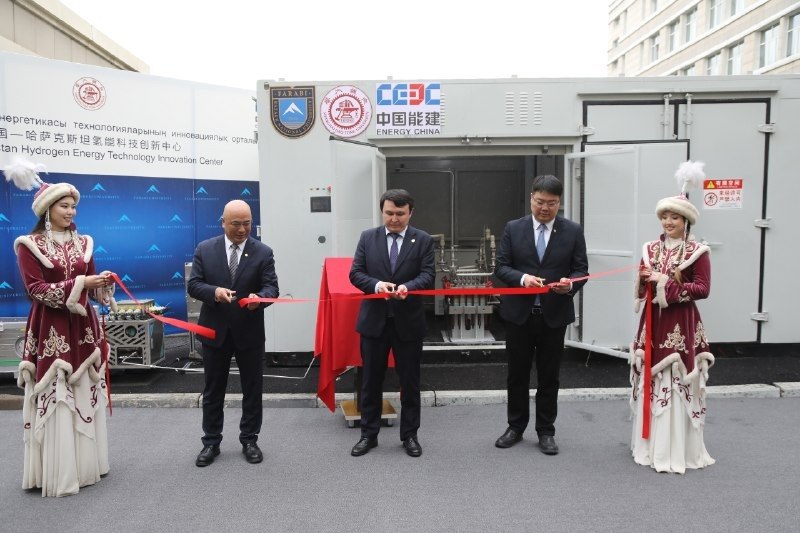
Kazakhstan and China have expanded cooperation in clean energy with the launch of the China-Kazakhstan Hydrogen Energy Technology Innovation Center at Al-Farabi Kazakh National University in Almaty on April 9.

The center is part of Kazakhstan’s strategy to build a modern technological base linking science, education, and industry in support of the country’s transition to low-carbon energy.

Speaking at the opening ceremony, Energy Minister Yerlan Akkenzhenov highlighted the importance of international partnerships in the development of the energy sector.

“Hydrogen energy is one of the strategic priorities for the development of the energy sector. The Concept adopted in 2024 laid the legal and economic foundation for the creation of a new industry aimed at decarbonizing the economy. The new center should become a key platform for training next-generation engineers, conducting applied research, and rapidly introducing innovations into production,” Akkenzhenov said.

As part of the ceremony, Al-Farabi Kazakh National University, Shanghai Jiao Tong University, and Energy China International Corporation signed a trilateral memorandum of understanding outlining the center’s operational framework.

The agreement includes expanding scientific and technical cooperation, facilitating technology transfer, and promoting academic exchange. The partners also plan to conduct joint research, test hydrogen technologies, and launch pilot projects, with a particular focus on the commercialization of innovations and their integration into Kazakhstan’s industrial sector.

The development of hydrogen energy is a key element of the global transition to cleaner energy systems. According to Kazakhstan’s Ministry of Energy, the country has significant potential in this field due to its natural resource base and growing renewable energy capacity. Cooperation with Chinese technology partners is expected to strengthen Kazakhstan’s position in emerging energy markets and support industrial modernization.

During the ceremony, Zhanseit Tuimebayev, chairman of the board and rector of Al-Farabi Kazakh National University, highlighted the evolving role of universities as drivers of economic and technological development.

“Universities today are not only centers for training specialists but also key drivers of economic growth, technological development, and national competitiveness. Al-Farabi National University has consistently pursued this mission, transforming itself into a new type of university, one that not only educates, but also develops technologies, shapes markets, and acts as a full-fledged partner to the state and industry,” Tuimebayev said.

Kazakh MP Calls for a Legislative Ban on Radical Religious Movements

Kazybek Isa, a deputy of the Mazhilis (Kazakhstan’s lower house of parliament ), has called for a legislative ban on radical religious movements, arguing that their spread poses a threat to social stability and national security. In a parliamentary inquiry addressed to the government and law enforcement agencies, Isa stated that the ability of such groups to recruit followers could undermine social cohesion and national values.

“A legislative ban on radical religious movements is a matter of national security. Such movements threaten social stability, and the state is obligated to protect its citizens from their influence,” the deputy said. He added that the proposed measures are not aimed at religion itself, but at organizations promoting what he described as destructive ideologies.

Several recent high-profile incidents prompted the inquiry. In March 2026, a blogger criticized the celebration of Nauryz, describing it as “not a Kazakh or Muslim holiday.” He was subsequently detained, and a criminal case was opened against him on charges of inciting religious discord.

In a separate case, a YouTube interview circulated featuring a man presenting himself as an imam who claimed to have given his second wife to a student. Following public backlash, he was held administratively liable and fined.

According to Isa, existing regulations governing extremist and radical organizations are dispersed across multiple legal acts and are not always effectively enforced. He proposed developing a more comprehensive legislative framework focused on prevention.

The deputy also raised concerns about compliance with laws regulating face-covering clothing. He referred to a court case in Aktobe in which the defendants’ wives attended hearings wearing niqabs, arguing that this highlighted the need for stricter enforcement of identification requirements.

Kazakhstan previously adopted legislation on the prevention of offenses that includes fines for wearing clothing that conceals the face and hinders identification in public places, including niqabs.

Isa further called for tighter oversight of individuals acting as religious preachers and questioned the role of the Spiritual Administration of Muslims of Kazakhstan in preventing the spread of radical ideologies. He warned that individuals presenting themselves as religious mentors may contribute to social polarization and the recruitment of young people into radical movements.

As previously reported by The Times of Central Asia, in recent years, Kazakhstani authorities have strengthened measures to counter religious extremism, including efforts to prevent radicalization and curb the spread of extremist ideologies.