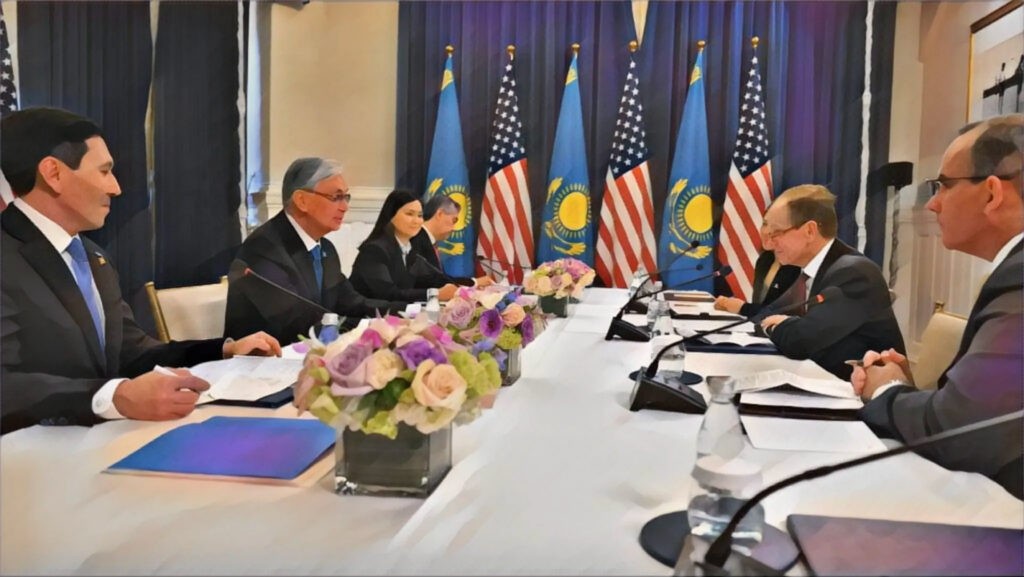
Kazakhstan’s Foreign Minister, Yermek Kosherbayev, conducted a diplomatic tour of the South Caucasus, Armenia, Azerbaijan, and Georgia, as part of Astana’s efforts to strengthen trade and economic ties, expand investment cooperation, and develop key transit routes between Central Asia and Europe.
Armenia: Trade, Investment, and Digitalization
In Yerevan, Kosherbayev held meetings with Prime Minister Nikol Pashinyan, President Vahagn Khachaturyan, and Foreign Minister Ararat Mirzoyan. He conveyed greetings from Kazakh President Kassym-Jomart Tokayev and highlighted the high level of bilateral cooperation.
“Thanks to the efforts of the leaders, bilateral relations between Kazakhstan and Armenia have reached a qualitatively new level,” Kosherbayev said.
He noted that the evolving geopolitical situation creates new opportunities for both economies. Kazakhstan reaffirmed its interest in long-term supplies of agricultural products, including grain and meat, as well as in expanding transport links and launching direct flights.
The two sides discussed the implementation of the Roadmap for Trade and Economic Cooperation for 2026-2030. More than 100 enterprises with Kazakh capital are registered in Armenia, while over 400 Armenian companies operate in Kazakhstan, indicating growing business activity.
Artificial intelligence, digitalization, nuclear energy, pharmaceuticals, higher education, and healthcare were identified as priority areas for cooperation. Particular attention was given to the establishment of a branch of the TUMO educational center in Astana.
Azerbaijan: Energy and Transport Corridors
In Azerbaijan, Kosherbayev met with President Ilham Aliyev and Foreign Minister Jeyhun Bayramov. Discussions focused on strengthening allied relations and expanding cooperation in energy, industry, and logistics.
“Kazakh-Azerbaijani relations are characterized by steady and progressive development and possess significant potential. We express our firm commitment to further strengthening our alliance with brotherly Azerbaijan,” the minister said.
Bilateral trade has increased sharply over the past five years, reaching $470.7 million in 2025. The two sides agreed to work toward raising this figure to $1 billion.
Particular attention was paid to the development of the Trans-Caspian International Transport Route, a key element in diversifying Kazakhstan’s export routes. For Astana, Azerbaijan is the pivotal Caspian link in the westward corridor connecting Kazakhstan to the South Caucasus and on to European markets. The parties also discussed projects to lay a fiber-optic communication line and a subsea power cable across the Caspian Sea to strengthen regional energy and digital connectivity. These projects fit a broader strategy to connect Central Asian energy and data infrastructure more closely with Azerbaijan and, through it, with Europe.
In addition, both sides highlighted opportunities to expand the transit of Kazakh energy resources through Azerbaijani territory, alongside growing cultural, humanitarian, and educational exchanges.
Georgia: Investment and a Logistics Hub
The final stop was Georgia, where the minister met with President Mikheil Kavelashvili and Foreign Minister Maka Bochorishvili.
“Kazakhstan views Georgia as a reliable political and economic partner in the South Caucasus,” Kosherbayev said.
The officials noted positive momentum in economic cooperation. Kazakh investment in Georgia has exceeded $600 million, with companies active in logistics, energy, and finance. Georgia’s importance to Kazakhstan lies not only in bilateral trade and investment, but in its role as the Black Sea gateway for cargo moving along the Middle Corridor.
The development of the Trans-Caspian route remains a central priority. Following the talks, the ministers signed a Cooperation Program for 2026-2027 aimed at further institutionalizing bilateral dialogue.
Regional Significance of the Visit
The visit highlights Kazakhstan’s effort to deepen its role in the South Caucasus, a region of growing importance for trade and for the development of transport routes between Asia and Europe. The expansion of the Middle Corridor is intended to reduce reliance on traditional logistics routes and broaden access to international markets. That goal has taken on greater urgency since regional governments and transport operators began seeking more reliable alternatives to northern routes and other vulnerable chokepoints.
More broadly, the tour reflects Astana’s push to expand investment ties and political dialogue with regional partners, with the aim of supporting closer economic integration across Central Asia and the Caucasus.