
• KGS/USD = 0.01144 0%
  • KZT/USD = 0.00192 -0%
  • TJS/USD = 0.10849 0.37%
  • UZS/USD = 0.00008 0%
  • TMT/USD = 0.28490 0%
  • KGS/USD = 0.01144 0%
  • KZT/USD = 0.00192 -0%
  • TJS/USD = 0.10849 0.37%
  • UZS/USD = 0.00008 0%
  • TMT/USD = 0.28490 0%
  • KGS/USD = 0.01144 0%
  • KZT/USD = 0.00192 -0%
  • TJS/USD = 0.10849 0.37%
  • UZS/USD = 0.00008 0%
  • TMT/USD = 0.28490 0%
  • KGS/USD = 0.01144 0%
  • KZT/USD = 0.00192 -0%
  • TJS/USD = 0.10849 0.37%
  • UZS/USD = 0.00008 0%
  • TMT/USD = 0.28490 0%
  • KGS/USD = 0.01144 0%
  • KZT/USD = 0.00192 -0%
  • TJS/USD = 0.10849 0.37%
  • UZS/USD = 0.00008 0%
  • TMT/USD = 0.28490 0%
  • KGS/USD = 0.01144 0%
  • KZT/USD = 0.00192 -0%
  • TJS/USD = 0.10849 0.37%
  • UZS/USD = 0.00008 0%
  • TMT/USD = 0.28490 0%
  • KGS/USD = 0.01144 0%
  • KZT/USD = 0.00192 -0%
  • TJS/USD = 0.10849 0.37%
  • UZS/USD = 0.00008 0%
  • TMT/USD = 0.28490 0%
  • KGS/USD = 0.01144 0%
  • KZT/USD = 0.00192 -0%
  • TJS/USD = 0.10849 0.37%
  • UZS/USD = 0.00008 0%
  • TMT/USD = 0.28490 0%
11 December 2025

Right Place, Right Time: Central Asia Basks in Russia’s Eastern Energy Pivot

On January 1, with the closure of pipelines through Ukraine, deliveries of Russian gas to Europe came to a virtual standstill. Prices across the continent have ratcheted up in the first six weeks of 2025 and have now hit two-year highs.

In Central Asia, the effects of the Russo-European decoupling have also been profound. In 2024, Kyrgyzstan posted a 48% year-on-year increase in Russian gas imports, while Uzbekistan’s inbound gas purchases soared over 142% to $1.68 billion.

But while Gazprom’s reorientation has been a boon to Central Asia’s economies, this phenomenon appears to be more than short-term supply dumping due to the war in Ukraine. Rather, it is part of a lasting trend that could define the region’s, and the world’s, energy map.

Russia’s Supply Glut

In 2018, Russia exported a record 201 billion cubic meters (bcm) of gas to Europe. The closure of the Yamal and Nord Stream pipelines had already brought these supplies down to 49.5 bcm by 2024 and will be further impacted by the cut in supplies via Ukraine. Despite some gas supplied via Turkstream and a steady trade in liquefied natural gas (LNG), Russian gas supplied to Europe is a fraction of what it once was.

The Central Asian market offers both short and long-term solutions to this.

“Most likely, Gazprom views its expansion into Central Asia as a partial and immediate solution to the challenge of finding new markets for its gas,” said Shaimerden Chikanayev, a partner at GRATA International, a law firm. “While the region cannot fully replace the volumes or profit margins previously achieved in Europe, it offers a readily accessible and stable outlet for Russian gas exports.”

Central Asia is accessible due to old Soviet pipelines that link the region to Moscow. These pipelines, known as Central Asia–Center, were originally built to take gas from Turkmenistan, via Uzbekistan and Kazakhstan to Russia. This system has now been engineered to run in reverse. The pipeline has a capacity of around 50 bcm per year, but there are ongoing efforts to increase it.

Still, this is only a quarter of what was once supplied to Europe, nor are the revenues as lucrative. In 2023, the average rate charged by Gazprom to Uzbekistan for gas was $160 per thousand cubic meters (tcm), this compares to European prices that fluctuated between $200-400tcm throughout the 2010s.

For Stanislav Pritchin, head of the Central Asia sector at the Institute for World Economy and International Relations (IMEMO), Moscow, the price is not a major factor. “Russia of course sells gas to Kazakhstan, Uzbekistan, and Kyrgyzstan lower than the market price. This is a politically motivated decision. And this is not just because it is struggling with [selling to] Eastern Europe. Russia could sell it to Central Asia at market prices, but this is the Russian approach towards its allies in the region,” he said.

Central Asian Serendipity

For Central Asian states, these new supplies have come at a good time. Countries such as Kyrgyzstan are trying hard to increase the use of gas rather than coal for domestic heating. Meanwhile, traditional gas exporters such as Uzbekistan and Kazakhstan are using the opportunity to buy cheap Russian gas while selling their own gas further afield, particularly to China.

“Kazakhstan and Uzbekistan have faced difficulties in fulfilling their gas export obligations to China due to rising domestic demand,” said Eldeniz Gusseinov, co-founder of the political advisory firm Nightingale International Intelligence. Uzbekistan was forced to briefly suspend its gas exports in 2022, with Kazakhstan also slashing its supplies. “Access to Russian gas enables these countries to meet their domestic needs and, theoretically, frees up resources to fulfill their export commitments to China,” Gusseinov added.

Tashkent in particular is in desperate need of these supplies. “Uzbekistan used to be a leading gas producer, but they lack the resources, technology, and investment to develop [their gas industry],” said Pritchin. “They are now in quite a vulnerable situation because they can barely even meet their demands for basic gas and electricity.”

According to Uzbekistan’s official statistics authority, gas production has fallen by around a third from 66 bcm/year in 2010 to 44.6 billion in 2024. Pritchin forecasts that this decline will continue, despite the increased demand for electricity and gas from Uzbekistan’s growing population and economy.
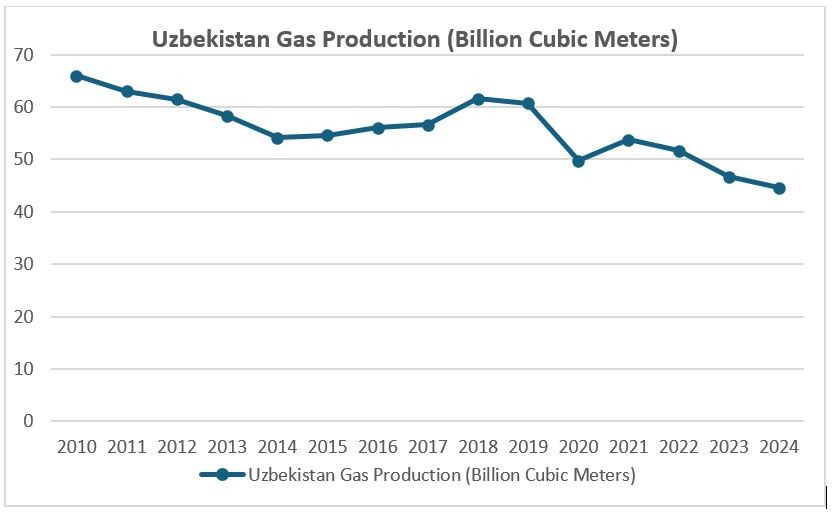
Uzbekistan’s gas production has declined over the past decade. Credit: Joe Luc Barnes. Sources: 2010-2023 Stat.uz; 2024 figure as reported in The Tashkent Times


Chikanayev refers to the paradoxical situation where resource-rich countries such as Uzbekistan and Kazakhstan are struggling with energy resources as the cobbler without boots. “Both [countries] have failed to invest adequately in their gas and power sectors since the collapse of the USSR. This includes neglecting the development of new gas fields and modernizing energy infrastructure,” Chikanayev said.

Uzbekistan has repeatedly stated that it intends to raise gas production to 62bcm as part of its Uzbekistan 2030 strategy, but the trend does not look positive.

No European Comeback

The increase in Russian gas imports is not without its critics. One fear is that Russia may simply abandon Central Asia and seek to prize open its old European markets should a peace deal be agreed in Ukraine.

Pritchin does not think so. “Even at the end of the special military operation, I don’t think the situation will dramatically change,” he said, adding that reopening pipelines between Russia and the EU is a decision for the Europeans, and even if there is re-engagement from Europe, the expansion of the Central Asian pipelines provides diversification.

Gusseinov agrees – “Diversify or die has become the prevailing mantra nowadays. Russia will want to remain at the center of Eurasian processes; [gas] allows the state to wield considerable geopolitical influence in the region with relatively modest resources.”

As evidence of Russia’s long-term plans for the region, he also points to a fifteen-year agreement signed at the St. Petersburg International Economic Forum 2024 between Sanjar Zhareshov, chairman of QazaqGaz, and Gazprom’s Alexey Miller, undertaking to supply Uzbekistan and Kyrgyzstan with Russian gas until at least 2040.

Transit to China (and India?)

Kazakhstan is seen as essential to Russia’s strategic pivot. According to Chikanayev, “Kazakhstan has effectively replaced Ukraine as the key transit region for Russian gas.” He said that this does not necessarily mean that Kazakhstan will be reliant on the Kremlin, instead seeing it as mutual dependence, particularly if new pipelines are built to bring gas to China and India.

Currently, the Power of Siberia gas pipeline provides China with 38 bcm/year, but there are plans to increase this capacity. In a recent interview with Rossiya 24 TV Channel, Russian Deputy Prime Minister Alexander Novak announced that talks were underway between Russia, Kazakhstan, and China on the joint construction of a new pipeline with a capacity of 45 bcm/year – 10 bcm of this would be made available to supply the northern and eastern parts of Kazakhstan, with the rest going to China.

The other huge benefit of these cheap Russian supplies is that it allows Central Asian countries to export their own gas at higher prices. Both Kazakhstan and Uzbekistan recently announced a surge in gas exports to China, despite imports also increasing. “This development supports the assumption that Uzbekistan and Kazakhstan are purchasing cheaper gas from Russia and reselling their own freed-up gas volumes to China at higher prices,” said Chikanayev.

Another prize is potentially even greater. For over a decade, Russia and India have discussed a pipeline to connect the two countries. However, the length of the route, mountainous terrain, and instability in Afghanistan have all conspired to keep such an option off the table.

“However, in the context of the new geopolitical realities – such as Russia’s pivot away from Europe and its growing focus on Asia – there may now be additional arguments in favor of revisiting this direction,” said Chikanayev.

The arrangement makes sense – on the one hand, the world’s most populous nation with limited natural resources, on the other, an enormous gas supplier. Should Central Asia be able to connect the two, it could be very lucrative.


Turkey’s Turkic Gambit: Balancing Influence in Post-Soviet States

Despite its superpower ambitions, which have diminished somewhat since February 24, 2022, Moscow views Turkey’s growing geopolitical influence with increasing concern. The Organization of Turkic States (OTS), which includes several Central Asian republics, is perceived by the Kremlin as a rival to its regional blocs, such as the Eurasian Economic Union (EAEU) and the Collective Security Treaty Organization (CSTO).

However, for Central Asian nations, the OTS is not a political or military alliance but rather a framework for economic, cultural, and humanitarian cooperation. The extent of Turkey’s influence remains limited within these parameters.


A Historical Perspective

Russia continues to interpret geopolitical dynamics through the lens of century-old concepts, particularly Pan-Slavism and Pan-Turkism, both of which emerged as nationalist movements against the Russian and Ottoman empires.

Pan-Turkism gained traction in the Ottoman Empire but lost momentum following its adoption and subsequent rejection by Mustafa Kemal Atatürk. The ideology was later revived during the Cold War, when Turkey’s NATO membership positioned it as a force for destabilizing Soviet Central Asia, Azerbaijan, and Turkic regions within Russia, such as Tatarstan and Bashkortostan.

Despite Turkish efforts, Pan-Turkic sentiment found limited success, influencing only Azerbaijan, which aligned closely with Turkey after losing the First Nagorno-Karabakh War. Azerbaijan formalized this relationship in the early 1990s with the doctrine of “Two Countries, One Nation.”

Baku only began to see concrete benefits from its alliance with Ankara after winning the Second Karabakh War in 2020.

The Organization of Turkic States: Reality vs. Rhetoric

Although the first summit of Turkic states was held in 1992, the OTS’s precursor, the Turkic Council, was only founded in 2009. The agreement, signed in Nakhchivan, Azerbaijan, initially included Turkey, Azerbaijan, Kazakhstan, and Kyrgyzstan. Uzbekistan expressed interest in joining in 2018, and officially became a member in 2019, whilst Hungary (2018), Turkmenistan (2021), the Turkish Republic of Northern Cyprus (2022), and the Economic Cooperation Organization (ECO) (2023) hold observer state status. Turkmenistan has frequently been rumored to be considering full membership.

Turkey’s geopolitical aspirations in Central Asia have often clashed with the ambitions of Kazakhstan and Uzbekistan. Uzbekistan delayed its membership in the Turkic Council until 2019 due to strained relations with Ankara which dated back to the mid-1990s. Turkey, the first country to recognize the independence of the Central Asian republics, expected to leverage its Cold War victory over the Soviet Union to expand its influence in the region.

While Kazakhstan initially welcomed Turkish economic expansion and Pan-Turkic rhetoric, it became increasingly skeptical in the 2000s. Uzbekistan, however, was cautious from the outset and largely resisted Turkish influence.

Kazakhstan’s shift in perspective coincided with Ankara’s increased push for deeper Turkic integration. Turkish-backed initiatives in Kazakhstan revealed clear expectations that Ankara would lead such a union, prompting Astana to resist.

Kazakhstan, which balances ties with the West, China, and Russia, rejected the notion of falling under Turkish leadership. The Kazakh government neutralized Pan-Turkic voices by integrating key advocates into political positions, redirecting their efforts toward promoting Kazakh nationalism instead.

Turkey’s Role in the OTS

According to Kazakh political analyst Marat Shibutov, Russia tends to overstate Turkey’s sway in Central Asia. “Russia significantly overestimates Turkey’s influence in Kazakhstan and Central Asia, not realizing that historical connections are minimal. A thousand years have passed since the Seljuks left, and the region only reconnected with Turkey after the exile of the Meskhetian Turks under Stalin,” Shibutov wrote.

In reality, the OTS serves primarily as a logistical and economic tool for Astana and Tashkent. In other sectors, China is a more attractive partner for technology, while Russia remains key for investment and industrial cooperation.

The Turkic Council officially became the Organization of Turkic States (OTS) in 2021, amid the COVID-19 pandemic and increasing logistical disruptions. The Ukraine War and Russia’s growing isolation have further accelerated economic cooperation among Turkic nations. At the 10th OTS Summit in Astana (November 2023), discussions largely focused on financial and logistical matters, particularly the expansion of the Middle Corridor, the Trans-Caspian transport route. Notably, Kazakhstan, not Turkey, was designated the Financial Center of the Turkic World.

Turkey’s military influence within the Turkic world, meanwhile, has largely stemmed from two factors: Azerbaijan’s military successes in Karabakh, achieved with Turkish support, and Ukraine’s early use of Turkish Bayraktar drones in the Russo-Ukrainian War. However, Turkey’s military reputation has waned as the effectiveness of Bayraktar drones declined over time.

A Geopolitical Challenger?

While Russia perceives Turkey as a geopolitical challenger in Central Asia, the reality is far more nuanced. Even within the OTS, Turkey’s role is limited, as Kazakhstan and Uzbekistan remain wary of external forces seeking to dominate. The economic and logistical priorities of the OTS nations, meanwhile, favor China and Russia over Ankara.

Ultimately, the OTS remains an instrument for regional cooperation rather than a geopolitical bloc, and Turkey’s leadership ambitions face significant resistance from within.

Kazakhstan Launches Flood Forecasting and Modeling System

Kazakhstan has launched Tasqyn, a new information system designed to forecast and model floods, Minister of Water Resources and Irrigation Nurzhan Nurzhigitov announced during a February 18 meeting on preparations for spring floods.

Currently, flood modeling is being conducted at 142 hydro posts along 128 river sections across the country. A team of 114 specialists monitors data from these hydro posts daily, entering it into the new system.

The Tasqyn system is integrated with the Global Flood Awareness System (GloFAS), a worldwide flood warning network. It is expected to provide a final forecast for Kazakhstan’s 2025 spring flood season in early March.

According to Nurzhigitov, in addition to domestic flood preparedness efforts, Kazakhstan’s Ministry of Water Resources and Irrigation maintains regular communication with neighboring countries to exchange hydrological data. The country has also begun controlled water releases from reservoirs to create additional capacity for melting snow runoff.

Currently, Kazakhstan’s reservoirs can accommodate 13 billion cubic meters of floodwater, the minister stated.

The new forecasting system is a crucial step toward preventing a repeat of the spring 2024 floods, which devastated Kazakhstan’s western and northern regions due to rapid snowmelt. The disaster destroyed thousands of homes and forced nearly 100,000 people to evacuate.

As previously reported by The Times of Central Asia, Kazakhstan’s reservoirs and lakes accumulated over 75 billion cubic meters of water in 2024, including more than 12 billion cubic meters of floodwater. 

Ukraine’s Drone Strike on Russian Oil Hub Sparks Concerns Over Kazakhstan’s Energy Security

On February 17, seven Ukrainian unmanned aerial vehicles (UAVs) attacked an oil transportation facility of the Caspian Pipeline Consortium (CPC), targeting the Kropotkinskaya oil pumping station in Russia. Following the attack, reports emerged that the volume of oil pumped from Kazakhstan through the CPC could decrease by 30% for a period of one and a half to two months.

Conflicting Reports on the Impact

On February 18, Ukraine officially confirmed the strike.

“Yesterday, the Ukrainian defense forces carried out a pinpoint strike on strategic facilities of the military and fuel and energy infrastructure of the Russian Federation… The Kropotkinskaya and Andriapol oil pumping stations, which played a key role in transporting fuel for the occupiers, were hit. After the strike, they were put out of action, significantly complicating the logistics of fuel supplies to the aggressor,” the General Staff of the Armed Forces of Ukraine stated.

Shortly after, Transneft, the Russian shareholder in the CPC, warned that oil pumping volumes from Kazakhstan could drop by approximately 30% due to the damage. 

Meanwhile, Russian Deputy Prime Minister Alexander Novak provided an even bleaker assessment. During a meeting with President Vladimir Putin, he stated:

“We see a decrease in pumping volumes by about 30 – 40% compared to levels before the drone attack.”

Novak estimated that restoring the CPC infrastructure would take “several months, at least,” citing the need to replace damaged Western-made equipment, including Siemens gas turbines. 

However, later that day, Kazakhstan’s Ministry of Energy issued a statement disputing these claims.

“Currently, there are no restrictions on Kazakh oil shipments via the CPC, and acceptance is proceeding as scheduled,” the ministry said. 

Despite this, Russian Foreign Minister Sergey Lavrov framed the attack as a direct assault on Kazakhstan’s energy infrastructure. 

Expert Perspectives: Overreaction or Serious Threat?

While officials issued conflicting statements, financial analyst Rasul Rysmambetov urged against panic. Writing on his Telegram channel ArtFinanze, he dismissed talk of a 30% reduction in pumping volumes as an “overreaction.” However, he acknowledged that the attack exposed the risks of Kazakhstan’s reliance on foreign transit routes.

“Geopolitical and other risks when exporting through third countries can easily double. It’s too early to panic; there are few catastrophic scenarios at this stage. But if attacks on infrastructure continue, it will become increasingly difficult to protect the underwater pipeline system, especially considering the Russian Black Sea Fleet’s recent losses. Kazakhstan’s oil facilities have been largely spared so far, but there’s no guarantee this will continue. Contrary to popular belief, the fact that companies like Chevron are involved won’t deter anyone; on the contrary, such infrastructure can be used to exert pressure on entire countries,” he warned. 

Kazakhstan’s Dilemma: Dependence on Russian Routes

While experts downplay immediate consequences, Kazakhstan’s vulnerability is undeniable. Calls to boost domestic petrochemical production to reduce dependence on foreign pipelines remain largely aspirational. Meanwhile, efforts to diversify oil export routes have yielded little progress.

Currently, 93% of Kazakhstan’s oil exports pass through Russian territory, leaving the country with limited alternatives:

  • Caspian Pipeline Consortium (CPC): Handles 80% of exports but is now a target of Ukrainian attacks.
  • Atyrau-Samara Pipeline: Accounts for 13% of exports, connecting to Russia’s Transneft system for access to European markets. 
  • Alternative Routes: The Kazakhstan-China pipeline, railway shipments, and the Baku-Tbilisi-Ceyhan (BTC) pipeline combined handle less than 7% of total exports.

There are plans to increase BTC capacity from 1.5 million to 3 million tons per year, but this pales in comparison to the 60+ million tons transported annually via the CPC. Despite discussions about diversification since 2022, little has changed in Kazakhstan’s oil export architecture.

Diplomatic Response: A Last Resort?

With no viable alternatives in the short term, Kazakhstan appears to be turning to diplomacy. On February 19, Foreign Ministry spokesperson Aibek Smadiyarov stated that Kazakhstan would raise the issue with Ukraine.

“This is a very important issue for Kazakhstan’s economy, and we will naturally discuss this situation with our Ukrainian partners through diplomatic channels,” Smadiyarov said. 

Whether Kyiv will heed Kazakhstan’s concerns or prioritize its military strategy remains to be seen.

Kazakhstan Introduces New Visa Categories to Attract Foreign Professionals

On February 18, 2025, Kazakhstan’s Ministry of Foreign Affairs hosted a briefing for representatives of the diplomatic community to highlight the country’s newly introduced visa categories: the Neo Nomad Visa, Digital Nomad Visa, and Residence Visa. 

Kazakhstan updated its visa regulations in November 2024 to attract business immigrants, skilled professionals, and tourists. Among the key offerings is the Digital Nomad Visa, which provides long-term residence options for freelancers, self-employed entrepreneurs, IT specialists, and startup founders. Meanwhile, the Neo Nomad Visa is designed for foreign citizens who work remotely while traveling. Applicants for this visa must demonstrate a verified monthly income of at least $3,000 and provide health insurance and a clean criminal record.

The Residence Visa is aimed at attracting foreign professionals with expertise in medicine, science, innovation, education, and the creative industries. It allows recipients to stay in Kazakhstan for up to 90 days.

Kazakhstan’s Deputy Foreign Minister Roman Vassilenko emphasized that these new visa categories significantly expand opportunities for foreign nationals wishing to live and work in the country.

“Our country provides the necessary conditions to attract international professionals by offering visa-free entry to citizens from more than 80 countries and a simplified electronic visa for 109 countries. By expanding air connectivity, Kazakhstan now operates over 700 international flights per week to more than 30 countries. Additionally, we are actively developing digital infrastructure, creating smart cities, and ensuring access to high-speed internet,” he said.

Vassilenko added that implementing a flexible visa policy benefits not only Kazakhstan but also its partners through tax revenues and remittances from remote professionals, as well as the skills and experience they acquire in the country.

Kazakhstan’s Deputy Minister of Tourism and Sports, Yerzhan Yerkinbayev, highlighted the timeliness and relevance of these visa initiatives, adding:

“Kazakhstan continues to strengthen its position as an open and accessible destination for international visitors. This commitment to openness has been a key factor in the growth of tourism. In 2024, 15.3 million people visited Kazakhstan, marking a 66% increase from the previous year.”

Kyrgyzstan Advances Hydropower Modernization Efforts

Kyrgyzstan is moving forward with the modernization of two major hydroelectric power plants as part of its efforts to increase electricity generation and meet the country’s growing energy demands.

According to the Ministry of Energy, on February 20, French company GE Hydro will begin reconstruction of hydroelectric generating unit No. 4 at the Toktogul Hydropower Plant (HPP) – the country’s largest power facility, located on the Naryn River. The plant currently generates approximately 40% of Kyrgyzstan’s electricity. Once completed, the upgrade will add 60 megawatts (MW) to the plant’s capacity.

In November 2024, Toktogul HPP successfully launched a modernized unit No. 1, increasing its output by 60 MW. That unit’s reconstruction, which began in March 2024, followed earlier upgrades to units No. 2 and No. 3, which collectively added 120 MW to the facility’s capacity. Before modernization, Toktogul HPP had a total capacity of 1,200 MW, with each of its four units generating 300 MW.

Upon completion of upgrades to all four units, Toktogul HPP’s total capacity will rise to 1,440 MW, and its operational lifespan will be extended by 25 to 30 years.

Meanwhile, on March 1, 2025, China National Electric Engineering Company (CNEEC) will begin the modernization of unit No. 2 at the Uch-Kurgan HPP, increasing its capacity by 9 MW.

Situated on the Naryn River, the Uch-Kurgan HPP plays a key role in Kyrgyzstan’s energy supply. Before its modernization, the plant had a total capacity of 180 MW, with four units generating 45 MW each. Since its commissioning in 1962, the plant had never undergone major upgrades until 2024, when unit No. 4 was reconstructed, boosting its output by 16 MW.

The modernization of Toktogul unit No. 4 and Uch-Kurgan unit No. 2 is expected to be completed by December 2025.

To ensure an uninterrupted power supply during the temporary shutdown of these units, the Ministry of Energy has held negotiations with neighboring countries regarding electricity imports. The government has also urged the population to use electricity sparingly while modernization work is underway.

In addition to these upgrades, Kyrgyzstan is constructing the Kambarata-1 Hydropower Plant, which will have a projected capacity of 1,860 MW and an average annual generation of 5.6 billion kilowatt-hours. Once completed, Kambarata-1 will be the country’s largest hydropower facility and is expected to help eliminate Kyrgyzstan’s electricity shortages.

