• KGS/USD = 0.01144 0%
  • KZT/USD = 0.00211 0%
  • TJS/USD = 0.10460 0.19%
  • UZS/USD = 0.00008 0%
  • TMT/USD = 0.28490 0%
  • KGS/USD = 0.01144 0%
  • KZT/USD = 0.00211 0%
  • TJS/USD = 0.10460 0.19%
  • UZS/USD = 0.00008 0%
  • TMT/USD = 0.28490 0%
  • KGS/USD = 0.01144 0%
  • KZT/USD = 0.00211 0%
  • TJS/USD = 0.10460 0.19%
  • UZS/USD = 0.00008 0%
  • TMT/USD = 0.28490 0%
  • KGS/USD = 0.01144 0%
  • KZT/USD = 0.00211 0%
  • TJS/USD = 0.10460 0.19%
  • UZS/USD = 0.00008 0%
  • TMT/USD = 0.28490 0%
  • KGS/USD = 0.01144 0%
  • KZT/USD = 0.00211 0%
  • TJS/USD = 0.10460 0.19%
  • UZS/USD = 0.00008 0%
  • TMT/USD = 0.28490 0%
  • KGS/USD = 0.01144 0%
  • KZT/USD = 0.00211 0%
  • TJS/USD = 0.10460 0.19%
  • UZS/USD = 0.00008 0%
  • TMT/USD = 0.28490 0%
  • KGS/USD = 0.01144 0%
  • KZT/USD = 0.00211 0%
  • TJS/USD = 0.10460 0.19%
  • UZS/USD = 0.00008 0%
  • TMT/USD = 0.28490 0%
  • KGS/USD = 0.01144 0%
  • KZT/USD = 0.00211 0%
  • TJS/USD = 0.10460 0.19%
  • UZS/USD = 0.00008 0%
  • TMT/USD = 0.28490 0%

Weaponizing the Past: Russian Commentators Invoke Famine in Attacks on Kazakhstan

The concept of a “besieged fortress,” adopted by the Kremlin in the second half of the 2010s, increasingly conflicts with Russia’s earlier foreign policy doctrine, under which post-Soviet states were expected to remain within Moscow’s sphere of influence. That doctrine relied on alliances across the post-Soviet space, with Central Asia often described as an area of privileged interest. By contrast, the “besieged fortress” narrative assumes encirclement by enemies and frames external communication less in diplomatic than in military terms.

Russia’s full-scale invasion of Ukraine, officially termed a “special military operation” by Moscow, has now lasted longer than the Soviet Union’s involvement in World War II, undermining earlier assumptions that some post-Soviet economies would remain dependent on Russian loans and access to the Russian market.

In the integration sphere, Kazakh political analyst Marat Shibutov has argued that Russia is effectively “reducing its participation in the EAEU by reinstating permanent customs controls on the borders with Kazakhstan and Belarus.” Such assessments reflect growing debate within the region over the future of integration mechanisms.

At the same time, segments of the Russian media space have adopted increasingly confrontational rhetoric toward Kazakhstan. In recent weeks, television host Vladimir Solovyov suggested the possibility of extending a “special military operation” to Central Asia, remarks that triggered strong reactions in Kazakhstan.

Political commentator Dmitry Verkhoturov followed with statements directed specifically at Astana, invoking the sensitive historical subject of Asharshylyk, the term used in Kazakhstan for the famine of the early 1930s that followed forced collectivization under Joseph Stalin. In Ukraine, the same period is referred to as the Holodomor and is recognized there as a genocide. Kazakhstan’s official terminology does not classify the famine in those terms.

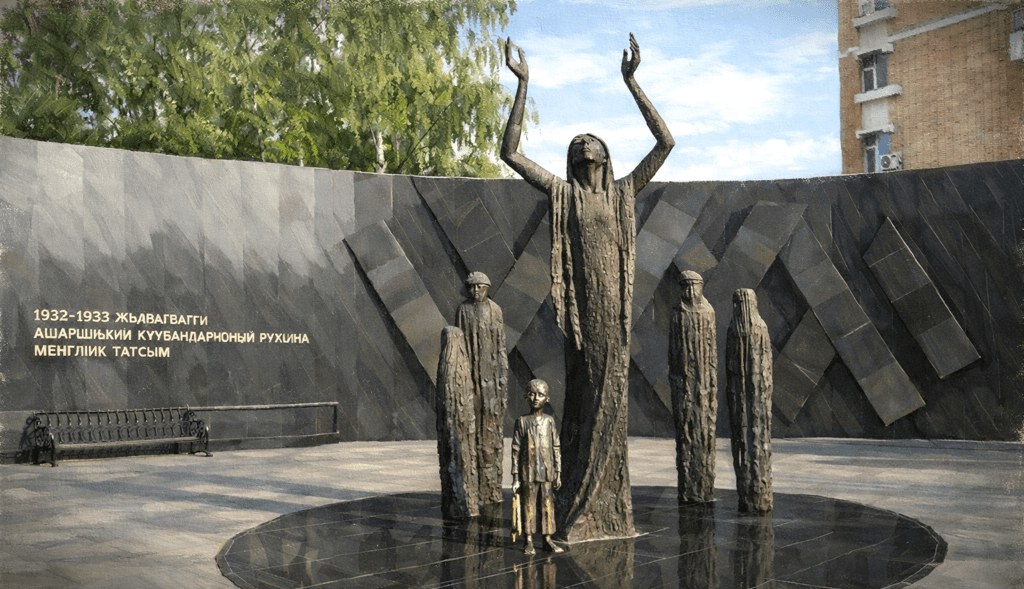
Last year, the inscription on a memorial in Astana dedicated to the victims of collectivization was revised. The earlier wording referred to “victims of the Holodomor,” while the updated plaque reads “victims of the famine of 1932-1933.” The change was widely interpreted as aligning the memorial with Kazakhstan’s established historical framing.

Despite this, Verkhoturov warned that further public discussion of Asharshylyk could be dangerous for Kazakhstan “from the point of view of statehood,” suggesting that such debates might escalate into armed confrontation. He also stated that Kazakhstan was “too weak and small” to oppose Russia, remarks that were widely perceived in Kazakhstan as dismissive and offensive.

Particular outrage was sparked by comments contrasting Ukrainians and Kazakhs, “for us, Ukrainians are very close relatives, they are practically our own people. And yet, yes, they have brought us to a situation where we have started to fight them, while Kazakhs are not quite our own people for Russians. Yes, you can be friends with them and all that, but they are still distant people, and, as they say, they will be beaten more willingly and, it seems, more harshly than the Ukrainians,” the Russian political scientist said.

Kazakh political analyst Gaziz Abishev characterized the comparison as “hard-to-hide racism.” He argued that the tragedy of the famine is not exclusively a Kazakh or Ukrainian issue, noting that millions of Russians also suffered during the period of mass famine and political repression. In his view, acknowledging the shared historical trauma should not threaten statehood but could instead provide grounds for collective remembrance.

Abishev also rejected claims of “Ukrainization” or alleged “Russophobia” in Kazakhstan, pointing out that Kazakhstan remains a member of both the CSTO and the Eurasian Economic Union, maintains a unified air defense system with Russia, hosts military facilities and the Baikonur Cosmodrome, and continues institutional cooperation across multiple sectors.

While Abishev described Verkhoturov’s remarks as “irresponsible propaganda” rather than representative of official Russian policy, he suggested that the response of Russian authorities would indicate whether such rhetoric is supported, tolerated, or rejected.

“The Kazakh state does not necessarily have to respond publicly,” Abishev said, suggesting that the statements resemble provocation. “But they cannot be ignored either.”

Verkhoturov’s comments are not isolated. In recent months, some Russian commentators have increasingly accused Kazakhstan of “Russophobia”, a narrative that analysts note was also used in the run-up to Russia’s invasion of Ukraine.
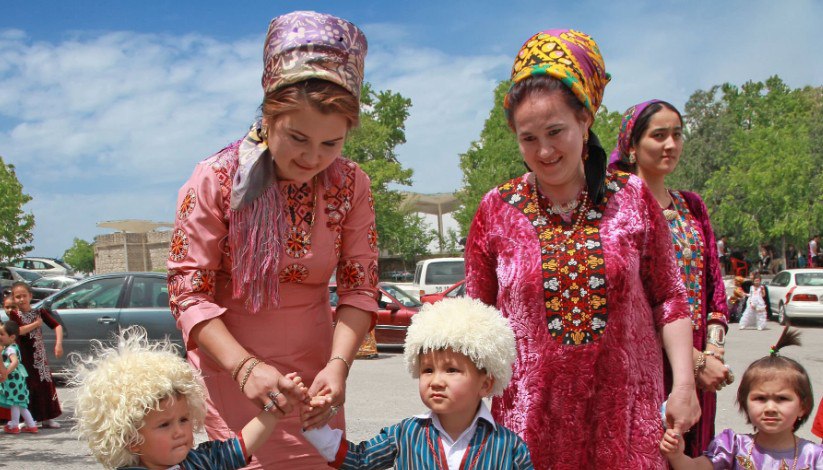

How Much is Berdymuhamedov’s 8 March “Gift” to Turkmen Women Actually Worth?

Turkmenistan’s President Serdar Berdymuhamedov has ordered that female residents of the country receive 60 manats each in honor of March 8, International Women’s Day. At the current market exchange rate of 19.5 manats to the U.S. dollar, this amounts to approximately $3.

Officially, the decision is described as recognition of “the great contribution of women in bringing about changes for the prosperity of the country, in raising a healthy and enthusiastic generation devoted to the Motherland, in order to continue the noble traditions of our ancestors in honoring our beloved mothers and dear sisters in the era of the rebirth of a new era of a powerful state.”

Payments are scheduled to be distributed between March 2 and March 6. Eligible recipients include women employed in enterprises and organizations regardless of ownership, pensioners and recipients of state benefits, graduate and doctoral students, clinical residents on leave from work, students of the Academy of Public Administration with a term of study of at least two years, as well as schoolgirls, university students, and kindergarten pupils.

Turkmen women have received the equivalent of about $3 for the holiday for seven consecutive years. However, since 2019, the cost of food and consumer goods in the country has risen significantly.

The official exchange rate of the Turkmen manat has remained fixed at 3.5 manats per dollar since 2015. By that rate, 60 manats would equal approximately $17. However, the widely used parallel market rate currently stands at about 19.5 manats per dollar, reducing the real value of the payment to roughly $3.

As a result, the actual purchasing power of the “gift” is significantly lower than the figure implied by calculations based on the official exchange rate.

In September 2025, one elder publicly called for an end to increasing such payments, stating that “the social and living conditions of the country’s population have reached a high level.”

Vučić in Astana: Trade, Defense, and Technology Drive Kazakhstan–Serbia Talks

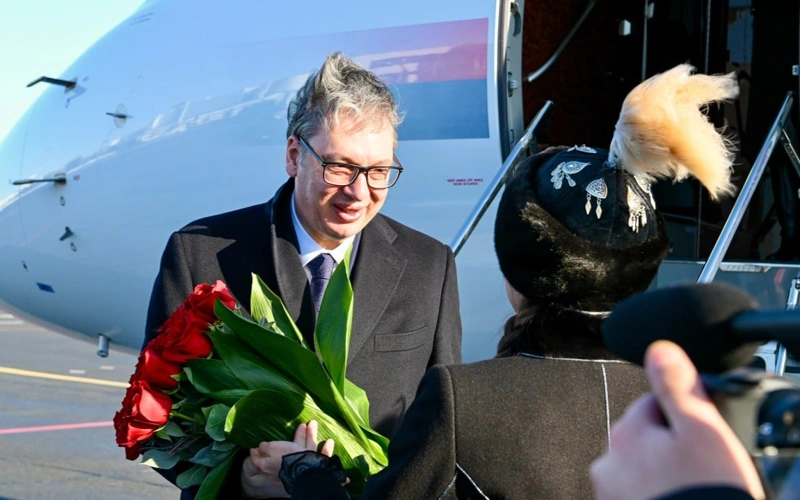
Serbian President Aleksandar Vučić arrived in Astana on February 26 for a two-day official visit. Prime Minister Olzhas Bektenov and Astana Mayor Jenis Qasymbek received him at the airport. Vučić is scheduled to hold talks with President Kassym-Jomart Tokayev on February 26–27. The agenda includes political dialogue, trade, digital transformation, healthcare, science, culture, and judicial cooperation. The two presidents are expected to adopt a joint statement and oversee the signing of ten memorandums. Kazakhstan also plans to award Vučić the Order of the Golden Eagle, the country’s highest state honor.

The Serbian delegation includes Minister of Internal and External Trade Jagoda Lazarević, Minister without Portfolio Nenad Popović, and Mihailo Jovanović, director of Serbia’s Office for eGovernment and IT. Economic ties form a central pillar of the visit. Kazakhstan’s government stated that bilateral trade grew by 7.6% in 2025.

At the first meeting of the Kazakhstan–Serbia Business Council and Business Forum in Astana, Nenad Popović said trade turnover reached about $117 million in 2025, an increase of roughly 7%.

“The free-trade agreement between our countries ensures a strong institutional basis. It is now important to further strengthen this foundation with concrete projects and targeted mechanisms to support entrepreneurship in Kazakhstan and Serbia, as well as their business communities,” he stated.

Defense cooperation has also emerged as a significant outcome of the business meetings. Kazakhstan’s LLP SP Kaztechnology and Serbia’s Yugoimport SDPR agreed to cooperate on the repair and modernization of 122mm and 152mm self-propelled artillery systems from the Nora and Soko/Soho families. LLP Great Sky and Yugoimport SDPR also signed a framework agreement on technology transfer and the organization of high-energy materials production.

The visit extends beyond defense. Astana Hub signed memorandums with Serbia’s Digital Transformation Center, SEE UP Accelerator, and Science Technology Park Belgrade. Kazakhstan’s National Biotechnology Center also signed a memorandum with Serbia’s Bio4 Campus.

Diplomatic relations between Kazakhstan and Serbia were established in December 1996. As previously reported by The Times of Central Asia, momentum in bilateral ties increased in late 2024 when Tokayev visited Serbia, and the sides signed multiple cooperation agreements in trade, investment, and industry.

The Astana meetings signal a practical expansion of relations between Central Asia and the Balkans. Trade remains modest in absolute terms, but the new agreements in defense, digital technology, and biotechnology point to the growth of a broader industrial partnership.

Kyrgyz Citizens to Be Allowed to Pass On E-Wallet Funds to Heirs

Kyrgyzstan’s parliament, the Jogorku Kenesh, has approved a government initiative to regulate the inheritance of electronic money, with the National Bank also backing the proposal.

According to the regulator, the popularity of electronic wallets in the country continues to grow. Their number has exceeded 6.5 million, marking an annual increase of about 20%. In the first six months of last year alone, the volume of electronic wallet transactions reached $3.2 million, while the total number of transactions amounted to 132 million.

At the same time, there have been no unified rules governing the inheritance of electronic funds, leading to disputes, including legal conflicts. The National Bank noted that many e-wallets remain unidentified and that legislation has lagged behind the rapid development of digital financial instruments.

Following the completion of public consultations, amendments are expected to be introduced to the Civil Code of Kyrgyzstan recognizing electronic money as part of a citizen’s property. This would allow funds held in electronic wallets to be inherited on an equal basis with bank accounts.

Previously, commercial banks were required to resolve such matters independently, which often resulted in legal disputes. In some cases, after the death of an e-wallet owner, funds were transferred to only one heir, typically the first to contact the bank. The new law is intended to establish a clear and uniform inheritance procedure.

Under the draft amendments, once notified of a customer’s death, a bank will be required to block transactions on the e-wallet account at the request of a notary. After heirs’ rights are verified, the funds will be distributed in accordance with the procedure established by law.

Financial institutions will also be required to provide notaries with information not only about the deceased’s bank deposits but also about their electronic wallets and other financial assets.

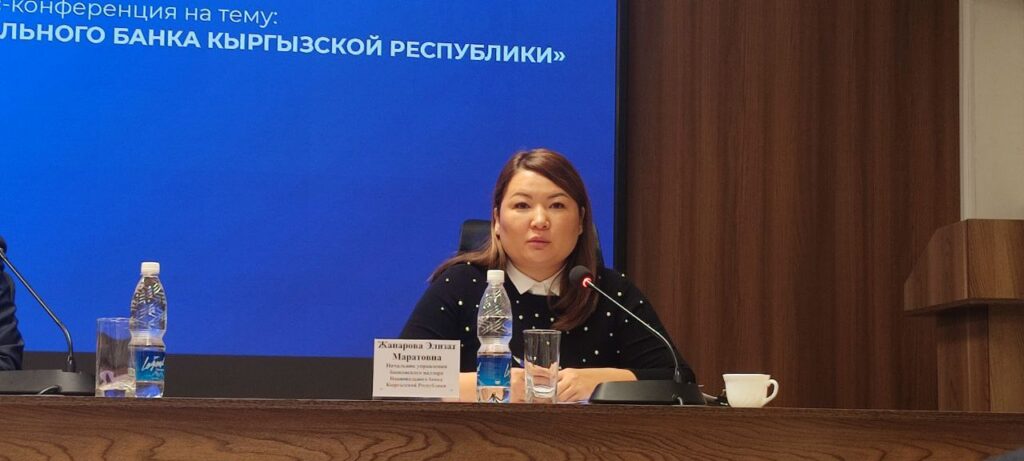
In comments to The Times of Central Asia, representatives of the National Bank said that the sums citizens hold in electronic wallets have become significant, prompting the regulator to support the initiative put forward by the Ministry of Justice.

Elizat Zhaparova, head of the banking supervision department, noted that amendments to the law on the protection of bank deposits were adopted last year, and the National Deposit Protection Agency now guarantees the safety of bank deposits. She added that extending similar inheritance provisions to electronic wallets is a logical step.

The reform marks a move toward aligning Kyrgyzstan’s digital financial sector with civil law, closing a regulatory gap and reducing the risk of disputes among heirs.

U.S. Sanctions Uzbek Citizen Over Alleged Cybercrime Links

The U.S. Department of the Treasury’s Office of Foreign Assets Control (OFAC) has imposed sanctions on an Uzbek citizen over alleged involvement in cybercrime activities linked to Russian actors, according to an official press release published on the agency’s website.

OFAC reported that Azizjon Mamashoyev, a citizen of Uzbekistan born in 1987, was added to the sanctions list under regulations related to Russia-linked activities. U.S. authorities allege that he participated in cyber operations and maintained connections with individuals suspected of conducting malicious cyber activities.

The announcement included identifying details, listing Mamashoyev’s date of birth as February 20, 1987, and confirming his Uzbek nationality. The designation was issued under the Ukraine-/Russia-Related Sanctions Regulations and forms part of measures targeting cyber-enabled threats.

According to OFAC, Mamashoyev is linked to Sergey Zelenyuk, who has also been associated with cybercrime investigations. The sanctions were introduced pursuant to authorities under the Countering America’s Adversaries Through Sanctions Act (CAATSA) and a cyber-related sanctions program identified as CYBER4.

The U.S. Treasury also designated Advance Security Solutions, a company reportedly connected to Mamashoyev. The firm, described as operating in computer programming, is registered in Dubai’s Jumeirah Living Marina Gate area and also lists operations in Tashkent. U.S. officials stated that the company was established in 2025 and may have engaged in activities posing secondary sanctions risks.

Under OFAC sanctions, designated individuals and entities are generally subject to asset freezes within U.S. jurisdiction, and U.S. persons are typically prohibited from engaging in transactions with them.

Kyrgyzstan Advances Construction of Ala-Too All-Season Ski Cluster

On February 25, Kyrgyzstan’s Ala-Too Resort OJSC and the Austrian company Doppelmayr, a global leader in cable car construction, signed a contract for the installation of four additional cable-car lines at the Jyrgalan resort. The site represents the first phase of the Ala-Too Resort project, a flagship state investment initiative to develop an all-season mountain ski cluster in the Issyk-Kul region, east of Lake Issyk-Kul.

Construction of the Ala-Too Resort cluster, which will combine three resorts, Jyrgalan, Ak-Bulak, and Boz-Uchuk, began in August 2025.

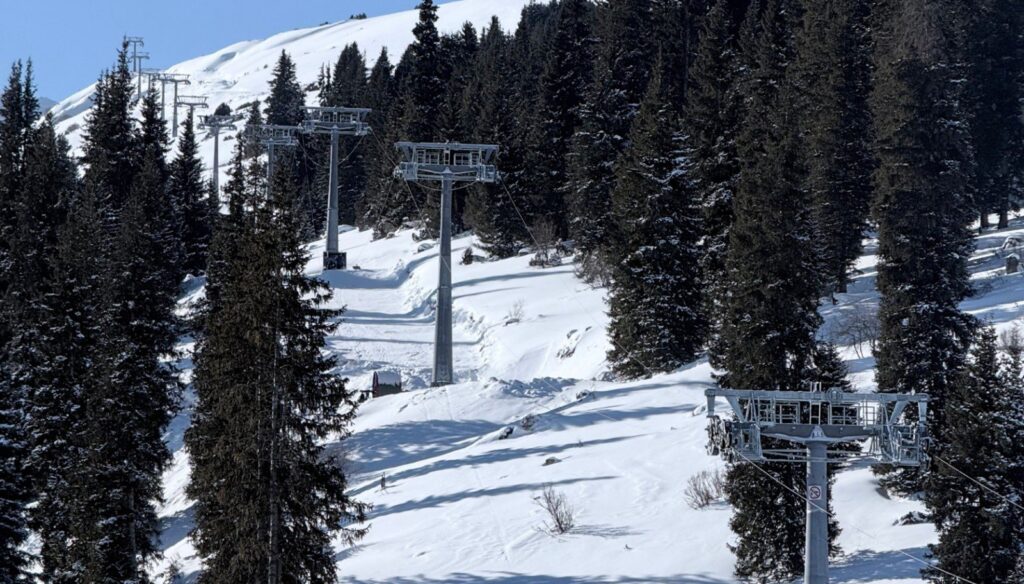
The new agreement follows a contract signed last year under which Doppelmayr is currently building two cable-car lines at Jyrgalan. Their commissioning is scheduled for May 2026.

The four additional cable-car lines are expected to be completed by the end of this year, with the official opening of Jyrgalan planned for December. Once operational, the total length of cable-car lines at the resort will exceed 8 kilometers, while ski trails will extend to 46 kilometers.

Doppelmayr has also completed a 1-kilometer cable-car line in the Ala-Archa State Nature Park, located about 30 kilometers from the capital, Bishkek. Officially opened on February 18, it became Kyrgyzstan’s first gondola lift.

According to the Ministry of Economy and Commerce, the Ala-Too Resort project will be implemented in stages through 2038, with total investments estimated at approximately €1.2 billion. The cluster aims to attract up to 4 million tourists annually.

The total area of the mountain cluster will cover 3,916 hectares, with ski slopes extending to 260 kilometers. Project developers state that this would place Ala-Too Resort among the world’s top ten resorts by total trail length and make it the largest ski destination in Central Asia.

The development plan includes the construction of private villas and three- to five-star hotels, as well as a panoramic restaurant, conference facilities, a medical center, a stadium, an amphitheatre, and recreational parks.

Infrastructure works are currently underway, including the construction of power transmission lines, drinking water systems, and wastewater treatment facilities. Reconstruction of the road linking Jyrgalan with Karakol, the administrative center of the Issyk-Kul region, has also begun.

The Ala-Too Resort project is expected to provide a significant boost to Kyrgyzstan’s tourism sector, positioning the country as a major destination for mountain skiing in Central Asia.