• KGS/USD = 0.01144 0%
  • KZT/USD = 0.00194 -0%
  • TJS/USD = 0.10834 -0.09%
  • UZS/USD = 0.00008 0%
  • TMT/USD = 0.28490 0%
  • KGS/USD = 0.01144 0%
  • KZT/USD = 0.00194 -0%
  • TJS/USD = 0.10834 -0.09%
  • UZS/USD = 0.00008 0%
  • TMT/USD = 0.28490 0%
  • KGS/USD = 0.01144 0%
  • KZT/USD = 0.00194 -0%
  • TJS/USD = 0.10834 -0.09%
  • UZS/USD = 0.00008 0%
  • TMT/USD = 0.28490 0%
  • KGS/USD = 0.01144 0%
  • KZT/USD = 0.00194 -0%
  • TJS/USD = 0.10834 -0.09%
  • UZS/USD = 0.00008 0%
  • TMT/USD = 0.28490 0%
  • KGS/USD = 0.01144 0%
  • KZT/USD = 0.00194 -0%
  • TJS/USD = 0.10834 -0.09%
  • UZS/USD = 0.00008 0%
  • TMT/USD = 0.28490 0%
  • KGS/USD = 0.01144 0%
  • KZT/USD = 0.00194 -0%
  • TJS/USD = 0.10834 -0.09%
  • UZS/USD = 0.00008 0%
  • TMT/USD = 0.28490 0%
  • KGS/USD = 0.01144 0%
  • KZT/USD = 0.00194 -0%
  • TJS/USD = 0.10834 -0.09%
  • UZS/USD = 0.00008 0%
  • TMT/USD = 0.28490 0%
  • KGS/USD = 0.01144 0%
  • KZT/USD = 0.00194 -0%
  • TJS/USD = 0.10834 -0.09%
  • UZS/USD = 0.00008 0%
  • TMT/USD = 0.28490 0%
10 December 2025

First ‘Comfortable’ Schools Open in Kazakhstan

On September 1, over 3.9 million pupils returned or newly enrolled in secondary schools across Kazakhstan.

The date also marked the opening of seventy new schools in the country, including several built as part of the nationwide project ‘Comfortable School.’

Speaking at the opening of one such school in the capital, Astana, Kazakh Minister of Education Gani Beisembayev announced that almost 90,000 schoolchildren are starting the new academic year in brand new schools,  and over 200,000 pupils will study in schools that have undergone significant repairs.

Initiated by President Kassym-Jomart Tokayev, the national project ‘Comfortable School’ aims to solve the shortage of student places and level the difference in the quality of education between rural and urban areas. Aimed to improve the educational environment, the new schools provide separate blocks for elementary and high school students, technology for teaching contemporary subjects, specially equipped classrooms to ensure pupils’ safety, and a barrier-free environment for children with special educational needs.

Kazakhstan plans to build 369 ‘Comfortable’ secondary schools by 2026, accommodating 740,000 pupils; 217 schools of which will be built in the 2024-2025 academic year.

Tajikistan to Launch Foreign Language TV Channel

On September 1, in a speech dedicated to “Knowledge Day,’ Tajik President Emomali Rahmon ordered the creation of a TV channel specializing in teaching children foreign languages.

In his emphasis on the the need for  a comprehensive approach to children’s development, the president  highlighted the importance of studying sciences, crafts, moral values, modern technologies, and mastering foreign languages.

With regard to the latter, special attention will be paid to Russian and English, as well as other foreign languages, to better prepare young people for the modern challenges and demands of both domestic and foreign labor markets. The President also noted the importance of adapting educational programs to meet the current and future needs of these markets.

The creation of a TV channel dedicated to teaching foreign languages is part of a broader government strategy to improve the country’s educational standards and integration into the global community.

Several languages are spoken in Tajikistan. Tajik (a form of Persian) is recognized as the official language, while Russian is recognized as an interethnic language. Uzbek is the third most commonly spoken language and  minority languages include Kyrgyz, Yagnob, Parya, and various forms of Pamiri. The most popular foreign languages amongst students include English and Chinese.

Kyrgyzstan Celebrates Independence Day

On August 31 Kyrgyzstan celebrated the 33rd anniversary of its independence.

Ala-Too Square in Bishkek hosted a gala concert featuring famous Kyrgyz and foreign artists, while President Sadyr Japarov addressed the nation.

“We are a great nation with a strong spirit!”, Japarov said. “That is why, on this day, we raise our flag high. Let our country reach new heights, and let the flag wave highly. May our independence never be threatened. I congratulate all of you on our Independence Day!”

Japarov also played the komuz, a Kyrgyz string instrument.

The centerpiece of the Independence Day celebrations was a drone show. In the sky above Ala-Too Square, drones created images of Kyrgyzstan, and portraits of national heroes and athletes. On August 31 festivities took place throughout the country.

@president.kg

On August 31, 1991, Kyrgyzstan officially withdrew from the USSR and declared its independence. Economist Nurgul Akimova said Independence Day is not just a national holiday but a symbol of economic and political independence:

“On this day, I reflect on how our country, having become independent, began to build its economic policy, focusing on the needs and opportunities of its people. Economic independence is not just freedom from external control but the ability to independently determine the trajectory of development. In the context of globalization, when small economies often face pressure from more powerful players, preserving sovereignty and independence requires competent management and a deep understanding of how to integrate into the global economic system profitably. This day reminds me of the importance of economic policies aimed at social equity and sustainable development. It prompts reflection on how our country can use its resources and potential to improve the lives of all citizens. Economic independence is not an end but a means to create a just society where everyone can realize their potential. Independence Day reminds us that economic stability and prosperity are impossible without responsible governance and transparent institutions. It is also a reason to consider integrating into global markets. Still, on terms that will contribute to Kyrgyzstan’s long-term development, not just short-term gain”.

@president.kg

Civic activist Mars Cherikchiyev told The Times of Central Asia that Independence Day is about family security and confidence in the future of children.

“I liked President Japarov’s speech, which talked about Kyrgyzstan’s achievements and plans for the future. Good work is being done in all sectors of the economy, and foreign investors see this. We are creating our infrastructure, opening regional airports, building internal roads, and cooperating with neighbors. We are gaining confidence for the future. Improving economic terms and general welfare for citizens is independence,” Cherikchiyev said.

@president.kg


Embracing the Spirit: An Interview with Nick Willert of the U.S. Team at the World Nomad Games

As Kazakhstan gears up to host the 5th World Nomad Games in Astana from September 8-13, a vibrant festive atmosphere is taking over the city with streets adorned with flags and banners celebrating this year’s theme, “The Gathering of the Great Steppe.”

In the build-up to the games, which will host competitors from 89 countries, TCA spoke to Nick Willert, who will be representing the U.S. in kokpar, horseback wrestling, and kok boru.

Kokpar; image: Nick Willert

TCA: What is your equestrian background, and when did you first hear about, become interested in, and start competing in kokpar and kok buru?

Willert: I grew up on a horse ranch in Wyoming, so I have always been comfortable around horses, but equestrian sports were never my main focus. After I served in the United States Marine Corps, I worked as a professional skier and professional MMA fighter, as well as a surf instructor and salvage diver in California. In 2018, I was recruited by friends that I grew up with to compete in kokpar and kok boru in the World Nomad Games. That is where I also discovered horseback wrestling, and became the first American horseback wrestler.

Image: Nick Willert

TCA: Have you traveled much in Central Asia before?

Willert: Besides traveling to Central Asia two previous times for horseback wrestling and kokpar par/kok boru, I spent a lot of time in Asia working for a wildlife production company as their animal wrangler and scout locator. That is where I truly developed a deep love and admiration for Asia and Central Asia and the cultures that exist in those regions.

Image: Nick Willert

TCA: What kind of horses do you use for training? During the competition, what horses will your team use?

Willert: Finding horses and having enough time to get to know each horse has always been a big challenge for the American team. However, our Kyrgyzstan colleagues have been a big help in facilitating the procurement of horses for our team.

Image: Nick Willert

TCA: Does your team try to imitate the Central Asian players, or are there some distinctive ways in which Americans play kokpar?

Willert: I think it tends to be an interesting mix of imitation of the techniques that we have seen, as well as combining some western horsemanship skills and bringing those into play as well.

Image: Nick Willert

TCA: How do you expect your team to fare in the World Nomad Games?

Willert: I’m aware that the U.S. team is considered underdogs in this sport, but are ready to play to the best of our ability, without fear, and have a lot of fun doing it!

ADB Launches New Strategy for Turkmenistan

The Asian Development Bank (ADB) announced its new country partnership strategy for Turkmenistan on August 28. The strategy is designed to help the country develop a competitive, diversified, and knowledge-based economy driven by an innovative private sector.

Under the new strategy, which spans from 2024 to 2028, the ADB’s assistance will focus on three strategic priorities: supporting the green transition to a sustainable and climate-resilient economy, promoting economic competitiveness through diversification with an emphasis on private sector and human capital development, and promoting structural reforms and institutional development.

The ADB Director General for Central and West Asia, Yevgeniy Zhukov, commented: “ADB and Turkmenistan have a longstanding partnership, and the new strategy underscores our unwavering commitment to the country’s development. We will continue working closely with the government and Turkmenistan’s development partners to help the country realize its ambitious long-term development goals.”

The ADB will support Turkmenistan’s green transformation with investments in energy efficiency, renewable energy, low-carbon pilot projects, and policy reforms. The bank will continue to help Turkmenistan develop long-term decarbonization plans and reduce methane emissions. The ADB will also support the development of sustainable and integrated transport networks focusing on railways along crucial trade corridors.

Recognizing the critical role of the private sector in driving inclusive economic growth in Turkmenistan, the ADB will help build an export-oriented private sector and continue supporting domestic financial institutions, including improving access to capital for small and medium-sized enterprises targeting export markets. To support human capital development, the ADB will help reform the country’s healthcare sector to improve access, quality, and the range of services.

Kazakh-German Business Council Meets to Expand Economic Cooperation

The 15th meeting of the Kazakh-German Business Council for Strategic Cooperation, co-chaired by First Deputy Prime Minister of Kazakhstan Roman Sklyar and Director of the Eastern Committee of the German Economy Michael Harms, was held in Berlin on August 28.

The meeting gathered Kazakh government and business representatives and heads of leading German companies such as Siemens, Svevind Energy, CT Agro, CLAAS KGaA, Flight Design General Aviation, Deutsche Bahn, KfW Banken Gruppe, and Deutsche Bank.

The co-chairs emphasized that the event was taking place ahead of Federal Chancellor of Germany Olaf Scholz’s visit to Kazakhstan in September.

The meeting focused on expanding Kazakh-German trade and economic cooperation, attracting investments, and implementing joint projects in the agro-industrial sector and processing industry.

It was noted that Germany is Kazakhstan’s largest trading partner in the European Union, and that Kazakhstan is among Germany’s top 50 foreign trade partners.

The lion’s share of German investments in Kazakhstan go to the country’s non-raw materials sector — the processing industry, chemical industry, production of building materials, transport, and agro-industrial sector.

Speaking on the sidelines of the event, Kazakhstan Deputy Minister of Foreign Affairs Alibek Kuantyrov urged further to intensify cooperation between the Kazakh and German business communities.

Noting the critical role of German companies in Kazakhstan’s industrialization, Kuantyrov stated that German companies are implementing 66 projects in Kazakhstan for a total of $54 billion, creating about 15,000 jobs.

Kuantyrov added that since 2005, German companies have invested about $7.8 billion in Kazakhstan’s economy, with a significant increase in the past year, reaching $770 million.

He expressed confidence that the upcoming visit of Scholz to Kazakhstan will bring bilateral relations to a new level and give an additional impetus to strengthening existing and creating new economic ties.

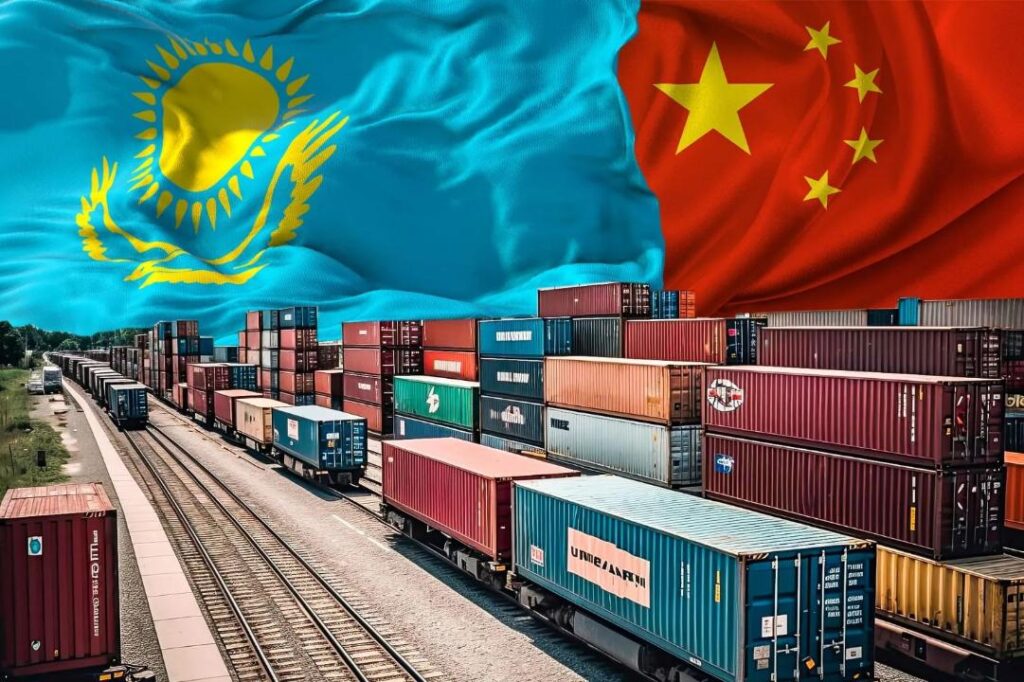
Kuantyrov emphasized the significance of cooperation in the context of the Trans-Caspian International Transport Route (TITR), also known as the Middle Corridor. He noted that cargo traffic through the Middle Corridor to Germany and the EU has increased almost threefold since the beginning of 2022 — to 1.5 million tons and 2.6 million tons, respectively, during the first seven months of this year, adding that the potential of TITR is estimated at 10 million tons of cargo a year. In this regard, Kuantyrov invited German partners to participate in developing Kazakhstan’s Caspian Sea ports of Aktau and Kuryk.