• KGS/USD = 0.01144 0%
  • KZT/USD = 0.00212 0%
  • TJS/USD = 0.10456 0.19%
  • UZS/USD = 0.00008 0%
  • TMT/USD = 0.28490 0%
  • KGS/USD = 0.01144 0%
  • KZT/USD = 0.00212 0%
  • TJS/USD = 0.10456 0.19%
  • UZS/USD = 0.00008 0%
  • TMT/USD = 0.28490 0%
  • KGS/USD = 0.01144 0%
  • KZT/USD = 0.00212 0%
  • TJS/USD = 0.10456 0.19%
  • UZS/USD = 0.00008 0%
  • TMT/USD = 0.28490 0%
  • KGS/USD = 0.01144 0%
  • KZT/USD = 0.00212 0%
  • TJS/USD = 0.10456 0.19%
  • UZS/USD = 0.00008 0%
  • TMT/USD = 0.28490 0%
  • KGS/USD = 0.01144 0%
  • KZT/USD = 0.00212 0%
  • TJS/USD = 0.10456 0.19%
  • UZS/USD = 0.00008 0%
  • TMT/USD = 0.28490 0%
  • KGS/USD = 0.01144 0%
  • KZT/USD = 0.00212 0%
  • TJS/USD = 0.10456 0.19%
  • UZS/USD = 0.00008 0%
  • TMT/USD = 0.28490 0%
  • KGS/USD = 0.01144 0%
  • KZT/USD = 0.00212 0%
  • TJS/USD = 0.10456 0.19%
  • UZS/USD = 0.00008 0%
  • TMT/USD = 0.28490 0%
  • KGS/USD = 0.01144 0%
  • KZT/USD = 0.00212 0%
  • TJS/USD = 0.10456 0.19%
  • UZS/USD = 0.00008 0%
  • TMT/USD = 0.28490 0%

Kyrgyzstan Encourages German Investment in Raw Materials Extraction and Logistics

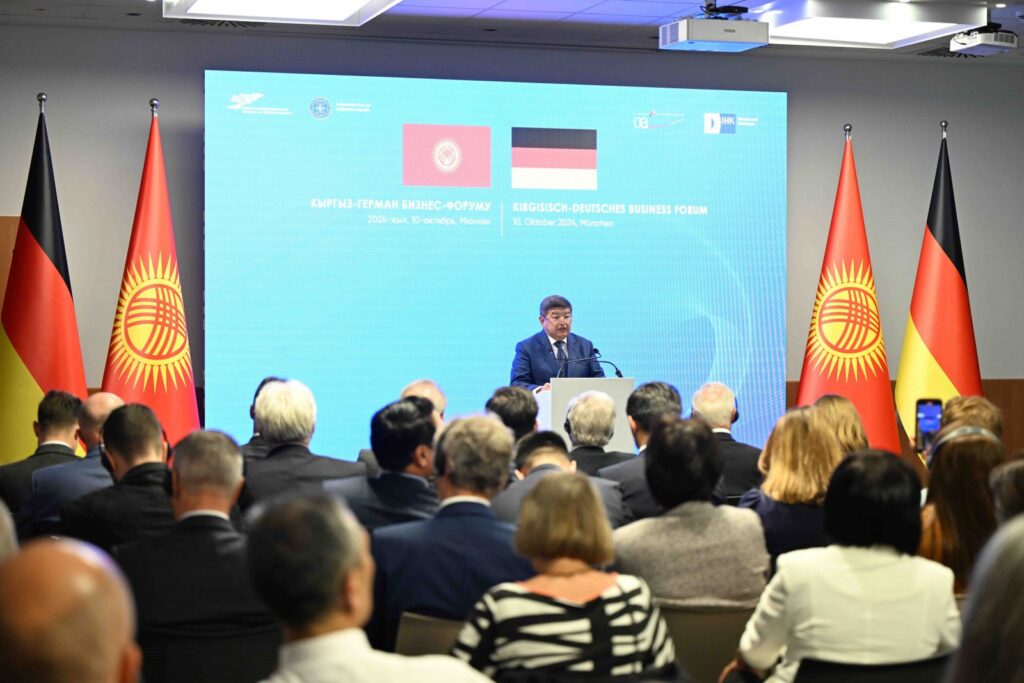
During a Kyrgyz-German Business Forum in Munich on October 10, Kyrgyzstan’s Chairman of the Cabinet of Ministers, Akylbek Japarov, stated that  following the first Kyrgyz-German Business Forum in Hamburg over a year ago, bilateral relations between the two countries had strengthened alongside a mutual interest in deepening cooperation.

Japarov cited the fact that 180 joint Kyrgyz-German enterprises are currently engaged in Kyrgyzstan’s trade, industry, agriculture, tourism, energy, education, and services sectors, and to encourage further  German investment and  participation in implementing the government’s ambitious economic development plans, invited businesses to attend the ‘Day of German Economy in Kyrgyzstan.’ Scheduled for summer 2025, the event follows three ‘Days of Kyrgyz Economy’ in Hamburg, Frankfurt am Main, and Munich.

Addressing the forum, Kyrgyz Minister of Economy and Commerce Daniyar Amangeldiev spoke of Kyrgyzstan’s interest in developing cooperation with Germany on raw materials, with reference to the presence of  100 raw material deposits in Kyrgyzstan. In addition, he proposed that German investors participate in auctions to gain the right to use the subsoil in Kyrgyzstan and develop deposits using modern technologies that comply with environmental standards.

The minister also touched upon the development of transport and logistics infrastructure and invited German companies to collaborate in the development of Kyrgyzstan’s logistics system, stating: “Kyrgyzstan, located in the heart of Central Asia, is  ‘landlocked’. At the same time, the Great Silk Road — a trade route between West and East, North and South — has been passing through our country since ancient times. Therefore, our country should rightfully be called ‘land connecting,’”

Scientists Attempt to Unlock the Secrets of Turkic Runes in Altai

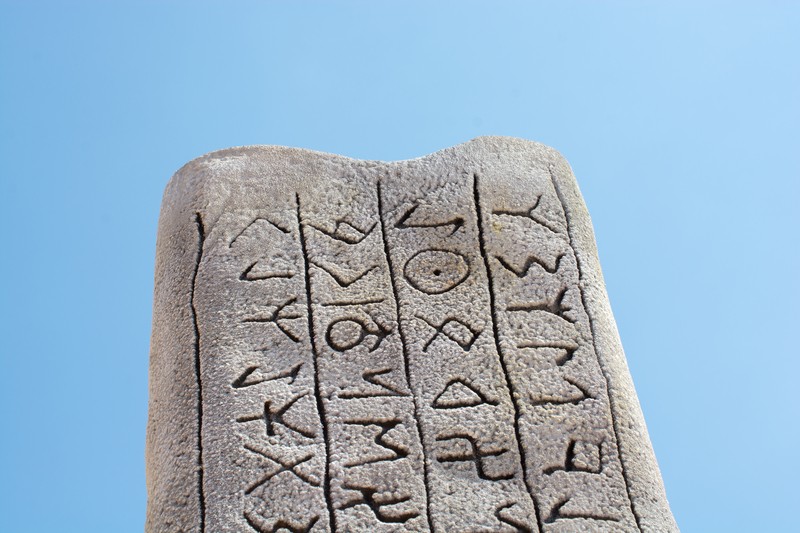
Russian scientists have started deciphering unique Turkic runic inscriptions in Altai, dating back to the VI-X centuries AD.

Speaking at the International Conference “Mountain Altai – the ancestral home of the Turks,” Alexander Vasiliev, head of the Oriental History Department of the Institute of Oriental Studies of the Russian Academy of Sciences, reported that whilst some 120 such texts have been identified, a significant number has yet to be deciphered due to a lack of “keys”.

According to Vasilyev, problems in evaluating inscriptions arise as a result of the different graphic systems used by Turkic peoples in various historical periods. Hence, researchers face a difficult task in making these texts accessible and determining the exact nature of the archaeological objects found. Historians also note that with the emergence of Mongolian vertical writing, the influence of the Turkic writing system began to weaken.

Previous attempts to decipher these texts using Iranian and Finno-Ugric languages, proved unsuccessful. Assuming that the key to understanding the inscriptions lies in one of the ancient Turkic languages, scientists are now focusing on the Chuvash language, which retains ancient features, or the Kypchak language group.

The decipherment of Turkic runic inscriptions began with the discovery of the famous Orkhon-Yenisei texts in Mongolia in the 19th century. In 1893, Danish scholar Wilhelm Thomsen was the first to successfully decipher these ancient texts using analogies to ancient Turkic words such as “tengri” (sky). These inscriptions, dating from the 7th to 10th centuries, recount the lives of the Turkic kagans and their victories. In addition to the Orkhon texts, significant inscriptions have been found in the Yenisei Valley and the Altai Mountains.

An international conference in Manzherok, in the Altai Republic, brought together scholars to discuss not only the problems of deciphering the Turkic script but also the formation of the Turkic civilization and the history of cultural interaction between the Turks and other peoples, including Slavic cultures.

Employees in Uzbekistan to be Rewarded with Company Shares

Uzbekistan is to introduce an initiative to reward employees with shares in companies, under a  regulation  developed by The National Agency for Perspective Projects (NAPP).

According to the NAPP, the transfer of shares to employees, as part of additional incentive programs, including bonuses, will help increase employee interest in the company’s sustainable development and improve labor relations.

The main goal of the initiative, modelled on ESOP (Employee Stock Ownership Plan) successfully applied in other countries, is to improve the population’s welfare and develop the domestic capital market.
Although joining in the Stock Ownership Plan will be voluntary, its development will be mandatory for joint stock companies with more than 50% state participation.

The presidential decree on capital market development, issued in September 2023, envisioned the implementation of ESOP. Funds of up to one month’s salary used to purchase shares will not be subject to personal income tax.

Kazakhstan-Tajikistan Trade Turnover Rises 6%

According to the State Revenue Committee of Kazakhstan’s Ministry of Finance, the trade turnover between Kazakhstan and Tajikistan has reached $780.7 million so far this year, 6% higher than for the same period last year.

From January to August 2024, Kazakhstan exported over 1.6 million tons of goods worth $613.2 million to Tajikistan, an increase of 15.5% compared to last year. The main export product was wheat, with 629,100 tons valued at $154.5 million.

Tajikistan also produces more sunflower, safflower, and soybean oil – 44,800 tons (+8.2%), pasta – 5,300 tons (+20.7%), and sweet drinks – 12.5 million liters (+5.8 times).

The export of aluminum oxide also increased by 40.5% to 105,400 tons; iron and steel rods increased 1.5 times, up to 36,800 tons; plastic windows and frames increased ten times, up to 12,400 tons; and smartphones and media stations increased 1.8 times, up to 148,100 units.
However, the supply of liquefied gas decreased by 4% (211,300 tons).

At the same time, imports from this country continued to decrease. In January-August, 220,800 tons (-19.4%) of products worth $167.5 million were imported from there.

This decrease affected the sales volume of ores and concentrates (lead, copper, zinc) by 12.3%, up to 106,500 tons, and children’s scooters and skateboards by 32.6%, up to 46,00 units.

In addition, Kazakhstan has begun to buy fewer fresh fruits and vegetables. For example, the supply of apricots, peaches, and grapes immediately decreased by 2.1 times, to 6,900 tons, and onions by 3.3 times, to 17,600 tons.

However, the volume of imported dried fruits increased by 23.3% and amounted to 36,800 tons.

Tajikistan Strives to Protect its Natural Environment Against Climate Change

Climate change is having an increasing impact on Tajikistan’s flora and fauna and climatologists predict further drying up of regions, jeopardizing the country’s biodiversity.

According to the International Union for Conservation of Nature (IUCN), over 860 species have disappeared worldwide since 1500, and some 17,300 species are currently under threat. To mitigate the effects of climate change in their country, Tajik scientists have urged that measures be taken to preserve rare species of plants and animals.

Speaking on the issue, Khikmat Khisoriev, a doctor of biological sciences and an academician at the National Academy of Sciences of Tajikistan, stated that climate has changed cyclically throughout history, with alternating periods of cooling and warming . In recent decades, however, the significant increase in the  rate of warming has a powerful impact on plant life. Rapid changes in environmental conditions do not allow  plants time to adapt, leading to the extinction of vulnerable species such as the anzur onion, the Vavilov almond, and other endemic plants of Tajikistan.

The loss of rare species of economic importance is a particular concern. For example, the endemic plant Ferula Tajiki, widely used in medicine, is on the verge of extinction due to intensive harvesting. Such processes lead to a decrease in the country’s biodiversity, and ecosystems are becoming less resistant to external changes.

Climatic change is also affecting wildlife. According to Abdusattor Saidov, zoologist and corresponding member of the National Academy of Sciences of Tajikistan, changes in humidity in Tajikistan’s mountains  can significantly impact the composition of vegetation, and in turn, forage for wildlife. Forced to migrate in search of food,  Tajikistan’s populations of species such as the Marco Polo sheep, Siberian ibex, and snow leopard, could potentially diminish.

The situation is also aggravated by anthropogenic factors including excessive collection of plants, poaching, and economic activities, which are especially dangerous for species with restricted habitats. Among such species is the Apollo Autocrator butterfly which living in the Pamirs, is unable adapt to change as quickly as other organisms.

To combat these challenges, the Government of Tajikistan has developed the “National Program of the Republic of Tajikistan ‘Green Country’ for 2023-2027″ to address climate change, restore ecosystems, and develop a green economy. The program aims to plant 65 million trees by the end of 2025, creating protected areas, and introducing modern technologies for sustainable management of natural resources.

Biodiversity conservation also includes expanding the network of protected areas. Tajikistan already has reserves and national parks covering 22% of the country’s territory, in which 70% of flora and fauna species are preserved. Much more, however, needs to be done to fully compensate for climate change and anthropogenic impact losses. In addition to more effective measures to protect rare species, such as introducing quotas for plant collection and controlling economic activities in habitats, other necessary measures include developing zero-waste technologies, and public education programs to raise awareness of the importance of nature conservation.

Experts believe that sustainable development is only possible with the active participation of all sectors of society, from scientists and environmentalists to representatives of government agencies and public organizations. Adaptation to climate change and biodiversity conservation in Tajikistan requires an integrated approach and international cooperation. Following the example of other countries, where the introduction of advanced technologies, increased monitoring of the state of the natural habitat, and research, has helped address these problems, Tajikistan is now striving to preserve its unique natural resources and ecosystems for future generations.

Tashkent Student Imprisoned for Trying to Broker Sale of Human Body Parts

A 21-year-old student studying at a university in Tashkent posted an advert on social media earlier this year, announcing that he would help citizens sell their kidneys, livers, and bone marrow. The student stated in his ad that he would buy a human kidney for $38,000, a liver for $43,000, and bone marrow for $23,000.

Someone read the ad and said he wanted to sell one of his kidneys. The student said that the donor would be paid $38,000 for it, that the kidney transplant operation would take place in Germany, and that he would have to pay $350 before the trip. The student was caught while receiving this money.

Law enforcement officers caught the student on April 26, when he received the agreed-upon $350 from the applicant. The police arrested him as a preventive measure.

The student told the court that he did it because he needed money, but he had no acquaintances in Germany. He said he used the $350 for his own needs but wanted to return the sum to his acquaintance later. He also said that his brother, sister, and himself are students and asked the court not to punish him.

The court sentenced him to three years in prison.