• KGS/USD = 0.01144 0%
  • KZT/USD = 0.00196 -0%
  • TJS/USD = 0.10899 -0%
  • UZS/USD = 0.00008 -0%
  • TMT/USD = 0.28490 0%
  • KGS/USD = 0.01144 0%
  • KZT/USD = 0.00196 -0%
  • TJS/USD = 0.10899 -0%
  • UZS/USD = 0.00008 -0%
  • TMT/USD = 0.28490 0%
  • KGS/USD = 0.01144 0%
  • KZT/USD = 0.00196 -0%
  • TJS/USD = 0.10899 -0%
  • UZS/USD = 0.00008 -0%
  • TMT/USD = 0.28490 0%
  • KGS/USD = 0.01144 0%
  • KZT/USD = 0.00196 -0%
  • TJS/USD = 0.10899 -0%
  • UZS/USD = 0.00008 -0%
  • TMT/USD = 0.28490 0%
  • KGS/USD = 0.01144 0%
  • KZT/USD = 0.00196 -0%
  • TJS/USD = 0.10899 -0%
  • UZS/USD = 0.00008 -0%
  • TMT/USD = 0.28490 0%
  • KGS/USD = 0.01144 0%
  • KZT/USD = 0.00196 -0%
  • TJS/USD = 0.10899 -0%
  • UZS/USD = 0.00008 -0%
  • TMT/USD = 0.28490 0%
  • KGS/USD = 0.01144 0%
  • KZT/USD = 0.00196 -0%
  • TJS/USD = 0.10899 -0%
  • UZS/USD = 0.00008 -0%
  • TMT/USD = 0.28490 0%
  • KGS/USD = 0.01144 0%
  • KZT/USD = 0.00196 -0%
  • TJS/USD = 0.10899 -0%
  • UZS/USD = 0.00008 -0%
  • TMT/USD = 0.28490 0%
08 December 2025

Protecting Women and Children Helps Preserve, Not Contradict, Traditional Family Values in Kazakhstan

In today’s rapidly evolving world, traditional values can sometimes clash with progressive movements advocating for inclusivity and modern perspectives in many areas of life. While these values are often seen as barriers, they can instead serve as a source of stability and continuity when thoughtfully upheld. President Kassym-Jomart Tokayev is aligning legislative reforms with Kazakhstan’s family values while integrating them with the society’s progressive aspirations.

At a recent meeting with young scientists in Almaty, President Tokayev took aim at domestic violence calling it “a manifestation of backwardness and moral degradation.”  He added that “only a society that values ​​and respects women can be considered truly civilized and cultured.” 

Regulatory actions

In his speech, Tokayev placed “strengthening of the institution of the family” at the center of modernizing Kazakhstani society. “After all, comprehensive protection of the rights of women and children does not at all contradict the preservation of traditional family values ​​and, on the contrary, contributes to their further strengthening”, he said.

“From the first days of my presidency, I have been paying great attention to protecting the rights of women and children. We are consistently taking legislative and institutional measures in this direction,” he noted. 

This is not a new issue for the President, who in his September 2022 address, had already ordered stricter penalties for domestic violence. His agenda to strengthen protective measures sped up following the high-profile murder of Saltanat Nukenova in November 2023 by her husband, an influential former minister. 

The events following this tragedy helped bring about new laws, inspired a culture of zero tolerance for any form of violence, and perhaps even opened the way for further reforms. On April 15, 2024, Tokayev signed a landmark law criminalizing violence against women and children, reversing a 2017 decriminalization. In two weeks, these amendments will be put into effect. The government’s response to the death of Nukenova and to the events following it, including the public reaction, has garnered international praise. 

Promoting a values-based society

Tokayev in his Almaty speech expressed that “not all problems can be solved by passing or tightening the law,” and adding that “everyone must start with themselves changing for the better”. “Family values ​​should be established in every home”, he said, highlighting the key role of women in raising the new generation.  Tokayev also prescribed enforcing good values in educational institutions while acknowledging that the country’s education system still had shortcomings.

This is another example of how the leadership’s rhetoric matters in advancing a society. Tokayev continues to set the tone for his country on women’s rights. As the Washington Post wrote on May 13, 2024, “Kazakhstan’s President Kassym-Jomart Tokayev has repeatedly spoken about strengthening protections for women.” 

Tokayev’s messaging of values has indeed been consistent – with a focus on rule of law as a basis for the protection of rights of all citizens. 

The future

The President’s actions have already begun inculcating a culture of no tolerance for aggression against women. “Today, the problem of domestic violence is widely discussed in the public space. This speaks of a positive transformation of the value system of our society, which is becoming more and more intolerant of any form of aggression and cruelty” said Tokayev in his Almaty meeting.

Such public discussion manifested broadly on social media before and during the Nukenova trial. Kazakhstan’s openness has since given courage to women in Russia and other Central Asian states to open up about their grievances.

While what constitutes core values for a society may differ between East and West, and North and South, it should be universally agreed that legislative advancements working with these notions rather than against them have a better chance of succeeding.
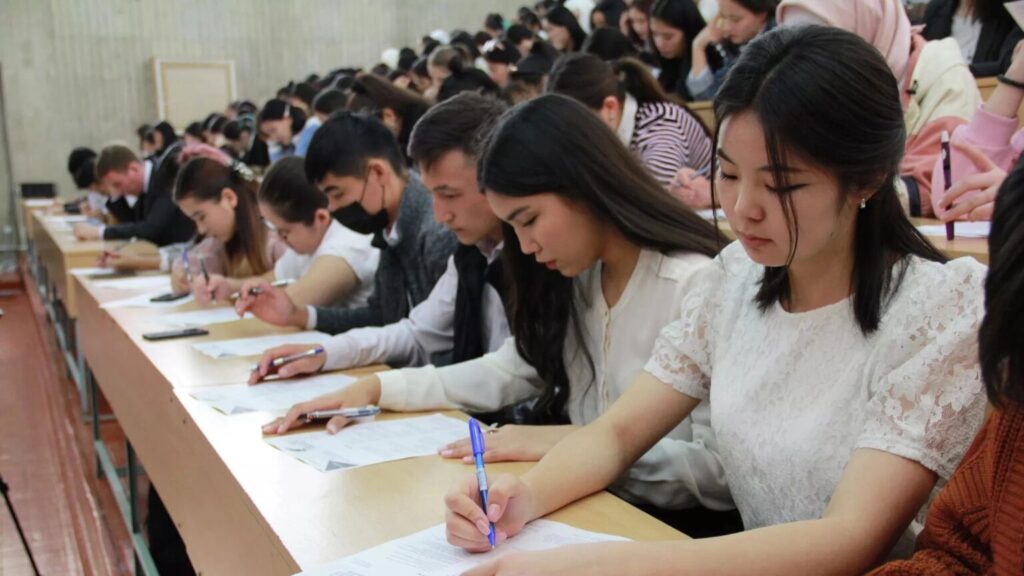
International Development Association Allocates $25 million to Kyrgyz Universities.

The International Development Association (IDA) has announced it will  provide Kyrgyzstan with a $25 million interest-free loan over 50 years, with a ten-year grace period.

The loan includes an allocation of $19.7 million to be divided between  five of the country’s universities.

The Academy of Medicine will receive $4 million, $1.3 million of which will be invested in laboratories for biochemical research, genetics, and molecular biology; $900,000 on equipment for pathomorphological research, and $800,000 on equipment for a laboratory for pharmaceutical bioequivalence studies. The remaining $1 million will be spent on laboratories, IT equipment, and software for new and expanded educational programs.

Kyrgyz State Technical University will be allocated $3.2 million,  $2.2 million of which will be used for equipment and software for three laboratories, IT equipment, and software.

The Kyrgyz National University (KNU) will also receive $3.2 million with $1.7 million allocated for scientific and IT equipment and software for teaching laboratories. The remaining $1.5 million will be spent on laboratories, IT equipment, and software for educational programs.

Osh State University (OSU) will receive $2.8 million, with $300,000 reserved for the purchase of an ultrasound machine for breast examination, $1.5 million for an MRI machine, and $1 million for laboratory and IT equipment and software programs.

The University of Agriculture has been allocated  $3.75 million, with $800,000 to be used to purchase equipment for an infectious animal disease diagnostic laboratory, $1.2 million for molecular genetic equipment, $550,000 for equipment for a histology and immunohistochemistry laboratory, $400,000 for equipment for the Department of Veterinary Medicine and Food Safety, and $800,000 for laboratory and IT equipment and software.

The national budget will cover $5.3 million of the loan funds whilst the universities will pay off the remaining amount through revenue provided by laboratory services.

Uzbekistan-EU Trade Reaches 5.13 billion Euros

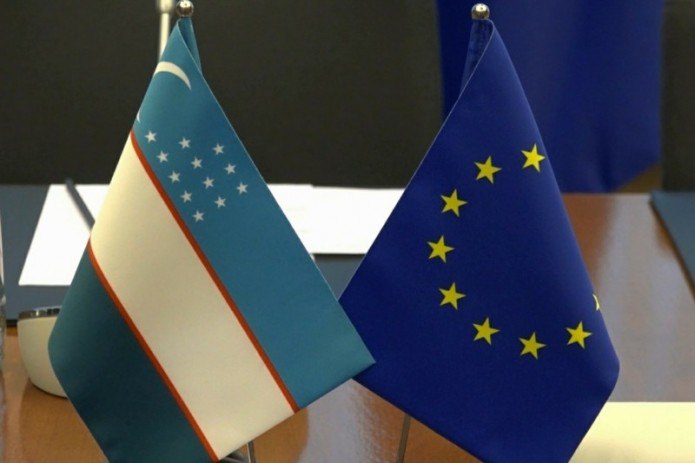
In 2023, the trade turnover between Uzbekistan and the European Union increased by 11% to 5.13 billion euros.

As reported by  EU Ambassador to Uzbekistan, Charlotte Adrian, exports from the EU to the Republic of Uzbekistan amounted to 4.35 billion euros, and imports from Uzbekistan to the EU,  780 million euros.

By way of comparison, she then stated that in 2022,  EU exports to Uzbekistan reached 3.77 billion euros, an increase of 63.9%, and imports from Uzbekistan to the EU rose by 77.1% to 845 million euros, resulting in around 70%  growth of trade turnover.

“Behind these figures,” announced Adrian, ” are stories of how our businesses have made bold decisions to invest in Uzbekistan.”

  This year celebrates the 30th anniversary of diplomatic relations between Uzbekistan and the European Union and on behalf of the EU, the ambassador praised  Uzbekistan’s “ambitious path of reforms” and pledged:   “We will continue to assist Uzbekistan using all the instruments at our disposal, including the Generalized Scheme of Preferences Plus (GSP+). We will also continue to support Uzbekistan’s accession to the World Trade Organization or EPCA (European Petrochemical Association), which will open a new chapter of our partnership.”

She added that by following its the path of reforms, Uzbekistan will create a level playing field which she hoped would encourage more interest from European companies.

Kazakhstan’s Constitution Now Published in Braille

The Kazakh Constitutional Court has presented the first edition of the country’s Constitution printed in Braille, making it accessible to the visually-impaired.

The initiative to translate copy of Kazakhstan’s Basic Law into Braille (relief-dot tactile font) was realized with support from the OSCE Program Office in Astana and the Ministry of Culture and Information.

Welcoming the move, Chair of the Constitutional Court of Kazakhstan Elvira Azimova stated: “The Constitutional Court will continue to promote equality, dignity, and justice for everyone according to the Constitution of Kazakhstan and the Universal Declaration of Human Rights. The publication of the Braille text of the Constitution is our joint contribution to promoting this policy.”

Volker Frobart, Head of the OSCE Programme Office in Astana, emphasized the Kazakh authorities’ commitment to valuing human rights  and demonstrating an inclusive approach to ensure equal access to information.

Publications in Braille will be distributed  to 56 institutions, including national and regional libraries, training centers, and specialized schools.

According to the World Health Organization,  Kazakhstan is currently home to 160 thousand visually- impaired citizens.

British Magazine Ranks Kazakhstan’s Katon-Karagay Top Travel Destination  

The Katon-Karagay district in Eastern Kazakhstan has been included in Asia & the Middle East’s top sustainable travel destinations for 2024 by the British magazine Wanderlust.

The district is home to Katon-Karagay National Park. Spanning over 643,000 hectares, the park was designated a Kazakh-Russian transboundary biosphere reserve in 2017 by the UNESCO World Network of Biosphere Reserves.

In promoting the reserve, Wanderlust stated: “Five years ago, residents of the Katon-Karagay district – a sweep of lonely steppe, mountains and forests in far eastern Kazakhstan – faced a dilemma. Though home to the country’s largest national park and around 275 bird species, its 48 villages attracted few visitors, and there was little work available. As a result, its population had almost halved since the turn of the century, many residents having moved to cities in search of employment.

So in 2019 the Sustainable Rural Development Fund was launched, with the aim of improving the quality of life in three remote districts, including Katon-Karagay. Key to this effort was the creation of sustainable community tourism opportunities, including training guesthouse owners and opening a hospitality school. Money has also been allocated to trail maintenance, signs and a tourist information centre, making it easier for travellers to explore a region whose communities and culture are finally being appreciated.”


Kazakhstan-Russia Relations in Focus at St. Petersburg

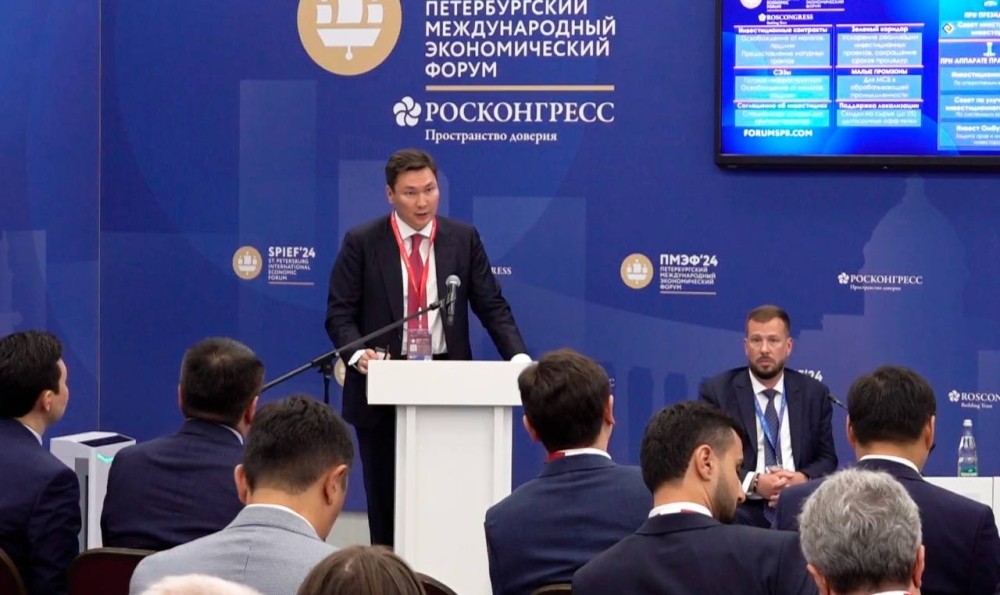
As part of the 27th St. Petersburg International Economic Forum on 5 June, delegates engaged in a panel discussion themed “Russia-Kazakhstan.”

The panel comprised representatives of both countries’ public and private sectors, including Deputy Prime Minister of Kazakhstan Serik Zhumangarin, Kazakh Ambassador to Russia Dauren Abayev, and Chairman of the Board of national company Kazakh Invest Yerzhan Yelekeev.

As reported by Kazakh Invest, Ambassador Abayev emphasized the strategic importance of Kazakhstan-Russia relations by stating: “Today, Kazakhstan and Russia are implementing 135 joint investment projects worth over $26 billion, creating 28,000 jobs, which is a record figure in recent years. We expect these numbers to continue growing.”

Kazakh Invest’s Yelekeev focused on the growing potential for developing bilateral relations, the need to increase investment in joint projects, and favorable changes in Kazakhstan’s investment environment.

“Over 19,000 enterprises are successfully operating with Russian participation in Kazakhstan,” announced Yelekeev. “Good results have been achieved through leading projects and very promising initiatives in the investment sector. Russia remains one of the largest investors in our economy. Joint projects contribute to the development of technologies, the opening of new markets, and the creation of jobs. Last year saw a record gross inflow of Russian investments approaching the $3 billion mark.”

Yelekeev also presented prospective niches to Russian businesses for potential investment projects in the mining and metallurgical sector, petrochemicals, and the automotive industry.