• KGS/USD = 0.01144 0%
  • KZT/USD = 0.00192 -0%
  • TJS/USD = 0.10849 0.37%
  • UZS/USD = 0.00008 0%
  • TMT/USD = 0.28490 0%
  • KGS/USD = 0.01144 0%
  • KZT/USD = 0.00192 -0%
  • TJS/USD = 0.10849 0.37%
  • UZS/USD = 0.00008 0%
  • TMT/USD = 0.28490 0%
  • KGS/USD = 0.01144 0%
  • KZT/USD = 0.00192 -0%
  • TJS/USD = 0.10849 0.37%
  • UZS/USD = 0.00008 0%
  • TMT/USD = 0.28490 0%
  • KGS/USD = 0.01144 0%
  • KZT/USD = 0.00192 -0%
  • TJS/USD = 0.10849 0.37%
  • UZS/USD = 0.00008 0%
  • TMT/USD = 0.28490 0%
  • KGS/USD = 0.01144 0%
  • KZT/USD = 0.00192 -0%
  • TJS/USD = 0.10849 0.37%
  • UZS/USD = 0.00008 0%
  • TMT/USD = 0.28490 0%
  • KGS/USD = 0.01144 0%
  • KZT/USD = 0.00192 -0%
  • TJS/USD = 0.10849 0.37%
  • UZS/USD = 0.00008 0%
  • TMT/USD = 0.28490 0%
  • KGS/USD = 0.01144 0%
  • KZT/USD = 0.00192 -0%
  • TJS/USD = 0.10849 0.37%
  • UZS/USD = 0.00008 0%
  • TMT/USD = 0.28490 0%
  • KGS/USD = 0.01144 0%
  • KZT/USD = 0.00192 -0%
  • TJS/USD = 0.10849 0.37%
  • UZS/USD = 0.00008 0%
  • TMT/USD = 0.28490 0%
11 December 2025

S. Paul Kapur Confirmed as U.S. Assistant Secretary for South and Central Asian Affairs

The U.S. Senate has confirmed political scientist S. Paul Kapur as Assistant Secretary of State for South and Central Asian Affairs to lead the State Department bureau that oversees relations with Afghanistan, Pakistan, India, Sri Lanka, Bangladesh, Nepal, Maldives, Bhutan, and the five Central Asian republics. The position carries responsibility for guiding U.S. diplomacy across the region, coordinating security and development strategy, and advising on policy toward regional powers such as China and Russia.

Kapur, 56, is an Indian American scholar known for his work on nuclear deterrence and South Asian security. He was born in New Delhi to an Indian father and an American mother, but grew up in the United States. After studying the region in graduate school, he pursued an academic career, earning a doctorate in political science from the University of Chicago and a bachelor’s degree from Amherst College. Kapur taught at Claremont McKenna College and Stanford University before joining the U.S. Naval Postgraduate School, where he is a professor of national security affairs and runs U.S.–India strategic dialogues for the Department of Defense.

Paul Kapur, a seasoned academic and security specialist, now takes a post that places him at the center of Washington’s engagement with Kazakhstan, Kyrgyzstan, Tajikistan, Turkmenistan, and Uzbekistan. His confirmation fills a key regional portfolio in the Trump administration, which may shape how the United States approaches Central Asia within its broader regional strategy.

Kapur’s portfolio covers both South and Central Asia, but his confirmation has been closely watched in the five republics that straddle the heart of Eurasia. Central Asian governments and business leaders are eager to see whether the new Assistant Secretary will continue Washington’s traditional emphasis on security partnerships or shift toward deeper economic and investment ties.

Kapur brings a distinguished scholarly pedigree and deep expertise in international security. He has written extensively on nuclear deterrence, South Asian security, and great-power competition. While much of his work focuses on India, Pakistan, and U.S. grand strategy, he has also examined how India manages its relationships with larger powers such as the United States and China – an enduring middle-power dynamic. That perspective is particularly relevant to Kazakhstan, an emerging middle power, and to Central Asia acting collectively, which is seeking to balance Russian and Chinese influence.

During his confirmation hearing, Kapur emphasized that U.S. engagement in Central Asia will focus on advancing the sovereignty and territorial integrity of the regional states. He noted that, if confirmed, he would leverage the C5+1 framework and bilateral partnerships to pursue cooperation in areas such as energy, critical minerals, counterterrorism, combating transnational crime, and developing physical and digital infrastructure. His remarks reflected a commitment to strengthening regional independence and stability while deepening practical cooperation with the United States.

For Central Asian governments, Kapur’s arrival comes at a time of shifting geopolitics. Russia’s war in Ukraine has unsettled long-standing assumptions, while China’s Belt and Road Initiative continues to expand Beijing’s economic influence. The United States has not always prioritized matching these dynamics. However, Kapur’s testimony underscored opportunities for cooperation in energy, critical minerals, and infrastructure – areas that suggest Washington could place renewed emphasis on practical economic engagement. Such efforts may also open the door for greater U.S. private-sector participation, aligning with Central Asian governments’ interest in diversifying their partnerships.

Energy security will likely remain a top priority. Kapur has written on the importance of diversifying energy routes, a theme that resonates in Central Asia, where leaders are pushing to expand pipelines and export channels through the Caspian and toward Europe. His confirmation may open the door to greater U.S. engagement in trans-Caspian projects and renewable energy cooperation.

Business leaders will be watching closely for signs of a more proactive U.S. economic presence. While American firms already operate in Kazakhstan’s oil and gas sector, broader trade and investment ties lag behind those of Europe, China, and Russia. Kapur has acknowledged in testimony that regulatory transparency and rule-of-law issues remain major obstacles. His bureau may prioritize programs that encourage legal reforms and foster investor confidence.

For regional governments, Kapur’s confirmation offers both reassurance and challenges. His arrival restores Senate-confirmed leadership to the State Department bureau responsible for South and Central Asia after a prolonged vacancy, ensuring clearer lines of authority and continuity in U.S. engagement. Central Asian observers are watching to see whether his stated priorities will translate into tangible initiatives.

Ultimately, Kapur’s tenure will test whether Washington can convert its political and security relationships in Central Asia into a more durable, business-oriented partnership grounded in trade, investment, and economic modernization. For Central Asia’s leaders and business community, his confirmation marks the possibility of expanded engagement with the United States – one that could open meaningful opportunities but will depend on building commercial ties that form the backbone of a stable, long-term relationship.

Kyrgyzstan Launches Development of English Law-Based Dispute Resolution Center

The Kyrgyz Ministry of Justice and the British Embassy in Kyrgyzstan have signed a memorandum to establish an International Center for Dispute Resolution based on English law within the newly designated Special Financial Investment Territory “Tamchy.”

The initiative follows legislation signed by President Sadyr Japarov establishing the Tamchy zone, a special legal and regulatory jurisdiction located in the Issyk-Kul region. The zone is designed to attract both domestic and foreign investment by offering tax incentives and a favorable business environment, particularly in sectors such as manufacturing, tourism, wellness, and transport infrastructure.

A central component of the initiative is the creation of an international arbitration and dispute resolution center operating under English common law, a legal system based on judicial precedent and widely used in major financial hubs like London, Dubai, and Singapore.

Under the memorandum, the British Embassy will support the Kyrgyz government by helping to engage a team of legal consultants to assist in implementing English law within the centre’s framework. The aim is to build a transparent, neutral, and internationally credible mechanism for resolving investment and commercial disputes in Kyrgyzstan.

Government officials described the center as a strategic step toward building a modern, rule-based platform for impartial dispute resolution. By integrating English common law principles, Kyrgyzstan aims to enhance investor confidence, ensure legal predictability, and strengthen its position as a competitive and secure destination for international capital.

Kazakhstan to Launch Unified Construction Portal in 2026

Kazakhstan will launch a unified electronic platform for the construction sector on January 1, 2026, Minister of Industry and Construction Yersayin Nagaspayev announced. The digital system aims to streamline operations for both developers and homebuyers by consolidating multiple existing databases into a single portal.

Presenting the draft of the new Construction Code to parliament, Nagaspayev said the industry currently relies on several fragmented information systems, creating confusion and inefficiencies.

“The new portal has already been developed and passed an information security audit. The only remaining step is to integrate two systems, private and state expertise. We expect full implementation by January,” the minister told the Mazhilis.

The Construction Code introduces several digital innovations, including a unique identifier for every construction project, enabling traceability throughout its lifecycle.

“If we compare it to everyday life, this unique number is similar to an individual identification number (IIN) for people,” Nagaspayev explained. “It will be assigned automatically at the planning stage within the state urban development cadastre and will remain in the system until the building’s demolition.”

This measure will help homeowners access electronic documentation even years after a building’s completion. Currently, many property owners struggle to retrieve original technical or project documents required for renovations or modernization.

The system will also include an electronic registry of licensed construction companies, listing only those that have undergone official accreditation.

Nagaspayev acknowledged that a significant number of companies and licenses exist only on paper, lacking real production capacity or qualified personnel.

“This situation poses risks to construction quality and safety, encourages fictitious participation in public procurement, and distorts the real picture of employment and business activity in the sector,” he said.

The new registry will enable authorities to audit existing licenses and integrate the data with other government databases for automated compliance checks. It will also introduce joint liability among market participants, with the potential to suspend or ban companies that commit serious violations.

Nagaspayev also announced plans to introduce certification for construction engineers, modeled on European Union practices and adapted to Kazakhstan’s legal framework.

“This certification process will be handled in a competitive environment by market participants,” he noted.

As previously reported by The Times of Central Asia, Kazakhstan faces a growing labor shortage in the construction sector. Some industry stakeholders are calling for simplified procedures to attract migrant workers to meet rising demand.

Turkish Police Detain Teenagers Linked to ISIS, Including Turkmen Citizen

Turkish security forces have detained two teenagers in Istanbul, one identified as a Turkmen national, on suspicion of planning terrorist attacks and communicating with members of the so‑called Islamic State (ISIS), Turkish press reported.

The arrests were carried out in two Istanbul districts after police discovered evidence of contact with ISIS operatives on encrypted messaging apps.

Authorities say a search of one suspect’s computer turned up files with instructions for making Molotov cocktails and explosives, materials on assembling long‑barreled weapons and shooting training, and a large volume of ISIS‑related propaganda and instructional videos. A court ordered that teenager held in custody.

The same reporting says a separate case in July involved a 14‑year‑old Turkmen national, identified by initials D.R., who was detained in the Maltepe district after allegedly being radicalized online. Investigators reportedly found “training materials” on bomb‑making, assassination techniques, videos on using drones and attack vehicles, and other instructions. The court placed that teenager under house arrest.

Turkish media cited broader figures showing intensified counter‑terror operations: 3,686 people suspected of links to ISIS have been detained in Turkey over the past nine months, with 784 formally arrested, the reporting states.

Earlier cases involving Central Asian nationals have also drawn attention. The Times of Central Asia previously reported that Turkish police had detained a Tajik man (named in reporting as Faziljon A.) and a Kyrgyz woman (named as Zulfiya S.) on suspicion of planning attacks for ISIS; authorities said they found police uniforms, emergency lights, knives and other equipment in the apartment where the suspects were hiding.

Putin in Tajikistan for CIS Summit Amid Migration Tensions

When President Vladimir Putin arrives in Dushanbe on 8 October for his first state visit, Tajikistan will briefly become the focal point of regional diplomacy. Currently holding the rotating chair of the Commonwealth of Independent States (CIS), Dushanbe is preparing to host both the CIS Heads of State Council and the second Russia–Central Asia summit. For Moscow, Central Asia has remained a priority since the invasion of Ukraine, and the visit highlights what is at stake for both Russia and its host. Tajikistan depends heavily on Russia for security, trade, and employment opportunities for its citizens, but relations have been tested by the aftermath of the March 2024 Crocus City Hall attack, which exposed the fragility of migration-driven economics and the risk of renewed extremism.

An Old Relationship Tested by New Tensions

Russia and Tajikistan have been closely entwined since the collapse of the Soviet Union. Putin has already made twelve trips to Tajikistan since taking office, and this will be his first with state‑visit status. Security cooperation remains the backbone of the relationship. Russia’s 201st military base in Tajikistan – formerly the 201st motor rifle division and now Moscow’s largest overseas facility – has long been billed as a shield along the Afghan frontier; the two sides continue to coordinate through the CSTO (Collective Security Treaty Organization), and within the SCO (Shanghai Cooperation Organization) framework.

Trade between the two nations has expanded despite sanctions headwinds. On the eve of the visit, presidential aide Yuri Ushakov said bilateral turnover rose by more than 17 % in the first seven months of 2025, and reached about US$1.5 billion in 2024. Russia accounts for over 22 % of Tajikistan’s foreign trade. Meanwhile, more than 1.2 million Tajik citizens work in Russia, making up about 16 % of all foreign workers there. They remitted US$1.8 billion back home last year, roughly 17 % of Tajikistan’s GDP. This symbiosis means that the two leaders routinely discuss labor migration and social issues alongside security and trade.

Yet the relationship has been strained by a wave of xenophobia following the Crocus City Hall attack, which killed 145 people, which the Russian authorities accused militants from Tajikistan of perpetrating. As previously reported by The Times of Central Asia, following the arrest of four Tajik suspects, Central Asian migrants in Russia have faced arson attacks, beatings, and boycotts of their businesses. Russian law enforcement has launched aggressive street inspections and created special units to check hostels and businesses frequented by Central Asians. Even long‑time Tajik residents with Russian citizenship have reported menacing phone calls and threats. In the wake of the attack, diaspora leaders urged compatriots not to leave their homes, and the Tajik interior ministry publicly rebutted Russian media reports, stating that three of the four suspects named were not involved.

Those pressures hit a country heavily reliant on remittances. The World Bank’s 2025 update estimates that money sent home by migrants accounted for 49 % of Tajikistan’s GDP in 2024. Since the start of the Ukraine war, Russian politicians and media have become increasingly hostile toward Central Asian migrants, leading Moscow to deactivate all foreign‑owned SIM cards and mandate biometric data collection for foreigners. Another rule introduced on June 30, 2025, requires citizens of visa‑free countries to pre-register in the Gosuslugi RuID app before entering Russia. Tajikistan has yet to outline a clear plan for reintegrating returning workers beyond its long‑range “Migration Regulation Strategy until 2040,” but with remittances central to household welfare, officials face limited room to maneuver.

The Economic Lifeline – And Trap – Of Remittances

Labor migration to Russia has become a structural feature of Tajikistan’s economy. These funds keep domestic consumption afloat, bolster the tax base, and underpin social stability in a country where exports cover only a fraction of import needs. Remittances, therefore, help close a chronic trade gap, but reliance on them also exposes Tajikistan to external shocks. Discrimination and tightening legal rules in Russia leave migrants at risk of detention or deportation, while Dushanbe’s ability to shield its citizens abroad remains limited.

The Asian Development Bank has described migration as both a “lifeline” and a source of social vulnerability, urging stronger consular protection and diversification of labor markets. High unemployment, which hit 11.6% in December 2024, ensures that the flow continues, however. A fast-growing and youthful population further limits opportunities at home, leaving many families with little alternative but to send relatives abroad.

The war in Ukraine has added another layer of insecurity. Rights groups and independent media have documented how Central Asian migrants, including Tajiks, face pressure from the Russian authorities and recruiters to enlist in the armed forces, sometimes under threat of visa complications, job loss, or criminal charges, and in other cases with the inducement of expedited citizenship.

A Crackdown That Cuts Both Ways

From Moscow’s perspective, migrant labor remains indispensable even as enforcement tightens. Russia may have deported 50 % more migrants in the first half of 2024 than in the same period in 2023, but at the same time, business groups continue to warn of severe labor shortages. Official estimates suggest the Russian economy may require an additional 2.5–3 million workers by 2030 to sustain growth, a gap widened by wartime mobilization and demographic decline. President Putin himself has acknowledged the essential role of migrants in sectors such as construction and manufacturing, underscoring the contradiction between nationalist rhetoric and economic reality.

For Tajikistan, the clampdown is more than a financial risk. In October 2024, Prime Minister Qohir Rasulzoda publicly expressed concern over the “widespread violation of the fundamental rights and freedoms” of its citizens in Russia. Analysts warn that if large numbers of young men are forced to return home without jobs, they could become more vulnerable to recruitment by extremist groups. ISIS-K, the faction that claimed responsibility for the Crocus City Hall attack, has already attracted dozens of Tajik fighters, fueling fears of a destabilizing feedback loop between repression abroad and radicalization at home.

Summit Diplomacy in Dushanbe

Against this backdrop, Tajikistan is rolling out the diplomatic red carpet. On 9 October, Putin will attend the Central Asia–Russia summit with the presidents of Tajikistan, Kazakhstan, Kyrgyzstan, Turkmenistan, and Uzbekistan. According to Ushakov, discussions will focus on further cooperation in the trade, economic, financial, investment, industrial, logistics, and energy spheres, alongside regional security concerns linked to Afghanistan and the Middle East. A concluding communiqué is expected to set joint priorities for 2025–2027 in politics, trade, transport, security, migration, and ecology.

On October 10, Dushanbe will host the CIS Heads of State Council, bringing together leaders from Armenia, Azerbaijan, Belarus, Kazakhstan, Kyrgyzstan, Russia, Tajikistan, Turkmenistan, and Uzbekistan. Drafts circulated ahead of the meeting point to a wide-ranging agenda, including the adoption of a concept for military cooperation through 2030, new programs for combating terrorism and extremism (2026‑2028), strengthening border security (2026‑2030), and a joint statement on fighting transnational crime. Leaders will also consider a declaration on regional energy security, a plan for multilevel inter‑ministerial consultations in 2026, and an initiative to grant the SCO observer status within the CIS.

One innovation on the table is the proposed creation of “CIS Plus,” a platform that would allow third countries and international organizations to participate in selected CIS events. Ushakov told reporters that the leaders will explore this idea as a way to open dialogue with outside partners. Belarusian officials, meanwhile, added that declarations marking the 80th anniversary of the United Nations and the 40th anniversary of the Chernobyl disaster will be adopted, underscoring the CIS’s desire to align with global commemorations.

Putin and Rahmon: Bilateral Priorities

Alongside the multilateral meetings, Putin’s state visit includes bilateral talks with President Emomali Rahmon. Russia’s Ambassador to Tajikistan, Semyon Grigoriev, told Izvestia that a high‑ranking delegation of security, economic, and humanitarian ministers will accompany the Russian leader, and that discussions will span economic cooperation, humanitarian ties, and regional security, framing the visit as a continuation of the two presidents’ regular consultations.

Trade and labor migration are widely expected to feature prominently in Putin and Rahmon’s discussions, given the centrality of Tajik migrant workers to bilateral ties and the presence of the Labor Ministry in the Russian delegation. The Tajik Foreign Ministry has stated that a series of “interstate and intergovernmental documents are scheduled to be signed,” whilst the Russian side has confirmed plans for an investment agreement on a new industrial park in Dushanbe.

For Rahmon, who has ruled since 1992, even modest improvements in migrant rights and remittance flows could bolster his domestic standing. For Russia, facing demographic decline and the strains of wartime mobilization, Tajik labor remains essential, but the Kremlin also needs to reassure its own public that security concerns are being addressed.

Observers also expect the leaders to coordinate on Afghanistan, where ISIS‑K and other militant groups pose a direct threat to both nations.

A Balancing Act Between Security and Dependence

Tajikistan’s dependence on Russia for work opportunities has long anchored Dushanbe’s foreign-policy alignment with Moscow, but the Crocus City Hall attack and the sweeping crackdown that followed have tested that loyalty. Reports of Tajiks being turned away or held at Russian airports and of migrants facing harassment have prompted rare public complaints from Tajik officials. At the same time, Dushanbe remains wary of destabilizing its security relationship with Moscow, not least because the Afghan border remains porous and Islamist recruitment pressures persist.

The high-level meetings in Dushanbe, therefore, give both sides a chance to recalibrate. For Moscow, they are an opportunity to mend fences with a key security partner; for Tajikistan, they are a chance to press for concessions. Bilateral deals on infrastructure and labor rights could soften the economic blow if migration flows slow. Meanwhile, the adoption of new CIS programs on counterterrorism and border security would send a signal to China and other regional actors that the bloc remains committed to collective defense. If the proposed CIS Plus format is launched, it could also open the door for Gulf states or other Asian partners to engage with the grouping, broadening Tajikistan’s diplomatic options.

Looking Ahead

Despite rising tensions, Tajikistan and Russia remain bound by geography, history, and economic necessity. For Tajik households, remittances continue to be the bedrock of income, even as this reliance leaves families exposed to policy shocks in Moscow. Russia, grappling with demographic decline and the demands of wartime mobilization, cannot afford to dispense with migrant labor, while Tajikistan faces the long-term challenge of diversifying its economy and protecting its citizens abroad.

The back-to-back summits in Dushanbe will therefore be more than ceremonial gatherings. For Tajikistan, hosting the Russia–Central Asia and CIS meetings is a chance to assert regional leadership and demonstrate its role as a bridge in Eurasian politics. For Russia, it is an opportunity to reassure allies that, despite the strains of war and domestic upheaval, it remains a central player in Central Asia’s security and economic architecture. The extent to which Putin and Rahmon can recalibrate their partnership in the coming days will be a litmus test for how both countries navigate the twin pressures of dependence and distrust in an increasingly volatile regional landscape.

Kyrgyz Authorities to Confiscate Vehicles Damaging Mountain Ecosystems

Kyrgyz President Sadyr Japarov has ordered law enforcement and environmental agencies to begin fining and in severe cases, confiscating vehicles used in a manner that damages mountain ecosystems, particularly in nature reserves and alpine pastures.

In a social media post featuring a video of individuals riding quad bikes through mountainous terrain, reportedly within a protected area, Japarov called on the Ministries of Internal Affairs and Natural Resources to take immediate action.

“Those driving gasoline-powered vehicles in mountain reserves and pastures should have them confiscated,” the president declared.

Japarov said such incidents are occurring nationwide, with the reckless use of off-road vehicles and quad bikes leading to the destruction of fragile slopes and pastureland.

“As seen in the video, quad bikes tear up slopes, burn grass, and destroy pastures. Most often these are our youth, but also adults and tourists. Despite existing roads, some choose to drive onto pastures, carving new tracks and damaging the natural landscape,” he said.

He emphasized that this behavior degrades mountain ecosystems by trampling vegetation, damaging soil, and accelerating erosion.

The president has directed the government to draft legislation authorizing the police and the Ministry of Nature to issue fines and seize vehicles used in ecologically harmful ways.

“Where the road ends, continue on foot or horseback. Nature is our shared heritage, and we must preserve it for future generations,” he added.

Japarov also called on local authorities to help identify violators and enforce ecological protection measures.

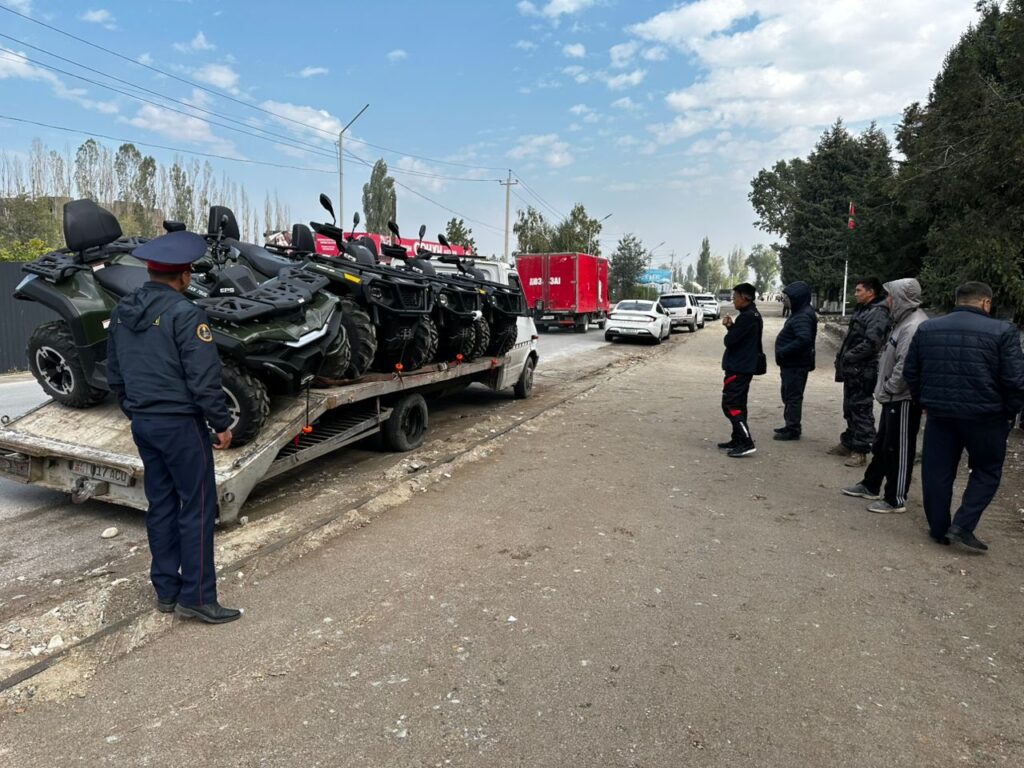
Following the president’s directive, the Ministry of Natural Resources, Ecology and Technical Supervision, in coordination with local police, detained a group of individuals operating quad bikes in mountain areas.

“They were informed about environmental safety rules, nature conservation, and relevant legislation,” the ministry said.

The offenders were each fined 5,500 KGS (approximately $60).