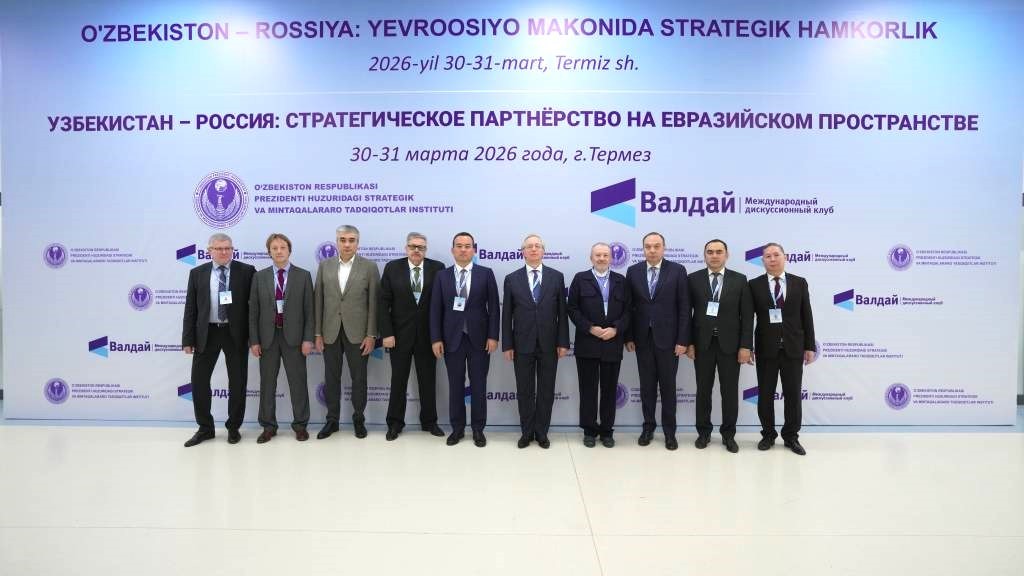
Uzbekistan and Russia used a conference in Termez on March 30–31 to highlight the breadth of their relationship, from trade and industrial projects to transport links and regional planning. The meeting was organized by Uzbekistan’s Institute for Strategic and Regional Studies and Russia’s Kremlin-linked policy forum, the Valdai Discussion Club. Participants included Russian Deputy Foreign Minister Mikhail Galuzin, Uzbek Deputy Foreign Minister Bobur Usmanov, ISRS director Eldor Aripov, Russian Ambassador Alexei Yerkhov, and other Uzbek and Russian officials, analysts, and business representatives.
The meeting comes at a time of shifting regional dynamics, as Central Asian states recalibrate ties with Russia while managing new economic and political pressures from multiple directions.
Termez sits by the Friendship Bridge on Uzbekistan’s border with Afghanistan and has become one of Tashkent’s main platforms for trade, logistics, and diplomacy aimed southward. The conference program focused on transport, infrastructure, interregional ties, and industrial cooperation, so the location matters. This aligns Uzbekistan’s relationship with Russia with a wider push for new routes across Eurasia and toward South Asia.
The economic backdrop is also substantial. Official Uzbek figures put bilateral trade with Russia at around $13 billion in 2025, making Russia Uzbekistan’s second-largest trading partner after China. Uzbek reporting says that trade has grown sharply since 2017, with Russian investment in Uzbekistan approaching $5 billion. Officials have described the relationship as moving beyond simple trade toward industrial cooperation, technological partnerships, and longer value chains.
The conference emphasized the growing role of direct regional links. Uzbek officials highlighted more than 200 regional initiatives worth over $4 billion and identified Tatarstan as a key partner in industry, petrochemicals, engineering, information technology, and education. Projects linked to the Himgrad industrial park model and branches of Kazan Federal University in Uzbekistan show how cooperation now extends through regions, universities, and industrial zones, not just central governments.
Energy remains a key part of the relationship. As previously reported by The Times of Central Asia, on March 24, Uzbekistan and Russia advanced work on Uzbekistan’s planned nuclear power project in the Jizzakh region. Uzbekistan’s nuclear agency, Uzatom, and Russia’s Rosatom signed new documents and began initial concrete works for a small-capacity unit, describing the step as moving the project into a new implementation phase.
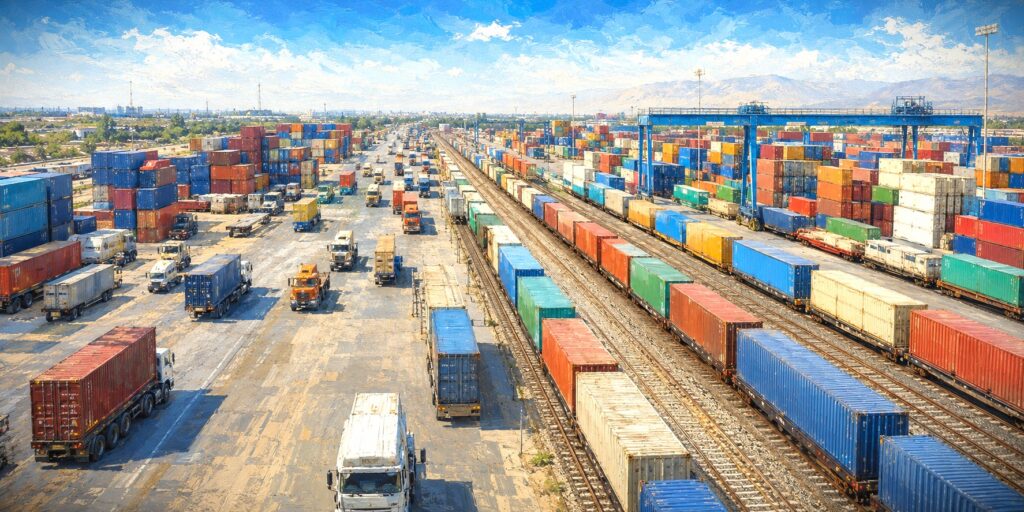
Transit formed another major part of the agenda. Uzbek reporting states that participants discussed modernizing northern routes and developing a southern route through Afghanistan toward ports on the Indian Ocean. This fits Uzbekistan’s longer effort to turn Termez into a logistics hub for Afghan and South Asian trade. The city hosts the Termez International Trade Center, designed to simplify border trade and business access.
The timing also reflects wider regional pressures. TCA previously reported that the war involving Iran is placing a strain on southern routes and increasing the importance of alternative corridors. In that context, a Russia–Uzbekistan meeting focused on trade and transport in Termez underscores how both countries are linking bilateral cooperation to shifting regional logistics.
The meeting in Termez did not produce a major treaty or a single headline project. It showed instead that Uzbekistan is expanding practical cooperation with Russia across trade, industry, energy, and transport while maintaining a broader multi-vector foreign policy. It also highlighted Termez as a key node where Uzbekistan’s ties with Russia connect to its wider ambitions in Afghanistan and South Asia.