In 2024, Uzbek jeweler Zokir Negmatov published a handbook of Bukharan jewelry making. Traditional Bukharan jewelry making left little technical documentation. Instead, its skills were transmitted largely through observation. “In jewelry making, much knowledge has traditionally been passed directly from master to apprentice,” he explains. “For me it was important to preserve the tradition for future generations.”
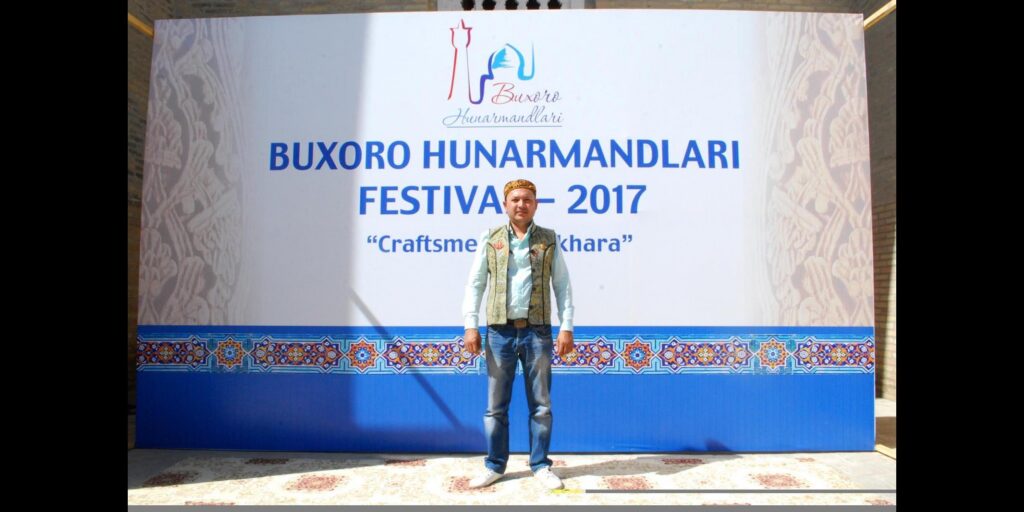
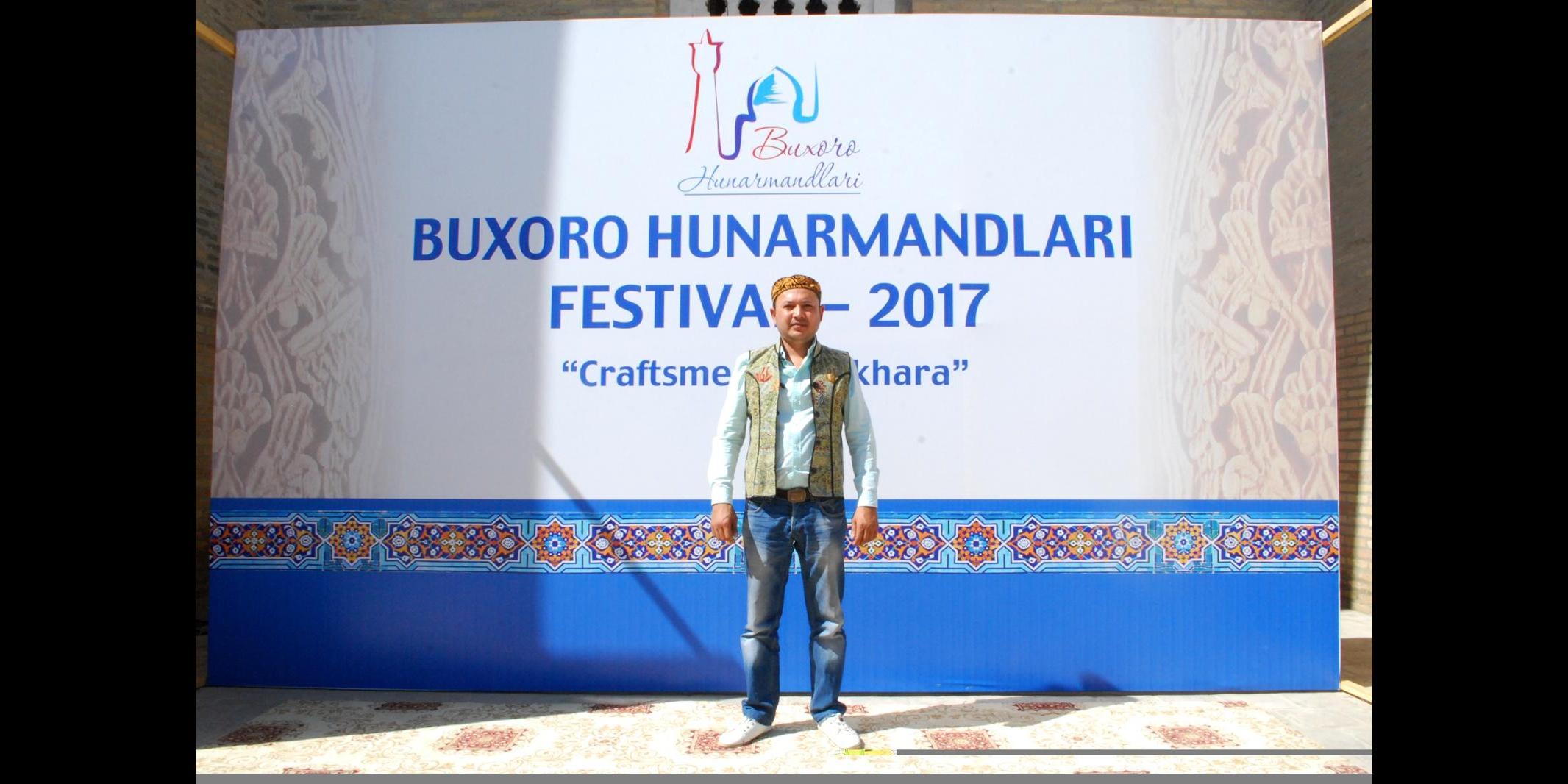
A man in his mid-forties, Negmatov was born and trained in Bukhara and has nearly three decades of experience as a jeweler. His native city has been a center of gold and silver work for well over a millennium, and craftsmanship helped shape the city itself: as many as two hundred crafts are believed to have flourished here, with each neighborhood, or mahalla, tied to a particular one.
At the center of the old town stands Toqi Zargaron, the Jewelers’ Dome, a covered bazaar built in 1569–70 that once housed thirty-six jewelers’ workshops and shops, where gold, precious stones, and coral were traded. It still stands, the largest of the surviving domes, and now sells spices and souvenirs.
Across Uzbekistan, silver was the dominant metal, but Bukhara’s jewelers were unusual in their preference for gold. The city lies in the Zarafshan oasis, named after the river whose Persian name means ‘spreader of gold’ and refers to gold-bearing sands in its upper reaches. By the nineteenth century, Bukhara ranked with Khiva, Samarkand, Karshi, and Kokand among Central Asia’s principal jewelry centers, each with a recognizable style. A jeweler was a zargar, a Persian word that survives in the name of the dome.
The trade was organized, with hierarchies, patron saints, and its own written texts: the risola, a pamphlet setting out the legend of how the craft’s patron founded it and the prayers required of a craftsman.
What those texts did not contain were the technical aspects of the craft: how to do the work. That knowledge was carried largely through the usta-shogird relationship. Usta, from the Persian ustad, means master and functions as a title; a man is addressed as Usta before his name. The shogird attaches himself to one master for years, works for little at the outset, and learns by being present at the bench.
Negmatov’s handbook is a different kind of text. Where the risola preserved the craft’s spiritual charter, his book sets down the methodology. It arrives at a moment when Bukhara and the traditions of Uzbekistan are drawing interest not only from tourists but also from the broader world of art and culture.
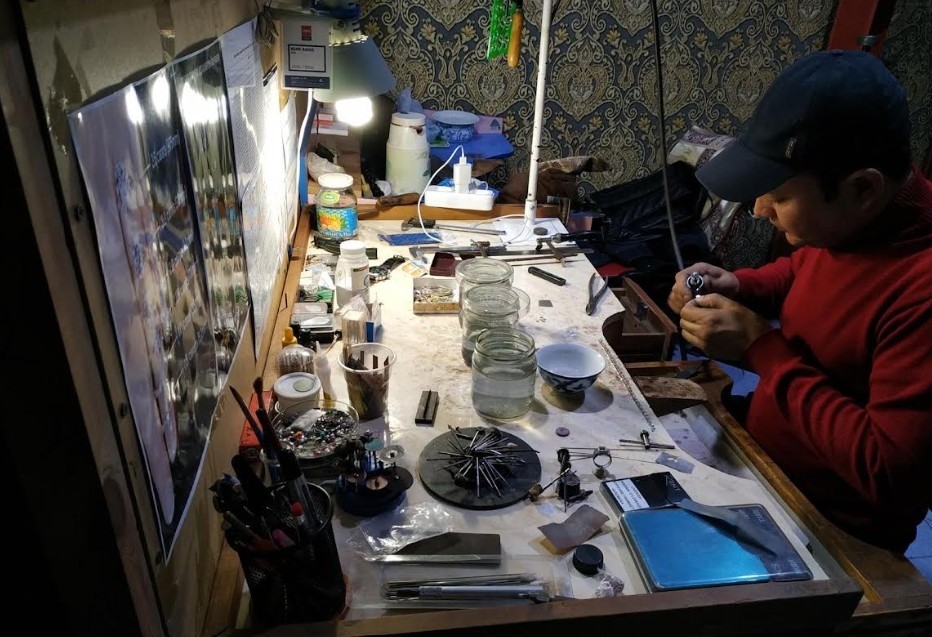
Image courtesy of Zokir Negmatov
Family Traditions
Zokir Negmatov grew up in a family where culture and tradition were central. His father was an educator. His mother, Gauhar Negmatova, was a master of zardozi, the gold embroidery for which Bukhara is equally known, creating figurative patterns and traditional ornament by hand in gold thread.
“There were no professional jewelers in my family, but craftsmanship and traditional art were always highly valued,” recounts Negmatov. “From childhood, I was surrounded by traditional ornament and beautiful handmade work, so my interest in artistic craftsmanship developed at an early age.”
His attraction to jewelry came early and never faded. “I was fascinated by gold from childhood,” he says. “I was interested in seeing how a craftsman could transform metal into a beautiful work of art.” In a city whose jewelers had favored gold for centuries, this was less an idiosyncrasy than an inheritance.
He began experimenting at sixteen or seventeen. His parents understood his commitment: “My parents could see that jewelry was not simply a hobby for me, but a profession to which I wanted to dedicate my life.” Asked what else he might have done, he is unequivocal: “It is difficult for me to imagine myself in another type of job!”
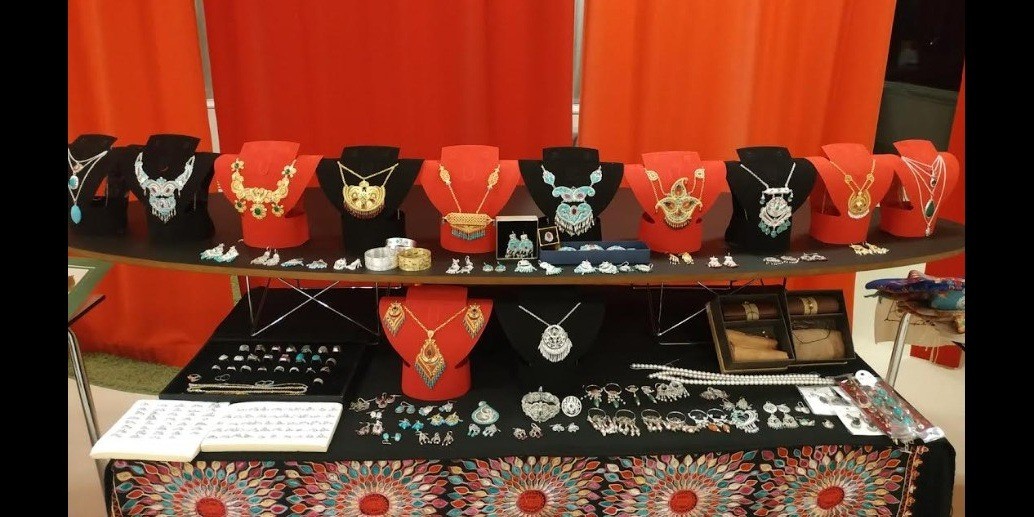
Image courtesy of Zokir Negmatov
Apprenticeship
Negmatov came of age as Uzbekistan’s craft economy was being reshaped after independence. The Soviet system had folded jewelry into planned production; after independence in 1991, that system broke down without an immediate replacement. In 1997, a presidential decree on folk arts and applied crafts led to the establishment of the Hunarmand Association to coordinate artisans, supply materials, and organize fairs, with tax privileges for qualifying craftspeople. Craft was being reconstituted as a viable occupation.
In 1998, the year after the decree, Negmatov became an apprentice to Ashur Khasanov, a member of the older generation of Bukhara craftsmen.
The first piece Negmatov finished was a pair of small earrings for children, a Bukharan form called Muhammadiy. “Although it is a small object, making such a piece by hand taught me the basic discipline of the craft,” he says. “Symmetry, proportion, soldering, construction, and finishing.” He returns to it as a marker: “Muhammadiy is therefore not simply an old jewelry form; it is also personally connected with the beginning of my path as a jeweler.”
What he took from Khasanov was broader than method. The master “taught me how to understand metal, proportion, construction, and ornament, and how to approach a piece as a complete work rather than simply as a decorative object.”
A year later, Negmatov married and moved to Tashkent. The apprenticeship, in its formal sense, was over, but he maintained a close relationship with his master. “Although I was no longer beside my teacher every day, our connection did not end,” he says. “Whenever I encountered a problem or needed knowledge or advice, I continued to consult Ashur Khasanov.”
Working independently in a new city, he honed his craft through repetition. “I worked extensively, studied different techniques, experimented, and learned through experience. If I was not satisfied with the result, I continued working on the piece or remade it until I achieved the quality I wanted.” A simple piece takes him days; a complex one takes weeks. “For me, quality is more important than speed.”
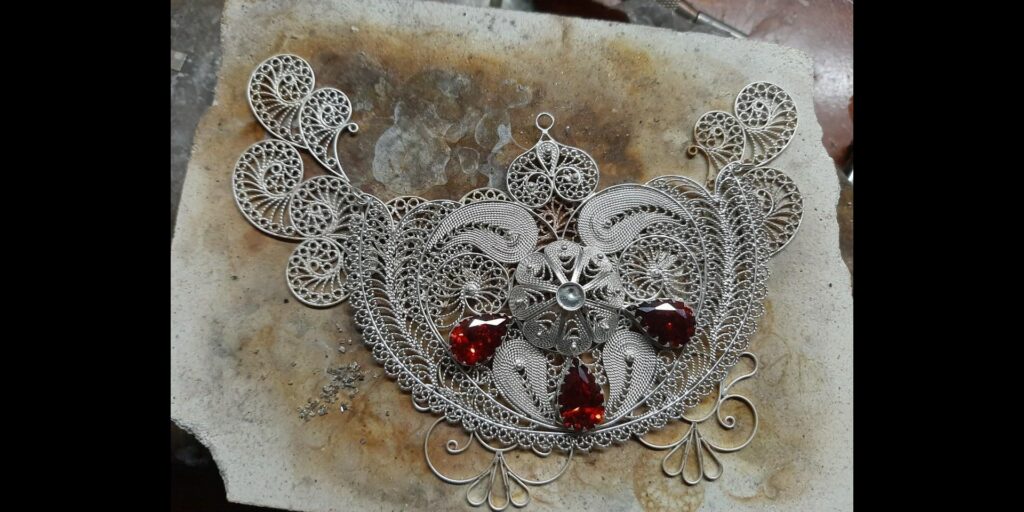
Image courtesy of Zokir Negmatov
The Bukharan School
Although he considers himself part of the Bukharan school of jewelry making, Negmatov is careful about the term. “When we speak of a ‘school,’ we do not necessarily mean a formal institution. We mean a tradition transmitted from master to apprentice: characteristic forms, proportions, ornament, construction methods, stones, and ways of working with metal.”
For a non-specialist, he offers three markers of Bukharan work. The first is ornament, which tends toward rich, detailed compositions, with repeated decorative and floral elements rather than plain surfaces.
The materials are also telling. “Coral is one of the materials strongly associated with traditional Bukharan and Central Asian jewelry,” he says. Coral was among the materials once traded under the dome of Toqi Zargaron. The third marker is construction: pieces are assembled from connected elements rather than made rigid, so that “small pendants and articulated components can move with the wearer.”
His mother’s expertise with embroidery is audible in how he speaks about ornament. “Jewelry and zardozi are different crafts, but their ornamental languages can be closely related. Floral forms, symmetry, repetition, rhythm, and the way ornament fills a surface are all things I observed from an early age, and I transferred embroidery patterns into jewelry in my own way, as a translation of sorts.”
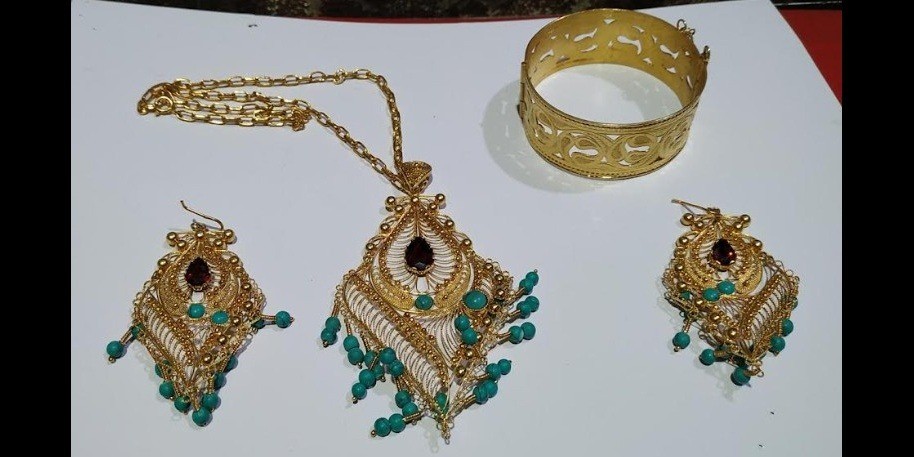
Image courtesy of Zokir Negmatov
Artisanal Jewelry Versus Industrial Production
For the past four years, Negmatov has worked as a jeweler in Baltimore, bringing the craft to the United States. Computer-aided design is now widespread in commercial production, in Uzbekistan as elsewhere, and he is measured about it.
“A computer can create a design and a machine can produce a model, but neither can replace the knowledge that develops in a jeweler’s hands after years of experience,” he says. The traditional master reads the metal directly: “how much it can be formed, where and how it must be heated, how very small elements should be soldered, how a stone should be set.”
Machine-made jewelry might still look right, but what disappears is the human experience of making a piece by hand, and with it a method. “The names of the different parts of the process, the construction methods of a piece, and original proportions can gradually disappear if craftsmen stop studying them,” he says of the older forms. Recreating one “does not mean simply copying its outline. You have to understand how the original master thought and how the object was actually made.”
Negmatov himself has trained more than twenty apprentices. “I consider teaching an important part of my work because a traditional craft survives only when knowledge is passed from one generation of craftsmen to the next.”