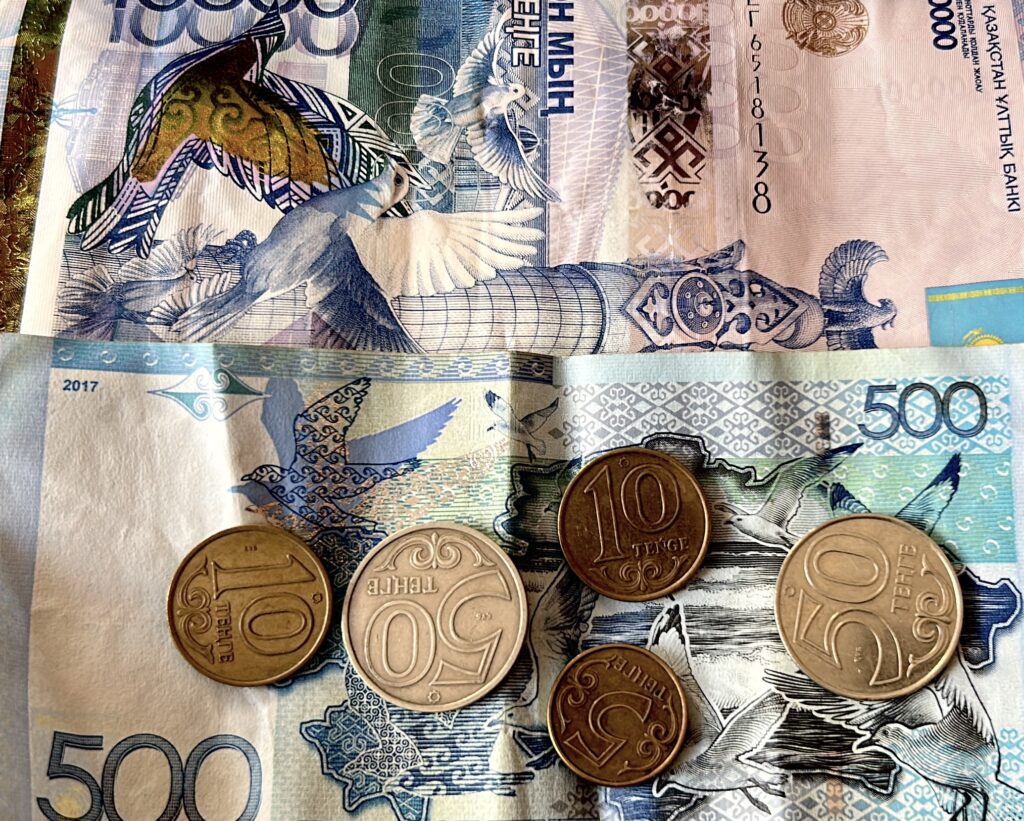
Kazakhstan’s tenge has strengthened by 9.7% against the dollar since the start of 2026, making it the best-performing currency across Europe and Asia, according to the Financial Times. The newspaper points to an influx of foreign capital into Kazakhstan’s government debt: nonresident holdings of tenge-denominated bonds have risen from roughly $2 billion to $5 billion over the past year. The appreciation has come despite serious disruptions to Kazakhstan’s oil exports through Russia.
Kazakh data show that foreign interest in government securities did not begin this summer. In July alone, nonresidents increased their holdings by 92.2 billion tenge, about $195 million, to 2.6 trillion tenge, or roughly $5.5 billion. Since the start of the year, their portfolio has grown by 32.9%, while their share of the market has risen from 6.2% to 7.2%. The Association of Financiers of Kazakhstan (AFK) attributes the interest to high real interest rates and relative macroeconomic stability.
Why Foreign Investors Are Buying Kazakh Debt
During 2025, nonresident holdings of Kazakh government securities rose from roughly 1.1 trillion tenge, about $2.3 billion, to 2 trillion tenge, about $4.2 billion. Growth continued this year. In June alone, foreign investors added 185.1 billion tenge, about $390 million, bringing their total holdings to 2.5 trillion tenge, roughly $5.3 billion. Their share of the market increased from 6.2% to 6.9% by then.
The reason for the interest is fairly straightforward: Kazakhstan offers high yields while maintaining an investment-grade credit rating. The base rate remained at 18% through the spring. The National Bank cut it to 17% in June and announced a further cut to 16.75% on July 24. Annual inflation, meanwhile, declined for a ninth consecutive month and stood at 10.3% in June.
For foreign investors, the combination of high interest rates and a strengthening tenge creates an opportunity to earn both on bond yields and currency appreciation. For the tenge itself, the same transaction works in reverse: before buying a Kazakh security, a foreign investor has to acquire the national currency. In June, AFK analysts cited nonresident transactions among the factors supporting the tenge, alongside foreign-currency sales by exporters, state-controlled companies, and the National Bank.
Market Access Is Becoming Easier
High yields alone do not explain the growing interest. Kazakhstan is also trying to make its domestic debt market easier for international investors to access.
A primary dealer system has been operating since May 4. Five banks were granted primary dealer status and are expected to support the government securities market, including buying and selling bonds in the secondary market.
In April, the National Bank announced that Euroclear had begun a project to make Kazakhstan’s government bonds eligible for settlement through its international system. A direct link with the local market infrastructure is planned for 2027. For foreign investors, this would make it possible to trade Kazakh government debt through a familiar global settlement system, alongside the existing Clearstream channel.
Kazakhstan is also seeking eventual inclusion of its tenge-denominated government bonds in JPMorgan’s GBI-EM, one of the main international indexes for emerging-market government debt. If that happens, funds whose portfolios track or benchmark against the index could become more active in the Kazakh market.
Why the Tenge Is Linked to Oil
The tenge is not formally pegged to the price of oil, but Kazakhstan remains a major oil economy, so the connection is clearly visible through export earnings. Higher export volumes and prices generally mean more foreign-currency revenue for exporters, while lower shipments or prices reduce it. Part of the state’s oil revenue goes into the National Fund, and foreign-currency sales from the fund also affect the domestic market. Oil therefore remains an important factor for the tenge, though far from the only one.
This is why the events of this summer might have been expected to push the tenge in the opposite direction. The Caspian Pipeline Consortium (CPC) carries more than 80% of Kazakhstan’s oil exports, and its Black Sea terminal near Novorossiysk repeatedly suspended loadings in July following attacks on tankers. The Times of Central Asia compiled a chronology of the incidents: four tankers were hit between July 17 and July 20, repeatedly interrupting loading operations. Exports resumed on July 27, but another attack on July 30 again halted loadings.
Reuters reported that by July 26, the country’s oil and gas condensate production had fallen to around 1 million barrels per day, less than half the June average. Production began to recover after CPC resumed accepting crude, but Kazakhstan still ended July with output down about 14% from June.
However, the tenge did not reverse course as oil flows were disrupted. That does not mean Kazakhstan’s dependence on oil exports has disappeared: the country still has no other route capable of replacing CPC at comparable volumes. Rather, the pressure from disrupted oil exports has coincided with unusually strong capital inflows into the domestic bond market.
What Happens as Rates Fall
Over roughly a year and a half, foreign holdings of Kazakh government debt have risen from about 1.1 trillion to 2.6 trillion tenge, from around $2.3 billion to $5.5 billion. AFK has already cited nonresident transactions as one factor supporting the tenge. The appeal of Kazakh securities, however, still depends heavily on conditions that are difficult to regard as permanent: the base rate remains at 16.75%, while the tenge has been appreciating.
The National Bank has already started cutting rates, from 18% in the spring to 17% in June and 16.75% in July. The regulator does not set a predetermined path for future decisions and says it may pause or change direction depending on inflation. Its next scheduled rate decision is September 4.
As yields decline, part of the current advantage offered by Kazakh bonds will diminish. On the other hand, Euroclear access, the development of the secondary market, and possible inclusion in international indexes could attract investors interested in Kazakhstan for reasons beyond a yield of almost 17%.
It is therefore too early to view the tenge’s current appreciation as evidence that Kazakhstan’s dependence on oil has weakened. A more revealing indicator will be how foreign investors behave when interest rates are lower. If their holdings continue to grow, then it would suggest that Kazakhstan’s debt market itself has changed, rather than simply the price of money within it.