A century ago, in 1926, the Russian-language Uzbek newspaper Pravda Vostoka published an appeal to the “working women of the Soviet East” written by Clara Zetkin – a Marxist and a women’s rights advocate from Germany. In its appeal for women’s unveiling, it asked where the mullahs had been while women suffered through the “dark past” and promised that Soviet law now shone “bright rays” over a liberated and free Soviet present. It closed not with a tribute to women, but with a slogan: “Forward to socialism! Always ready to fight for world revolution!”
There was a significant problem with this text. Literacy among Uzbek women was extremely low, particularly in rural areas, and those who could read generally read Uzbek rather than Russian. Historian Marianne Kamp documents this gap in her book The New Woman in Uzbekistan. The article calling women to political consciousness was, therefore, not directly accessible to the overwhelming majority of its stated audience.
That gap is not just a flaw in the propaganda or evidence of its exaggerated reach. Rather, it explains how the propaganda worked. A Russian newspaper speaking to Uzbek women who largely could not read it depended on party cadres, activists, public readings, meetings, and other literate intermediaries who could disseminate the message in Uzbek. It did not address an existing constituency so much as construct one – handing local organisers a model of the politically awakened Soviet woman they were expected to promote in villages where practically no woman could have read the article herself.
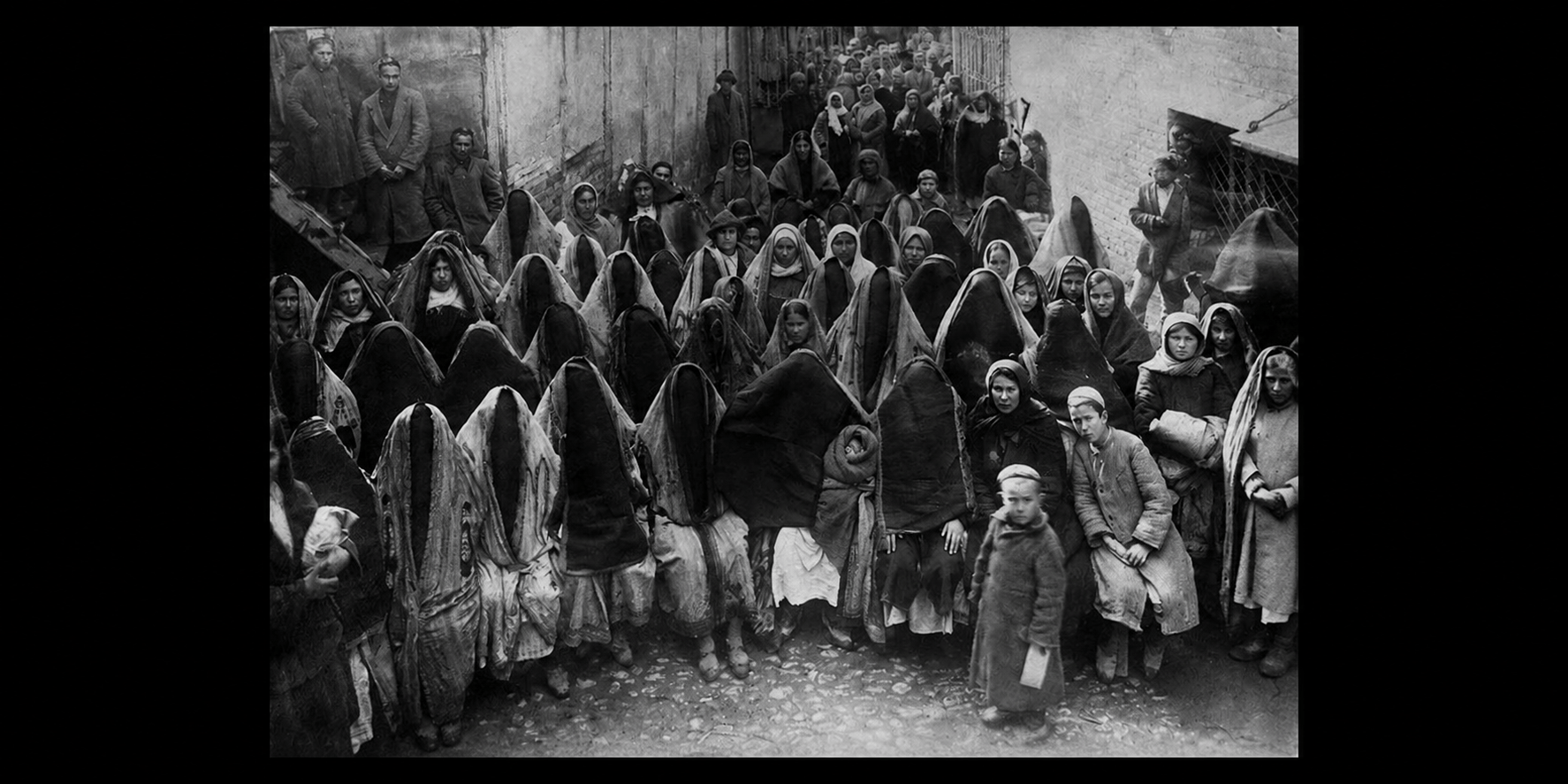
Uzbek women in the old city of Tashkent before going out into the street on International Women’s Day, March 8, 1924. Photo: Public domain.
The “working women of the Soviet East” were therefore both an audience and an emerging political category. That category served a larger claim the Soviet state was making about Central Asia: that the region was “backward” and required revolutionary socialist transformation. In Soviet rhetoric, as in some earlier Russian imperial writing, the condition of women became one of the principal measures by which a society’s level of development was judged. A society’s position on the imagined path from feudalism to modernity could be read from whether its women were veiled or unveiled, secluded or employed, illiterate or educated. Transforming women’s appearance and public role offered the state an especially visible means of demonstrating that Central Asia was leaving its supposedly backward past behind.
This does not mean that Soviet female emancipation was merely an empty disguise for imperial domination. Many contemporary works by historians such as Adrienne Edgar, Marianne Kamp, and Shoshana Keller showcase the genuine changes produced by Soviet literacy campaigns, education, employment, family law, and women’s political participation. Soviet gender policy did not simply reproduce the restrained paternalism of the tsarist administration. It attempted, and in many ways succeeded, at a much more radical transformation in the realm of gender politics.
What it does complicate is who was doing the defining. It is tempting to read the appeal as a male party apparatus speaking about women for its own revolutionary purposes. In a conversation with a Central Asian historian, Marianne Kamp, about the authorship of the appeal, she pushed back on the claim and argues it was substantially defined by women working inside the state. She attributes the article, and the “working women of the Soviet East” campaign more broadly, to a milieu shaped substantially by women themselves – among them Clara Zetkin and the Zhenotdel, which Kamp describes as having had real institutional agency of its own rather than simply executing instructions from male leadership. “When I hear this, “Oh, it is just the state trying to exploit women,” give me a break!” she says. “It is women fighting back, trying to figure out how they are going to survive and maybe even thrive in this new [political] configuration (…) I see it [Zhenotdel] as an organisation that was started by women, that always was for women”. Staffed and largely run by women, the Zhenotdel combated illiteracy, explained new laws, recruited activists, and helped drive the campaigns that fed into the 1927 hujum, the mass unveiling drive. That work was real, and it was substantially women’s own work – carried out through a party apparatus that was itself overwhelmingly male at senior levels.
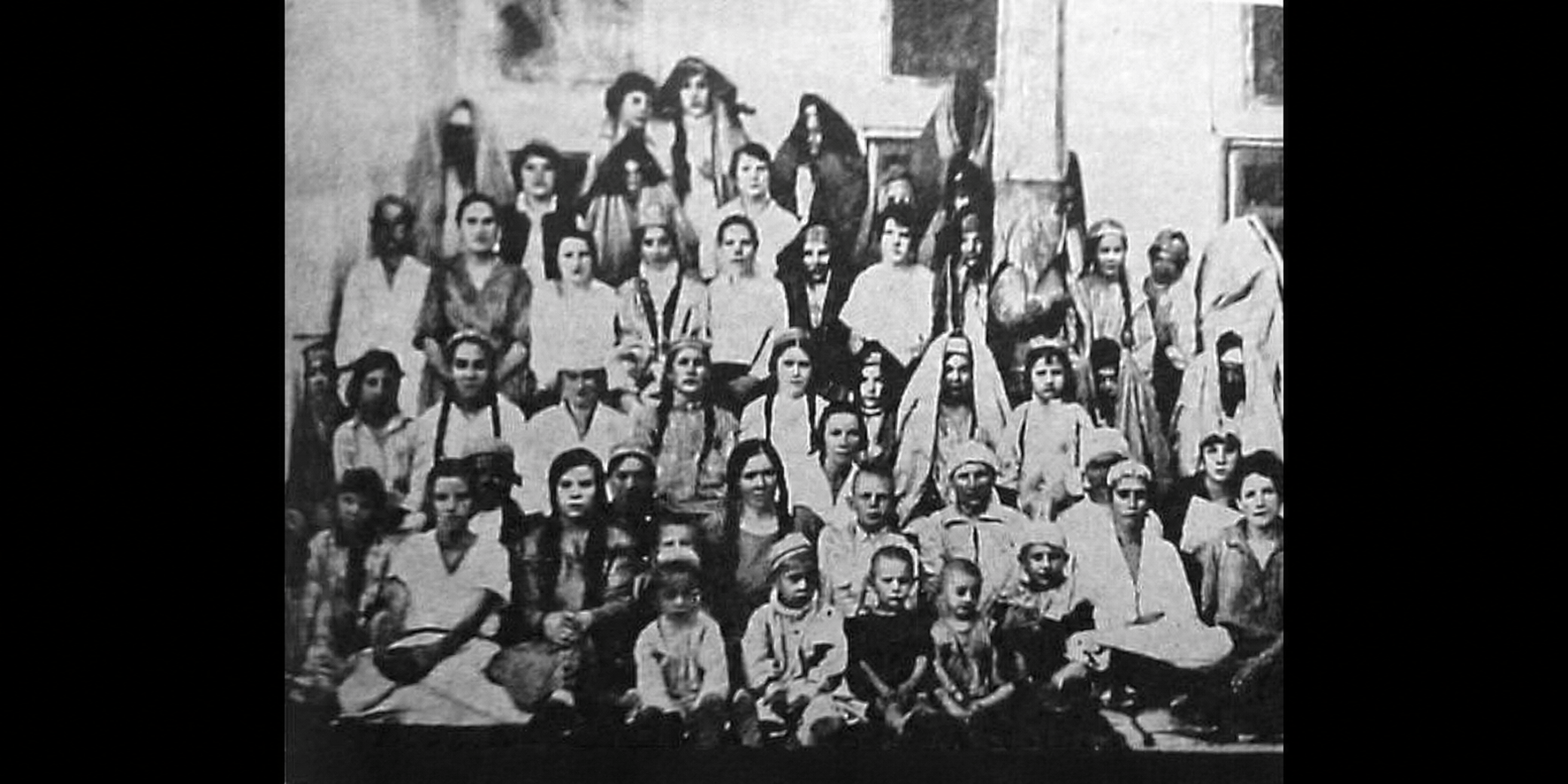
Women from the local women’s division in Bukhara in 1928, many of whom had recently stopped wearing the veil. Photo: Public domain.
Nonetheless, those opportunities were still inseparable from the political purposes of the Soviet state. Women were encouraged to participate not principally as an autonomous constituency, but as participants in socialist transformation. And the history of the Zhenotdel and its abolition in 1930 illustrates that tension. Officially, this was billed as an elevation, not an abandonment. Scholars of the Zhenotdel have, however, pointed to a longstanding Bolshevik suspicion that organising women within a separate organisation risked “feminist deviations” from the wider class struggle. The question here was not only whether women would enter public life, but also whether they would do so in the form prescribed by the party.
Both things can be true, and together they say something sharper than either: the Zhenotdel was allowed to operate at scale for as long as literate, mobilised, wage-earning women also served the party’s own priorities – industrial labour, a war on religious authority, proof of revolutionary transformation. When autonomous women’s organising stopped tracking those priorities and began to look like a rival source of loyalty, it was dissolved.
The abolition is neither proof that Soviet women possessed no real agency nor evidence that men did not care about women’s emancipation while dressing up other goals in its language. It is evidence of something more specific: women who did care about it had to advance it through institutions men ultimately controlled, and were funded, published, and protected only for as long as their agenda and the party’s economic and political agenda pointed in the same direction.
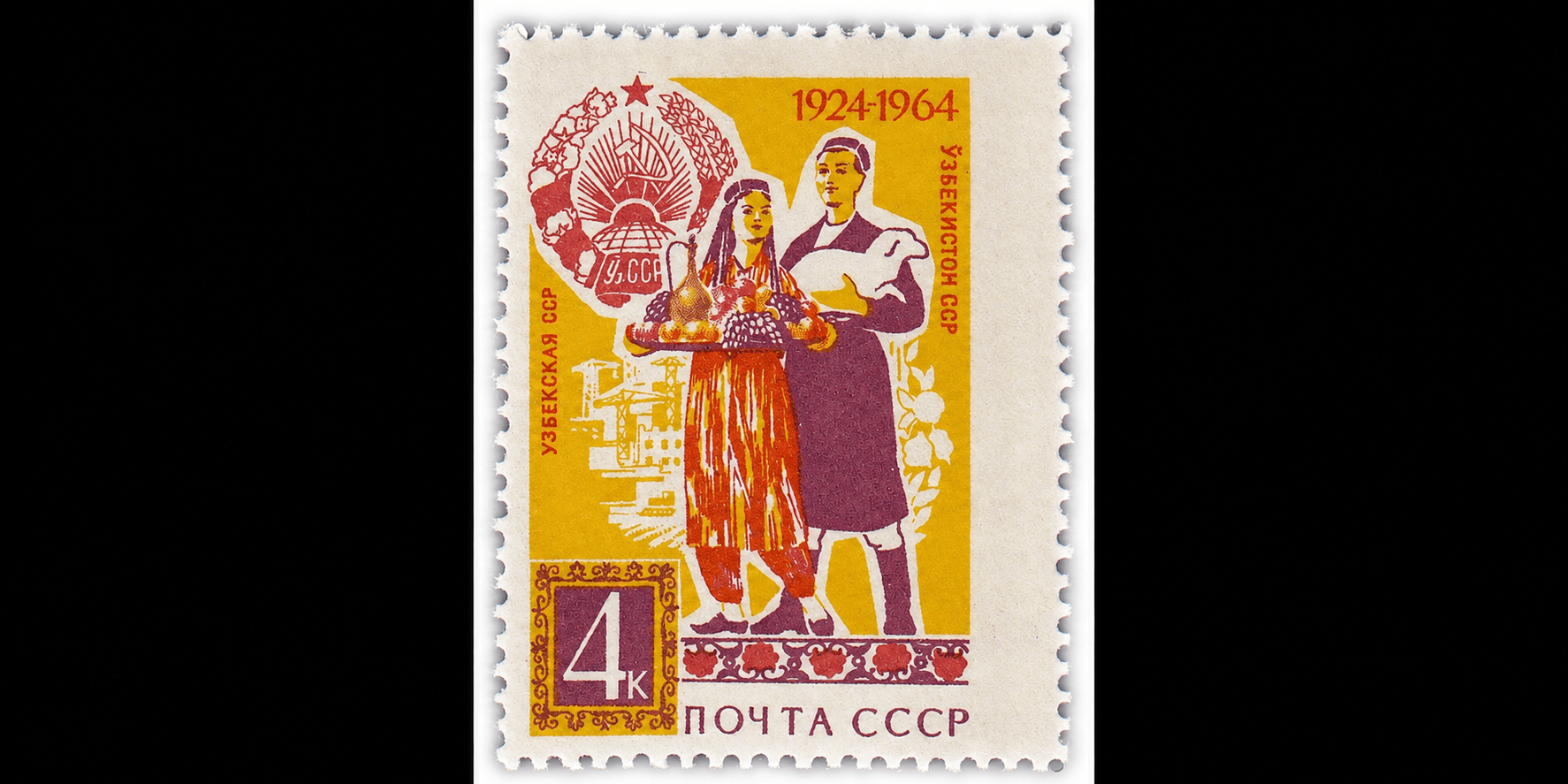
USSR postage stamp marking the 40th anniversary of the Uzbek Soviet Socialist Republic, 1964. Image: Public domain.
A century later, International Women’s Day remains one of Uzbekistan’s most widely celebrated holidays, and its official register has changed completely
In his address marking 8 March this year, President Shavkat Mirziyoyev described Uzbek women as entrepreneurs, scientists, teachers, doctors, engineers, athletes, and public figures. The official account also emphasised gender-impact assessments for new legislation and reported that Uzbekistan now has nearly 230,000 women entrepreneurs, more than 12,000 women farmers, and over 6,000 women working in scientific research. Days before the ceremony, Mirziyoyev had also signed a decree tightening penalties for harassment and violence against women and children, framed as part of the same policy of expanding women’s legal protections. Taken together, these claims present women’s professional participation and legal standing as central components of the government’s program for a “New Uzbekistan.”
Yet Mirziyoyev also placed those achievements within a pronounced maternal and familial framework. Women, he said, had raised the country’s young generation “with a mother’s love.” Whatever their profession, they remained “above all” the guardians of the hearth and the foundation of the family and society.
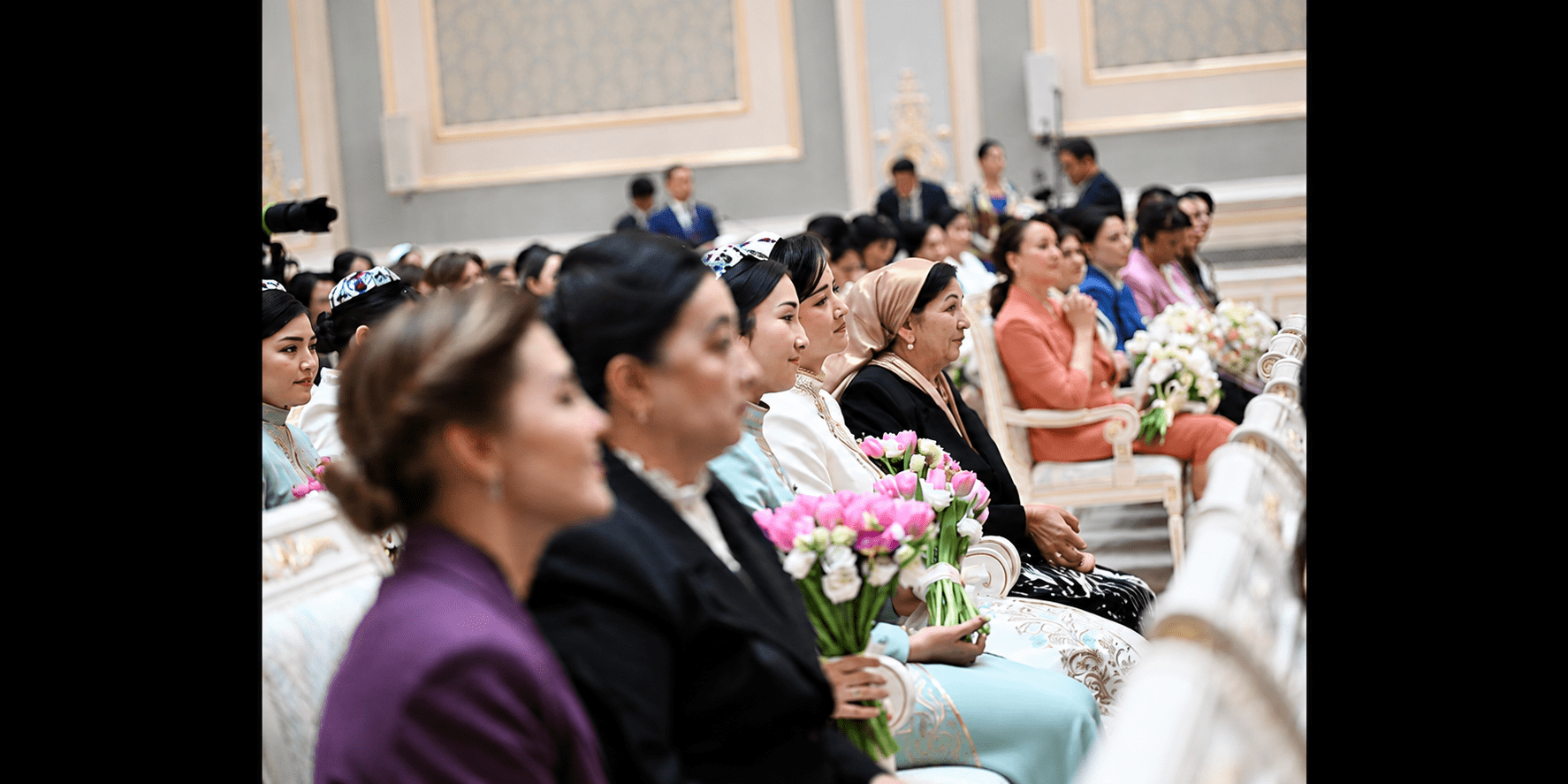
Women attending an International Women’s Day ceremony at Kuksaroy in Tashkent, March 6, 2026. Photo: President.uz
Irina Matvienko, a feminist activist and gender-policy expert and founder of Nemolchi.uz, hears that combination as a demand rather than a description. “There is a strong emphasis on the image of a woman leader, a woman politician, or a woman who has achieved significant professional success,” she said. “At the same time, it is always highlighted that she successfully combines these achievements with motherhood, marriage, or caring for her family. Moreover, she is expected to remain gentle, slim, well-groomed, attractive, and beautiful.” She points out that journalists routinely ask successful women how they balance career and family and seldom ask men the equivalent: “I rarely, if ever, hear journalists ask successful businessmen or politicians, “does your wife allow you to travel so frequently?”.” The issue, in her framing, is not that the balance is hard – it is that “the rules of the game are not equal.” She connects this to the “second shift”: paid public work added on top of undiminished domestic responsibility, normalized as unremarkable rather than named as a burden of womanhood.
Kamp does not dispute that this is the effect of the rhetoric. She disputes who is producing it, and argues the more useful question is not who wrote it but what let it through. In her account, the substance of Mirziyoyev’s address – the emphasis on women’s education, entrepreneurship, and legal protection, and the specific concern with women’s underuse of their own qualifications — reflects the influence of Saida Mirziyoyeva, the president’s daughter and head of the Presidential Administration, and of feminist advisers working through the government’s gender equality commission, rather than indifference from the men who formally deliver these speeches.
It is worth situating that feminist agenda alongside where Uzbekistan says its own priorities lie. The Uzbekistan–2030 Strategy, adopted in 2023, originally set a GDP target of $160 billion by 2030. After GDP exceeded $145 billion in 2025, Mirziyoyev raised the 2030 target to more than $240 billion. The government also aims to diversify the economy away from labour migration and remittances, which the World Bank puts at about 14% of GDP, and toward sectors that can absorb large-scale foreign investment. Educated, economically active women are a direct input to that target; a government pursuing it has an obvious interest in graduates staying in the workforce. None of this means the policies were designed cynically; that is a separate and much harder claim, and not one this piece is making. But the overlap is worth naming: the parts of the women’s agenda that have become decree and headline statistic are also the parts that align with targets the government has committed to for other reasons. The maternal framing Matvienko flags sits outside that overlap. Redistributing domestic labour is not a line item in a national strategy the way GDP or FDI is – which may be as much an explanation as any for why it has not drawn the same institutional weight.
Kamp and Matvienko are not, in the end, describing different things. Matvienko is describing the effect: rhetoric that requires women to be both accomplished and domestic and treats that as unremarkable. Kamp describes who wrote the content that produces the effect: women working from within institutions they did not fully control. The 1930 dissolution of the Zhenotdel and the maternal frame around Mirziyoyev’s 2026 address are the same mechanism a century apart – a state that will carry as much of a women’s agenda as also serves its own priorities, and sets it down exactly where that alignment stops. Literate, mobilised labour for a revolutionary economy then; educated, economically active women for an investment-seeking one now. What made it through the gate in both cases was real. What did not – autonomous organising in 1930, an equal division of domestic labour today – is precisely the part that offered the centre nothing it was already trying to buy.
That is not a claim of equivalence. The Soviet campaign involved compulsory transformation, an assault on religious authority, and, often, violence; contemporary Uzbekistan is a fundamentally different political order, and the scale of change in women’s education, employment, and legal standing over the century is real and not in dispute.
Nor does it settle what either text was actually for. Two official statements, however carefully traced back to their authors, cannot say how Uzbek women themselves experienced either moment. Women in the 1920s adapted, resisted, and used Soviet institutions for purposes the state never intended; their experience survives in oral histories and their own writing, not only in the newspaper that claimed to speak for them. A presidential address today reveals what the state is willing to recognise in women, not what Uzbek women make of the combination it recognises – empowering, restrictive, unremarkable, or all three at once.
What has changed in the hundred years between them is who is positioned to answer that question. The audience the 1926 appeal could only imagine – largely illiterate, reached through intermediaries, unable to write back – is now an educated, professionally active population that includes feminists sitting closer to the centre of power than the Zhenotdel ever reached, and that can contest, in its own voice, how much of its own definition the centre is actually willing to let through.
The views expressed in this article are those of the author and do not necessarily reflect the official policy or position of the publication, its affiliates, or any other organizations mentioned.