More than 3,000 athletes from 104 countries gathered in Bishkek on August 31 as the World Nomad Games returned to Kyrgyzstan, a sharp increase from the 583 competitors from 19 countries who attended the inaugural event at Issyk-Kul 12 years ago. Tour operators are also seeing more Western travelers, many using the Games as the centerpiece of a longer journey through Central Asia.
Around 30,000 people attended the opening ceremony before the sporting and cultural programs moved to Issyk-Kul. Ahead of the Games, Kyrgyzstan’s State Agency for Tourism Development projected more than 100,000 guests over the course of the event. Late on September 2, organizers reported that around 150,000 people had visited Kyrchyn during the first two days, though they provided no methodology or breakdown between domestic and foreign visitors.
Kyrgyzstan’s foreign tourism market remains predominantly regional, with more than 95% of foreign tourists in recent years coming from neighboring Central Asian countries and Russia. Arrivals from Europe and the United States have nevertheless been rising, according to the Tourism Development Fund.
Western interest in the World Nomad Games was already apparent in 2024, when packages offered by Regent Holidays and Wild Frontiers, both based in the United Kingdom, sold out months before the fifth Games in Kazakhstan.
Ak-Sai Travel, a Kyrgyzstan-based tour operator, is offering two itineraries built around this year’s Games. Asked whether the company has seen a significant rise in Western visitors, its chief marketing officer, Aikanysh Akynbekova, told TCA, “Yes. We have seen growing interest from Western markets over the past few years, particularly since international travel fully recovered after the pandemic.”
Akynbekova identified Germany, France, Italy, the UK, Spain, and Switzerland as the company’s strongest Western markets. She attributed the increase to improved air connections and greater media coverage of Central Asia, along with growing interest in nature and cultural travel.
Demand for Ak-Sai’s Games itineraries has been particularly strong among people already considering a trip to Central Asia. Many of its Western customers are visiting Kyrgyzstan or the region for the first time and are looking for less crowded destinations and meaningful cultural experiences.
“For most travelers, the Games are an important highlight rather than the only reason for visiting,” Akynbekova said. The itineraries combine the event with travel through Kyrgyzstan, including its mountain landscapes and historical sites.
MIR Corporation, a Seattle-based tour operator, is running one scheduled small-group tour for the Games. Andrew Barron, the company’s director of service and support for retail tours, said 11 of the 16 places had been booked, all by travelers from the U.S.
For most of the group, the Games are the principal reason for traveling, although about half are also visiting elsewhere in Central Asia before or after the event. Barron knew that roughly a third had visited the region before, but could not say how many of the others were first-time visitors.
Bookings opened in fall 2025, but most were made during 2026, about half since the spring. MIR continued to receive last-minute inquiries during the final month before departure. Barron said bookings had met expectations, adding that “interest has been higher this year than in the past.”
Barron described MIR’s customers as cultural travelers. Asked about the event’s strongest attraction, he said, “The unusual character of the event in all its facets.”
One of those travelers, Mike, an American based in New York, had never taken an organized tour before. “I’ve never used a tour company before, let alone a group tour, so I was a bit apprehensive, but it has been excellent,” he said.
Mike had already planned an extended overseas journey and decided to include Central Asia, a region he previously knew little about. The Games gave him a cultural event around which to build part of the trip.
Describing MIR’s role, Mike said, “The company transformed what could be a difficult process of navigating a complicated event with significant language, logistical, and cultural hurdles into a relatively seamless process.” He credited tour leader Farhad’s local knowledge with resolving problems as they arose and was sufficiently impressed with MIR’s planning to use the company for a longer Central Asian itinerary.
Still traveling in Kyrgyzstan, Mike entered the country from Tajikistan through the Pamir Mountains, reaching Sary Tash before continuing to Osh and flying to Bishkek. At the first border checkpoint, he mistook a guard’s outstretched hand for a request for his passport; the guard simply wanted to shake hands, ask his name, and welcome him to Kyrgyzstan. From Bishkek, Mike traveled to the Games at Issyk-Kul, stopping at Burana along the way. His trip has also included a visit to Ala-Archa National Park.
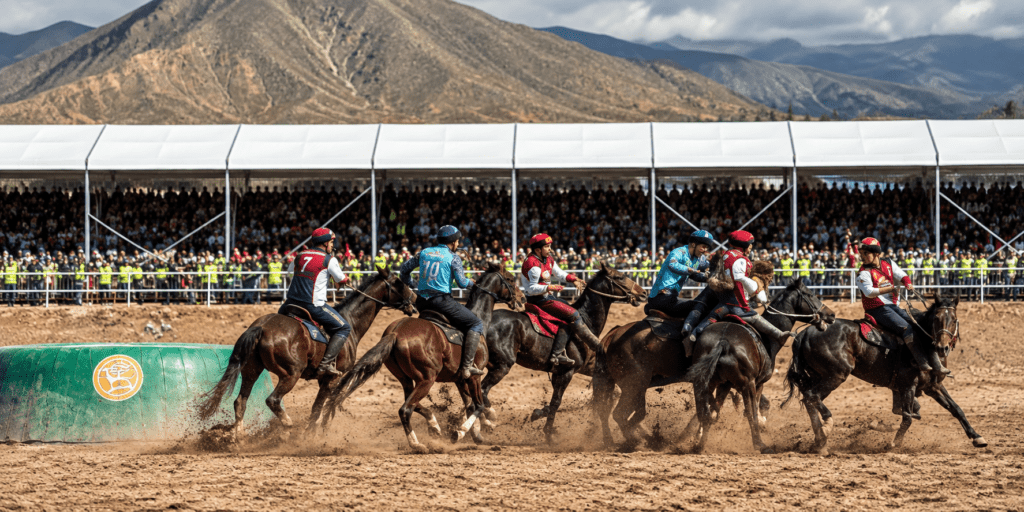
During the Games, Mike met Norwegians on a shuttle and discussed lagman, a noodle dish popular across Central Asia, with a Uyghur from Russia while watching kok boru. In the mounted team sport, riders try to carry a goat carcass, known as an ulak, into the opposing goal. “The games themselves are unlike any athletic events I’ve seen, but throwing an ulak in the goal with a flip is just as thrilling as a spectacular alley-oop,” he said.
Mike said the event was experiencing “growing pains in event management” amid higher attendance and pressure on venues, although his overall experience had been very good.
Barron cited limited accommodation as a practical difficulty for the group tour, while guide availability affected the custom independent travel MIR also arranges.
Asked whether uncertainty over tickets and schedules had affected planning, Barron replied, “Yes, finalized information has been somewhat challenging to come by on the ticketing and schedule fronts, but our travelers understand this as an aspect of the planning and are patient in awaiting final details.”
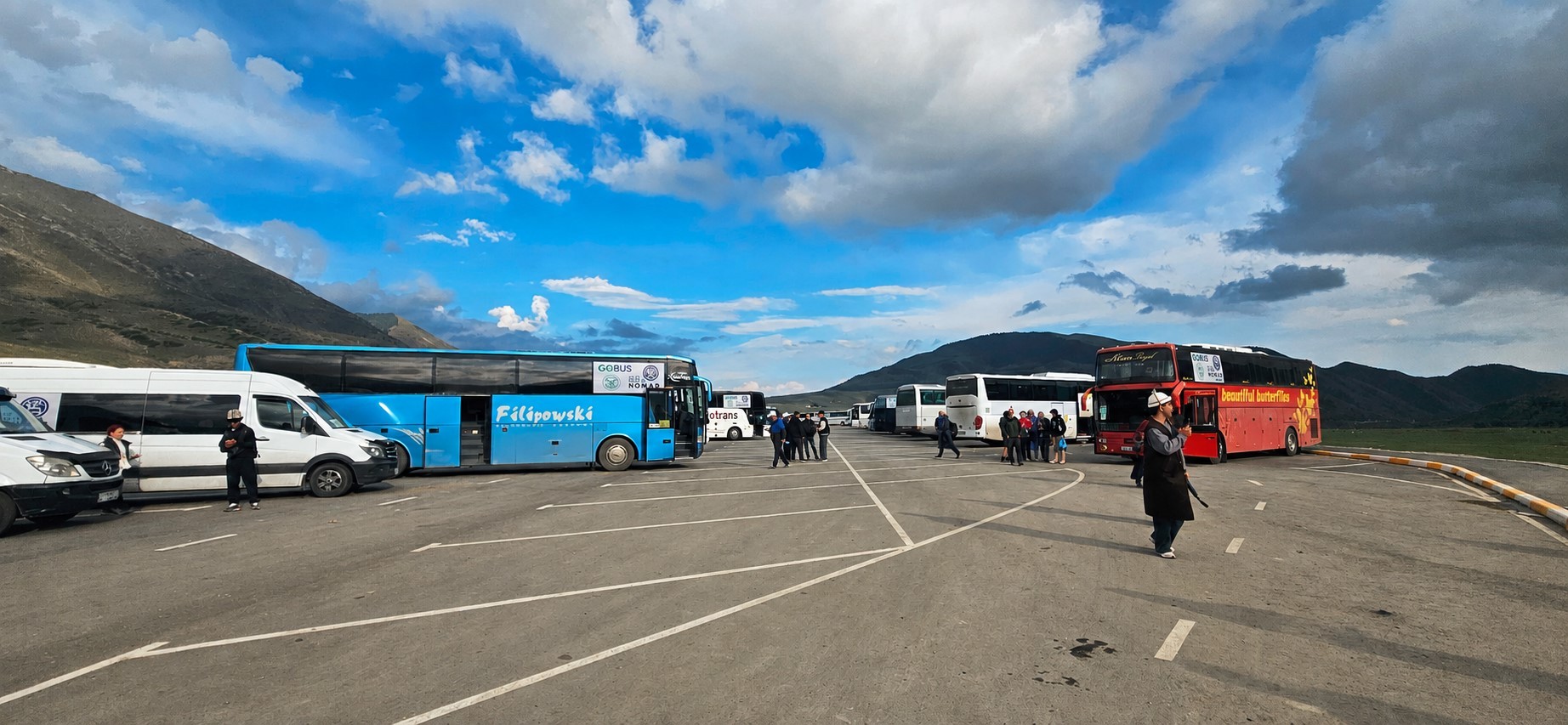
Akynbekova had also expected greater pressure on accommodation and transport, along with increased competition for experienced English-speaking guides. Organizers published the detailed schedule for the Issyk-Kul program on August 21, ten days before events there began. On September 2, after large queues formed, the World Nomad Games media headquarters said 40 additional buses had been sent to Cholpon Ata and another 10 to Kyrchyn.
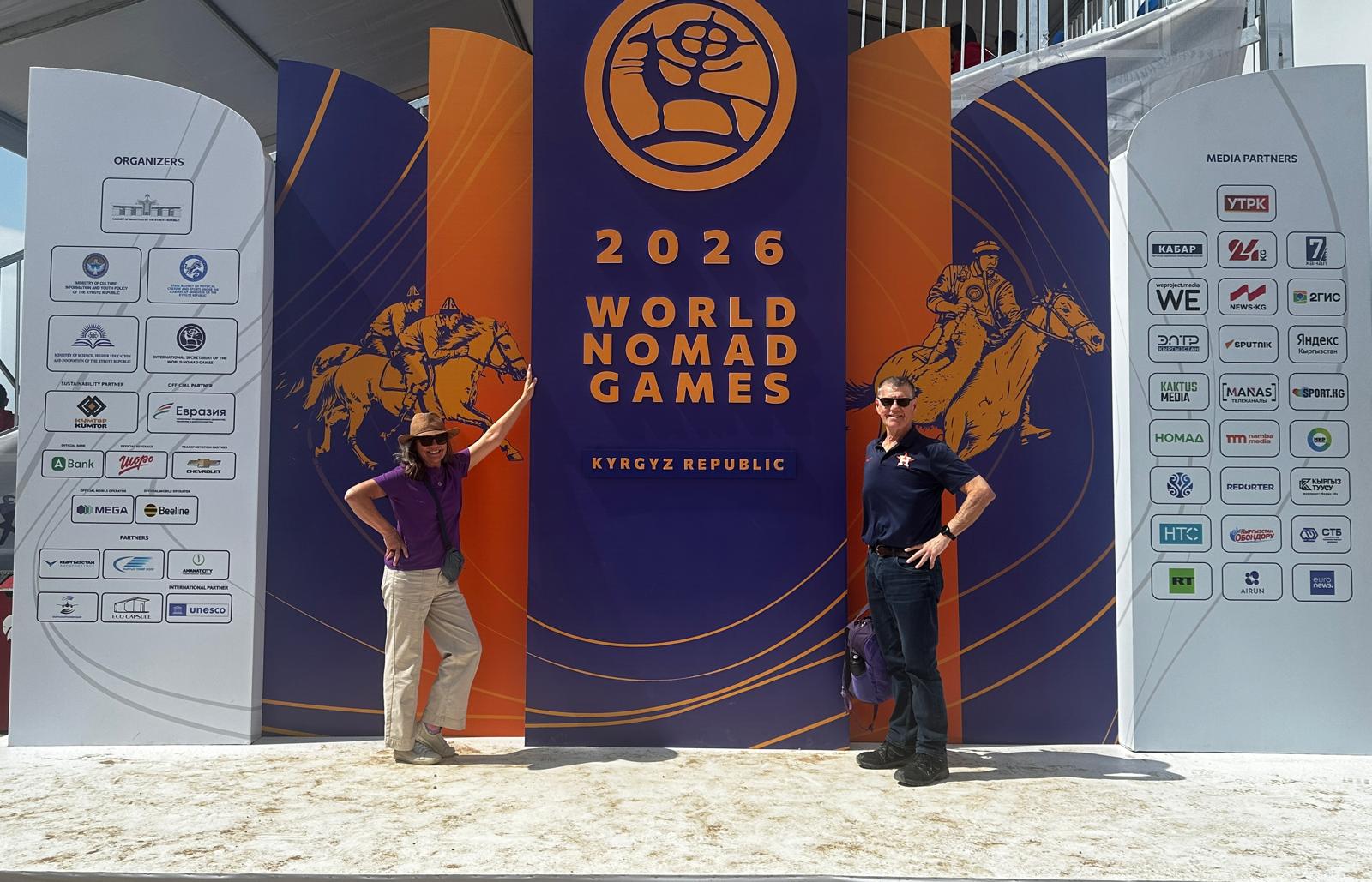
Image courtesy of Karen and Howard Bowland
Karen and Howard Bowland, from Sydney, Australia, are attending with a UK-based tour company after a friend of Karen’s spoke highly of a previous trip to the region. The Games form part of a longer Central Asian journey for the couple.
Still early in their trip, they had toured Bishkek and walked in a national park before reaching Issyk-Kul.
“Our guide is finding out information in real time,” they said. They had encountered problems entering the opening ceremony, and volunteers had been unable to tell them where to go.
The Bowlands have nevertheless enjoyed the Games and were impressed by the opening ceremony once the presidents arrived. They were unsurprised by the loud cheers for Russia but did not expect the U.S. team to receive such an enthusiastic reception.
“As a Westerner, it is interesting and surprising to see the solidarity of the region here that is not really apparent back at home in Australia,” one of them said.
Asked about kok boru, which was another highlight for them, the couple replied, “Basically mounted rugby with a goat as a ball. Very good.”
Akynbekova believes the Games can encourage some first-time Western visitors to return after discovering more of Kyrgyzstan. Asked whether the event had become a mainstream international attraction or remained a specialist one, Barron replied, “Somewhere in between, an established tourism event, but only for those ‘in the know.’”
For more from our World Nomad Games 2026 special coverage, click here.