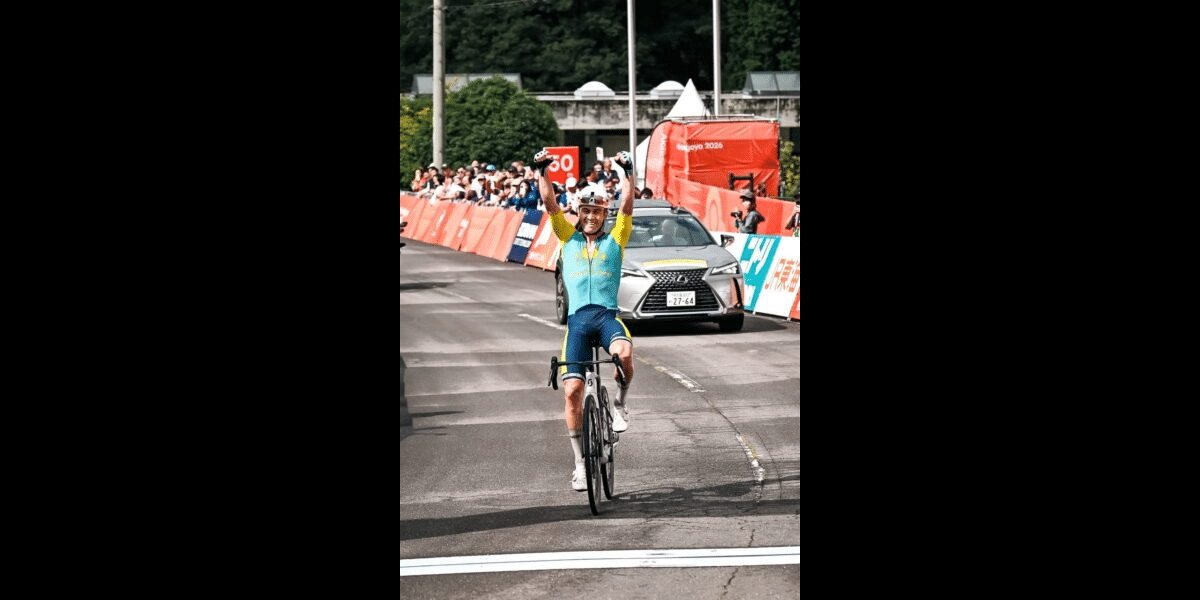
Kazakhstani cyclist Alexey Lutsenko won the men’s road race at the 2026 Asian Games in Aichi-Nagoya, Japan, becoming his country’s most successful athlete in Asian Games history. The victory gave the 34-year-old his sixth Asian Games gold medal as he prepares to end his professional career.
On September 23, Lutsenko completed the 160.5-kilometer race in 4 hours, 13 minutes, and 11 seconds. His teammate Yevgeniy Fedorov finished second, 1 minute and 58 seconds behind. Another Kazakhstani rider, Nicolas Vinokurov, the son of Olympic champion Alexander Vinokurov, helped control the race for the team and finished seventh.
His second gold at the current Games came on September 20, when he won the individual time trial for the fourth consecutive Games, a discipline in which riders race individually against the clock. Lutsenko covered the 32.4-kilometer course in 41 minutes, 24.05 seconds, beating silver medalist Shunsuke Imamura of Japan by more than a minute and a half.
Before the Games in Japan, Lutsenko had won four Asian Games gold medals. He won the individual time trial in 2014, 2018, and 2022, and also took gold in the road race in Jakarta in 2018.
His fifth gold brought him level with Kazakhstan’s previous record holder, canoeist Konstantin Negodyayev, who won three titles at the 1994 Asian Games in Hiroshima and two more at the 1998 Games in Bangkok. His sixth victory put Lutsenko alone at the top.
“I did my job,” Lutsenko said after the race. “The Asian Games, like the Olympics, take place once every four years. As a national team athlete, I prepared responsibly for these events and didn’t think about any records. I did my maximum and brought a medal to the country. That is what matters most. I’m not such a young rider anymore, because cycling is now increasingly focused on youth. A new generation is coming through. But I’m glad they believed in me, gave me a chance, and I fully justified their trust.”
Lutsenko plans to retire in the near future. He said he had made the decision at the end of last year.
“Time passes. Cycling is changing. Young riders are coming through and producing strong results from an early age. I have done my maximum. Six Asian Games gold medals, stage wins at the biggest Grand Tours. I am proud of what I have done over 15 years in professional sport. Now I have won two gold medals. And this is the best moment to end my career in the near future,” he said.
During his professional career, Lutsenko has won stages at two of cycling’s three Grand Tours, the sport’s most prestigious stage races: the Vuelta a España in 2017 and the Tour de France in 2020.
By the evening of September 23, Kazakhstan was fourth in the medal standings with seven gold, four silver, and eight bronze medals, behind China, Japan, and South Korea.
All five Central Asian countries had won medals at the Aichi-Nagoya Games. Tajikistan had won two gold medals and Uzbekistan one, while Turkmenistan had won one silver medal and Kyrgyzstan three bronze medals.
The Asian Games debut of mixed martial arts (MMA) has been particularly notable for the region. Tajikistan’s Mirzobek Umarov became the first athlete in Asian Games history to win a Modern MMA title, defeating Uzbekistan’s Firdavs Atamuratov in the men’s under-60-kilogram final. Otabek Rajabov won another gold for Tajikistan in the men’s under-65-kilogram Traditional MMA category, while Kazakhstan’s Yerkingali Burkutalin took the Traditional MMA title in the under-77-kilogram category.
Central Asia has already produced champions in cycling, karate, and MMA. The Times of Central Asia has reported on Kazakhstan’s MMA gold medalist and Uzbekistan’s first gold medal, won by karateka Abdulvahob Rashidov.