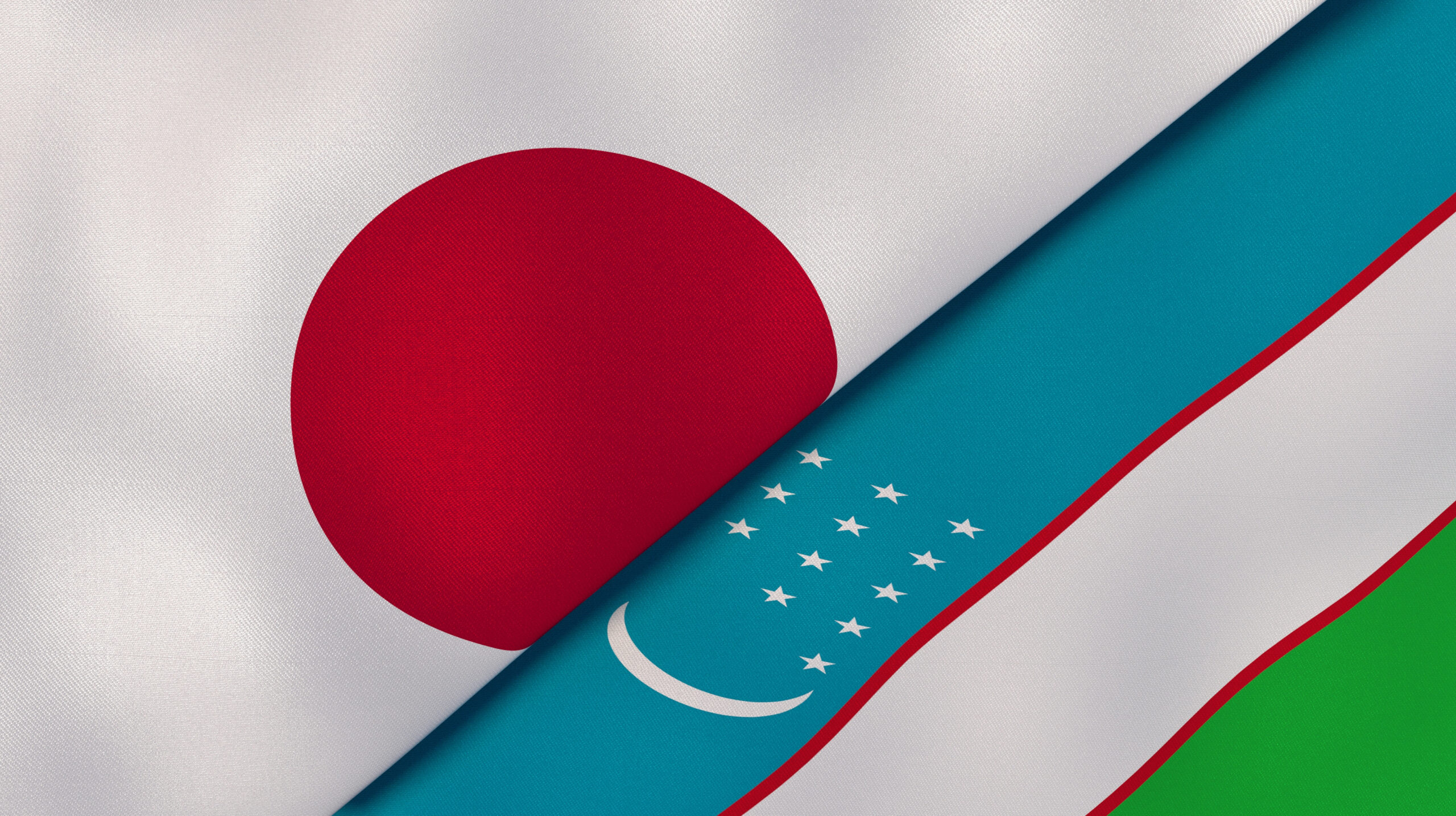
Uzbekistan’s first nuclear power plant, now under construction in the Jizzakh region, is primarily a Russian project. Rosatom is supplying the reactors, and Atomstroyexport, part of its engineering division, is the main contractor. But at the first summit of the Central Asia plus Japan Dialogue in Tokyo in December 2025, a Japanese company agreed to cooperate on a related project: a 50-megawatt data center that could become the first in the world powered entirely by a small modular nuclear reactor.
What Russia Is Building
The plant in the Forish district will combine two large VVER-1000 reactors with two smaller RITM-200N reactors, for a total capacity of just over 2.1 gigawatts. Uzbekistan’s nuclear energy agency, Uzatom, has estimated the maximum contract value at $9.5 billion.
Initial concrete work began in March 2026, while the first concrete for the small reactor’s foundation was poured in June. The first small reactor is expected to start up in 2029, while the two larger reactors are scheduled for 2033 and 2035.
Japan’s Role?
On December 20, 2025, at the summit, Uzatom signed a memorandum of understanding with Muroosystems Corporation. This Tokyo-based company, founded in 2006, specializes in information technology infrastructure and renewable energy. It expanded into nuclear engineering through its acquisition of a German company, NUKEM Technologies Engineering Services (NUKEM), in 2024.
Through NUKEM, Muroosystems plans to provide nuclear safety assessments and engineering services, alongside technical consulting that includes owner’s engineer support. These services are intended to support the project in line with international best practices and International Atomic Energy Agency requirements. The cooperation agreement also covers the proposed nuclear-powered data center, involving Uzbekistan’s Ministry of Digital Technologies.
There is an interesting history behind NUKEM’s involvement. The German company was previously owned indirectly by Atomstroyexport and remains based in Germany, although it has been Japanese-owned since September 2024.
The Data Center Itself
The project involves a data center with an estimated power demand of 50 megawatts. According to DatacenterDynamics, it is expected to receive its normal electricity supply through a direct line from one of the Russian-made RITM-200N reactors, each capable of generating 55 megawatts, rather than from the national grid.
Public announcements do not specify how backup power would be provided during reactor maintenance or shutdowns.
Combining a Reactor With a Data Center
The rationale, outlined by NUKEM, is straightforward. The data center would receive a stable, round-the-clock power supply. In return, the nuclear power plant would gain a steady customer whose high demand could be met through a direct connection, potentially improving the use of its generating capacity.
The project also fits into Uzbekistan’s efforts to develop artificial intelligence (AI) and digital infrastructure. In September 2026, the country opened new AI-capable data centers in Bukhara and Kokand, while state telecommunications operator Uztelecom announced an agreement to distribute Amazon’s satellite internet services.
A Pattern, Not an Isolated Case
Muroosystems’ involvement in Central Asia is not limited to Uzbekistan. The Japanese company has also signed a memorandum of understanding with the National Nuclear Center of the Republic of Kazakhstan (NNC), with NUKEM acting as a technical partner and consultant. The cooperation focuses on the peaceful use of nuclear energy and the management of radioactive waste.
NUKEM’s relationship with Kazakhstan predates its Japanese acquisition. The NNC reported in July 2026 that the two organizations were continuing cooperation under an agreement originally signed in 2015.
“This collaboration, linking Japan, Germany, and Central Asia – including Uzbekistan and Kazakhstan – is a symbol of international partnership built on technology and trust,” said NUKEM’s managing director, Nobuaki Ninomiya.
A Less Visible Partnership
The Russian contribution to the Jizzakh Nuclear Power Plant has attracted considerably more attention than the Japanese involvement. Construction milestones and financing arrangements have been widely reported, as have presidential meetings. The proposed data center has received less coverage outside specialist nuclear and technology publications, despite being publicly announced during the Tokyo summit.
If completed, the Jizzakh data center could give Uzbekistan and Japan a world first at a time when technology companies are increasingly looking to nuclear energy to power their facilities. For now, the project remains at the memorandum stage. Its unusual combination of Russian reactors and Japanese investment interests, supported by German engineering expertise, nevertheless illustrates how international partnerships are developing around Central Asia’s emerging nuclear industry.