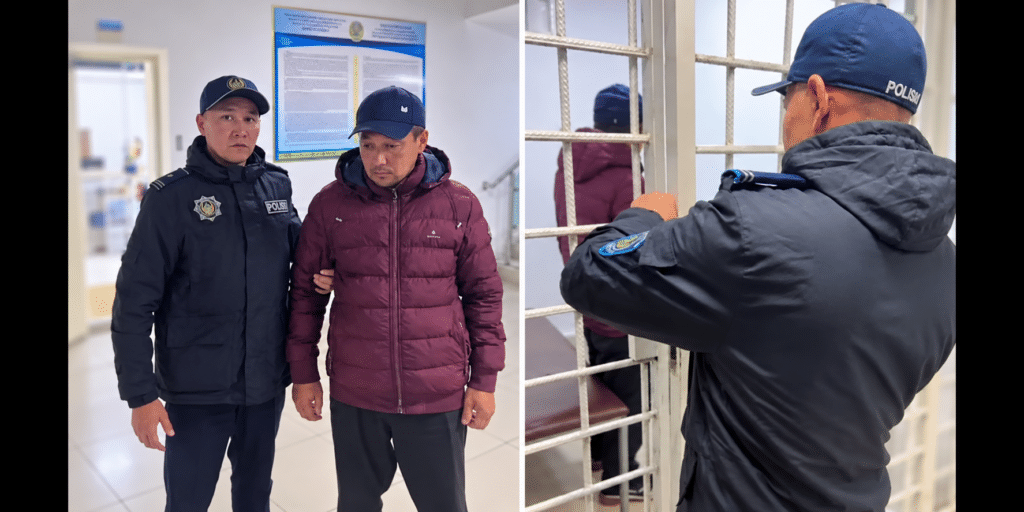
A woman who said she was sexually harassed on a bus in Astana decided against going to the police because she feared she would be unable to prove what had happened. Instead, she confronted the man and photographed him.
“It wasn’t an accidental touch because the bus was crowded. He was groping me,” she wrote on Threads. Police identified the 46-year-old man after discovering her post. A court sentenced him to ten days of administrative detention for indecent behavior on public transport.
On October 13, a court in the capital had imposed the same penalty on an inDrive driver who had asked a female passenger intimate questions and propositioned her for sex during a ride. The woman also took to Threads to describe the incident. The court classified the driver’s actions as petty hooliganism.
Why Sexual Harassment is Prosecuted as Petty Hooliganism
Kazakhstan does not have a comprehensive legal provision specifically addressing sexual harassment of adults in public places. Depending on the circumstances, law enforcement authorities may apply administrative or criminal law.
Article 434 of the Code of Administrative Offenses, which covers petty hooliganism, is used in cases of this kind. It applies to offensive harassment of others and other conduct that disturbs public order, including obscene language. The law does not distinguish sexual harassment from other forms of offensive behavior.
A first offense is punishable by a fine of 20 times the monthly calculation index (MCI) or 20 to 60 hours of community service. Alternatively, courts can impose five to 15 days of administrative detention.
The MCI is a government-set unit used to calculate fines and certain other payments. In 2026, it stands at 4,325 tenge, making a fine of 20 MCI equal to 86,500 tenge, or approximately $190.
In August 2023, an Almaty moped rider was held administratively liable under the petty hooliganism provision after slapping a woman he did not know on the buttocks.
Because these incidents are recorded alongside other public order violations, official statistics do not show how many cases specifically involve unwanted sexual conduct.
Criminal law provides more serious penalties for certain forms of sexual coercion. Article 123 of the Criminal Code addresses coercion into sexual acts through blackmail or threats against property. It also covers exploitation of a victim’s financial or other dependence. It does not cover every instance of unwanted touching or verbal sexual harassment.
In April 2024, Kazakhstan amended legislation protecting women and children, including provisions establishing criminal liability for sexual harassment of children under 16. The amendments did not create an equivalent standalone offense covering all forms of sexual harassment of adults in public places.
Workplace Sexual Harassment Legislation Is Being Developed
The Ministry of Labor and Social Protection of the Population has developed amendments that would introduce a definition of workplace sexual harassment into national labor legislation for the first time. The proposals would establish employers’ responsibilities for preventing such conduct and create legal grounds for dismissing offenders. However, they would not establish a separate criminal or administrative penalty for harassment.
In June 2026, Labor Minister Askarbek Yertayev said the bill was expected to be submitted to parliament in the fall. At the time, the document was still being discussed with business representatives.
The proposed changes would not establish a separate offense for sexual harassment between strangers on public transport or in other public places.
How Many Cases Go Unrecorded?
There are no reliable official figures showing how many women in Kazakhstan experience sexual harassment on public transport each year, and some victims never report incidents.
In 2020, the regional publication CABAR.asia conducted an online survey of 400 people across Central Asia. According to the published findings, 81% of the women surveyed reported experiencing sexual harassment in taxis. Only 4.3% had reported such incidents to the police. However, the survey primarily involved younger, urban respondents and was not representative of Kazakhstan’s population as a whole.
A 2021 survey by the MediaNet International Centre for Journalism found that 82% of respondents considered sexual harassment a problem in Kazakhstan. This measured public perceptions rather than the proportion of people who had personally experienced harassment.
The two recent Astana cases demonstrate that a social media post can prompt a police investigation even without an initial complaint from the victim. But how many women experience similar incidents without attracting public attention or receiving the same response from the authorities?