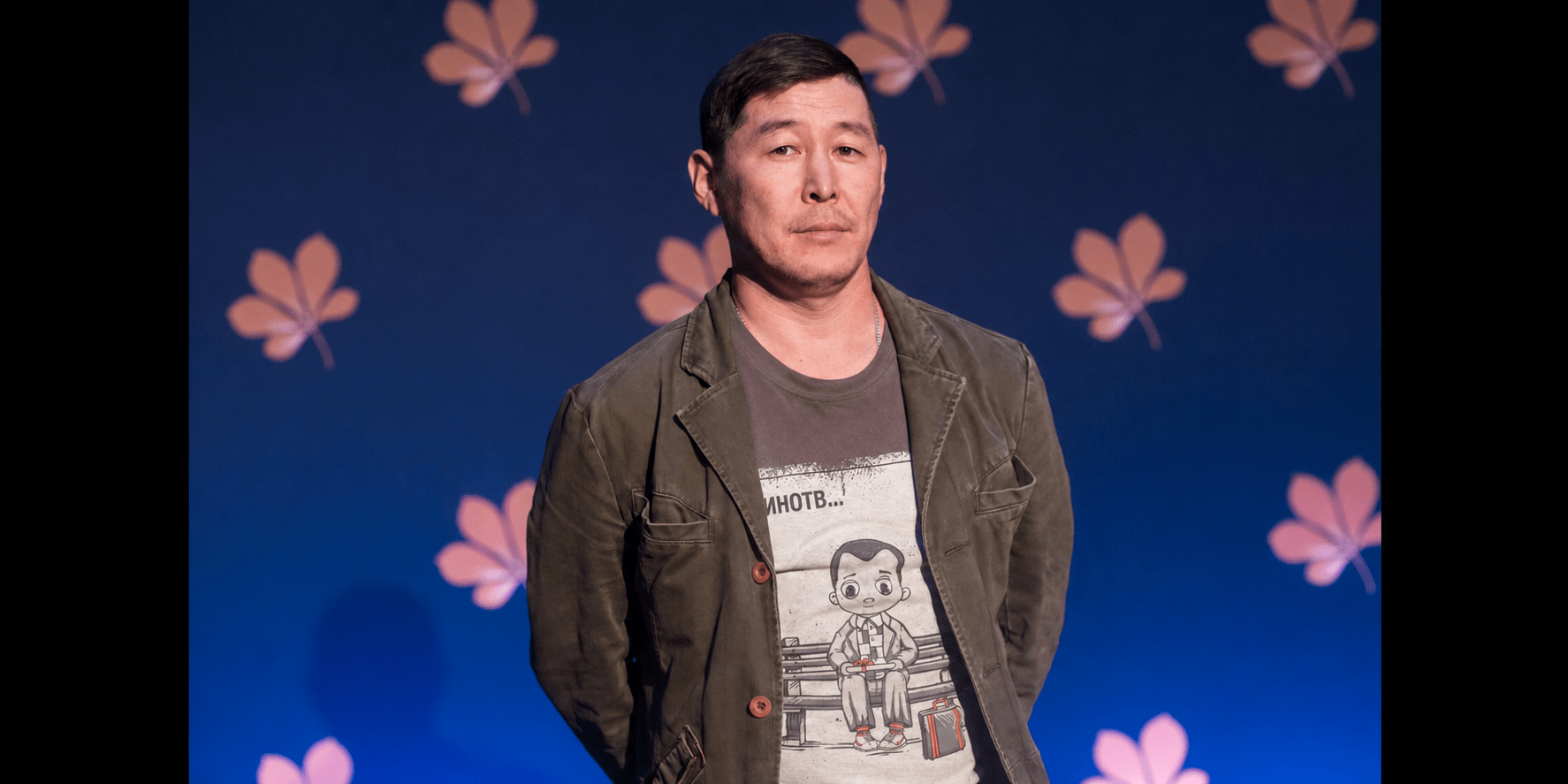
Stepan Burnashev is a Sakha filmmaker from Yakutia who has helped bring Yakut cinema to audiences far beyond the republic. His films have screened at international festivals, appeared on Amazon, and helped turn Yakut cinema into one of the most distinctive regional film movements in Eurasia.
In Bishkek, where Burnashev served on the jury of the national KyrgyzBox section, The Times of Central Asia spoke with him about the phenomenon of Yakut cinema, international ambitions, and what connects Yakutsk, Bishkek, and other emerging cinemas of Eurasia.
TCA: Stepan, this is not your first time attending the Bishkek International Film Festival. What attracts you to it?
Stepan Burnashev: I love Bishkek very much. There is good cinema here, wonderful people, and Kyrgyz culture feels very close to me in many ways. I have attended three of the four festivals held so far. Still, I have never shown my own films here. The first time I came to Bishkek was at the invitation of Erke Jumakmatova, the head of the festival’s industry program. We met back in Busan, and she invited me to participate in a pitching session.
Back then, I flew in with a team of Yakut filmmakers: Apollinaria Degtyareva, Alexey Egorov, and me. Apollinaria and I both participated in the pitching, and this year she entered the main competition of the Bishkek Film Festival with that project.
The second time, I came on my own initiative because I had really fallen in love with the festival. It has a special warmth and atmosphere. This time I was invited as a jury member for the national KyrgyzBox program.
TCA: How do you assess the KyrgyzBox program? Do you see any common ground between Kyrgyz and Yakut cinema?
Stepan Burnashev: The program is interesting, though, as everywhere, there are weaker films and stronger ones. From what I understand, mainstream cinema, such as comedies, is more popular here, while in Yakutia, auteur films are also audience-driven. It is interesting, but I noticed that music is used much more actively in Kyrgyz films. In our films, music usually does not dictate anything to the viewer or tell them what to feel. Here I saw films with a different approach. It is curious.
TCA: What kind of cinema interests you more today, auteur or mainstream?
Stepan Burnashev: In fact, I do not divide cinema into auteur and mainstream. I divide films into good and not-so-good. I even try not to use the word “bad.” It seems unfair to the people who create films. Any director starts working on a film convinced they will make a great one. And I sincerely believe that no one sets out to make a terrible movie. Of course, there are cases where the result does not meet expectations, but behind every project there is the labor of many people. That deserves respect.
TCA: What do you think about contemporary Kazakh cinema? Do you know it well?
Stepan Burnashev: To say that I know Kazakh cinema very well would be an exaggeration. But I try to follow what is happening, I see the successes of Kazakh filmmakers, sometimes I watch Kazakh films, and I communicate with your directors and producers at festivals. So, I do have a certain understanding of the processes taking place in Kazakh cinema today.
I like the work of Farkhat Sharipov, including Personal Growth Training and The Scheme. Once, we even discussed a troubling trend: your cinemas have become increasingly focused on films with obvious commercial potential, paying little attention to auteur cinema.
TCA: Is it not the same for you?
Stepan Burnashev: No. Of course, it is a market, but films in which an author tries to speak about social problems and cultural identity immediately find themselves at a disadvantage compared to other films. Perhaps cinemas consider such films too difficult for audiences, but I am sure that is not the case. Moreover, viewers eventually grow tired of repetitive content and popcorn cinema and begin looking for deeper stories. That is why I think it is important to change this trend and create conditions in which auteur cinema can also find its audience on the big screen.
TCA: So auteur cinema feels better in Yakutia?
Stepan Burnashev: Yes. I am very grateful to audiences in our republic because there is interest in all kinds of cinema. People watch comedies, horror films, thrillers, and dramas. Of course, arthouse films are a little more difficult, but audiences support them, too.
TCA: Why does local auteur cinema enjoy such support in Yakutia?
Stepan Burnashev: It is hard to say. Yakutia is generally a very creative region, and people there genuinely love cinema. If you look at statistics, the average occupancy rate of movie theaters worldwide is around 10% to 13%, while for us it can reach 35%. That is a huge difference. And audiences do not only love Yakut cinema; they love cinema itself. That love, at a certain point, helped our own film industry grow.
TCA: When did Yakut cinema begin to succeed at the box office?
Stepan Burnashev: Probably in the 2000s. Yakutia was part of Russia even in Soviet times and did not have independent status, so unlike the republics of the former Soviet Union, we did not have our own film industry for a long time. Kazakhstan, Kyrgyzstan, Tajikistan, and Uzbekistan had national film studios even in Soviet times, while our full-fledged studio appeared only after the collapse of the Soviet Union. So, we started much later. But when Yakut films began to reach wide distribution, it became a real discovery for everyone: audiences, cinemas, and filmmakers themselves.
One of the first was My Love by Sergey Potapov in 2004. Although it was experimental and very bloody, it still paid off, and it became clear that local cinema was truly in demand.
TCA: Is that the film about two brothers dreaming of Hollywood and Broadway but killing prostitutes at night?
Stepan Burnashev: Yes. It also had a very memorable poster. We walked past it and were amazed that someone had made a film featuring Sakha people. For me personally, it was a very important moment. Even as a child, I dreamed of seeing stories about us on the big screen, and that is largely why I later decided to become a director.
TCA: When did Yakut filmmakers realize that local cinema could be both complex and a successful business?
Stepan Burnashev: Quite quickly. In 2006, Trail of Death by Anatoly Sergeyev was released. It showed that local cinema could not only find an audience but also make money. Its success was linked not only to the film itself, but also to competent marketing. Posters were all over the city, there was an active advertising campaign, and quite bold promotional methods for that time were used. For example, the creators even launched a fake news story about a missing person connected to the film’s plot.
TCA: What do you consider the most significant success of Yakut cinema?
Stepan Burnashev: Without question, a huge event for all of Yakutia was the Oscar nomination received in 2023 by Haulout, the documentary film by Evgenia Arbugaeva and Maxim Arbugaev. And this was not just making the longlist or shortlist; it was a full nomination. For Yakut cinema, it was a very serious success. Another important achievement was the participation of Nuuccha by Vladimir Munkuev in the East of the West program at the Karlovy Vary Film Festival, where it won the Grand Prix in the East of the West Competition.
TCA: And your film was also recognized in Warsaw, wasn’t it?
Stepan Burnashev: Yes. For the anthology Yt, which we made together with Dmitry Davydov, we received a Special Jury Prize at the Warsaw Film Festival. But the most important thing was not even that. Our film deeply moved audiences; we had sold-out screenings. Viewers said they saw themselves on screen. And these were not people from Yakutia, but Polish audiences in Warsaw. For us, it became confirmation that a local story can be absolutely universal.
TCA: Your film Aita, which was effectively banned in Russia after its distribution license was revoked, was released on Amazon. How important was that deal for you?
Stepan Burnashev: Very important. But they bought not only Aita. Other Yakut films also made it onto international platforms. For me, it was a deliberate strategy. I understood that it was necessary to work not only within the region or the country, but also on global recognition for Yakut cinema. In Russia, there are no problems with access to our films, but abroad, for a long time, there were literally only a handful. On Amazon, for example, there was my zombie thriller Republic Z, the detective My Murderer by Kostas Marsaan, and several others.
Such deals are important not only in terms of money. They also bring recognition, new professional connections, and the possibility of drawing attention to an entire industry.
TCA: How did you manage to break into international distribution?
Stepan Burnashev: It all started with a chance meeting. At one independent film gathering in Los Angeles, I met someone involved in international distribution. We started talking, and I told him I had come from Yakutia. At first, he reacted rather skeptically, something like: “From Siberia? And what could possibly be there?” Then I showed him my work, my IMDb page, and explained what was happening in Yakut cinema. He was genuinely surprised and interested. After that meeting, cooperation began, which later helped bring films onto international platforms.
TCA: Today, you are trying to promote not only your own films, but the Yakut cinema brand as a whole?
Stepan Burnashev: Yes, exactly. It is important to me that recognition appears not only for individual directors or specific projects, but for Yakut cinema as a whole. So that audiences and professionals abroad see it not just as a festival phenomenon, but as a full-fledged cinematic brand. That is why I want as many Yakut films as possible to appear on international platforms, not just my own.
TCA: Your new films are co-productions. Does that mean your stories are becoming increasingly international?
Stepan Burnashev: Yes, probably. And much of that is connected to the fact that in recent years I have constantly worked at international film markets. When you regularly attend the Asian Contents & Film Market in Busan, the American Film Market, the Marché du Film in Cannes, Hong Kong Filmart, and other industry platforms, you gradually begin to think more broadly. You come to understand that the world is at once very large and very small. You meet people from different countries, find partners, and realize that local stories can be of interest to international audiences. So if there is an opportunity to tell such stories to the world, why not try?
TCA: Recently you made a film about the Korean diaspora in Japan, an unexpected turn in your filmography.
Stepan Burnashev: Yes, this year I finally made my first short film after a dozen feature-length ones. I was inspired by the story of actor Soji Arai, with whom we worked on a project in Malaysia, though that is another story. My short film is dedicated to the Zainichi, the Korean minority in Japan. It is a very dramatic page of history, connected with families divided by war and political circumstances.
The story follows a man who, after two generations, tries to find his relatives and restore the lost connection with his family. I was interested in the themes of memory, loss, and the search for one’s roots.
TCA: One of your new projects, Melting, is about ecology. Today, there is a lot of talk about climate change. How seriously is this problem felt in Yakutia?
Stepan Burnashev: The environmental crisis is quite noticeable. Much of Yakutia is built on permafrost, and its thawing could have serious consequences. Even now, we see how the thawing affects the environment. It is especially visible in places where forests are cut down. There is the famous Batagaika Crater, a huge depression that continues to expand every year. And it is frightening.
TCA: This film fits very well into the festival agenda. When choosing your next story, how important is it for you to fit into a trend?
Stepan Burnashev: Honestly, at some point, I stopped thinking about that. Earlier, I probably also tried to analyze trends and understand what topics were in demand or what might interest festivals. But then I realized it was pointless. It is impossible to predict what the festival agenda will be in two or three years, when the film is ready. So now I try to think first and foremost about the film itself. If you tell a good story and make a good film, it will find its audience regardless of trends. But when you write solely with festival success in mind, it is very easy to lose sincerity.
TCA: You are one of the most productive directors in Yakutia. What is the secret of your productivity?
Stepan Burnashev: There is no special secret. I simply like telling stories. If an opportunity appears to realize a project, I try to use it. For me, it is a natural process. Stories come constantly, and if there is a way to film them, I start working. That is all.
TCA: You work in different genres, but it seems to me that your films are especially strong in talking about human relationships and emotions. Or are you still searching for your genre?
Stepan Burnashev: For me, everything begins with the story. When an idea appears, I do not think about whether it will be a horror film, a drama, or a melodrama about family relationships. The story itself gradually suggests the form in which it should exist. Sometimes this leads to genre cinema, sometimes to more intimate and emotional stories. What I do worse and what I do better is for audiences and critics to judge. But I definitely do not build my career on the principle of: now I will make a horror film, then a drama, then a comedy. I determine the genre in the process.
TCA: How do you choose which project to launch next?
Stepan Burnashev: It all comes down to the feasibility of the project at a given moment. Right now, I probably have around eight finished scripts. Some were written specifically for competitions and pitching sessions, while others emerged during work on other projects. For example, one script was written with a screenwriter for a competition.
We did not receive support at the time, but the story itself remained. So there are many projects, and after that, it all depends on which one I can find financing, partners, and opportunities for. There are enough ideas; if only there were money for all of them.