The Caspian seal is the only marine mammal native to the Caspian Sea and the world’s only seal species found exclusively in an inland body of water. Once numbering close to one million, its population has declined dramatically over the past century due to commercial hunting, habitat degradation, pollution, accidental entanglement in fishing gear, and climate change. Today, the species is listed as Endangered on the IUCN Red List.
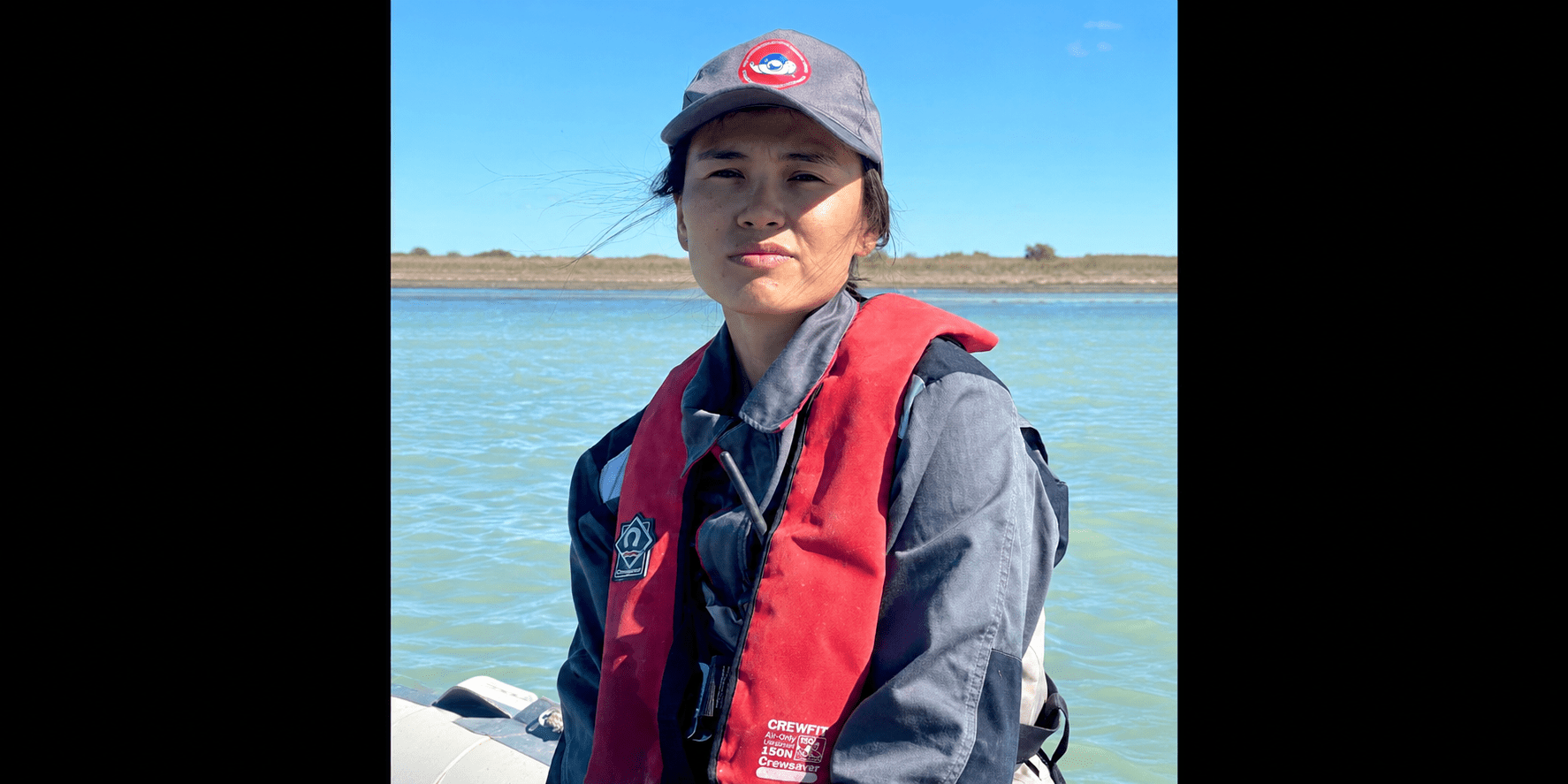
Kazakh zoologist Assel Baimukanova has spent the past 13 years studying the Caspian seal alongside her father, renowned scientist Mirgaliy Baimukanov. Their work takes them to remote islands in the northern Caspian, where they spend weeks living in tents, monitoring the animals and collecting data essential to understanding the rapidly changing sea.
The Times of Central Asia spoke with Baimukanova about how the Caspian seal coexists with offshore oil production, why scientists perform necropsies on dead animals, and what the future holds for the sea’s only endemic marine mammal.
TCA: Assel, you have been studying the Caspian seal for 13 years. Since it is an endemic species found nowhere else in the world, are there many international researchers working on it, or is it studied mainly by Kazakh scientists?
Baimukanova: The Caspian seal is indeed an endemic species, meaning it is found only in the Caspian Sea. But it is not studied only by our Institute of Hydrobiology and Ecology. Several research organizations, both in Kazakhstan and abroad, are involved in studying the species. Russian and Iranian scientists also work on the Caspian seal. In addition, we cooperate with researchers who study other seal species in Estonia, Finland, the United Kingdom, and the United States. Each of these countries has experience studying different pinniped species, so we regularly exchange expertise and research findings. Our cooperation with international colleagues was particularly active between 2005 and 2017, when we carried out a number of joint research projects.
TCA: In your documentary film, you say that although the Caspian Sea is shared by several countries, Kazakhstan bears the greatest responsibility for protecting the Caspian sealbecause the species’ most important habitats are located in Kazakh waters.
Baimukanova: Yes, that is true. In spring and autumn, up to 90% of the Caspian seal population may gather in Kazakhstan’s sector of the Caspian Sea. In winter, the animals breed on the ice in the northern Caspian. Depending on ice conditions, breeding colonies may be located in either the Kazakh or Russian sectors. During spring and autumn, however, most seals are found in the shallow and hard-to-reach northeastern part of Kazakhstan’s sector of the sea. That is why the condition of our part of the Caspian is critical to the conservation of the species.
TCA: But the ice cover is shrinking every year because of climate change. Should we already be worried, or is there no immediate cause for concern?
Baimukanova: There is every reason to be concerned. Warm winters are becoming more common, while cold and severe winters are becoming increasingly rare. Ice still forms, but it covers a smaller area each year and is becoming thinner. Overall, warming is a serious concern because Caspian seals breed primarily on the ice. Mating takes place during the winter.
TCA: Two years ago, Kazakhstan established the Caspian State Nature Reserve to protect the seal. Can we already say that it is producing results?
Baimukanova: It is still too early to draw conclusions. The reserve was established only in 2024, and such a short period is not enough to assess its effectiveness objectively. It is only beginning its work.
We very much hope that, in the future, it will include a rehabilitation center where sick and injured animals can be treated and where research that cannot be carried out in the wild will be possible.
For our part, together with the Fisheries Committee, we are doing our best to support the new reserve so that it can become an effective conservation institution. The government has begun supporting efforts to protect the Caspian seal, but another problem is emerging: the Caspian Sea itself is changing very rapidly.
TCA: So the current conservation efforts are still not enough?
Baimukanova: Not yet. We recently published a study on the regression of the Caspian Sea, which shows that the sea is gradually retreating and that seal haul-out sites are shifting every year along with the changing coastline. Suitable islands are also becoming fewer in number.
The northeastern Caspian is becoming shallower, which means fixed protected areas are no longer sufficient. We believe that, in the future, conservation efforts should move toward a system of dynamic protected areas: where the seals are, protection should follow.
TCA: What happens if the seals move into industrial areas?
Baimukanova: Unfortunately, we believe their haul-out sites will gradually shift into industrial areas, where oil production, fishing, and shipping are concentrated. This creates additional risks for the animals.
Seals are rather shy. If they are disturbed repeatedly, they simply abandon their traditional resting sites. No wild animal can adapt quickly to changes like these. Neither can people, if you think about it.
TCA: But it is impossible simply to ban oil production. What solution do you see?
Baimukanova: We fully understand that Kazakhstan is an oil-producing country, so banning oil production is not an option.
In my view, the solution lies elsewhere: we need to learn how to work together. It is important that the interests of industry and nature conservation are taken into account at the same time. I believe this is entirely possible. The key is to learn to listen to one another.
TCA: It is often said that there are about 300,000 Caspian seals left. How accurate is that figure?
Baimukanova: It is only an estimate. At present, no one can say with certainty how many Caspian seals remain because much depends on the methodology used.
We believe the figure of 300,000 is more of a rapid assessment than a precise population estimate. In fact, we think the actual number is probably lower.
The last aerial survey was carried out almost five years ago, and since then we have observed a declining population trend. To produce a more accurate estimate, we need at least three more years of research on the winter ice. That will allow us to build a mathematical model of the population’s dynamics.
TCA: How do you count the seals?
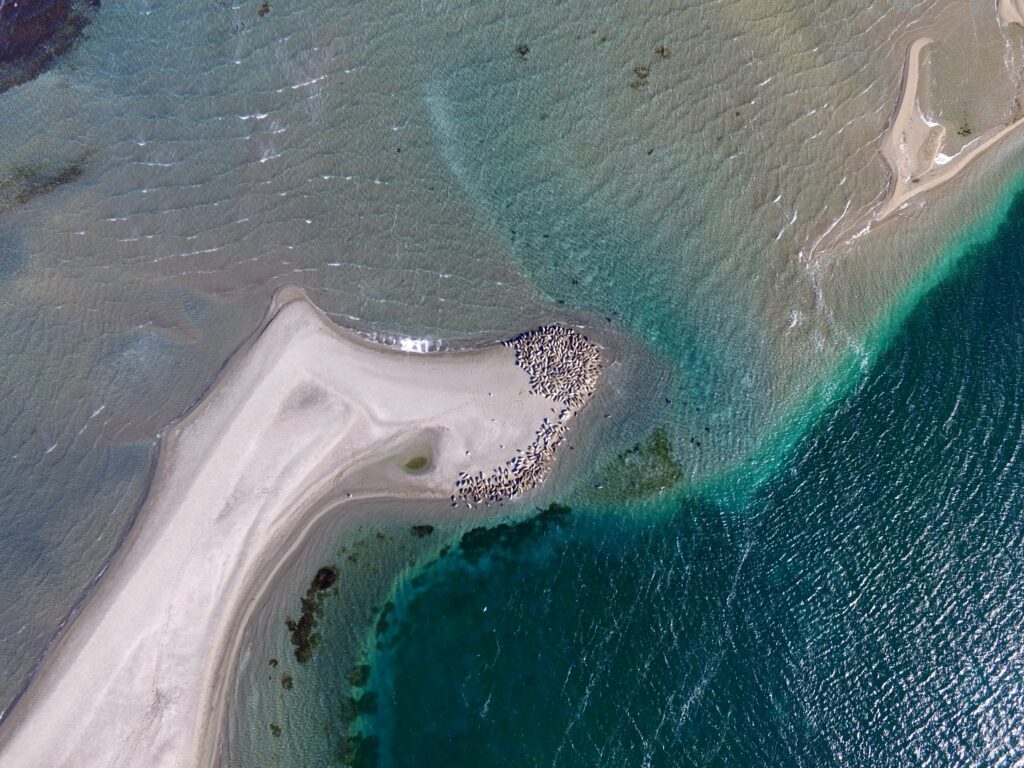
Baimukanova: We conduct field expeditions twice a year, in spring and autumn, to survey haul-out sites along a specially planned route.
Before each expedition, we analyze sea levels, wind patterns, and satellite imagery. We then compare those data with the location of islands and search the area using drones. When we find a haul-out site, we photograph the seals and later count them from the images in the laboratory, assigning each animal its own identification number.
We also analyze the population’s size structure by measuring the animals from the photographs to determine the age and size groups present at the haul-out sites.
TCA: Is the main purpose of this work to estimate and analyze the population?
Baimukanova: Yes, but not only that. We have several research areas.
For example, we study the Caspian seal’s diet. During expeditions, we collect fecal samples to determine what the animals eat.
Another area of research focuses on seal mortality. We record every dead seal we encounter, collect samples for further analysis, and preserve teeth and claws, which allow us to determine the animal’s age at the time of death.
TCA: Is studying dead seals just as important?
Baimukanova: Of course. We need to understand why they died and which environmental factors are having the greatest impact on them.
Unfortunately, many carcasses are already badly decomposed by the time we find them, but we try to perform necropsies whenever possible. The samples are then sent for histological, histopathological, and parasitological analyses to help determine the likely cause of death.
TCA: Your Instagram video diaries are fascinating. Are they simply a personal passion, or are they also part of your scientific research?
Baimukanova: Video observation is part of the research. I go out to the islands, try to approach the animals as quietly as possible, and record them on video. Later, back in the office, I analyze the footage to see how the seals interact with one another, how they respond to birds, people, weather conditions, and other external factors. I am interested in their behavior in different situations and in how they adapt to changes in their environment.
This is an important part of our work. We also collect hydrological and hydrobiological samples around the haul-out sites and assess biodiversity and the condition of the surrounding environment. In essence, we study not only the seals themselves, but the entire ecosystem they are part of.
TCA: Do you spend most of your time on these expeditions?
Baimukanova: In fact, fieldwork is only a small part of what we do. We usually spend about 30 to 40 days in the field each spring and autumn, living in tents on the islands, surveying the seals’ habitat, observing their annual molt in spring, and watching them gather on island haul-out sites in autumn as they prepare for winter and wait for the ice to form.
Altogether, we spend about three months a year on expeditions. The rest of the time is devoted to analyzing the material we have collected.
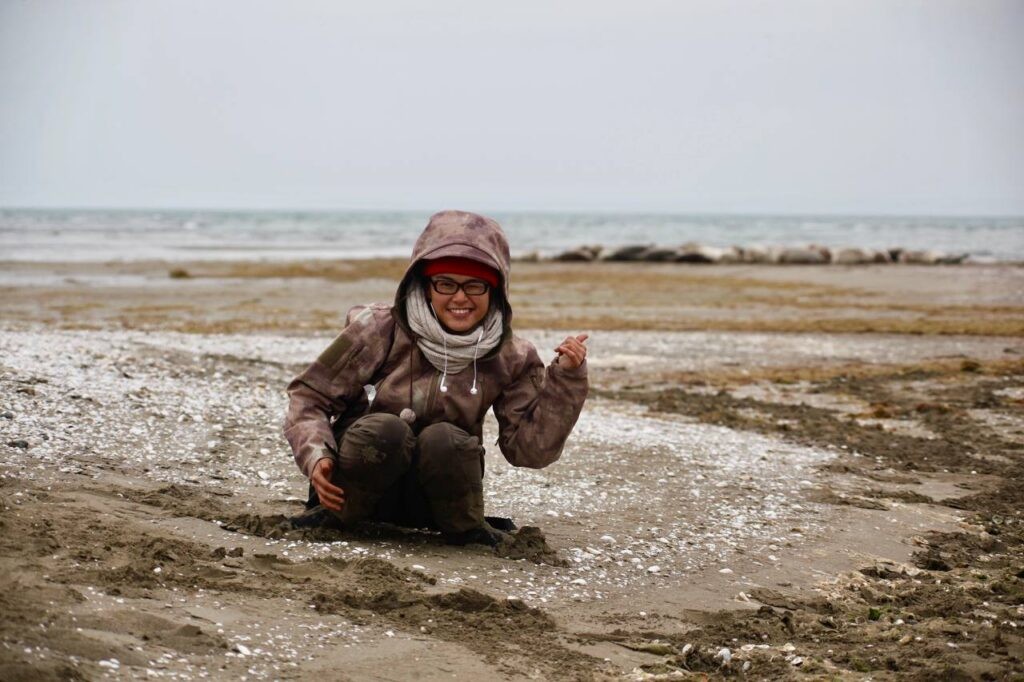
TCA: Looking at the beautiful photographs and videos of the seals, it seems like a dream job. But I imagine the reality is not nearly as romantic as it appears.
Baimukanova: There is certainly some romance to it. For me, it is the opportunity to spend 30 or 40 days in a place with no people, no cars, and no city noise. We have become so used to living in a constant flow of information that the chance to experience complete silence has become something truly valuable.
Long trips by boat, living in tents, waiting for storms to pass, I can no longer imagine my life without these things.
But the work itself is psychologically demanding because we study a rare species and constantly deal with animal mortality. We perform necropsies and sometimes have to work in very difficult conditions. At such moments, you have to put your emotions aside and maintain a professional, objective approach.
By the end of a month-long expedition, you are exhausted not only physically, but emotionally as well.
TCA: Seals are often portrayed in popular culture as gentle and adorable animals, and the way they move on their flippers makes them look rather funny. What are they really like?
Baimukanova: They really are very cute and incredibly interesting animals. Each one has its own personality, its own behavior, and its own way of living. But, like any wild animal, a seal can become aggressive, especially if it feels threatened or is protecting its space. So, it is important not to think of them only as harmless and amusing creatures.
I often say that Caspian seals have their own special vibe. First, they are the smallest of all true seals, and second, they remind me very much of dogs.
TCA: Dogs?
Baimukanova: Yes. In Kazakh, they are called it-balyq, which literally means “dog-fish.” You can build a connection with them. But it is important to remember that they are still wild animals. If you try to get too close, catch, or pet a seal, it will naturally defend itself and may bite.
At the same time, if you respect its boundaries, it will not show any aggression. We have had seals swim right up to us or even lie down nearby, but they have never attacked people without reason.
TCA: Are seals social animals?
Baimukanova: As a zoologist and an ethologist, I have to be careful when describing animal behavior. Scientists must rely on observations rather than emotions.
That said, after observing them for 13 years, I can say they are quite social animals. They interact with one another: they sniff each other, touch noses, rest their heads on one another, and sleep together. We have even seen healthy animals stay close to sick ones despite significant disturbance from people.
So we can say that they have social bonds, although we should avoid attributing human emotions to them.
TCA: You mentioned that you are an ethologist. What does that mean?
Baimukanova: Ethology is the study of animal behavior. My job is not simply to observe animals, but to record every type of behavior I see.
To do this, we compile what is known as an ethogram, a description of all observed behaviors. Only then can we draw scientific conclusions based on evidence rather than assumptions.
TCA: Does the behavior and lifestyle of Caspian seals change significantly from year to year? Is it really necessary to observe them every season?
Baimukanova: Environmental conditions are changing so quickly that we have to stay alert. Every field season is different from the previous one. That is why this work never becomes routine.
It is impossible to understand a species in a single season. Seals migrate and move constantly. Unlike people, they cannot arrange a meeting or tell you what has changed over the past year. A researcher is always an observer, trying to collect as much information as possible during the most important periods of the animals’ lives.
All our conservation recommendations are based on long-term research. For example, our data show that the maximum lifespan of Caspian seals has declined. In the past, we found animals that lived to around 50 years of age. Today, the oldest seal we have recorded lived to 32.
TCA: So their lifespan has decreased by almost 20 years?
Baimukanova: Unfortunately, yes. We have also documented changes in the distribution of the animals. In the past, tens of thousands of seals gathered on Durneva Island, but as the sea has become shallower, those haul-out sites have disappeared, and the animals have dispersed among other islands in the northeastern Caspian.
Only long-term observations like these allow us to recognize when it is truly time to sound the alarm.
TCA: After 13 years of studying the Caspian seal, can you say that you understand this animal?
Baimukanova: No, it still holds many mysteries for me.
It is much like human relationships. Even if you spend many years with another person, you can never say you know everything about them. The same is true of wild animals. There are always new aspects of their behavior waiting to be understood.
That is why it is impossible to observe seals a few times and conclude that you know everything about the species.
TCA: What if the Caspian seal were to disappear one day?
Baimukanova: I do not even want to imagine such a scenario. In any case, we are doing everything we can to make sure it never happens.
No matter how difficult the environmental situation becomes, I never lose hope or allow myself to think that this species could disappear. But if it did, it would be an enormous loss;not only for us and for the Caspian Sea, but for global biodiversity.
TCA: What impact would that have on the ecosystem?
Baimukanova: Even hypothetically, that is a very difficult question to answer.
We know of cases where the disappearance of a single species has led to major changes throughout an ecosystem. One of the best-documented examples is Yellowstone National Park in the United States, where the elimination of wolves caused the elk population to increase dramatically, leading to the degradation of riverside vegetation. Wolves were reintroducedin 1995, and the ecosystem gradually began to recover.
The Caspian seal is at the top of the food chain and is also an indicator of the health of the sea. By studying its health, mortality, diseases, and even its diet, we can assess the condition of the entire Caspian ecosystem. It may also play a role in removing weakened and diseased fish from the population.
The disappearance of such a species would inevitably have consequences, although it is difficult to fully assess their scale today.
TCA: So if the seal population begins to recover, would that mean the ecosystem is recovering as well?
Baimukanova: Yes. It would indicate that conditions are becoming more favorable for the animals. Population growth usually means that the habitat is becoming healthier and more stable. That is why the status of the Caspian seal population is one of the key indicators of what is happening in the Caspian Sea.
TCA: Is the opposite scenario possible? Could the sea recover and the seal population begin to grow again, or have we already passed the point of no return?
Baimukanova: I believe there should always be hope.
Natural systems are capable of recovering, although it is a very long process. Much will depend on climate change, the condition of the Caspian Sea, and the measures taken to conserve the species.
It is too early to give a definite answer, but it is certainly something we should strive for.
TCA: Three years ago, the documentary Haulout, made by Yakut filmmakers, was nominated for an Academy Award. Do you think Kazakhstan has the potential to produce a film of similar impact about the Caspian seal?
Baimukanova: I think it does.
Right now, documentary filmmaker Katerina Suvorova is making a film about the Caspian seal and our work, and I believe that is very important.
We want to show not only the animals themselves, but also how the research is carried out, the challenges scientists face, and why this work matters.
In many ways, we are documenting the history of the Caspian Sea itself. We are preserving a record of what it looks like today because we do not know what it will look like in the future.
We are working not only to conserve the Caspian seal, but also the Caspian ecosystem as a whole. Most importantly, Kazakhstan’s scientists must continue to have the opportunity to carry out this work.