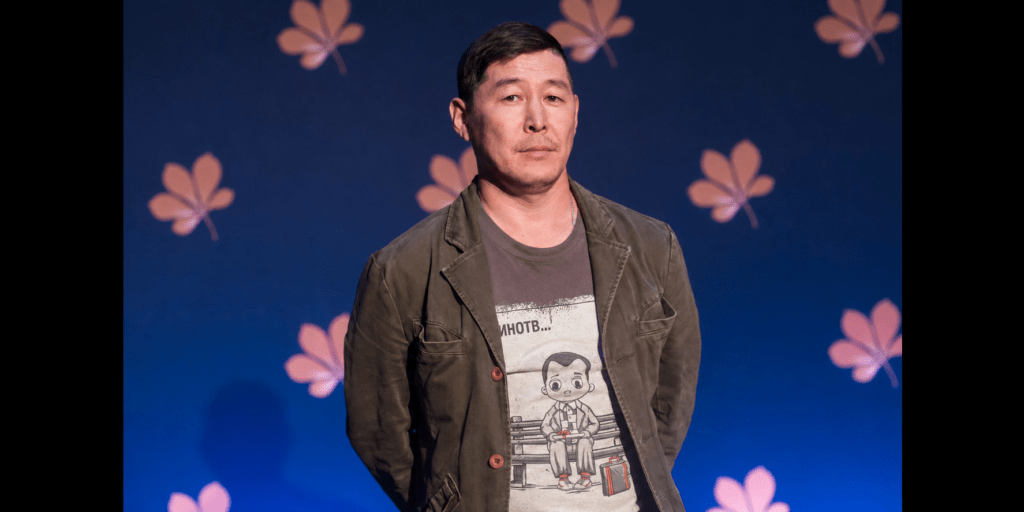
The Cord, the latest feature by Kazakhstani director Darkhan Tulegenov, will have its world premiere in the Vision section of the 31st Busan International Film Festival, held in South Korea from October 6 to 15. Developed from his series Kindik, the film has been described by its creators as a drama about blind maternal love, but further plot details remain under wraps. The Kazakhstani director’s recent television work also includes Mūnai and Khanskaya Okhota.
Tulegenov studied acting before moving into directing, making eight short films and earning early recognition on the festival circuit before completing his first feature, Brothers, in 2022. In an interview with The Times of Central Asia, Tulegenov explained why filmmakers from Kazakhstan now have lessons of their own to share with international colleagues, how his acting education helps him on set, and how a director adapts when nature rewrites the plan, from unexpected snow in Aktau to the icy waters of the Caspian Sea.
TCA: Your path into international cinema began while you were still a student. Which festival was your first?
Tulegenov: Yes, essentially it all started with short films, which I began making while I was still a student. Before making my debut in full-length feature cinema, I made eight short films and several series. My short films won many awards around the world. My first trip abroad with one of my films was, I think, to Bishkek, to a short film festival, where I won the Grand Prix. That was the beginning. After that, I really traveled a lot thanks to cinema.
TCA: One of those trips took you to Iran’s Fajr Film Festival. How did that experience influence you as a filmmaker?
Tulegenov: In Iran, I participated in the Talent Campus program. It is similar to Berlinale Talents at the Berlin Film Festival, only at the Fajr Film Festival. They organize it for participants from Arab countries, Central Asia, other parts of Asia, and other regions. Well-known Iranian directors serve as mentors there: Majid Majidi was there, for example, and Asghar Farhadi had come the year before me. For a student, it is an amazing experience because you can attend lectures by masters of Iranian cinema while surrounded by people from all over the world. At some point, you realize that filmmakers everywhere actually speak the same language, and where you studied does not matter at all. You can study cinema in Iran, Kazakhstan, or America. The main thing is to speak the language of real cinema.

All images courtesy of Darkhan Tulegenov
TCA: You also studied at the New York Film Academy. How different was that experience from studying in Kazakhstan?
Tulegenov: Yes, it was what they called an “academic mobility program” at the Zhurgenov Academy, where I graduated. I don’t know whether it still exists, but at the time they sent us to Los Angeles for three months. The academy paid for our tickets, daily expenses, and other costs. For me, above all, it was an opportunity to see the world, meet people doing the same thing you are doing, and understand that cinema is actually an attainable dream. The education itself is, in fact, roughly the same everywhere. And in my view, directing cannot really be taught at all; you learn everything through practice. You can sit all day studying theory, but if you don’t go onto a set, don’t shoot, don’t try things yourself, and don’t experience all that stress, there is little benefit in that kind of education. Our cinema is young and active, a lot is being filmed, and there are plenty of opportunities to practice.
TCA: So Kazakh film education is not inferior to what is available abroad?
Tulegenov: Not at all. My mentor was Amanzhol Aituarov, and he taught me a great deal because he has a very subtle understanding of the nature of cinema itself. The most important things often emerged through that kind of informal education: we would sit together, analyze every film, talk about stories from life and how they could be transferred into a screenplay. Ultimately, a director shares not so much knowledge with you as his own experience, and that is probably the most valuable thing.
TCA: At international festivals, are Kazakhstani directors still there as students, or can they now share their own experience?
Tulegenov: You always need to learn, and I am always open to that myself. But to be honest, our industry is now at such an interesting point in its development that people can already learn from us. For example, they can learn how to make fairly competitive films with budgets that are minimal by global standards. We have long been part of the global film industry, and we should already get used to the idea that we are leaders – definitely in Central Asia and, perhaps, already in the CIS as well. The only thing we genuinely lack is budgets. We have talent, professional crews, ambition, and, most importantly, ideas. Recently, young people have gained good opportunities to develop their talent – platforms, for example. When we were taking our first steps, those did not exist.
TCA: After the festival success of your short films, finding money for your feature debut proved difficult. Were state-commissioned television series a compromise?
Tulegenov: Not at all. I try to give everything I have to every project. Besides, my series were unusual. Steppe Hawks, for example, was about aviation, and we experimented a great deal there. While filming, we even flew in real fighter jets. Where else can you do that? All of this gives you experience and emotions that you absorb and then use to create something new. Of course, they didn’t let us anywhere near the controls, but the experience was unforgettable.
TCA: What criteria do you use to choose projects today?
Tulegenov: I can’t say that the situation has changed dramatically, because in fact I have always chosen my projects. As for my criteria, first of all, the producer who will be making the project matters to me. You talk to the person and try to understand whether you are on the same wavelength, whether you can work together or not. Second, the subject of the project matters. A rough screenplay is not a problem because a screenplay can always be improved. If I am interested in the subject, if it affects me, I agree.

TCA: You came to Almaty at 15 dreaming of becoming an actor. Why did you ultimately choose directing?
Tulegenov: Yes, I studied acting for three years and graduated from college. I even graduated with honors. During my studies, I realized that acting personally didn’t interest me at all; it simply wasn’t for me. But I don’t regret spending those three years on it. That education helps me a great deal when working with actors: I understand where and how something needs to be explained, and sometimes I can act something out myself, demonstrate it, or put the right emphasis on something.
TCA: Are you comfortable appearing on camera yourself?
Tulegenov: I once had a small part in the series Aferisty (The Swindlers), where I had a close-up, and we did, I think, 10 or 15 takes because I was uncomfortable in front of the camera. As soon as I started thinking that, on the other side of the camera, maybe a million people would eventually be watching this, I became uncomfortable. I’m an introvert, and even at my own premieres I don’t feel very comfortable. I feel awkward being the center of attention.
TCA: How does your acting education influence your decisions during casting?
Tulegenov: Of course it does. But it seems to me that acting talent is obvious. A person walks into an audition, starts acting, and you understand whether they have ability or not. After that, you look at the specific task and whether they can handle it. I can’t say my acting background makes it easy for me to make casting decisions. I always have doubts until the very end.
TCA: Some actors audition for you eight or nine times, while one of the cast members of Munai went through 24 auditions. What ultimately convinces you to say yes? And do you ever feel awkward about putting someone through such a long casting process?
Tulegenov: No, I don’t. What makes me cast them? Simply that, eventually, they convince me that they can play what is needed. I don’t cast someone just because they have tried hard or because I already feel awkward about rejecting them. When someone auditions many times, that is normal. When I was a student, I could go somewhere 20 or 30 times myself, bring in a screenplay, try to get something done, and I was rejected more than once too. That is normal. It is part of the profession.
TCA: In Munai, newcomer Dana Amirkul played a role that was fairly bold by Kazakh cinema standards. How do you approach intimate scenes when the local industry does not yet have detailed protocols governing such shoots?
Tulegenov: It isn’t difficult, because everything is discussed in advance. At the audition stage, I warn them that there are intimate scenes. If the person is prepared to work, we move on. We work through the role so that the actress can immerse herself in it as deeply as possible while also feeling as comfortable as possible during filming.
TCA: What is your method for working with actors?
Tulegenov: I don’t have one established method, but I try not to explain everything through actions: “You have to cry here, you have to laugh here, and here you have to slap him.” I try to explain everything through the character’s internal state. For example: you feel yourself starting to boil, but you are trying with all your strength to hold yourself together. Then some particular word triggers you, and at that moment you can’t take it anymore, you break and let your emotions out.
I think it is disrespectful to an actor to show them how to act. You need to guide an actor somehow and put them in the right state. How they show it – expressively or calmly – should come from them. It depends on how well they know the character, how deeply they have studied them, and how comfortable they are with them. And yes, sometimes actors suggest something better than what you came up with yourself, and I use it.
TCA: You worked with Aibar Saly on Brothers, Munai, and The Khan’s Hunt. What makes you keep casting the same actor in different projects?
Tulegenov: Aibar is a talented actor. You see that a person is improving, and you understand that you can take him to a new level. You understand that he can give you new possibilities that weren’t there before. There are actors who, broadly speaking, work in one particular type of role. With Aibar, you understand that a person can reveal himself in completely different types of roles. I can see Aibar growing, and very quickly. In general, I like actors whose attitude toward their profession borders on obsession. And Aibar is obsessed. I am the same, and I try to surround myself with people who are also obsessed with what they do. I don’t think cinema is possible without that kind of obsession at all; our profession demands total commitment.
TCA: You have said that what distinguishes a director is a willingness to take responsibility and the ability to work through any unexpected situation. Which shoot was the toughest for you?
Tulegenov: Yes, that’s true. If a person doesn’t have those qualities, the profession will be very difficult for them. I try to react calmly to any unusual situation, and any working director encounters dozens of them. Even when something unexpected happens, I try not to panic and to think that everything happens for the best. It just so happens that I have always shot my films in fairly harsh conditions. For example, we filmed my debut feature, Brothers, in western Kazakhstan in December. It was very cold, and the actors filmed in icy water. When we were shooting the series Munai (“Oil”) in Aktau, it snowed for the first time in many years. But because of that, we were able to shoot a noir scene in which a body is found in the snow. Cinema is a living process, and those weather conditions only enriched our series.
TCA: Directing requires constantly exploring human fears, desires, and actions. Has cinema helped you understand people better?
Tulegenov: Definitely, yes. Life itself gives us our screenplays. And the more familiar you are with human nature, the better your screenplay becomes. You try to visualize different situations on screen, you constantly dig into the subject, and fairly quickly you begin to understand how everything works within us, where fears come from, what lies behind a particular action, and so on. Because of that, it is as if you gain the ability to understand anyone, even a criminal. Not to justify them, but to understand them, because everyone has a choice in life: to do something or not to do it.
TCA: How do you respond to criticism?
Tulegenov: With interest. I read reviews and comments and analyze them. It helps me understand where I may have miscalculated or failed to communicate what I wanted to communicate. I’m interested in how people perceived a particular film – that is human nature; we always care what other people think of us. But at the same time, I try not to dwell on it. Ultimately, criticism cannot fundamentally change your cinema. Creativity is irrational; it comes from internal feelings.
TCA: And when critics single you out in particular?
Tulegenov: It’s nice, but I try not to focus too much attention on it. Of course, kind words are very valuable, but essentially they don’t change my life. I mean, they don’t go to my head. Tomorrow I’ll get up as usual, take my daughter to kindergarten, and go to work.