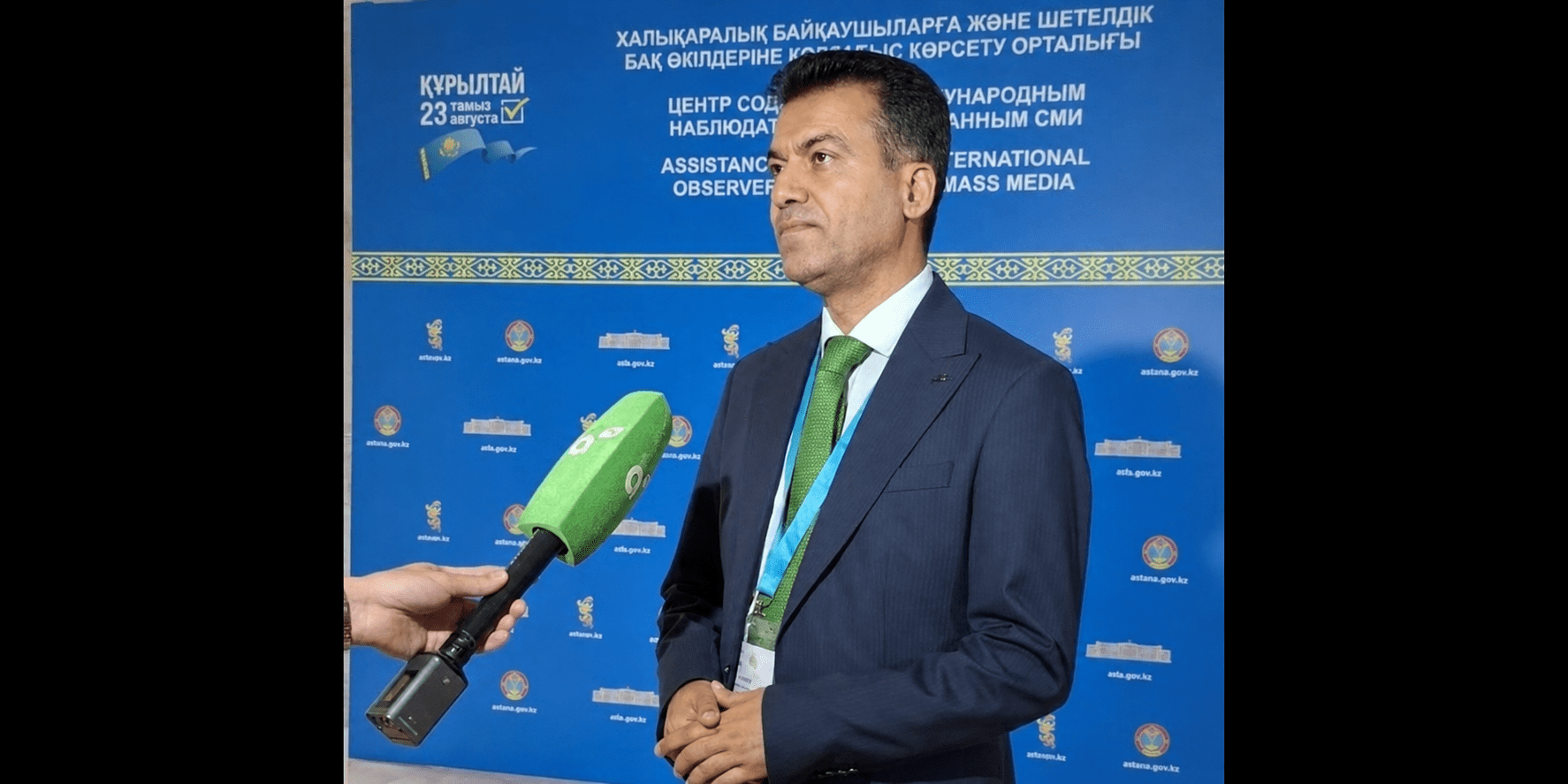
Basel Al-Haj Jassem, a Syrian political adviser and analyst, has worked on the Middle East, the Caucasus, Russia, and Central Asia for many years, with a particular focus on peace processes. He is the author of the Arabic-language book Kazakhstan and the Syrian Astana, which examines Kazakhstan’s role in the Astana Process on Syria.
While Al-Haj Jassem was in Kazakhstan as an observer of the first elections to the country’s new unicameral parliament, the Kurultai, The Times of Central Asia spoke with him about Kazakhstan’s international standing and the country’s possible role as a mediator in the South Caucasus and the Middle East. He described the elections as well organized and “a new stage in the development of Kazakhstan’s political system,” although he added that “in a year it will already be possible to give a more concrete assessment of the Kurultai’s work.”
TCA: You have known Kazakhstan for many years and have observed the country from different professional perspectives. In your view, how have Kazakhstan’s role and international standing changed over the past two decades?
Al-Haj Jassem: I think the changes that have taken place in Kazakhstan over the past two decades go far beyond economic growth or the expansion of foreign relations. The country has gradually moved from being an important Central Asian state to one whose political and diplomatic presence extends beyond its immediate geographical surroundings.
Several factors have contributed to this: its geographical position, balanced relations with Russia, China, the West, and the Islamic world, as well as its ability to avoid becoming rigidly aligned with opposing political blocs. But what I consider most important is that Kazakhstan has built a reputation as a state capable of maintaining dialogue with different parties, including those that are sometimes opposed to one another.
TCA: One of your books is devoted to Kazakhstan and the Astana Process on Syria. That experience demonstrated Kazakhstan’s potential as a venue for negotiations. What further role could the country play in the Middle East?
Al-Haj Jassem: The experience of the Astana Process on Syria was important because it showed that a state that is not itself a direct party to a conflict can provide space for dialogue that cannot be achieved elsewhere.
Kazakhstan, of course, was not a party determining decisions on the Syrian issue, but it created a political and diplomatic environment that helped maintain channels of communication between participants who found it difficult to sit at the same table.
I think this experience can be developed further, but it is not necessarily a matter of literally reproducing the Astana Process model. Today, the Middle East needs different forms of mediation, including quiet diplomacy, humanitarian initiatives, and support for dialogue between religious and cultural communities.
Kazakhstan’s advantage is that it carries no colonial legacy in the region and is not part of traditional intra-Arab rivalries. At the same time, the country maintains good relations with various Arab and Islamic states. This gives Kazakhstan a certain freedom of action, particularly in situations where a settlement requires, above all, building trust rather than imposing ready-made solutions.
TCA: You devoted a separate book to the Karabakh conflict. After the major changes of recent years, how realistic is a lasting peace between Azerbaijan and Armenia, and is there room for Kazakhstan to play a diplomatic role?
Al-Haj Jassem: I believe that peace between Azerbaijan and Armenia is considerably more realistic today than it was at previous stages. However, reaching an agreement does not mean that peace will automatically become sustainable. There is a major difference between signing a political document and creating conditions in which a return to conflict becomes unlikely.
The real challenge will be the parties’ ability to resolve the remaining issues, above all those related to border delimitation, the opening of transport links, building mutual trust, and ensuring the implementation of agreements already reached.
As for Kazakhstan, I think it is capable of playing a useful role, particularly if such involvement is based on the consent of both parties rather than becoming an attempt to impose its own mediation.
Kazakhstan has an important advantage here: good relations with Azerbaijan and Armenia, as well as with Turkey and Russia, plus its position within the regional system. There is already such an example: in May 2024, Almaty provided a venue for direct talks between Azerbaijani Foreign Minister Jeyhun Bayramov and Armenian Foreign Minister Ararat Mirzoyan. Symbolically, the meeting took place in the same building where the 1991 Alma-Ata Declaration, which established principles for determining interstate borders, was signed.
Therefore, if there is a corresponding request from Baku and Yerevan, Kazakhstan could provide a venue for dialogue or help build trust between the parties.
TCA: Given your experience working on the Middle East, the Caucasus, Russia, and Central Asia, how do you see Kazakhstan ten years from now: primarily as a regional power, or as a state capable of playing an independent mediating and political role far beyond Central Asia?
Al-Haj Jassem: If Kazakhstan continues to pursue a balanced foreign policy, strengthen its domestic institutions, and use the advantages of its geographical and economic position, I think that over the next ten years it could reach a higher level of international influence.
I do not think that becoming a “great power” should be a realistic goal for Kazakhstan; there is no need for that. A more realistic and useful model for the country is that of a middle power whose diplomatic influence exceeds its geographical and demographic weight.
Kazakhstan’s ability to maintain relations with Russia, China, Europe, and the Islamic world, alongside its ties in the Caucasus and the Middle East, gives it an opportunity to develop its role as a mediator or a kind of “bridge-builder.”
However, to do so, it needs to preserve its independence in decision-making and ensure that its multi-vector diplomacy does not become solely a matter of balancing between great powers.
In my view, the most accurate description of the role Kazakhstan could play over the next decade is that of a regional power with international influence and a potential venue for dialogue in crises where the great powers themselves find it difficult to act as mediators.