• KGS/USD = 0.01144 0%
  • KZT/USD = 0.00196 -0%
  • TJS/USD = 0.10899 -0%
  • UZS/USD = 0.00008 -0%
  • TMT/USD = 0.28490 0%
  • KGS/USD = 0.01144 0%
  • KZT/USD = 0.00196 -0%
  • TJS/USD = 0.10899 -0%
  • UZS/USD = 0.00008 -0%
  • TMT/USD = 0.28490 0%
  • KGS/USD = 0.01144 0%
  • KZT/USD = 0.00196 -0%
  • TJS/USD = 0.10899 -0%
  • UZS/USD = 0.00008 -0%
  • TMT/USD = 0.28490 0%
  • KGS/USD = 0.01144 0%
  • KZT/USD = 0.00196 -0%
  • TJS/USD = 0.10899 -0%
  • UZS/USD = 0.00008 -0%
  • TMT/USD = 0.28490 0%
  • KGS/USD = 0.01144 0%
  • KZT/USD = 0.00196 -0%
  • TJS/USD = 0.10899 -0%
  • UZS/USD = 0.00008 -0%
  • TMT/USD = 0.28490 0%
  • KGS/USD = 0.01144 0%
  • KZT/USD = 0.00196 -0%
  • TJS/USD = 0.10899 -0%
  • UZS/USD = 0.00008 -0%
  • TMT/USD = 0.28490 0%
  • KGS/USD = 0.01144 0%
  • KZT/USD = 0.00196 -0%
  • TJS/USD = 0.10899 -0%
  • UZS/USD = 0.00008 -0%
  • TMT/USD = 0.28490 0%
  • KGS/USD = 0.01144 0%
  • KZT/USD = 0.00196 -0%
  • TJS/USD = 0.10899 -0%
  • UZS/USD = 0.00008 -0%
  • TMT/USD = 0.28490 0%
08 December 2025

EDB to Fund Feasibility Study for Kyrgyz Hydropower Cascade

On September 18, the Eurasian Development Bank (EDB) and Orta Asya Investment Holding signed an agreement to develop a feasibility study for the Suusamyr-Kokomeren hydropower plant cascade project in Kyrgyzstan.

The study will be financed by the EDB, a multilateral development bank headquartered in Almaty that invests across its member states: Armenia, Belarus, Kazakhstan, Kyrgyzstan, Russia, Tajikistan, and Uzbekistan.

This agreement builds on earlier investment deals between Kyrgyzstan and Central Asian Investment Holding, a subsidiary of Turkey’s İhlas Holding, to develop both the Kokomeren and Kazarman cascades. With a combined capacity of 2,217 MW, these agreements were signed on August 11 by Kyrgyz Energy Minister Taalaibek Ibraev and Ahmet Mücahid Ören, Chairman of İhlas Holding’s Board of Directors.

These projects are considered strategically important for both Kyrgyzstan and the broader Central Asian region, with planned investments exceeding $6 billion. Once completed, they are expected to increase Kyrgyzstan’s electricity generation capacity by more than 50%, meeting rising domestic demand and enabling future electricity exports.

The Kokomeren River cascade will include three hydroelectric plants with a combined capacity of 1,305 MW:

  • Karakol HPP33 MW
  • Kokomeren-1 HPP360 MW
  • Kokomeren-2 HPP912 MW

Under the terms of the agreements, Central Asian Investment Holding will operate the plants for 20 years, with Kyrgyzstan guaranteeing the purchase of the electricity generated.

İhlas Holding, through its subsidiary, is also developing a 250 MW natural gas-fired combined heat and power plant (CHPP-2) in Bishkek. Scheduled for commissioning in 2028, CHPP-2 is expected to enhance the capital’s heating and electricity supply while reducing reliance on the aging coal-fired Thermal Power Plant, currently the city’s primary energy source.

The parallel development of hydropower and cleaner thermal energy projects is seen as central to Kyrgyzstan’s energy transition, offering both economic benefits and improved environmental outcomes.


Kazakh School Teams to Compete at Drone Soccer World Cup in South Korea

Three school teams from Astana will represent Kazakhstan for the first time at the FIDA Drone Soccer World Cup 2025, set to take place in late September in Jeonju, South Korea, according to the Ministry of Artificial Intelligence and Digital Development.

Drone soccer, a South Korean innovation launched in 2016, is a rapidly growing esport. The game is played in a netted arena by two teams of five, each piloting spherical drones measuring 20-40 centimeters in diameter. The goal is to score by flying a designated drone, known as the drone-ball, through the opponent’s gate while defending one’s own. Matches consist of three three-minute rounds.

The Federation of International Dronesoccer Association (FIDA) was founded in 2021, bringing together national associations. The inaugural world championship took place in South Korea in 2023, evolving from a school-based initiative into a national sensation. Today, more than 1,000 school and university teams compete across South Korea, and FIDA now includes over 35 countries. The 2025 World Cup in Jeonju is expected to feature dozens of national squads and hundreds of athletes, including Kazakhstan’s debut delegation.

Kazakhstan will be represented by three Astana-based teams: Specialized Lyceum No. 82 “Daryn,” School-Lyceum No. 8, and the private school Skillset. “For children, this is not just a tournament but a ticket to the future. Today they pilot drones; tomorrow they’ll design unmanned systems that could reshape aviation in Kazakhstan and beyond,” said Dmitry Ivanov, head of the Kazakhstan Drone Soccer Association.

The championship will run from September 25 to 28 at two venues: the Jeonju International Drone Sports Center and the Jeonju World Cup Stadium. This autumn, the Kazakh teams will also participate in Digital Bridge 2025 in Astana, where they are scheduled to lead masterclasses and demonstration matches for international guests.

Organizers say the event will mark the launch of Kazakhstan’s national drone soccer season for 2025-2026, with the introduction of regular school and city leagues.

As previously reported by The Times of Central Asia, Kazakhstan is also investing in drone technology for broader applications, including agriculture and safety engineering.

Kazakh Wheat Flour Enters U.S. Market

Kazakhstan has reached a new milestone in diversifying its agricultural exports with the inaugural shipment of wheat flour to the United States. A 50-ton batch recently arrived in New York, marking the beginning of what could become a regular supply channel.

Marketed under the Eurasian Legacy brand, the flour is now available on Amazon and Walmart. It retails for $14.50 per 1.36 kg package on Amazon and is advertised as non-GMO and glyphosate-free. Each package bears the label “Product of Kazakhstan,” highlighting the country’s positioning as a producer of environmentally friendly, high-quality food products.

According to the QazTrade Center for Trade Policy Development, monthly exports could exceed 100 tons in the near future. In addition to e-commerce platforms, discussions are underway with American restaurants, coffee shops, and major retail chains about incorporating Kazakh flour into their supply chains.

In July, QazTrade opened a representative office in the United States to boost the visibility of Kazakhstani food products. “We are not limited to flour. We have already presented buckwheat, granola, talkan, chocolate, and cocoa in the United States, and partners in New York, Chicago, and Washington have tested their quality. A business mission of Kazakh producers to these cities is the next logical step. This is not only an opportunity to strengthen ties with partners but also to enter the HoReCa segment, where natural and authentic products are in demand,” said Aitmukhammed Aldazharov, CEO of QazTrade.

The move into the U.S. market follows Kazakhstan’s growing grain and flour exports to Europe. For the first time, Kazakh wheat has been shipped to Belgium, Estonia, Italy, Norway, Poland, Portugal, and the United Kingdom.

Despite this growing diversification, Kazakhstan’s primary grain buyers remain Uzbekistan, Tajikistan, Afghanistan, Kyrgyzstan, Iran, and Azerbaijan.

Next Stop, Wi-Fi: Kazakhstan Pilots Satellite Internet on Rails

Just a few years ago, internet access on passenger trains in Kazakhstan seemed like an unattainable dream. Today, this service is becoming a reality.

In an interview, Anuar Akhmetzhanov, Chairman of the Board of JSC Passenger Transport, told The Times of Central Asia that providing passengers with access to high-speed internet on trains is one of the key directions in the digitalization of the passenger transportation sector.

Since the beginning of this year, the national company, Kazakhstan Temir Zholy (Kazakhstan Railways), together with the official distributor of the low-orbit satellite network OneWeb in Kazakhstan, has launched a pilot project to provide internet access on passenger trains. The service was first introduced on the Astana–Almaty route, and in the spring, on the Astana–Oskemen route. According to Akhmetzhanov, Kazakhstan is among the first countries in the world to implement low-orbit satellite internet on passenger trains. In addition, internet access based on Starlink technology was recently launched in pilot mode on the Astana–Borovoe electric train.

“The preliminary results of the pilot project show strong demand from passengers. According to surveys, 87% of our passengers are satisfied with the quality of the internet, and the service meets their expectations,” said Akhmetzhanov.

High-speed internet of up to 150 Mbps benefits both passengers and the carrier. Travelers can remain connected throughout the journey, have access to various online services, make online payments during the trip, and enjoy unlimited entertainment options.

JSC Passenger Transport will, in turn, gain additional opportunities to sell tickets, control passenger boarding, provide additional services, and ensure safety control by connecting an onboard video surveillance system.

“As of today, only three trains are equipped with internet. Work is underway to expand the service to all types of trains. Based on testing results, we plan to roll out the solution to all major routes as early as next year,” noted Akhmetzhanov.

One of the main questions for passengers is whether the introduction of internet services on trains will affect ticket prices. On this point, Akhmetzhanov stated that an increase in ticket prices is not currently under consideration. “However, to reduce and offset expenses, the national carrier, together with its partner, is conducting market research on the demand for paid internet packages with higher speeds,” he said.

For example, the operator Jusan Mobile offers paid internet services; currently, passengers can choose tariffs for the entire trip or purchase 1 GB packages with the option to increase the volume as needed. There are no restrictions on which internet resources can be accessed.

In the near future, JSC Passenger Transportation is preparing to launch internet services on trains traveling on western routes, such as Aktobe–Almaty, Kyzylorda–Semey, and others.

The Train Internet project, based on satellite technology, ensures a stable, high-speed connection even in remote and hard-to-reach regions where traditional mobile services are limited. For Kazakhstan, with its vast territory and long travel distances, providing internet access on passenger trains is a service in high demand.

Turkmenistan Expands Educational Partnership with UK’s AQA

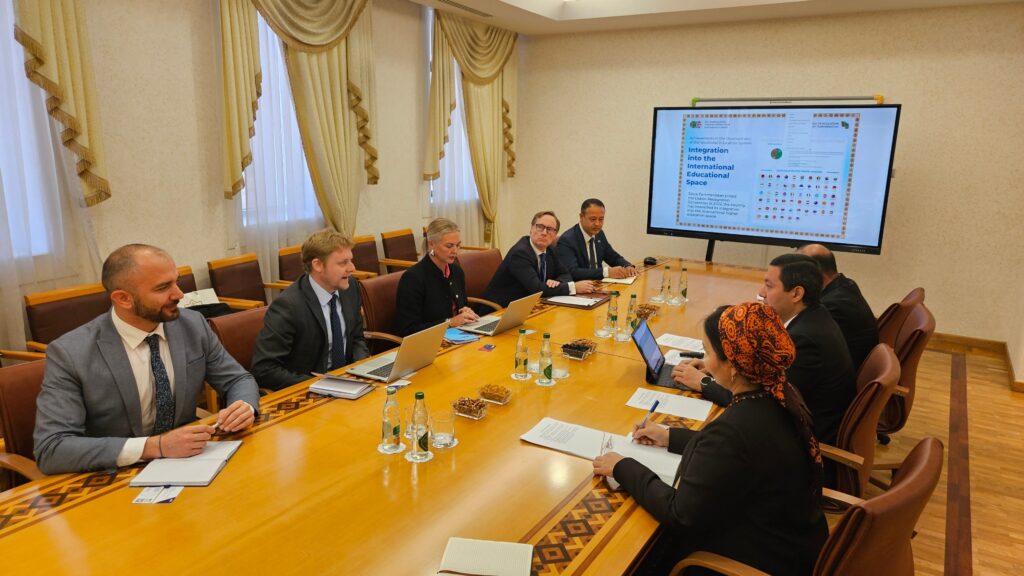
The Ministry of Education of Turkmenistan has held an official meeting with representatives of AQA Global Assessment Services, a leading UK-based organization specializing in educational assessment.

The AQA delegation included Sean Crowley, Director of International Business Development; Anna Green, Director of Assessment Systems; and regional consultant Vali Huseyn. Deputy Minister of Education Azat Ataev emphasized Turkmenistan’s interest in deepening strategic cooperation with AQA, particularly in introducing modern methods of academic evaluation.

“Our key task is to improve the quality of education and ensure it fully meets the needs of the labor market,” Ataev said.

Regional Experience

AQA has led numerous educational reform initiatives globally, including across Central Asia. In Uzbekistan, the organization contributed to the development of a new model for senior school graduation exams, aligning national assessments with international standards. In Kazakhstan, AQA supported the transition to a criteria-based assessment system, which formed the basis for updated qualification requirements.

Experts note that such reforms increase trust in national diplomas, improve transparency, and make education systems more competitive and aligned with labor market demands.

Prospects for Cooperation

During the meeting in Ashgabat, both sides discussed several areas for collaboration, including:

  • the introduction of modern examination platforms
  • digital analytics of learning outcomes
  • development of qualification standards
  • training of teachers and administrators in examination processes

Particular emphasis was placed on methodological support and establishing a systematic approach to educational planning. According to participants, the adoption of international best practices will help Turkmenistan build a sustainable, data-driven model of educational development.

Uzbekistan to Host First-Ever Web Summit Spotlight in Central Asia

Uzbekistan will host its first Web Summit Spotlight on September 27 in Tashkent, marking a significant milestone for the country’s growing tech sector. The Ministry of Digital Technologies and IT Park Uzbekistan, co-organizers of the event, confirmed the announcement in an official press release.

The event is being held in partnership with Web Summit, one of the world’s most prominent technology conferences, which draws more than 70,000 participants each year to its flagship gathering in Lisbon. In recent years, Web Summit has expanded globally with editions in Rio de Janeiro, Qatar, and Vancouver. Tashkent will now join this lineup, positioning Uzbekistan as a rising hub for innovation and international tech collaboration.

According to organizers, Web Summit Spotlight: Uzbekistan will bring together leading global experts, venture capitalists, startup founders, and IT industry executives. The program will highlight Uzbekistan’s evolving role as a center for technological innovation, opportunities for international investment in emerging markets, and current trends in venture funding.

President Shavkat Mirziyoyev has consistently stressed the importance of digital transformation for Uzbekistan’s future. “We are creating conditions for Uzbekistan to become a true center of innovation, where young people can turn their talent and energy into globally competitive projects,” the president said earlier this year while outlining the country’s digital development strategy.

The forum comes amid rapid growth in Uzbekistan’s IT sector. As previously reported by The Times of Central Asia, revenues from IT outsourcing tripled to more than $300 million, following four consecutive years of annual doubling. The United States remains the primary destination for Uzbek IT exports, accounting for half of all outsourcing contracts. Authorities aim to grow outsourcing revenues to $5 billion by 2030, with a projected 300,000 people employed in the sector.

IT Park Uzbekistan has played a pivotal role in this transformation. By the end of 2023, it was home to 1,652 resident companies, nearly half of which were founded that year. With attractive tax incentives and support services, the park has become a magnet for both domestic and international tech talent.