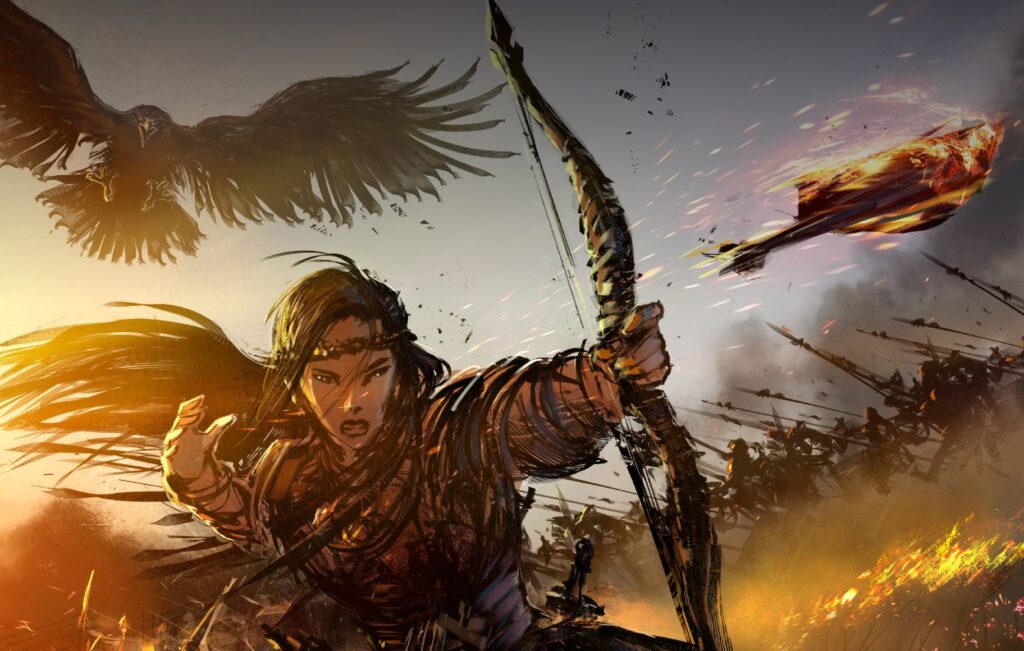
Today, comics and visual storytelling are increasingly going beyond entertainment. They are becoming part of a cultural dialogue, helping audiences reconnect with their roots. One such project is the graphic novel series The Legend of Ergenekon (Ergenekon Destanı), created by Turkish artist and designer Emre Erdur.
The Legend of Ergenekon is a Turkic origin myth that tells of a people driven into a remote valley after defeat in battle, where they lived in isolation for centuries until a blacksmith forged a path through the surrounding mountains. Guided by a gray wolf, they emerged to reclaim their strength and expand across the steppe. In Central Asia, the story symbolizes resilience, unity, and renewal, often invoked as a metaphor for nations overcoming hardship to reassert independence and identity on the Eurasian crossroads. It resonates strongly in Kazakhstan, Kyrgyzstan, Turkmenistan, and Uzbekistan, where Turkic identity, language, and heritage are foundational.
Born in Istanbul and trained as an architect at Mimar Sinan Fine Arts University, Emre Erdur worked for many years in the entertainment and design industries. Since 2019, however, he has dedicated himself to developing a multi-volume graphic novel series inspired by ancient Turkic history and mythology. His work was first presented at a festival in Taldykorgan. As part of his research, he visited the National Museum of Kazakhstan in Astana and collaborated with historian Assoc. Prof. Dr. Talgat Moldabay to ensure historical accuracy.

Image: Emre Erdur
For Central Asia, Ergenekon Destanı is more than a creative project; it represents an effort to connect a shared heritage through the language of comics and popular culture. In an interview with The Times of Central Asia, Emre Erdur spoke about his inspiration, research, the role Kazakhstan plays in his work, and his plans for expanding this unique visual universe.
TCA: You were born and educated in Turkey, yet you chose to dedicate yourself to wider ancient legends and Turkic history. When did you first feel drawn to this theme?
Erdur: Yes, I was born in the westernmost corner of Turkic geography, but every individual in this world has cultural roots that reach out and nourish them. Naturally, as an artist, the desire to draw from and explore my own roots is an inner force. Although I was born and raised in Istanbul, you can find traces of our roots as far as Yakutia in Russia, Buryatia, Mongolia, the Altai, further south in East Turkestan, in the Gobi Desert, and even in Korea. None of these places feels separate from us; you can sense the connection.
Of course, as a human being, every part of this world is valuable and fascinating; each region holds its own beauty and heritage. But there is also something called “national identity,” which is different from our individual identity. Our soul cannot be confined to this world; it knows no geography or race, it belongs beyond time and space. Yet during our lifetime on Earth, we do carry both national and individual identities, and defining them correctly is essential for life in this world.

Image: Emre Erdur
Among Turkic legends, Ergenekon was a story that was at once widely known and yet largely unknown. In people’s minds, it was usually reduced to something like: “Ergenekon is our legend, the Turks’ legend, they followed the wolf…” Yes, we know this, but what was Ergenekon really? Which tribe? When did it happen? There, nothing was clear. What we had was only this: they were betrayed, defeated, retreated to the Ergenekon Valley, stayed there for four hundred years, then returned and took revenge. But that’s barely more than a paragraph. It is mentioned almost casually, as if in passing, yet we still call it an “epic.”
Writers did, of course, create plays, books, and essays about it. But those works, as valuable as they are, were based largely on imagination. In their time, there was no internet, very few sources, perhaps just a paragraph or two in a library. The overall framework was there, but the rest was interpretation, shaped by the mindset of the era. I felt I needed to go beyond that, rather than settling for emotional or imagined figures – I wanted to get as close as possible to the truth. That’s why I set out to research and uncover what Ergenekon really was.
Moreover, in my own country, at one point, the name “Ergenekon” began to be associated with political crimes. That disturbed me, because names are precious; they carry deep meanings. When the meaning of a name is altered, people lose their connection to it and, in turn, their connection to their own roots. I didn’t find this right. So, both my curiosity about the unknown mystery of the epic and my discomfort with the way its name was being distorted in my society led me to focus on it.
TCA: Your academic background is in architecture and design. How do those skills influence your visual storytelling in a project that combines both art and history?
Erdur: As an artist, my ability has always been to turn ideas into scenarios and create something with both a visual and literary quality. When I entered the faculty of architecture, I was a little worried, but there I learned something essential: how to design and realize a project.
As an architect, you’re required to know and analyze many things. First and foremost, it’s essential to understand the needs and the problem correctly. Then you must be able to express a structure visually and with quality. A good architect is also, in a sense, a scriptwriter because the building is a living work. People will inhabit it, so you must consider every possibility, turn the concept into a kind of scenario, and even anticipate potential disasters in order to design it accordingly. And that is only the conceptual and design phase; there is also the process of realizing the project.

Image: Emre Erdur
In truth, the foundation of all this is very similar to what an artist must also know. My education in architecture taught me to analyze and design a project from multiple angles. It also gave me a deep understanding of space, scale, and composition.
In the context of this project, I’m not simply illustrating a scene in a comic; I’m designing an environment that the reader can step into. In a work that combines history and art, my architectural background gives me a strong perspective both in structuring the scenes and in conveying the visual traces of ancient cultures with authenticity.
Even though I studied architecture, I believe the entertainment industry offers a far broader field for my abilities.
TCA: The Legend of Ergenekon (Ergenekon Destanı) project required extensive research. How did you approach this process? In which countries and archives did you gather material?
Erdur: I began by studying widely recognized written sources. The Ergenekon myth appears in three different Chinese chronicles as a legend of Turkic origins. I also consulted medieval works such as Rashid al-Din Hamadani’s Jāmiʿ al-Tawārīkh and Abu’l Ghazi Bahadır Khan’s Shajara-i Turk, written between the 13th and 17th centuries. Additionally, I drew on recent studies by Kazakh and Russian scholars.
That said, I don’t consider these old texts entirely reliable. They were produced within the limitations and belief systems of their times. They offer clues, but uncovering the real story requires a different lens. While modern historians often relay information without interpretation, I believe the role of a designer includes shaping the narrative and extracting its deeper meaning.
My central question was simple: “What does Ergenekon actually tell us?” The legend refers to a 400-year period that ends with the founding of the First Turkic Khaganate in 552. Going back four centuries places us in the Han dynasty and the waning years of the Huns. At that point, China was much smaller, and much of the land belonged to the Huns. Yet the Han were pushing the Turks and Huns back toward the Altai or assimilating those who stayed. Studying that political context revealed the deeper layers of the story.

Image: Emre Erdur
Eventually, I realized I couldn’t rely solely on theoretical research. I needed to see things with my own eyes: what people wore, how they forged weapons, how they lived. That led me to the National Museum of History in Kazakhstan, which had recently opened and housed important artifacts. Seeing the armor, clothing, and tools of that era gave me a vivid sense of the culture. It was also there that I met Professor Dr. Talgat Moldabay, who generously supported my research.
Another vital contributor was my friend Aybike Şeyma Tezel, a historian and anthropologist focused on Central Asian Turkic history. She encouraged me to examine the material through alternative perspectives, beyond conventional historiography. Her insights were invaluable. She now works in Kazakhstan as well, and I hope to return soon to collaborate further with her and Dr. Moldabay.
Interestingly, I also found inspiration from the Kazakh Nomad Stunts team. Although I don’t know them personally, their cinematic portrayal of historical battle scenes, horseback combat, use of authentic weapons, and even physical traits provided many notes and visual references.
Ultimately, being on that land, walking through the museums, and breathing its air gave me something no book or archive could. It’s ancestral soil, you feel it, and it transforms the way you tell the story.
TCA: You collaborated with Kazakh historians and visited the National Museum. What aspects of Kazakhstan’s history and culture became sources of inspiration for you?
Erdur: What struck me most was how vividly history is preserved in Kazakhstan. At the museum, viewing armor, clothing, and daily objects directly inspired how I portrayed my characters. The insights of Kazakh historians and the detailed reenactments by the Nomad Stunts team helped bring realism to the epic.
Simply walking the streets and observing people also mattered. Over time, Turks in Anatolia have developed a different aesthetic, whereas Central Asian nations have retained original features. Realizing that people with similar appearances walked these lands 2,000 years ago added authenticity to my storytelling.
TCA: Your comics have been published in Kazakh. How do you perceive the response from Central Asian audiences?
Erdur: The comic hasn’t been fully published yet. In 2019, I was invited to the Taldykorgan Comic Festival, where 500 promotional copies of the first issue were printed with support from the municipality and the festival, and they sold out immediately. I signed books and drew sketches for readers. What moved me most was when people asked, “Is this our legend?” And I answered, “Yes, it’s yours, it’s ours.”
We are currently in discussions for an official publication in Kazakhstan, and I hope to finalize it soon.
TCA: What has been the most challenging part of creating Ergenekon Destanı: developing the storyline, finding the right visual style, ensuring historical accuracy, or balancing myth with history?
Erdur: The greatest challenge was uncovering the true historical narrative behind the epic. I believe I’ve achieved that, and the first three issues present the origins of the Ergenekon story through a blend of historical figures and facts.
Creating a graphic novel means working alone at nearly every stage: project development, plot, script, illustration, and visual storytelling. Of course, friends offer ideas, but the core effort is solitary.
I aimed to go beyond traditional comic storytelling to offer a cinematic experience. Even in coloring, I avoided classical comic aesthetics to create a more immersive visual style. This is both an epic and a creative work; every page should captivate and instill pride.
What truly tested me was maintaining quality, even in exhaustion. But out of respect for our ancestors, for readers today, and for future generations, I accepted nothing less than my best.
TCA: You mentioned your trip to Kazakhstan was pivotal. What impressed or surprised you most?
Erdur: My first visit was in 2017. Having lived in Russia, the language and social atmosphere felt familiar, but I also knew this was ancestral land. At first, I didn’t notice cultural traces, but walking to the museum, I began to sense it, in sculptures’ expressions, in their spirit. Seeing a statue of Atatürk felt like distant roots reconnecting.
Yellow flowers by the river reminded me of Yunus Emre’s poem: “My mother and father are the soil.” Their movement felt like a greeting. At the museum, mounted warriors greeted me, and Professor Moldabay guided my research. One day, I was stopped from sketching due to Soviet-era rules, but we resolved it through understanding.
Two moments left a deep impression. In a mosque, I felt compelled to bring greetings back to Istanbul, and in front of statues of a grieving mother and a WWII Kazakh woman soldier, I was overwhelmed by their pain and strength. Later, I realized I already knew their stories. It was like meeting parts of myself from across thousands of kilometers.
That’s what connecting with history means, rediscovering fragments of yourself.
TCA: Several volumes of your series have been released. Which part is most meaningful to you personally, and why?
Erdur: That’s a hard question; each volume holds its own meaning and importance. But the first issue stands out. It had to serve as both an introduction and a hook for the entire series. It was also the most difficult to create.
The second issue is meaningful because it reveals key secrets. The third delves into mysticism and mystery. Each subsequent volume adds a new layer. They form one interconnected whole; without one, the rest are incomplete.
TCA: The project goes beyond comics. You’ve mentioned games, films, and animation. Which direction is currently your top priority?
Erdur: My top priority is finishing the comic series, because it’s something I can complete on my own. After that, with the right partners, we could develop it into games. I’ve already designed a board game concept, one box containing three games that families can enjoy together, possibly while learning parts of different languages.
A film would require a committed producer, and so far, that opportunity hasn’t come. I’m not rushing into it. First, I want to complete the series.
TCA: Mythology is a global trend from Marvel to Netflix. How is Ergenekon different, and what do you want global audiences to understand?
Erdur: Mythology typically aims to convey values and teach lessons. In today’s media, though, it’s often framed through individual power and ambition. It entertains, but it doesn’t go deeper.
Ergenekon is different. It’s not about one person’s fate, it’s about a nation’s destiny. The story starts with strategic national goals, but pivotal changes occur due to individual ambitions and mistakes. In the end, the fate of an entire geography shifts. What remains is not personal memory, but collective memory.
Characters change, but the nation’s “genetic code” endures. Perhaps Ergenekon is the only epic in the world that tells of a nation’s near extinction and rebirth. It’s a pure epic, one worth internalizing.
Its historical lessons are still relevant today. Love stories exist, but they remain private. What matters is the collective rebirth of a people. Other mythologies leave you dreaming; Ergenekon gives you a homeland. And no one can take that away from you.
TCA: In Central Asia, preserving cultural memory is vital. Do modern formats like comics and animation help younger generations connect with their heritage?
Erdur: Absolutely. That’s why I created this project. Historical and academic knowledge evolves and often appeals only to specialists. But creative works engage wider audiences. They plant seeds that reveal themselves later.
Epics were once the entertainment of their time, using metaphor, aesthetics, and symbolism to preserve meaning. Today, comics and animation can play the same role, connecting new generations to heritage in engaging, lasting ways.
TCA: On a personal level, what does “connecting cultural heritage through art” mean to you? Is it a mission or a personal journey?
Erdur: It’s a question everyone should ask. We are temporary beings with limited time, and within that time, we have tasks to complete. One’s spiritual journey is deeply personal. But we also carry responsibilities to family, community, nation, and planet.
My skills aren’t just for personal joy; they should be used to give back. I try to do my part in that direction.
I also believe our nations have suffered many injustices and cultural losses over the centuries. That’s hard to accept. We have people of great purity and strength, and it’s important to preserve and pass on those qualities. Art is one way to do that. There are other paths, but mine is through art.
TCA: Beyond Ergenekon Destanı, do you have other creative dreams? Are there other legends or themes you want to explore?
Erdur: Yes, Ergenekon is a major project, but it opened a path to explore broader historical, contemporary, and futuristic ideas. I’ve mapped out interconnected stories, reinterpreting past moments and imagining how they link to the future.
One result is The Book of Red Apple, which explores global power shifts, the role of Turkic states, and themes like cyber warfare. I’m also developing stories set in the future and in space because space won’t follow earthly rules. New struggles for resources and influence are inevitable. In such worlds, I ask: how would our nations act?
My aim is not glorification but exploration of identity, behavior, and cultural response. If readers connect with these stories, they connect with their own roots and potential futures. Helping people feel pride in their past and imagine their future, even in space, that’s the ultimate reward.
TCA: Finally, how do you assess the current level of comic book development in Central Asia? What are the prospects?
Erdur: Comic book culture in Central Asia is still emerging. It’s not yet as widespread as in Europe or America, and in that way, it mirrors the situation in Türkiye. Foreign publishers dominate the market, and that’s not necessarily a bad thing. Their presence expands shelf space and visibility, creating room for local creators.
Being a comic reader is a different experience; it’s a more engaged form of storytelling. Central Asia has a wide-open field. But to reach audiences, comics must be visible. That means distribution networks and dedicated sections in bookstores are essential.
Previously, comics weren’t valued as highly as novels. But the West has shown otherwise. Comics have surpassed novels in popularity. A comic artist must both write and draw, and quality depends on both. If the artwork is weak, the whole story suffers.
Today’s youth, raised on social media, often struggle with long attention spans. Traditional books can be hard for them to finish. Comics offer visual engagement, helping to hold attention while still delivering meaningful stories.
For Central Asian youth, visual storytelling is key. It helps maintain values while preparing them for a globalized world. The cultures that invest more in visual formats will shape the next generation’s mindset. That’s the reality.
To support this, we need more shelves for comics in bookstores, and more public events, not just in universities, but citywide.
However, these events must feel both fun and purposeful. In the West, cosplay events are huge, but the materials for costumes can be costly in our region. More importantly, we need to ask: what kind of events would genuinely engage our culture?
In the West, fans often want to enter fictional worlds. But in our culture, we’re already part of a profound heritage. Central Asian events should be forward-looking, focused on the next 100 years. That’s the kind of purpose that will inspire real interest.
That’s a little secret worth sharing.