• KGS/USD = 0.01144 0%
  • KZT/USD = 0.00212 0%
  • TJS/USD = 0.10523 0%
  • UZS/USD = 0.00008 0%
  • TMT/USD = 0.28530 0%
  • KGS/USD = 0.01144 0%
  • KZT/USD = 0.00212 0%
  • TJS/USD = 0.10523 0%
  • UZS/USD = 0.00008 0%
  • TMT/USD = 0.28530 0%
  • KGS/USD = 0.01144 0%
  • KZT/USD = 0.00212 0%
  • TJS/USD = 0.10523 0%
  • UZS/USD = 0.00008 0%
  • TMT/USD = 0.28530 0%
  • KGS/USD = 0.01144 0%
  • KZT/USD = 0.00212 0%
  • TJS/USD = 0.10523 0%
  • UZS/USD = 0.00008 0%
  • TMT/USD = 0.28530 0%
  • KGS/USD = 0.01144 0%
  • KZT/USD = 0.00212 0%
  • TJS/USD = 0.10523 0%
  • UZS/USD = 0.00008 0%
  • TMT/USD = 0.28530 0%
  • KGS/USD = 0.01144 0%
  • KZT/USD = 0.00212 0%
  • TJS/USD = 0.10523 0%
  • UZS/USD = 0.00008 0%
  • TMT/USD = 0.28530 0%
  • KGS/USD = 0.01144 0%
  • KZT/USD = 0.00212 0%
  • TJS/USD = 0.10523 0%
  • UZS/USD = 0.00008 0%
  • TMT/USD = 0.28530 0%
  • KGS/USD = 0.01144 0%
  • KZT/USD = 0.00212 0%
  • TJS/USD = 0.10523 0%
  • UZS/USD = 0.00008 0%
  • TMT/USD = 0.28530 0%

Leaders of Turkic States Meet in Azerbaijan

The 12th Summit of the Heads of State of the Organization of Turkic States (OTS) convened in Gabala, Azerbaijan, bringing together leaders from Azerbaijan, Kazakhstan, Kyrgyzstan, Turkey, Uzbekistan, Hungary, Turkmenistan, and the Turkish Republic of Northern Cyprus.

Discussions focused on regional stability, economic integration, and strengthening fraternal ties among Turkic nations.

Aliyev: The OTS Is Becoming a Major Geopolitical Center

Opening the summit, Azerbajani President Ilham Aliyev welcomed participants to Gabala and thanked Kyrgyzstan for its prior chairmanship.

“Today, the Organization of Turkic States is not merely a platform for cooperation; it is forming as one of the serious geopolitical centers,” Aliyev said.

He announced Azerbaijan’s $2 million contribution to support OTS activities and emphasized shared historical roots and cultural values across Turkic nations. Addressing peace and security, Aliyev added, “In light of modern geopolitical challenges, it is crucial that Turkic states act as a unified center of power,” and proposed hosting joint military exercises of OTS member states in 2026.

South Caucasus Peace and Economic Connectivity

Aliyev highlighted the recent peace agreement initialed between Azerbaijan and Armenia in Washington as a breakthrough for the South Caucasus:

“This will turn the region into a space of peace.”

He also noted Azerbaijan’s growing role in regional logistics:

“Since 2022, cargo volumes along the Middle Corridor have increased by nearly 90%. Our Caspian fleet, the Alat Port, the Baku-Tbilisi-Kars railway, and nine international airports have made Azerbaijan a leading transport hub.”

He stressed the importance of the Zangezur Corridor, intended to connect Azerbaijan with Nakhchivan and Central Asia, and cited Azerbaijan’s energy diversification, exporting natural gas to 14 countries and a projected 40% share of renewables in its energy mix by 2030.

Unity and Vision from the Turkic Leaders

Kyrgyz President Sadyr Japarov praised the summit location and the symbolic timing: “Gabala is an ancient city with a 2,000-year history, and it is no coincidence we gathered here.” He called the joint peace declaration with Armenia a historic step toward trust in the South Caucasus.

Kazakh President Kassym-Jomart Tokayev echoed support: “This historic document has ended a conflict that had remained unresolved for more than 30 years.” He quoted poet Bakhtiyar Vagabzade: “A Turk has no right to be hostile to another Turk.”

Turkish President Recep Tayyip Erdoğan called for developing a “Common Turkic Language Model” to protect cultural heritage and advance artificial intelligence research.

“We once again demonstrate that the Turkic states, driven by solidarity, mutual respect, and brotherhood, are confidently looking to the future,” he said.

Uzbek President Shavkat Mirziyoyev credited Aliyev’s leadership: “This peace declaration became possible thanks to your political will and is a common achievement of the Turkic world.”

Turkmenistan and Hungary on Brotherhood and Energy

Gurbanguly Berdimuhamedov, Chairman of Turkmenistan’s Halk Maslahaty, described the OTS as a unifying platform for brotherly nations with shared culture and language, committed to promoting cooperation at regional and international levels.

Hungarian Prime Minister Viktor Orbán underscored Azerbaijan’s value to Europe:

“Your incredible achievements, economic development, and investments in renewable energy prove that Central Asia is the ‘golden reserve’ of the European Union.”

Karabakh, Transit, and Future Integration

Ersin Tatar, President of the Turkish Republic of Northern Cyprus, marked the fifth anniversary of the Karabakh Victory, calling it “a common victory for the entire Turkic world.”

OTS Secretary-General Kubanychbek Omuraliyev highlighted the strategic timing of the summit and upcoming infrastructure developments:

“The opening of the Zangezur Corridor and restoration of the ancient Silk Road will create new transit opportunities. With the launch of the China-Kyrgyzstan-Uzbekistan railway, the Middle Corridor’s importance will increase further.”

He also announced the creation of a Permanent Secretariat and a Special Fund for the Union of Turkic Universities, supported in part by Azerbaijan.

Gabala Declaration and Path Forward

Aliyev closed the summit by affirming its strategic value:

“The ideas and positions voiced today will guide the Organization of Turkic States in its future work. I am confident this summit will further strengthen our friendship and brotherhood.”

The summit concluded with the signing of the 12th OTS Summit Declaration and a groundbreaking ceremony for a new mosque.


Jackie Chan to Film New “Armour of God” Sequel in Kazakhstan

Legendary actor and filmmaker Jackie Chan is set to return to Kazakhstan to work on the latest installment of his iconic action franchise, Armour of God: Ultimatum.

The project will be produced in partnership with Kazakhstan’s Salem Entertainment, which officially confirmed its involvement.

“We can now officially reveal details of Jackie Chan’s visit to Almaty. He will be working on the new film Armour of God: Ultimatum. The fourth installment of this legendary saga will be filmed here in Kazakhstan,” the studio said in a statement.

Chan visited Almaty in late September, prompting speculation in local media, including rumors he might attend a football match between Real Madrid and FC Kairat. However, the visit turned out to be professional: he was scouting filming locations with the Kazakh production team.

“During his stay in Almaty, Jackie Chan joined our team in selecting filming sites. Most of the production will take place in Kazakhstan. We can’t reveal details yet, but it’s going to be something truly spectacular,” Salem Entertainment added.

The original Armour of God premiered in 1986 and became an international box office success, cementing Chan’s status as a global star. A sequel followed in 1991, and the franchise was revived two decades later with Armour of God 3: Chinese Zodiac.

For Kazakhstan, the production presents a rare opportunity to showcase its cinematic potential and diverse filming locations to a global audience.

Chan remains famous for performing all his own stunts. In an interview with Haute Living, he confirmed that this principle still guides his work, even after six decades in the industry.

“I always do my own stunts. It’s part of who I am, part of my profession and my identity. That won’t change until I retire. And retirement doesn’t interest me,” Chan said.

He added that staying in peak physical condition has become instinctive: “I don’t need special preparation anymore. It’s already inside, in my heart, my mind, and my muscles. It’s just a habit I’ve never lost.”

Bishkek Authorities Ban Low-Quality Coal to Curb Air Pollution

On October 6, the Kyrgyz government banned the use of powder-like coal with particle sizes between 0-13 mm in Bishkek and the surrounding Chui region as part of a broader effort to combat air pollution and improve public health.

According to the Ministry of Natural Resources, Ecology, and Technical Supervision, this fine-grade coal is inefficient for household heating and generates significant dust, contributing to particulate air pollution. The new regulation applies only to private households and does not affect heating plants or boiler facilities.

As part of its wider decarbonization strategy, the Ministry of Finance has partnered with domestic banks to launch the Improving Air Quality project. This initiative supports the transition to modern, environmentally friendly heating systems and promotes cleaner household energy use.

Funded through a $50 million loan from the International Development Association, the project will distribute $31.8 million in preferential loans via Aiyl Bank, Eldik Bank, and Bakai Bank. The program aims to reduce household coal consumption, promote energy-efficient heating, and expand access to cleaner technologies across the capital and beyond.

Officials believe the project will help accelerate the adoption of eco-friendly heating solutions and improve urban air quality in Bishkek, a city of more than one million residents. Air pollution remains a chronic problem, particularly during winter months, when coal burning in households surges and accounts for an estimated 40% of the city’s harmful emissions. Bishkek frequently ranks among the top 10 most polluted cities worldwide, according to IQAir’s global index.

Washington and Tashkent Push for More Trade and Investment

Speaking at the United Nations in New York on September 23, President Mirziyoyev of Uzbekistan made it clear that he no longer adheres to his predecessors’ post-Soviet policies of isolation and ‘go-it-alone’ economic development strategy – those days are over.

Uzbekistan today – or so the evidence suggests – is more open for business than at any time in its history, with the caveat that deals must be win-win, strategic, fair, and reciprocal. Though it’s unclear what that precisely entails, both Washington and Tashkent are clearly working to accelerate capital and trade flows.

“[Our] top-priority goal”, Mirziyoyev said at the United Nations, “is to fundamentally transform the lives of each and every family and citizen in our country, to enhance human dignity and wellbeing.” These are not mere words, but stand at the core of Uzbekistan’s efforts to build a new nation on the back of its – until recently – entirely archaic Soviet era socio-economic institutional structures and often ossified old ways of thinking.

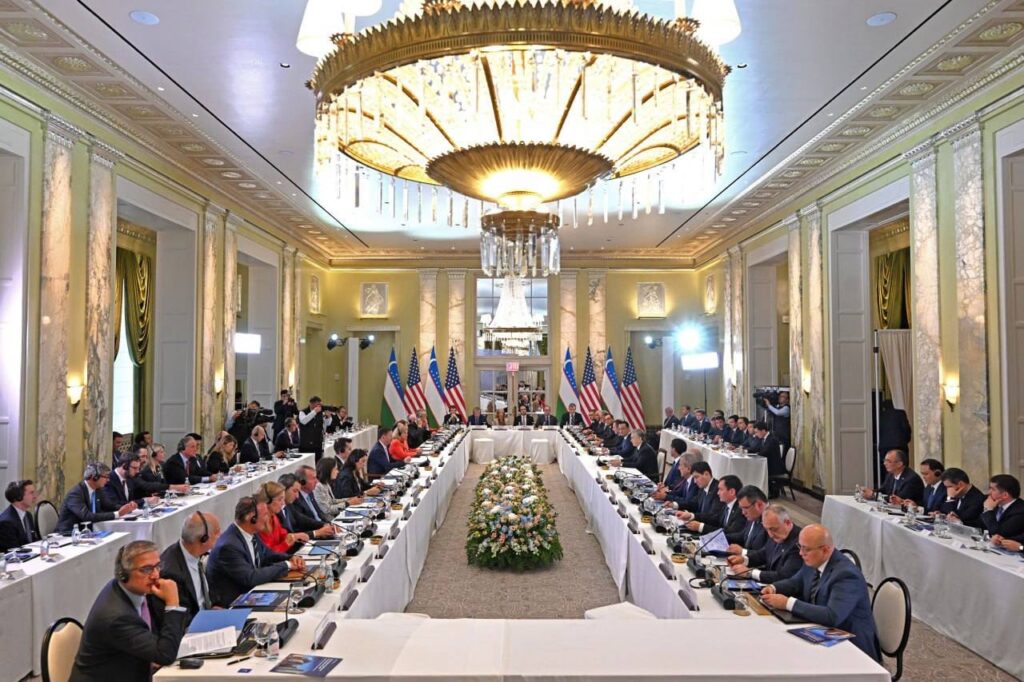
With this in mind, the main event of Mirziyoyev’s recent New York visit – besides his meeting with President Trump – was the high-level US-Uzbekistan investment roundtable with senior executives of major U.S. corporations and financial institutions.

The roundtable was more than just symbolic. Its strong turnout underscored both the U.S. and Uzbek commitment to advancing joint initiatives in key sectors, including strategic minerals, transport infrastructure, energy, and smart agriculture.  Top executives from Boeing, Citigroup, BNY Mellon, NASDAQ, Nvidia, Mastercard, Visa, General Motors, Jefferies, Oppenheimer, Cleveland Clinic, Cargill, and other U.S. corporations descended on the meetings in force, clearly eager to court the president and his team.

Image: president.uz

At their face-to-face meeting, President Trump personally congratulated Mirziyoyev on the landmark $8 billion Boeing-Uzbekistan Airways deal, projected to generate over 35,000 U.S. jobs – that in itself is not news. Rather, the NY business roundtable appears to have signaled that the American business community is more than just sniffing around for deals. Undoubtedly, a key force behind this growing interest is Washington’s expanding engagement with Uzbekistan.

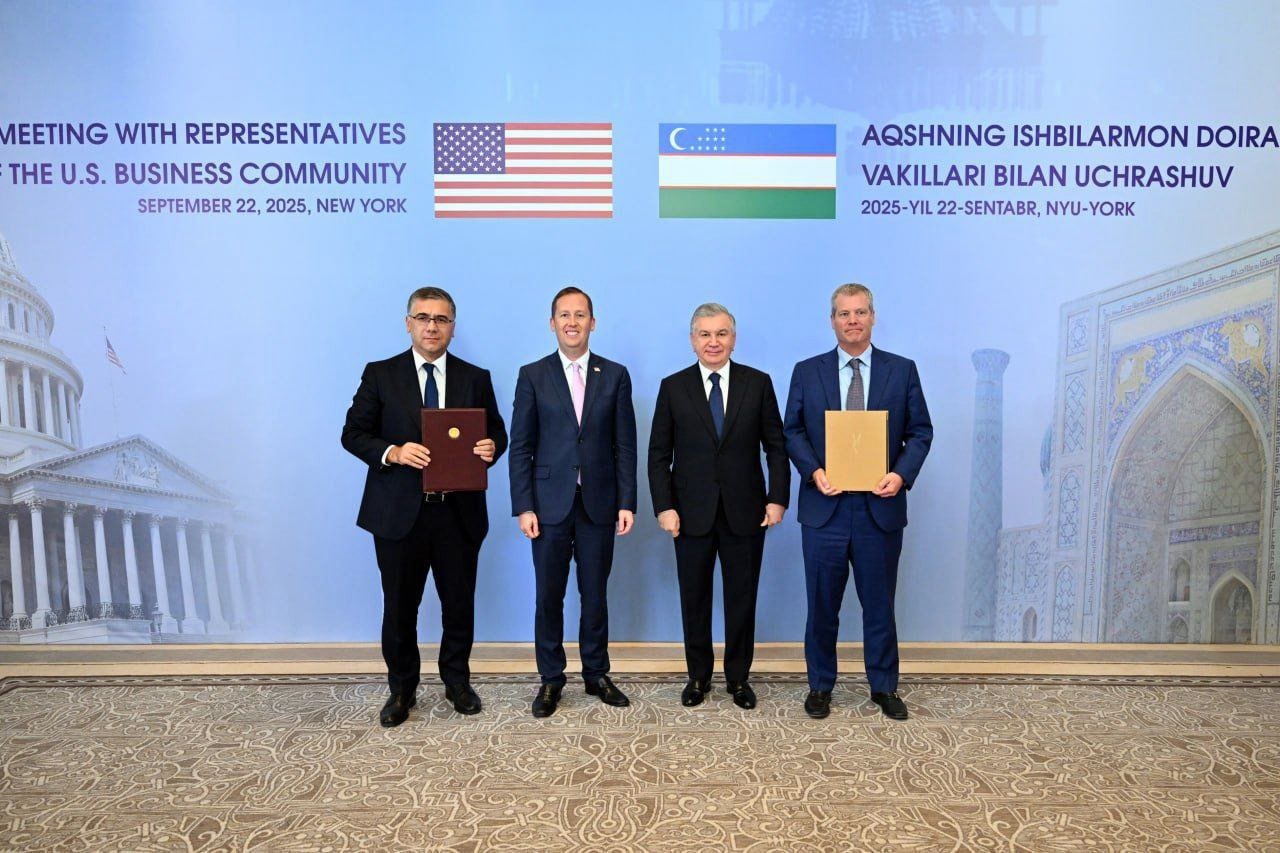
Highlighting Washington’s strategic swing towards Uzbekistan, Mirziyoyev, Sergio Gor, U.S. Special Envoy for South and Central Asian Affairs, and William Kimmitt, Under Secretary of Commerce for International Trade, attended the signing ceremony of bilateral agreements, which ranged from transport, logistics and AI to mining, healthcare, and financial services. Their presence helped move discussions from initial interest to serious dealmaking.

To dispel investor uncertainty related to sovereign risk and other hidden booby traps often embedded in cross-border investment agreements, Mirziyoyev declared: “I assure you, I personally guarantee the success of U.S. companies operating in Uzbekistan. At the Ministry of Investments, a dedicated Deputy Minister for U.S. Affairs has been appointed. He will accompany you 24/7.”

While this makes plain Uzbekistan’s shift from aid recipient to active economic player, it’s also an attempt to shore up “investor butterflies” who are wary of corruption and shaky legal remedies in the event of contract disputes.

Moreover, recognizing that companies are often cautious about entering new markets, Washington has taken additional steps to encourage American companies to invest in Uzbekistan – at least so it would seem from the literature. For example, the U.S. Department of State’s newly released September 2025 Uzbekistan Investment Climate Statement strikes an overall positive note, avoiding the overly cautious or even negative framing often seen in such reports in the past.

With pragmatism in hand and a more engaged Washington, the long-awaited U.S. pivot to Central Asia appears to be taking shape. Strong, realism-based diplomatic efforts, if sustained and smart, should encourage deeper ties between the two countries and, over time, generate job opportunities in both the U.S. and Uzbekistan, a matter of concern for China and Russia.

Uzbek Companies Begin Gas Exploration at Afghanistan’s Toti-Maidan Field

Uzbek companies have received official licenses from Afghanistan to explore and produce hydrocarbons, Uzbek Energy Minister Jurabek Mirzamakhmudov announced in a documentary titled The Path of a New Uzbekistan – A Truth Recognized by the World, broadcast on Uzbekistan 24.

According to Mirzamakhmudov, Afghan authorities have granted Uzbek firms the right to conduct geological exploration and develop hydrocarbon deposits on Afghan territory. Work began in mid-September at the Toti-Maidan gas field in Jowzjan province under a 25-year contract signed with the Uzbek company Eriell KAM.

“This will be the first stage,” Mirzamakhmudov said, as quoted by Uzbek media. “Depending on the results, we plan to expand cooperation to new sites. The project is being implemented as an initiative that will benefit both the Uzbek and Afghan economies.”

The Toti-Maidan field spans approximately 7,500 square kilometers and includes around 30 wells, according to Afghanistan’s Ministry of Mines and Petroleum. Uzbekistan is expected to invest about $100 million annually over the next decade, with plans to process the extracted gas domestically.

Mirzamakhmudov emphasized that the initiative reflects Uzbekistan’s growing role in regional energy cooperation and aligns with its policy of fostering mutually beneficial ties with neighboring countries. He noted that the project aims to support local industry development and job creation in both nations.

In August 2025, Uzbek and Afghan energy companies signed a series of agreements in Kabul to implement four major infrastructure projects. These include the construction of a 500-kilovolt Surkhan-Dasht-e Alwan transmission line, substation expansions in Arghandeh and Nangarhar, and upgrades to the Kabul-Nangarhar power corridor.

Former Afghan Deputy Speaker “Abbas Dollar” Arrested in Tashkent

Abbas Ibrahimzada, a former deputy speaker of Afghanistan’s parliament, was arrested in Tashkent on September 24, according to sources cited by Amu. Despite reportedly posting bail of more than $350,000, he has remained in custody for over a week. His arrest follows multiple complaints filed by business rivals.

Local sources indicate that Ibrahimzada has invested more than $50 million in Uzbekistan over the past four years, with ventures spanning commercial transport and flour production. His detention has raised concerns about potential disruptions to his extensive business interests. Ibrahimzada has not publicly commented on the case.

A prominent representative from Balkh province during the 16th term of Afghanistan’s parliament, Ibrahimzada is widely known by the nickname “Abbas Dollar”, a nod to his reputation as one of Afghanistan’s wealthiest private investors.

In addition to his political career, Ibrahimzada has long been active in business. According to Afghan-Bios, he heads the Ibrahimzada Group, which operates across multiple sectors, including energy, infrastructure, and education.

His arrest in Uzbekistan adds a new layer of complexity to his cross-border business profile, drawing attention to the intersection of political and commercial interests in Central Asia. The case also highlights the legal uncertainties foreign investors may encounter in the region. Authorities have not released an official statement regarding the specific charges or the status of his business operations in Uzbekistan.