• KGS/USD = 0.01144 0%
  • KZT/USD = 0.00194 0%
  • TJS/USD = 0.10879 -0.18%
  • UZS/USD = 0.00008 0%
  • TMT/USD = 0.28490 0%
  • KGS/USD = 0.01144 0%
  • KZT/USD = 0.00194 0%
  • TJS/USD = 0.10879 -0.18%
  • UZS/USD = 0.00008 0%
  • TMT/USD = 0.28490 0%
  • KGS/USD = 0.01144 0%
  • KZT/USD = 0.00194 0%
  • TJS/USD = 0.10879 -0.18%
  • UZS/USD = 0.00008 0%
  • TMT/USD = 0.28490 0%
  • KGS/USD = 0.01144 0%
  • KZT/USD = 0.00194 0%
  • TJS/USD = 0.10879 -0.18%
  • UZS/USD = 0.00008 0%
  • TMT/USD = 0.28490 0%
  • KGS/USD = 0.01144 0%
  • KZT/USD = 0.00194 0%
  • TJS/USD = 0.10879 -0.18%
  • UZS/USD = 0.00008 0%
  • TMT/USD = 0.28490 0%
  • KGS/USD = 0.01144 0%
  • KZT/USD = 0.00194 0%
  • TJS/USD = 0.10879 -0.18%
  • UZS/USD = 0.00008 0%
  • TMT/USD = 0.28490 0%
  • KGS/USD = 0.01144 0%
  • KZT/USD = 0.00194 0%
  • TJS/USD = 0.10879 -0.18%
  • UZS/USD = 0.00008 0%
  • TMT/USD = 0.28490 0%
  • KGS/USD = 0.01144 0%
  • KZT/USD = 0.00194 0%
  • TJS/USD = 0.10879 -0.18%
  • UZS/USD = 0.00008 0%
  • TMT/USD = 0.28490 0%
15 December 2025

Azerbaijan, Kazakhstan, and Uzbekistan Partner on Caspian Green Energy Corridor

Azerbaijan, Kazakhstan, and Uzbekistan have signed a landmark agreement with the Asian Development Bank (ADB) and the Asian Infrastructure Investment Bank (AIIB) to advance a regional renewable energy initiative known as the Caspian Green Energy Corridor.

The Memorandum of Understanding (MoU), signed on April 5 in Baku, outlines plans for a feasibility study to assess the project’s potential. The primary objective is to establish a robust legal and institutional framework that will facilitate cross-border electricity trade among the three countries, particularly from renewable sources.

The Caspian Green Energy Corridor is part of ADB’s broader regional strategy to promote clean energy and enhance multilateral cooperation. The initiative aims to interconnect the energy systems of Azerbaijan, Kazakhstan, and Uzbekistan, enabling them to share and distribute renewable electricity more efficiently.

“This agreement lays the foundation for deeper cooperation and shows our shared commitment to building a clean energy future,” said Yevgeniy Zhukov, ADB Director General for Central and West Asia.

A key ambition of the project is to develop a green energy supply route from the Caspian region to Europe via the Black Sea Cable. The corridor is expected to improve energy security, reduce carbon emissions, and support economic development across the region.

The initiative is also backed by the Central Asia Regional Economic Cooperation (CAREC) Program, which brings together 11 countries and several development partners to promote regional integration and reduce poverty through economic collaboration.

Excitement Mounts After Trio of Central Asian Countries Launch Joint Bid to Host 2031 AFC Cup

On February 24, Uzbekistan, Kyrgyzstan, and Tajikistan officially submitted a joint bid to host the 2031 AFC Asian Football Cup. If selected, the 2031 tournament would be the first top-level football event hosted in Central Asia.

Central Asian Football Association (CAFA) President Rustam Emomali – the eldest son of Tajik President Emomali Rahmon – displayed his enthusiasm following the bid. “Our Central Asian region has never hosted the final part of the Asian Cup. I think the time has come. Our region is represented by very strong teams, and I am confident that together with the fraternal countries, we will host the final part of the Asian Cup at the highest level,” he stated.

Whilst a joint bid amongst Central Asia countries has stoked excitement for many in the region, they currently face strong competition to host the event. The UAE, Kuwait, Australia, Indonesia, and South Korea have all signaled their intention to bid to be the tournament’s next host.

Whilst none of the three Central Asian nations have hosted a top-level football tournament, Uzbekistan has experience with similar events after hosting the AFC U-20 and U-23 tournaments and the Futsal World Cup in 2024.

However, after attending the Futsal World Cup, Uzbek fan Farrukh Irnazarov is nervous that the authorities may not promote the event aggressively enough. “When Uzbekistan hosts an event like this, they’re very serious about it. However, unfortunately their biggest concern is security. [The Futsal World Cup] wasn’t heavily publicized, and many people weren’t aware we were hosting it,” he told The Times of Central Asia.

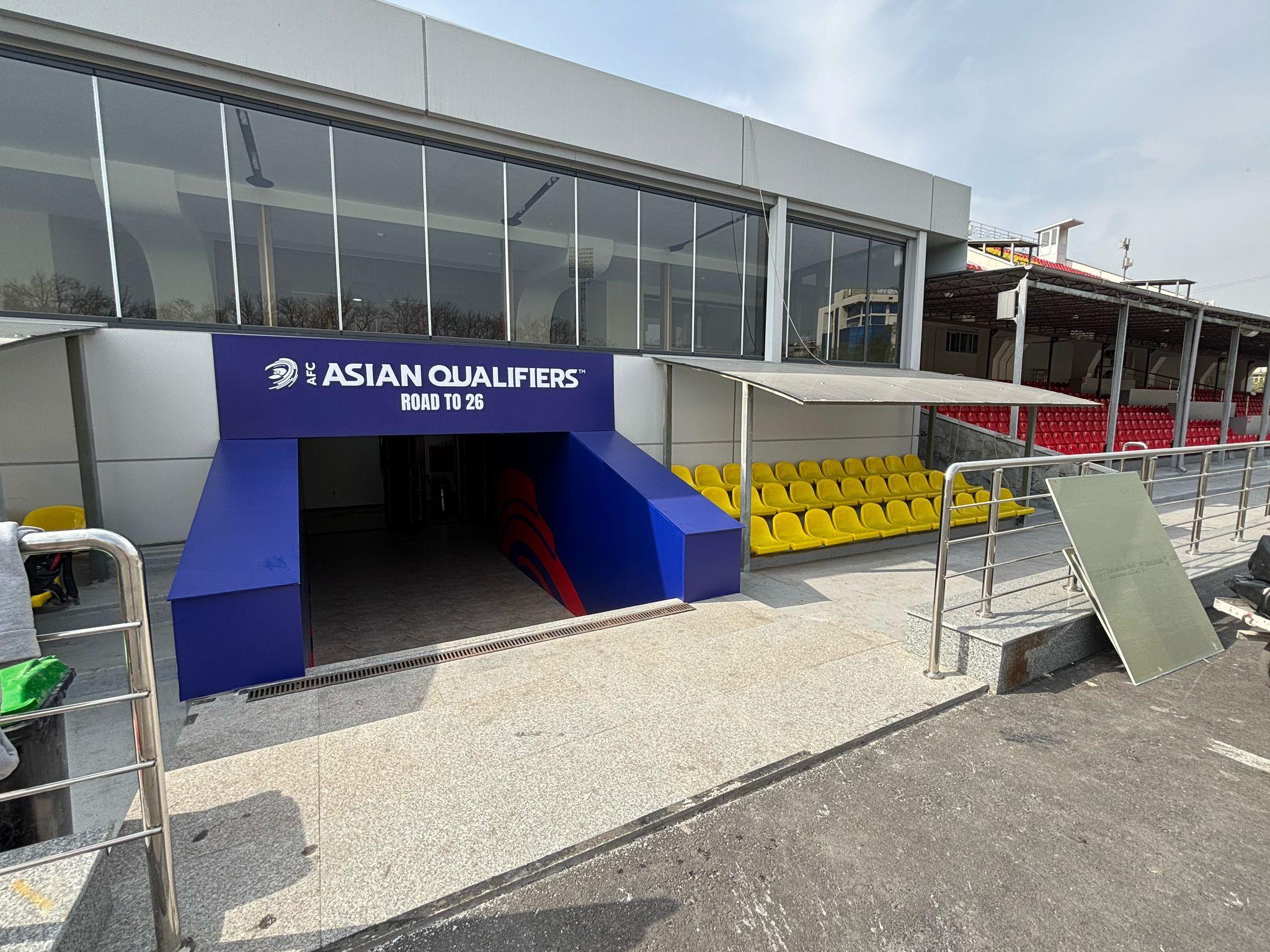
To be considered for the bid, all three countries will need to complete stadium renovations by the time the AFC committee makes its decision in 2026.

Uzbekistan is the most prepared of the three, with stadiums already at international tournament capacity in Tashkent, Namangan, Fergana, and Qarshi. A stadium with a minimum capacity of 50,000 seats is required for the final, and Bishkek has already volunteered.

Tashkent and Dushanbe are also revamping their respective stadiums, as the host nations must have two cities with 40,000-seat stadiums for the semi-finals in the tournament.

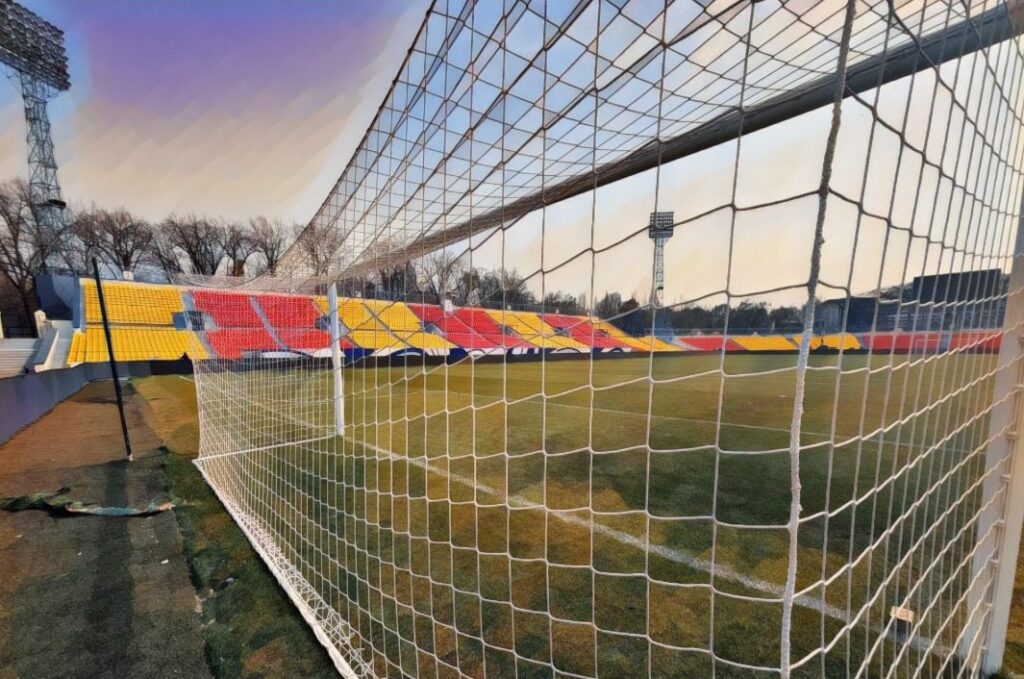
The Dolon Omurzakov Stadium in Bishkek; image: TCA, Joe Luc Barnes

What is the AFC Asian Cup?

The AFC Asian Cup is an Asian (plus Australia) football competition that has been held every four years since 1956. The previous tournament was held in 2023 in Qatar, which saw the host nation become champions.

The tournament started with just four teams: South Korea, Israel, South Vietnam, and Hong Kong, playing a round-robin style tournament before expanding to 24 teams in 2019. Kyrgyzstan and Uzbekistan have already qualified for the next tournament in Saudi Arabia in 2027, whilst Tajikistan and Turkmenistan need to win their group in the final round of qualification to participate.

However, for the 2031 tournament, if Kyrgyzstan, Uzbekistan, and Tajikistan see their bid accepted, all three teams will qualify automatically.

Central Asia’s best tournament result came with a fourth-place finish by Uzbekistan in 2011. All three teams are hoping for similar success twenty years later.

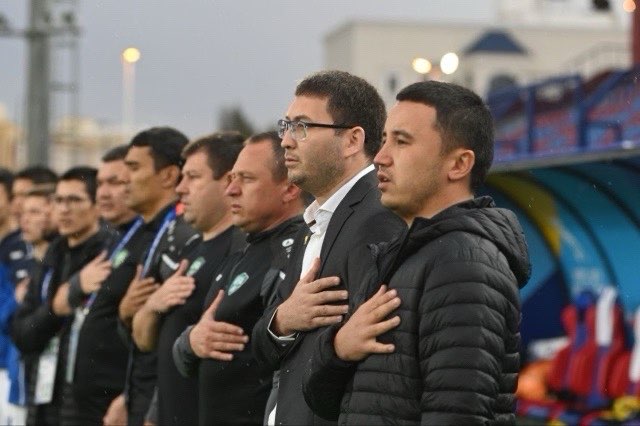
Image: Sherzod Ibragimov

Impacts of Hosting the Tournament

If the Central Asia trio see their bid accepted, this could lead to significant long-term recognition and progress for Central Asian football. The investment in modernized stadiums could significantly benefit Uzbek, Kyrgyz, and Tajik football moving forward.

However, according to Aidana Otorbaeva, the vice-president of the Kyrgyz women’s football association and a former Kyrgyz national team player, these investments wouldn’t just support the top level of men’s football.

“Co-hosting the Asian Championship can bring even more investment and recognition to our favorite sport, football, but particularly women’s and youth football as well. For my academy, we struggle to provide enough coaches, stadiums or even fields to accommodate the demand for the sport. Investments have led to some small stadiums being built across the country, but it’s still not enough,” Otorbaeva told TCA.

Hosting any international tournament brings substantial media coverage and recognition, and therefore leads to sponsorships, partnerships, and foreign investment.

Sherzod Ibragimov, Uzbekistan’s U-17 National Team Head Coach, has another view about the sustainability of funding in Central Asian football. “The attention of foreign investors on [Central Asia], where football is developing, will increase, and in the future, there will be no need for government investment,” he told TCA

Central Asia could also see increased opportunities to host international friendly matches, especially with more modernized stadiums, featuring teams across Asia or even Europe. Tourism could also see a big boost. When the United Arab Emirates hosted the tournament in 2019, they saw an influx in tourism revenue through hotels, restaurants, and retail outlets.

Hosting the event could lead to similar long-term gains in tourist revenues.

Many are already thrilled about the possibility of this continental tournament coming to the region, including Tajik U-17 National Team Head Coach Marco Ragini. “When I saw the joint bid for 2031, I really thought this will be the right time to bring change to football in Central Asia. It will be a good time and opportunity to have a spotlight on Central Asian football,” Ragini told TCA.

Jennifer Lopez to Perform in Kazakhstan – Billion-Tenge Boost Expected

American pop icon Jennifer Lopez will perform in Kazakhstan’s capital this summer, with local officials predicting a major economic windfall from the event. Malik Hasenov, producer at Astana Concert Company, told a recent government meeting that the concert could generate over 6.5 billion KZT ($12.6 million) for the city’s economy and contribute 400 million KZT ($778,000) in taxes to the state budget.

Kazakhstan on the Map of J.Lo’s World Tour

Astana has been added to Lopez’s Up All Night world tour schedule, with the concert set to take place at Astana Arena on August 1.

The tour includes stops in Turkey, Egypt, Spain, Hungary, Poland, the UAE, and other countries, but Kazakhstan is her only Central Asian destination. She is scheduled to perform in Abu Dhabi before arriving in Astana and will close the tour in Armenia’s capital Yerevan.

“I will have some special concerts this summer. I am very much looking forward to meeting you. We haven’t seen each other for too long. This summer is going to be awesome,” Lopez wrote on Instagram.

Economic Impact: Expectations and Numbers

According to Hasenov, approximately 15,000 tourists are expected to visit Astana for the concert, with significant spending projected across hotels, restaurants, transportation, and retail sectors. “Jennifer Lopez’s arrival will be a landmark moment, opening Astana on the touring map of A-class stars,” he said.

Tickets are expected to go on sale shortly, ranging in price from 40,000 to 150,000 KZT ($75 to $290).

Astana will also host two other major events in 2025. On July 13, the Alem Fest music festival, featuring British singer Craig David as headliner, will take place at Astana Arena, coinciding with the closing of Comic Con Astana. Additionally, large-scale drone shows are planned, expected to attract up to a million spectators.

J.Lo and Kazakhstan: A Brief History

This won’t be Jennifer Lopez’s first visit to Kazakhstan. In 2010, she performed at a private birthday celebration, and in 2011, she returned for a New Year’s corporate event. Reports estimate she was paid around $3 million for both appearances.

In 2017, Lopez drew attention from Kazakhstani fans during a Las Vegas concert when she echoed chants of “Kazakhstan!” shouted by Gennady Golovkin supporters, a moment that quickly went viral.

A year later, controversy arose when YouTube temporarily blocked the Kazakh music video Zyn-zyn, citing similarities to Lopez’s Control Myself. The video was later reinstated following public backlash in Kazakhstan, with many hailing it as a “small victory”.

Most recently, in February 2025, Lopez interacted with a Kazakh fan named Binura during a concert in Abu Dhabi, sparking lively discussions across Kazakhstani social media.

Ruling Party Urges Government to Revise VAT Reform Plans

Kazakhstan’s ruling Amanat party has called on the government to revise its proposed tax reforms, particularly those affecting the value-added tax (VAT). The party is pushing to double the planned threshold for mandatory VAT registration, warning that the current proposal could harm small and medium-sized businesses.

Under current law, businesses must register for VAT if their annual turnover exceeds 78.6 million KZT (approximately $152,000). The government’s draft reform proposes to lower this threshold to 15 million KZT (around $29,000). It also includes raising the basic VAT rate from 12% to 16%, introducing a zero rate for agricultural producers, a 10% rate for selected industries, and gradually applying VAT to the healthcare sector. The reform also proposes eliminating 128 tax exemptions worth more than 1.3 trillion KZT.

A progressive personal income tax is also under discussion. With a base rate of 10%, the government suggests introducing a 15% rate for annual incomes exceeding 8,500 MRP (monthly calculation index), equivalent to over 33.5 million KZT. For 2025, the MRP in Kazakhstan is set at 3,900 KZT (about $7.50).

The draft Tax Code is scheduled for a first reading in the Mazhilis, Kazakhstan’s lower house of parliament, on Wednesday, April 9. On the eve of the session, government officials presented the proposals at an expanded meeting with Amanat’s parliamentary faction, which holds 62 of the 98 Mazhilis seats.

Amanat deputies voiced strong opposition to the proposed reduction in the VAT registration threshold, warning it could drive businesses into the informal economy. Instead, they urged the government to raise the threshold to at least 30 million KZT (approximately $58,000).

The party also proposed exempting 19 socially important food items from VAT to ease the financial burden on citizens. These items include flour, bread, pasta, eggs, buckwheat, rice, sugar, vegetable oils, various meats (such as beef and chicken), dairy products (milk, kefir, cottage cheese), staple vegetables (potatoes, carrots, onions, cabbage), and salt.

“Particular concern was expressed over proposals to apply VAT to healthcare and to tax financial services,” the party said in a statement. “Such measures would drive up prices and impose additional costs on the population, which is unacceptable under current conditions”.

As The Times of Central Asia previously reported, the government initially considered raising the VAT rate to 20%, but President Kassym-Jomart Tokayev rejected that proposal in favor of a more moderate increase​.

Kazakhstan Limits Duty-Free Smartphone Imports to Two Per Person Annually

Kazakhstan’s Ministry of Finance plans to amend regulations governing the volume of goods citizens may import for personal use without paying customs duties. According to a draft order published on the Open NPAs (Normative Legal Acts) website, individuals will be allowed to bring in no more than two new smartphones and two new tablets per year, duty-free, from outside the Eurasian Economic Union (EAEU).

The proposed changes, open for public discussion until April 22, also cap duty-free imports at one new laptop, one new bicycle, one baby stroller, and one car per person annually. All restrictions apply exclusively to newly manufactured goods in factory packaging. Used versions of these items, except for cars, will not be subject to quantity limits.

Additionally, individuals may import up to five pieces of jewelry and one item of fur clothing (including headwear) per year, provided each item differs by name, size, or style. These restrictions are part of a broader effort by authorities to curb the illegal import and resale of consumer goods, especially smartphones.

As The Times of Central Asia reported earlier this year, Kazakhstan intensified efforts in March to clamp down on the smuggling of smartphones into the domestic market. The new limits on personal-use imports are a key part of this crackdown. However, questions remain as to why the regulations do not cover used smartphones, which are also commonly trafficked through unofficial channels.

Gas Crunch in Uzbekistan: Industry Falters as Demand Surges

In the first two months of 2025, Uzbekistan’s natural gas production declined by 4.2% compared to the same period in 2024, continuing a troubling trend that has seen output fall from 61.59 billion cubic meters in 2018 to 44.59 billion cubic meters in 2024. This persistent decrease raises concerns about the nation’s energy security and economic stability.

Once among Central Asia’s energy success stories, Uzbekistan became a net importer of natural gas in 2023, a symbolic turning point for a country whose identity was long intertwined with hydrocarbon abundance.

The extent of the strain was demonstrated in December 2024, when gas stations around the country were forced to close during a cold snap as heating systems across the country kicked into action. This led drivers of methane-powered cars, which are common in the country given that it costs about $15 to fill the tank as opposed to $40-50 in a gasoline-powered vehicle, into a desperate hunt for places to fill up. Kilometer-long queues formed, and drivers ferociously competed to be first to the pump.

Such scenes have become a familiar sight in the Uzbek winter as gas production has fallen.

“Uzbekistan’s gas production is already quite mature,” Anne-Sophie Corbeau of Columbia University’s Center on Global Energy Policy told The Times of Central Asia. “The existing fields are entering a phase of decline. The reserve-to-production ratio was around 18 years based on 2020 data, and the situation is unlikely to be much better now.”

Put simply, the country is running out of easy gas. Despite repeated efforts to locate new reserves, particularly in the under-explored Ustyurt region, exploration has so far failed to yield significant breakthroughs. Even if discoveries are made, the timeline to bring new fields online would mean little impact before 2030, at best.

In parallel, demand for gas has remained stubbornly high. Corbeau noted that “the country’s energy mix and electricity generation are very dependent on natural gas. And Uzbekistan is one of the countries with the lowest wholesale gas prices in the world.” Those prices have long distorted both domestic consumption and investor interest, keeping demand high while choking off potential upstream capital.

Image: Wholesale Gas Price Survey 2024 Edition. International Gas Union. https://www.datocms-assets.com/

This sentiment is echoed by Irina Mironova, Senior Energy Analyst at the New Energy Advancement Hub. “Domestic production is declining faster than consumption,” she said, “and domestic gas pricing is not market-based. It remains below the price of imported gas, which undermines the investment appeal of upstream projects for foreign investors.”

The government has undertaken some measures to control demand over the past year, raising the tariffs for electricity and gas by 52.5% and 71% respectively, hitting consumers in the pocket in an attempt to alter the wasteful use of scant resources.

On the supply side, the government has declared a bold ambition to raise production to 62 billion cubic meters annually under its Uzbekistan–2030 development strategy, but observers remain skeptical. “They’ve tried to facilitate exploration, especially in the Ustyurt region,” says Corbeau. “But even if results are positive, it’s unclear if significant production can be up and running by 2030.”

In 2019, Uzbek state television announced that British oil major BP and Azerbaijan’s state oil company SOCAR would lead exploration into the potential of gas reserves in the Ustyurt Plateau in the far west of the country. BP abandoned the project in 2021, with Tashkent blaming the company’s new focus on low-carbon projects. SOCAR retained an interested and signed a strategic partnership with Uzbekneftegaz in 2024, but six years on from BP’s initial interest, the two companies are still at the “initial exploration” stage, suggesting BP’s concerns may have been more than simply environmental.

Return of the Mack

Right now, Uzbekistan is looking to imports to bridge the gap. The timing is auspicious: Russia’s Gazprom, once focused almost entirely on Europe, has redirected its gaze to Central Asia in the wake of Western sanctions and lost market share. In November 2022, Moscow proposed a “gas union” with Kazakhstan and Uzbekistan, offering Russian supply to compensate for the region’s faltering output.
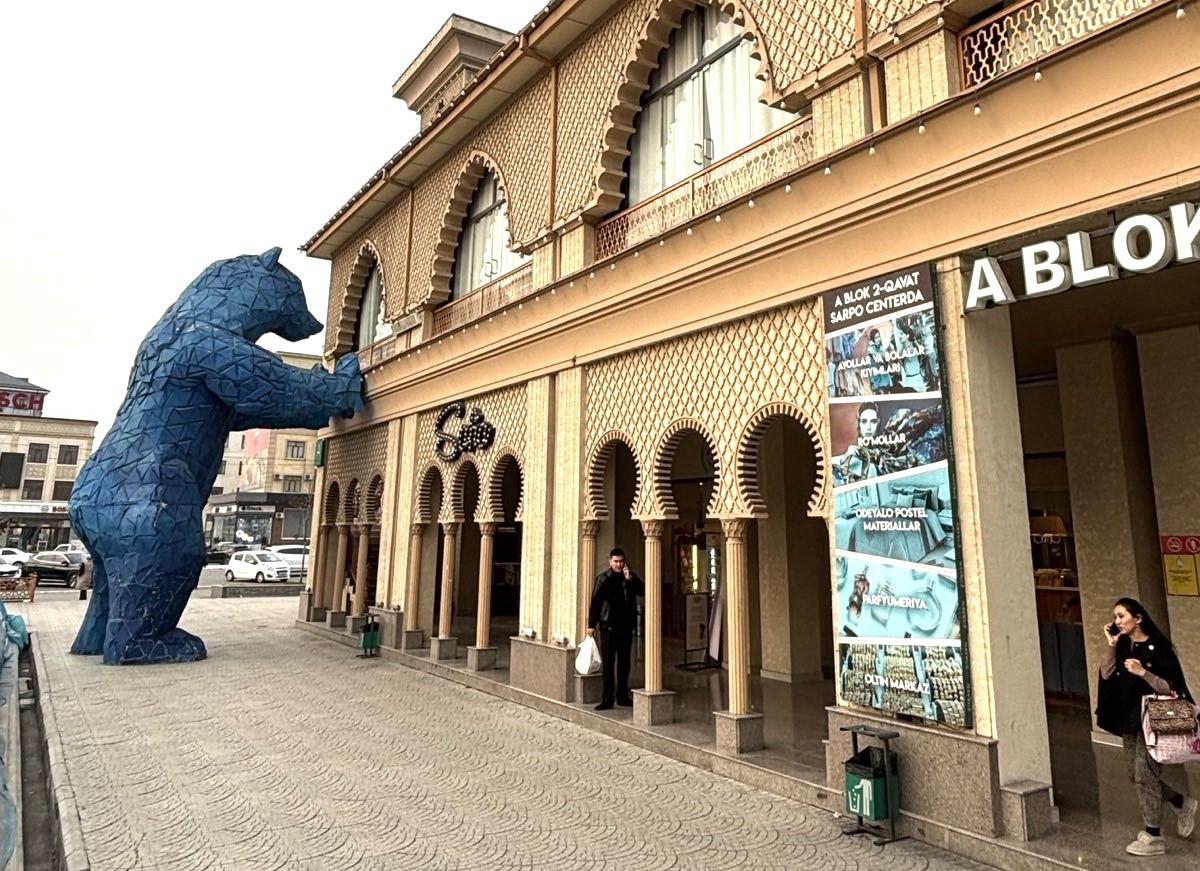
Uzbekistan’s energy sector is increasingly propped up by Russian gas imports; image: TCA, Joe Luc Barnes

The Soviet era Central Asia–Center pipeline, once used to transport gas from Turkmenistan, Uzbekistan and Kazakhstan to Russia, has now been engineered to run in reverse. Exports to Uzbekistan in the year to October 2024 exceeded five billion cubic meters.

But are these offers strategic, even predatory?

Not quite, says Corbeau. “Russia stepped in because both Uzbekistan and Kazakhstan each had pipeline export commitments to China – 10 bcm per year each – that they failed to deliver.” She explained that Russia saw an opportunity to fill that gap, sending gas to these two countries, who could then continue to export their own gas on to China. For Russia, it was “a good way to reach China, without building additional infrastructure.”

Mironova agrees that Russia’s motives are largely economic, not geostrategic. “Gazprom is likely to maximize the sales price under current market conditions. Given that Uzbekistan has some level of domestic production, it offers opportunities to integrate local output and optimize costs. If there were a viable opportunity for production expansion, I believe Gazprom would seek involvement rather than attempt to undercut local production.”

That said, Gazprom’s own challenges make it an unreliable savior. The company’s finances have been battered by the collapse in European sales. As Mironova noted, “Following the reduction of gas exports to Europe in 2022 – and especially given Gazprom’s financial difficulties in 2024 – the company’s investment capabilities have been significantly reduced. Uzbekistan is unlikely to be a priority.”

Other sources

In the long run, Tashkent is seeking to diversify. In December, the government announced that twelve modern thermal power plants will be installed by 2027, with almost $5 billion of investment in public private partnerships with companies from France, Germany and Japan. Meanwhile, Russia’s Rosatom has begun work on a small-scale nuclear power plant near the picturesque Tuzkan Lake.

“Uzbekistan aims to derive 54% of its electricity from renewables by 2030,” said Mironova. While current capacity is measly – wind and solar comprised less than 1% of its energy needs in 2023 – the country has made some recent steps forward. The country is currently constructing a series of renewable energy projects worth around $13 billion.

Posters across Tashkent have declared “2025 is the Year of Environmental Protection and the Green Economy”, echoing Mirziyoyev’s announcement in January. Two major wind energy projects in the Bukhara region, built by Chinese and Saudi investors, should have come online by 2026.
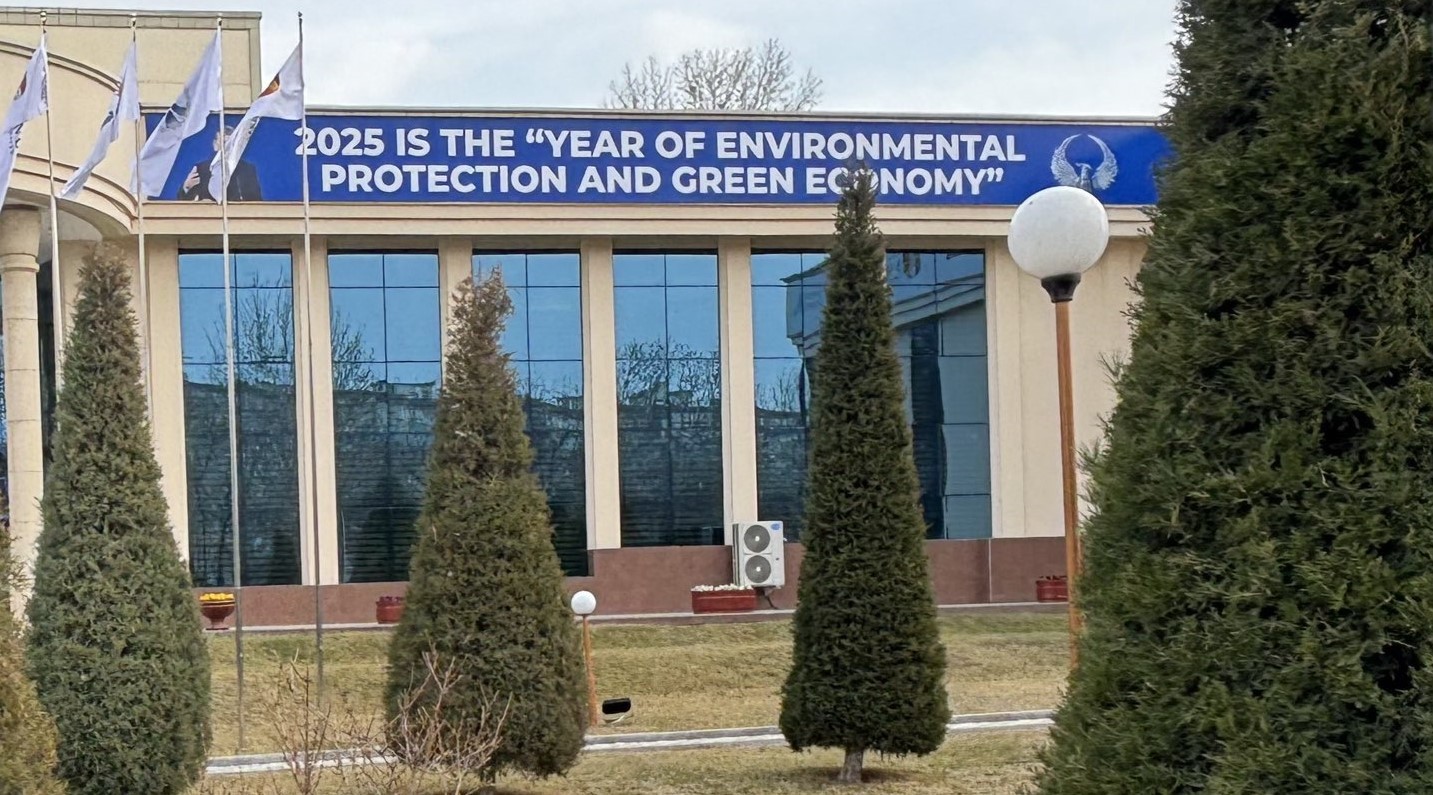
Environmental declarations are displayed across the city; image: TCA, Joe Luc Barnes

Meanwhile, in a country which averages 320 sunny days per year, solar has huge potential. A top-down order in January from Energy Minister Jurabek Mirzamakhmudov stipulated that 50% of all roofs in the nation will have solar panels installed on them, although specific details were lacking.

Electric cars are now increasingly populating the streets of Tashkent, with the Chinese firm BYD opening its first factory outside China in Mirziyoyev’s hometown of Jizzakh.

At the recent EU-Central Asia summit in Samarkand, the European Union made climate and energy one of its four key pillars of cooperation with Central Asia. Given Tashkent’s recent push toward regional leadership and Central Asia’s more general push toward economic integration, it also stands to benefit from hydroelectric projects in Kyrgyzstan and Tajikistan.

Still, the road to an energy-secure Uzbekistan is bumpy and potholed. Grid infrastructure remains underdeveloped, and familiar allegations of corruption in procurement remain a concern. With the country’s economy and population both booming, demand will continue to surge. As a result, natural gas will likely remain a cornerstone of the energy mix for years to come, leaving the country in a race against time to develop alternatives.