• KGS/USD = 0.01144 0%
  • KZT/USD = 0.00193 -0%
  • TJS/USD = 0.10876 0.55%
  • UZS/USD = 0.00008 0%
  • TMT/USD = 0.28490 0%
  • KGS/USD = 0.01144 0%
  • KZT/USD = 0.00193 -0%
  • TJS/USD = 0.10876 0.55%
  • UZS/USD = 0.00008 0%
  • TMT/USD = 0.28490 0%
  • KGS/USD = 0.01144 0%
  • KZT/USD = 0.00193 -0%
  • TJS/USD = 0.10876 0.55%
  • UZS/USD = 0.00008 0%
  • TMT/USD = 0.28490 0%
  • KGS/USD = 0.01144 0%
  • KZT/USD = 0.00193 -0%
  • TJS/USD = 0.10876 0.55%
  • UZS/USD = 0.00008 0%
  • TMT/USD = 0.28490 0%
  • KGS/USD = 0.01144 0%
  • KZT/USD = 0.00193 -0%
  • TJS/USD = 0.10876 0.55%
  • UZS/USD = 0.00008 0%
  • TMT/USD = 0.28490 0%
  • KGS/USD = 0.01144 0%
  • KZT/USD = 0.00193 -0%
  • TJS/USD = 0.10876 0.55%
  • UZS/USD = 0.00008 0%
  • TMT/USD = 0.28490 0%
  • KGS/USD = 0.01144 0%
  • KZT/USD = 0.00193 -0%
  • TJS/USD = 0.10876 0.55%
  • UZS/USD = 0.00008 0%
  • TMT/USD = 0.28490 0%
  • KGS/USD = 0.01144 0%
  • KZT/USD = 0.00193 -0%
  • TJS/USD = 0.10876 0.55%
  • UZS/USD = 0.00008 0%
  • TMT/USD = 0.28490 0%
11 December 2025

Russian Exodus and Return: Kazakhstan Feels the Impact as War Migrants Come and Go

The mass migration of Russians following the war in Ukraine has significantly impacted Kazakhstan’s economy and social fabric. However, many Russian citizens who initially sought refuge in the country are now returning home.

Adapting to Post-Soviet Countries Proves Challenging

According to independent Russian demographer Alexei Raksha, Russian migrants who left their homeland after February 2022 are more likely to return from Kazakhstan than from other countries.

An estimated 800,000-900,000 people left Russia following the outbreak of war in Ukraine, the first wave coming after the military campaign was launched, and the second following the announcement of a partial mobilization in September 2022, when queues on the Russian side of the Verkhny Lars border with Georgia stretched for twenty miles. Reports of graft were rife, with the police blocking the roads and demanding bribes from those attempting to flee. Free seats in cars were being sold for $1,000, with border guards charging $200 for an exit stamp.
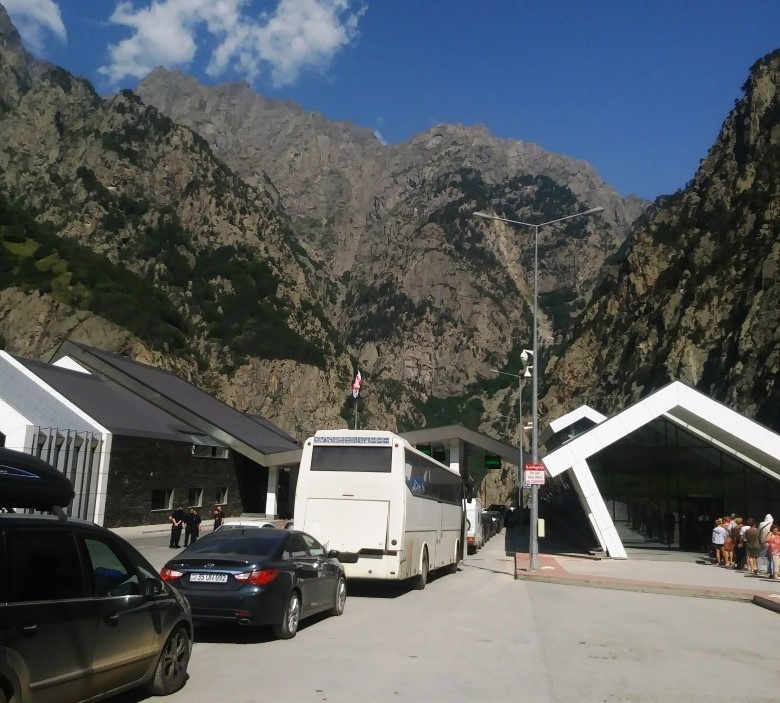
The Georgian side of the Verkhny Lars border with Russia; image: TCA, Stephen M. Bland

This wave of migration left Russia with a labor shortage of some 4.8 million people. The choice of destination was often influenced by visa-free entry, ease of legalization, and the presence of acquaintances.

Prices in Tbilisi skyrocketed in 2022-23, leading to a surge in evictions, resentment, and understandable fears given previous invasions that Russia would use the new diaspora as a pretext for another incursion. A similar situation occurred in Yerevan. “With the influx of Russians, rents in Yerevan doubled and, in some cases, even tripled,” Ani Khachataryan, an environmental activist told TCA.

Migration continued in 2023, but the number of returnees also increased. Around 45% of those fleeing Russia initially went to Georgia, Kazakhstan, and Armenia, though by 2023, that share had dropped to 32%. As of July 2024, at least 650,000 people who left Russia after it invaded Ukraine were estimated to still be abroad.

Migration routes were fluid: 64% of Russians stayed in their first destination, while 26% moved further, often to the European Union, the United Kingdom, or Switzerland. About 10% returned to Russia. Among those who relocated, nearly half changed countries more than once, with Serbia emerging as a new hub. Many continued working remotely for Russian companies or found employment with Western firms.

Most returnees came from the former Soviet republics, with Kazakhstan leading the trend – one in five Russian emigrants in Kazakhstan eventually went back. By contrast, those who settled in the European Union, the United States, Canada, and Israel were far less likely to return.

Raksha attributes this pattern to economic factors: Russians who moved to post-Soviet states, including Kazakhstan, tended to be middle-income earners. Meanwhile, wealthier Russians, who had jobs with Western firms or owned businesses were more likely to relocate to the U.S. or Europe.

A Temporary Relocation

In September 2022, following Russian President Vladimir Putin’s decree on partial mobilization, Russian migrants surged into Kazakhstan. Long queues formed at border crossings, and some fleeing men abandoned their vehicles in a desperate bid to enter the country. According to Kazakhstan’s Ministry of Internal Affairs, more than 200,000 Russian citizens arrived in the country within weeks – though 147,000 quickly left. Only a few hundred applied for Kazakh citizenship, half of whom were ethnic Kazakhs.

The Kazakh authorities noted that over a million Russian citizens travel to Kazakhstan annually, indicating that the influx was not an extraordinary event. Nevertheless, the sudden surge led to economic disruptions, including rising prices, and fueled public anxiety.

By January 2024, Dmitry Turaev, Russia’s Consul General in Almaty, estimated that about 80,000 Russian migrants remained in Almaty and Shymkent, down from over 300,000 at the end of 2022. Turaev predicted that the trend of Russian citizens returning home would continue.

In response to the migration surge, Kazakhstan’s government implemented new regulations in January 2023 to restrict long-term stays. The so-called “visa run” practice – where foreigners could exit and re-enter the country to reset their permitted stay – was abolished. Now, visa-exempt foreigners, including Russians, can stay for a maximum of 90 days within any 180-day period.

A Pattern of Soaring Rental Prices

One of the most immediate consequences of mass migration was a surge in housing costs. Rental prices doubled in Astana, Shymkent, Kostanay, Uralsk, and Petropavlovsk, while in Almaty, they almost tripled. Although prices stabilized after several months, they remained significantly higher than pre-migration levels. The costs of goods and services also rose.

Financial expert Rasul Rysmambetov argues that, despite the strain on the housing market, the arrival of Russian migrants has positively impacted Kazakhstan’s economy.

“Most Russian relocants belong to the middle or upper-middle class and are financially stable, which has driven up consumption,” Rysmambetov told Nur.kz. “This increased demand benefits the economy, especially in the food and consumer goods sectors. Additionally, Russian specialists have brought business connections and facilitated the export of goods to Russia that are no longer available due to sanctions.”

Rysmambetov also believes Kazakhstan stands to benefit from competition between local and foreign professionals. Many Russian migrants are highly skilled, working in IT, finance, consulting, and investment services – fields in which Kazakhstan faces a workforce shortage.

“Some Russian companies have fully relocated to Kazakhstan and offer high-quality services,” Rysmambetov stated. “For example, IT specialists have integrated into Kazakhstani firms and are bringing valuable expertise to the market. Competition is ultimately beneficial.”

Experts suggest that a new wave of Russian migrants could occur only if another round of mobilization, partial or full, is announced, which appears unlikely at present given the recruitment of foreign fighters.

Exaggerated Expectations

Some Russian migrants arrived in Kazakhstan with unrealistic expectations. Igor K., a resident of Krasnodar who relocated to Kazakhstan in 2022, described his experience adjusting to life in the country.

“Many newcomers expected Kazakhstan to be either a desert filled with camels or a wealthy oil state like the Middle Eastern emirates,” Igor told The Times of Central Asia. “People from Russia’s eastern cities, Novosibirsk, Barnaul, and Yekaterinburg, often had little knowledge about the country.”

Igor, who previously lived in Kazakhstan before emigrating eleven years ago, was more prepared than most. He first arrived in Ust-Kamenogorsk, where he had acquaintances, before moving to Almaty.

“I struggled with employment at first. I worked as a cab driver, sales manager, and deliveryman. But after obtaining a residence permit, I landed a job with a large international company,” he said.

Many Russian migrants, he noted, had inflated expectations of Kazakhstan and either returned home or moved on to another country. Those who stayed found work in IT, journalism, and medicine. Russian companies operating in Almaty actively hire Russian professionals.

“Will Kazakhstan become a permanent home for us?” Igor asked rhetorically. “That’s an open question.”


Kyrgyz Citizen Arrested in U.S. for Illegally Exporting Firearms to Russia

A Kyrgyz citizen has been accused of illegally exporting American semi-automatic rifles and pistols from the United States to Russia via Kyrgyzstan. The U.S. Department of Justice announced the charges on its official website.

U.S. federal authorities in Brooklyn have indicted 46-year-old Kyrgyz national Sergei Zharnovnikov, alleging that he orchestrated a criminal scheme to smuggle American firearms to Russia using a front company.

“Zharnovnikov traveled from Kyrgyzstan to the United States last month and was arrested on January 24, 2025, in Las Vegas, Nevada, while attending the Shooting, Hunting, and Outdoor Trade Show to meet with U.S. gun dealers,” the Department of Justice stated.

Zharnovnikov is currently in custody and is set to stand trial in the Eastern District of New York at a later date. If convicted, he faces up to 30 years in prison.

According to U.S. prosecutors, Zharnovnikov conspired with others to violate American export control laws by shipping firearms to Russian buyers. He reportedly signed a five-year, $900,000 contract with a Virginia-based arms company to export rifles from the U.S. to Kyrgyzstan. However, the company’s export license explicitly prohibited the resale or re-export of these weapons to Russia.

Investigators allege that Zharnovnikov disregarded these restrictions, instead selling the firearms to a front company in Kyrgyzstan, which then transferred them to Russia. U.S. authorities discovered that the Bishkek-based company had signed a $10 million contract with a Moscow-based firm, suggesting the weapons may have been delivered in multiple shipments.

U.S. Attorney for the Eastern District of New York John J. Durham emphasized the gravity of the case: “The defendant used a complex scheme to circumvent export controls and ship semi-automatic firearms to Russia. Today’s indictment sends a clear message that we will vigorously enforce laws designed to protect U.S. foreign policy and national security.”

This is the second high-profile case involving the smuggling of American weapons to Russia. The Times of Central Asia previously reported that Kyrgyz security services had intercepted attempts to re-export American-made arms and weapons components to Russian organized crime groups.

Uzbekistan Launches Eco-Friendly Program to Reward Green Lifestyles

Uzbekistan has introduced a new initiative to promote eco-friendly habits. A presidential decree has been adopted as part of the state program for implementing the ‘Uzbekistan 2030’ strategy during the country’s ‘Year of Environmental Protection and Green Economy’.

The nationwide movement, One Million Green Families, aims to encourage sustainable living and raise environmental awareness. The program seeks to integrate eco-friendly habits into daily life through advocacy efforts and incentives.

The initiative is based on several key principles:

  • Promoting a healthy lifestyle through better nutrition, daily walks, and jogging
  • Encouraging the use of green transportation, such as bicycles
  • Reducing plastic waste
  • Preventing food waste
  • Using water, gas, and electricity more efficiently
  • Sorting waste for recycling

To support this initiative, the Ministry of Ecology, Environmental Protection, and Climate Change, along with the Ministry of Digital Technologies, will launch a digital platform in June. This platform will track participation and offer incentives to those who actively adopt eco-friendly practices.

Citizens who demonstrate outstanding commitment to sustainable living will earn the title of “Eco-Active Citizen”. Benefits include a 10% discount on public services and lower interest rates on consumer loans from state-owned banks. Families in which all adults achieve this status will be recognized as Green Families, and will have a chance to win one of 14 electric cars awarded annually through an open competition.

The initiative also extends to local communities. Mahallas (neighborhoods) where at least half of the residents qualify as Green Families will compete in the Cleanest Mahalla and Greenest Mahalla contests. Winning communities will receive 500 million UZS ($38,500) to fund local infrastructure improvements, such as road repairs, energy-efficient lighting, playgrounds, green spaces, and waste management upgrades.

Rosenberg King Prawns to Be Bred in Turkmenistan

Turkmenistan’s Elin Balyk fish farm is expanding its operations by introducing the breeding of Rosenberg freshwater king prawns.

Located in the Ak Bugday district of Ahal province, on the Karakum River, Elin Balyk has been engaged in fish farming for over a decade.

The farm operates on a 130-hectare site, granted for free use for 99 years. It features 20 ponds covering a total area of 400 square meters, along with six indoor rearing facilities that house shrimp and fish at various growth stages – from larvae and fry to mature commercial stock and breeding specimens. A newly launched hatchery, equipped with technology from Russia, Iran, and Europe, enhances production capabilities.

The facility employs modern aquaculture methods, including a closed water circulation system that limits water loss to just 10%. The intensive fish farming process avoids antibiotics and chemicals while ensuring optimal oxygenation levels.

As part of its diversification efforts, Elin Balyk has begun breeding Rosenberg freshwater shrimp, a species native to Thailand. These prawns can grow up to 100 grams in weight, with body lengths comparable to an adult’s palm.

Looking ahead, the company plans to introduce Vannamei shrimp, a saltwater species, and has trained its specialists in Iran and Thailand to master the necessary aquaculture techniques. An additional land plot is expected to be allocated for this expansion.

Tajikistan’s Health Ministry Seeks Alternative to USAID Assistance in Combating Deadly Diseases

Tajikistan’s Ministry of Health is exploring alternative funding sources following the suspension of USAID programs.

The recent freeze on U.S. foreign aid has affected several health initiatives in Tajikistan, particularly those focused on combating HIV/AIDS, tuberculosis, and malaria.

At a press conference, Health Minister Jamoliddin Abdullozoda stated that authorities are seeking new mechanisms to sustain these programs.

“USAID has played a key role in the fight against HIV, tuberculosis, malaria, as well as in maternal and child health. Until the agency’s future involvement is clarified, we intend to mobilize other resources,” Abdullozoda said.

One of Tajikistan’s main partners remains the Global Fund to Fight AIDS, Tuberculosis, and Malaria, which continues to finance drug supplies and testing. The Health Ministry confirmed its commitment to strengthening cooperation with the Fund and engaging additional international organizations.

Tajikistan’s Republican Center for AIDS Prevention and Control clarified that USAID did not provide antiretroviral therapy (ARV) drugs or testing kits. Instead, the agency’s primary role was offering psychological and social support to HIV patients, mainly through nongovernmental organizations.

According to official data, 12,480 people living with HIV are currently registered in Tajikistan’s healthcare system, including 1,022 children. In 2023, 293 new cases were detected among labor migrants. However, the overall number of registered HIV cases declined by 98 compared to previous years.

Regarding tuberculosis, Tajikistan recorded 4,545 new cases in 2023 and 4,537 in 2024. The health minister attributed the slight increase to improved diagnostic capabilities. The country now has 77 tuberculosis diagnostic machines, 84 BAG laboratories, and 40 specialized devices for detecting infections.

Kazakhstan and China Set to Expand Trade and E-Commerce

Trade between Kazakhstan and China continues to grow, reaching $43.8 billion in 2024, according to China’s General Administration of Customs. Kazakhstan’s exports to China amounted to $15.8 billion, marking a 9% increase from the previous year. These figures were announced by Han Chunlin, China’s newly appointed ambassador to Kazakhstan, during a meeting with Kazakh Minister of Trade and Integration Arman Shakkaliyev on February 8.

“This trend confirms our steady progress toward the ambitious goal of doubling bilateral trade turnover in the near future,” the ambassador stated.

Strengthening Trade and E-Commerce Cooperation

The meeting focused on expanding Kazakh-Chinese trade and economic cooperation, with particular emphasis on e-commerce platforms.

Shakkaliyev highlighted that bilateral trade reached a historic high in 2024 and reaffirmed Kazakhstan’s commitment to diversifying its exports while expanding the range of products supplied to China. He also announced plans for trade and economic missions in 2025, alongside Kazakhstan’s participation in major exhibitions in China.

A key discussion point was the development of online trade through leading Chinese e-commerce platforms, including JD.com, Alibaba, and Douyin.

Kazakhstan’s Growing Presence in Chinese E-Commerce

  • Alibaba: Launched in 2022, Kazakhstan’s dedicated section on Alibaba now includes 290 domestic companies offering over 7,500 products. Total sales on the platform have already surpassed $260 million.
  • JD.com: In 2023, JD.com opened a Kazakhstan section, featuring over 60 products. Revenue from Kazakhstani goods sold on the platform grew from RMB 1 million in 2023 to RMB 1.3 million in 2024.

Kazakhstan’s e-commerce industry has seen rapid growth in recent years. According to the Ministry of Trade and Integration, online transactions from January to November 2024 totaled approximately 3.2 trillion KZT (over $6 billion), accounting for 14.5% of total retail trade.

As Kazakhstan strengthens its trade ties with China, digital commerce is expected to play an increasingly important role in bilateral economic relations.