• KGS/USD = 0.01144 0%
  • KZT/USD = 0.00192 -0%
  • TJS/USD = 0.10879 0.28%
  • UZS/USD = 0.00008 0%
  • TMT/USD = 0.28571 0%
  • KGS/USD = 0.01144 0%
  • KZT/USD = 0.00192 -0%
  • TJS/USD = 0.10879 0.28%
  • UZS/USD = 0.00008 0%
  • TMT/USD = 0.28571 0%
  • KGS/USD = 0.01144 0%
  • KZT/USD = 0.00192 -0%
  • TJS/USD = 0.10879 0.28%
  • UZS/USD = 0.00008 0%
  • TMT/USD = 0.28571 0%
  • KGS/USD = 0.01144 0%
  • KZT/USD = 0.00192 -0%
  • TJS/USD = 0.10879 0.28%
  • UZS/USD = 0.00008 0%
  • TMT/USD = 0.28571 0%
  • KGS/USD = 0.01144 0%
  • KZT/USD = 0.00192 -0%
  • TJS/USD = 0.10879 0.28%
  • UZS/USD = 0.00008 0%
  • TMT/USD = 0.28571 0%
  • KGS/USD = 0.01144 0%
  • KZT/USD = 0.00192 -0%
  • TJS/USD = 0.10879 0.28%
  • UZS/USD = 0.00008 0%
  • TMT/USD = 0.28571 0%
  • KGS/USD = 0.01144 0%
  • KZT/USD = 0.00192 -0%
  • TJS/USD = 0.10879 0.28%
  • UZS/USD = 0.00008 0%
  • TMT/USD = 0.28571 0%
  • KGS/USD = 0.01144 0%
  • KZT/USD = 0.00192 -0%
  • TJS/USD = 0.10879 0.28%
  • UZS/USD = 0.00008 0%
  • TMT/USD = 0.28571 0%
12 December 2025

Uzbekistan Aims to Join WTO by 2026

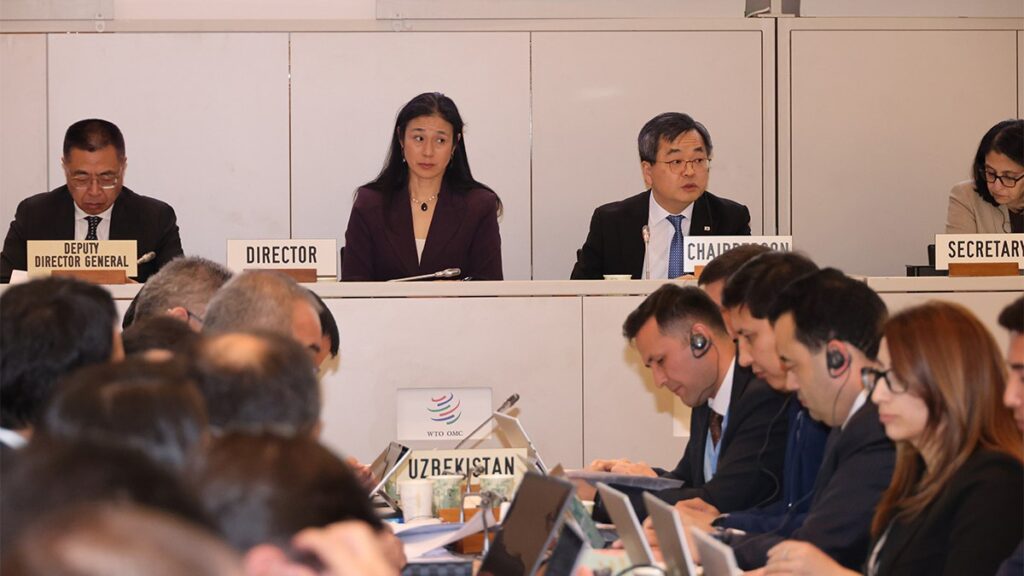
Uzbekistan is intensifying efforts to finalize its accession to the World Trade Organization (WTO), aiming for completion by 2026. At the ninth meeting of the Working Group on Accession, held December 5-6, a delegation led by Deputy Prime Minister Jamshid Khodjayev reaffirmed the country’s commitment to this timeline.

WTO members expressed support for Uzbekistan’s high-level political engagement, and encouraged continued alignment of its trade regime with international standards. Khodjayev emphasized that WTO accession is not merely a technical procedure but a critical driver of internal reforms.

“This goal demonstrates the inevitability of Uzbekistan’s integration into the global trading system. In 2025, efforts will focus on completing negotiations and harmonizing legislation with WTO norms,” Khodjayev stated.

The Uzbek delegation included Azizbek Urunov, the president’s special representative on WTO issues, Deputy Economy Minister Ahadbek Khaidarov, and representatives from various agencies. Some officials joined the discussions virtually from Tashkent.

Chief Negotiator Azizbek Urunov reported that Uzbekistan has concluded bilateral negotiations with nine additional WTO members, bringing the total to 22. This milestone underscores significant progress in the accession process.

WTO Deputy Director General Xiangchen Zhang commended Uzbekistan for its ambitious reforms, including Presidential Decree DP-85, which aims to align national legislation with WTO norms. These efforts align with President Shavkat Mirziyoyev’s strategy to accelerate economic modernization.

Chairman of the Working Group, Ambassador Yoon Seong-Dok of South Korea, also noted substantial progress at both bilateral and multilateral levels. He highlighted Uzbekistan’s productive cooperation with international organizations such as the IMF, World Bank, and WTO.

The Working Group reviewed Uzbekistan’s draft report outlining commitments as a prospective WTO member and examined recent legislative changes. Since May 2024, Uzbekistan has enacted 192 legal acts to comply with WTO standards.

Ambassador Yoon stressed the importance of sustained efforts in 2025 to meet the next milestones.

“The coming seven to eight months will be crucial to achieve the goal of completing the process by 2026,” he said.

The Times of Central Asia previously reported that Uzbekistan has secured China’s agreement for its WTO accession. Joining the organization is a cornerstone of Uzbekistan’s broader economic reforms aimed at integrating the nation into the global trading system.

Tinker, Tailor, Kazakh Ties: UK Spy Trial Reveals Moscow’s Long Shadow in Kazakh Politics

London’s Central Criminal Court, known as the Old Bailey, is currently hearing the trial of several Bulgarian nationals accused by the British authorities of spying for Russia’s intelligence services. The case is likely being scrutinized not only in Moscow but also in Astana, as at least two of the six alleged operations relate to Kazakhstan.

A Favor for Nazarbayev

The defendants, five Bulgarian citizens, are accused of planning six espionage operations, one of which centers around Bergey Ryskaliyev, a former senior Kazakh official during the presidency of Nursultan Nazarbayev.The accused filmed Ryskaliyev in his London home and plotted to alternately dress up as DHL or Deliveroo drivers, or use a fake ambulance as a cover to access his premises.

Ryskaliyev served as akim of the oil-rich Atyrau region from 2006 to 2012, before leaving Kazakhstan amid serious corruption allegations. Both he and his brother Amanzhan – an ex-deputy of the Mazhilis – have been wanted in their homeland for over a decade, facing charges of large-scale corruption, organized crime, false entrepreneurship, and money laundering.

Public opinion in Kazakhstan attributes the Ryskaliyev brothers’ prosecution to their alleged involvement in the December 2011 Zhanaozen uprising. According to reports, the uprising was intended to culminate in Nazarbayev’s resignation through a symbolic “march to Astana.” By the summer of 2012, Nazarbayev seemed wary of Ryskaliyev, publicly thanking him for his service during a visit to Atyrau. Shortly after, Ryskaliyev resigned for “health reasons,” while Amanzhan stepped down as a Mazhilis deputy.

The brothers remained in hiding for years, with their lawyers claiming in a 2019 trial that their whereabouts were unknown. However, reports later surfaced that Ryskaliyev had filmed and leaked a video of Nazarbayev in London’s Hyde Park, allegedly using it to blackmail the former president. Ryskaliyev denied this, characterizing his actions as a “small rally” outside Nazarbayev’s residence.

Despite these allegations, Kazakhstan’s Supreme Court ruled in 2020 to return some of Ryskaliyev’s confiscated assets, including land, money, and shares in various companies, and to reverse property seizures which had affected their spouses.

Prosecutors in the London trial allege that Ryskaliyev’s case was part of an operation to foster stronger ties between Moscow and Astana, with Russia suggesting that Kazakhstan might benefit from pursuing him. If accurate, this initiative likely predated January 2022, when Nazarbayev retained significant influence despite stepping down as president.

Targeting Tokayev?

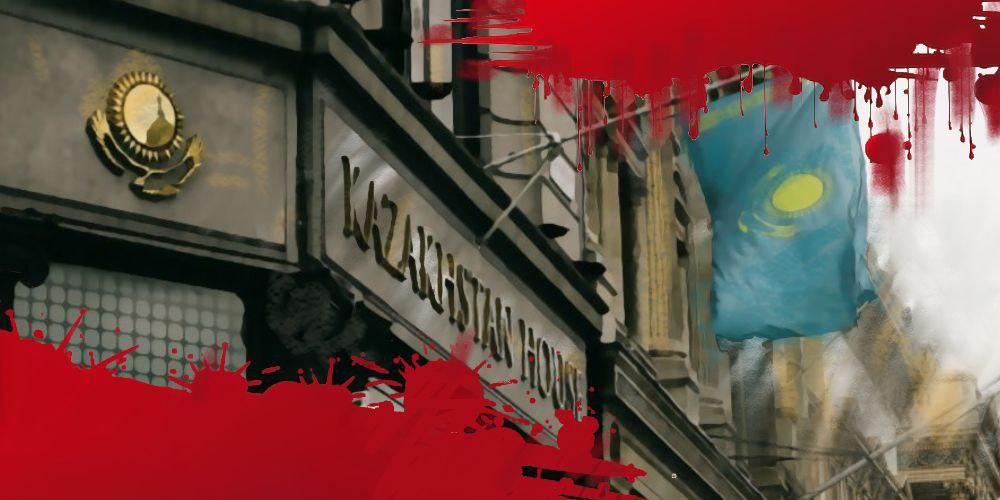
The second alleged operation appears to have been directed at Kazakhstan’s current president, Kassym-Jomart Tokayev. Prosecutors claim the defendants planned a staged protest outside Kazakhstan’s embassy in London in September 2022, intending to pass information about the “organizers” to the Kazakh authorities. This, they argue, was another effort to bolster Russian-Kazakh relations.

However, details reported by Germany’s Der Spiegel suggest a more specific objective. According to the report, the FSB instructed the operatives to stage a protest and send a letter to European Commission President Ursula von der Leyen, ostensibly from a fabricated group critical of Tokayev. Plans also included splashing fake blood or pig’s blood on the embassy during Kazakhstan’s November 2022 presidential election, aiming to frame the fictitious opposition group. As part of the same operation, prosecutors contend that the group discussed fabricating content to slander Tokayev’s son, Timur.

This elaborate plot reportedly sought to pressure Kazakhstan into extraditing Major Mikhail Zhilin, an FSO officer who had fled Russia after the 2022 mobilization announcement. Zhilin, fearing deployment to eastern Ukraine, illegally crossed into Kazakhstan with his family. While his family traveled legally, Zhilin himself was detained at Astana airport en route to Yerevan. On December 29, 2022, he was deported to Russia.

Notably, no protests occurred outside the London embassy before Zhilin’s deportation, nor was any letter to von der Leyen publicized. Like the Ryskaliyev case, no clear evidence links these actions to a Kremlin initiative aimed at appeasing Astana.

For Kazakhstan, the London trial offers a rare glimpse into Russia’s covert operations, raising questions about other undisclosed activities that may similarly escape public awareness.

Second Train Tour Launched Between Kazakhstan and Uzbekistan

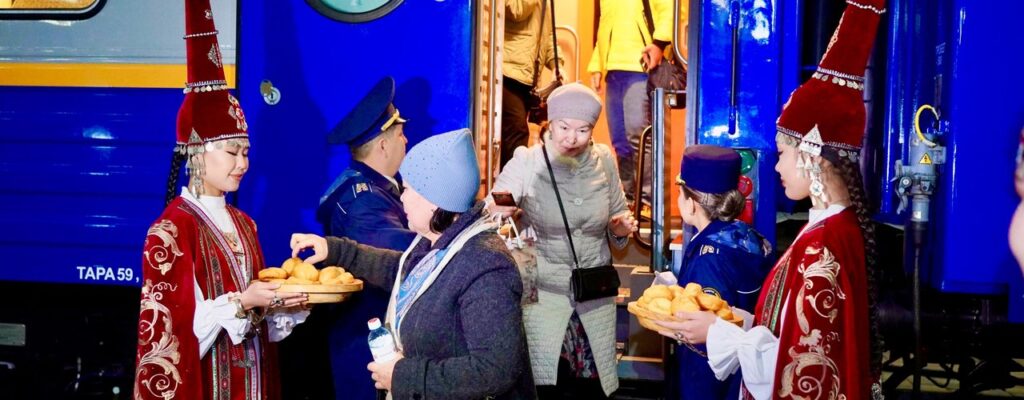
Kazakhstan’s national railway company, Kazakhstan Temir Zholy (KTZ), has announced the launch of its second train tour, Jibek Joly (Silk Road) 2.0, connecting major cities in Kazakhstan and Uzbekistan. The inaugural journey on this new route will depart from Almaty on January 2, 2025, and return on January 7.

The itinerary includes stops at some of the most iconic and culturally rich destinations in the region:

  • Turkestan, Kazakhstan: Passengers will spend a full day exploring this ancient city, including a visit to the Mausoleum of Khoja Ahmed Yasawi, a UNESCO World Heritage Site renowned for its unique architecture.
  • Tashkent, Uzbekistan: The tour will highlight the historical landmarks of the Uzbek capital, along with modern attractions such as the Magic City theme park.
  • Samarkand, Uzbekistan: Travelers will visit landmarks including the Gur-Emir Mausoleum, Registan Square, and the Ulugbek Madrasah.
  • Shymkent, Kazakhstan: The final stop on the tour is Kazakhstan’s third-largest city, known for its dynamic urban culture.

As previously reported by The Times of Central Asia, this initiative follows the success of the first four-day train tour launched in November, which connected Almaty, Turkestan, and Tashkent. The Jibek Joly 2.0 train route underscores Kazakhstan’s commitment to enhancing regional tourism and strengthening cultural ties between the two nations.

EDB Thinks Tajikistan and Kyrgyzstan Will Show Strongest Growth in 2025

The Eurasian Development Bank (EDB) forecasts that Tajikistan and Kyrgyzstan will lead regional economic growth in 2025. According to the bank’s Macroeconomic Forecast, published on November 5, GDP growth rates for Kyrgyzstan are given at 8.7%, Tajikistan at 8.4%, and Kazakhstan at 5.5%. For comparison, the corresponding figure for Russia is just 2.4%.

Tajikistan’s robust growth is attributed to rising prices for gold and other export metals, coupled with reduced costs for imported energy and food products. These factors are expected to enhance economic efficiency by freeing up funds for consumption and investment. Additionally, the country’s rapidly growing population remains a central driver of its economic expansion.

Similarly, Kyrgyzstan’s strong economic performance will be fueled by industrial development, high investment activity, and resilient domestic demand. However, in both Kyrgyzstan and Tajikistan, industrial growth and investment activity are anticipated to lag behind GDP expansion.

Kyrgyzstan and Tajikistan are expected to grow above the global average, supported by steady exports and robust domestic demand.

Kazakhstan’s economy will benefit from increased oil production, large-scale government infrastructure projects, and supportive fiscal policies.

The EDB predicts that inflation across the region will gradually decline, from 7.9% in 2024 to 6.4% in 2025. High interest rates will remain a key tool in controlling inflation, with rates expected at 7.3% in Kazakhstan by the end of 2025.

Inflation in Kyrgyzstan and Tajikistan is projected to remain within target levels, reaching 5.0% and 5.8%, respectively. These lower inflation rates are expected to support continued economic stability in both countries.

Uzbekistan Strengthens Criminal Penalties for Organising Mass Disturbances

On December 11, Uzbekistan’s Parliament, the Oliy Majlis, adopted a draft law amending Article 244 of the Criminal Code, which addresses mass riots. The amendments, passed in the first reading, aim to strengthen legal measures against organizing or financing mass disturbances.

Deputy Prosecutor General Svetlana Artikova explained the rationale behind the proposed changes, emphasizing the importance of protecting individuals, society, and the state during turbulent times.

“Is there criminal liability for training aimed at organizing mass disturbances or preparing weapons, explosives, or special devices for such purposes? In our opinion, there is,” Artikova stated. She highlighted that such actions threaten public safety and stability, warranting criminal accountability.

The draft law introduces two new provisions – parts 3 and 4 of Article 244 – focused on addressing these threats. Financing the organization of mass riots will also be explicitly recognized as a crime. According to Artikova, the amendments aim to safeguard the country’s peace and stability, serving as a preventive measure rather than an act of retribution.

“Whether online or offline, participating in such ‘training’ is about destroying our way of life,” she remarked.

The proposed amendments will not require extra funding from the state budget. The draft law has already been reviewed and approved by key government entities, including the Supreme Court, the State Security Service, and the Ministries of Economy and Finance, Internal Affairs, and Justice.

Details regarding the specific penalties for these offenses were not disclosed by the prosecutor’s office.

Turkmenistan Bans Students from Celebrating New Year’s Eve

Authorities in Turkmenistan have imposed strict measures preventing students and schoolchildren from celebrating New Year’s Eve, requiring them to sign written pledges to abstain from festivities. Students are prohibited from hosting or attending parties at home or in cafes and are barred from being outdoors during the celebration.

“Students have been forced to write forms stating they will not celebrate New Year’s Eve and will return to their dormitories after attending official events,” a source revealed. Violations of the ban are met with threats of expulsion. According to reports, older students in previous years were expelled for secretly hosting parties, serving as a warning to others.

Similar restrictions are being enforced in schools across Ashgabat, where festive parties have been banned following an order from the Ministry of Education. Teachers have been instructed to ensure compliance with these regulations.

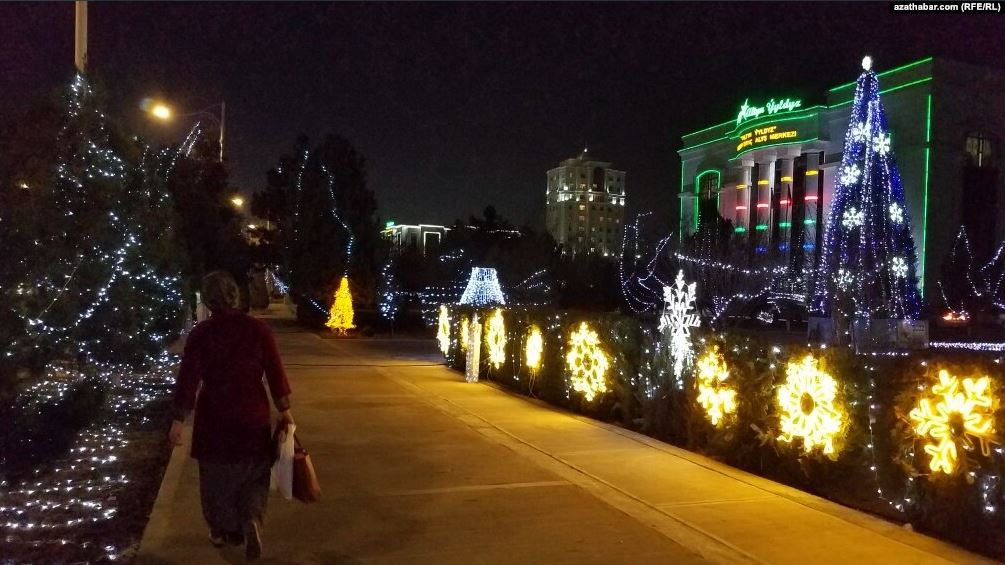
Paradoxically, official state media in Turkmenistan are showcasing large-scale New Year preparations, including the lighting of the “Main Christmas Tree of the Country” on December 14. Despite the visible holiday decorations, New Year celebrations remain tightly controlled. Last year, schools and kindergartens canceled New Year events, and state institutions were prohibited from installing Christmas trees.

Local analysts attribute these stringent measures to the conservative policies of President Serdar Berdimuhamedov. Unlike his father, Gurbanguly Berdimuhamedov, who was known for extravagant celebrations and even personal performances at New Year’s events, Serdar has opted for a more restrained and controlled approach.

The restrictions reflect the growing emphasis on regulation and conformity under Turkmenistan’s current leadership, casting a shadow over what was once a more festive and unifying holiday.