• KGS/USD = 0.01144 0%
  • KZT/USD = 0.00193 -0%
  • TJS/USD = 0.10811 -0.28%
  • UZS/USD = 0.00008 0%
  • TMT/USD = 0.28490 0%
  • KGS/USD = 0.01144 0%
  • KZT/USD = 0.00193 -0%
  • TJS/USD = 0.10811 -0.28%
  • UZS/USD = 0.00008 0%
  • TMT/USD = 0.28490 0%
  • KGS/USD = 0.01144 0%
  • KZT/USD = 0.00193 -0%
  • TJS/USD = 0.10811 -0.28%
  • UZS/USD = 0.00008 0%
  • TMT/USD = 0.28490 0%
  • KGS/USD = 0.01144 0%
  • KZT/USD = 0.00193 -0%
  • TJS/USD = 0.10811 -0.28%
  • UZS/USD = 0.00008 0%
  • TMT/USD = 0.28490 0%
  • KGS/USD = 0.01144 0%
  • KZT/USD = 0.00193 -0%
  • TJS/USD = 0.10811 -0.28%
  • UZS/USD = 0.00008 0%
  • TMT/USD = 0.28490 0%
  • KGS/USD = 0.01144 0%
  • KZT/USD = 0.00193 -0%
  • TJS/USD = 0.10811 -0.28%
  • UZS/USD = 0.00008 0%
  • TMT/USD = 0.28490 0%
  • KGS/USD = 0.01144 0%
  • KZT/USD = 0.00193 -0%
  • TJS/USD = 0.10811 -0.28%
  • UZS/USD = 0.00008 0%
  • TMT/USD = 0.28490 0%
  • KGS/USD = 0.01144 0%
  • KZT/USD = 0.00193 -0%
  • TJS/USD = 0.10811 -0.28%
  • UZS/USD = 0.00008 0%
  • TMT/USD = 0.28490 0%
10 December 2025

Kazakhstan and Russia Strengthen Cooperation on North-South Transport Corridor

Kazakhstan Temir Zholy (KTZ), the country’s national railway company, and Russian Railways have signed a landmark agreement aimed at modernizing railway infrastructure at nine border stations, increasing capacity, and developing a unified digital system for transportation and cross-border operations.

The agreement was signed on November 27 during Russian President Vladimir Putin’s state visit to Kazakhstan.

Enhancing Key Trade Corridors

This cooperation seeks to boost the efficiency of trans-Eurasian transport corridors, with a particular focus on increasing cargo volumes along the East-West and North-South routes. The North-South corridor, connecting Kazakhstan, Russia, Turkmenistan, and Iran, has an annual capacity of 10 million tons of cargo. So far, 1.8 million tons have been transported along this route in 2024, and plans are underway to double its capacity to 20 million tons annually.

On November 26, Kazakhstan’s Minister of Transport, Marat Karabayev, emphasized the strategic importance of the North-South corridor. In July, Kazakhstan agreed on a roadmap with Iran, Turkmenistan, and Russia for the synchronized development of this corridor. To attract cargo flow, Kazakhstan has introduced special transit tariff discounts of 50%.

New Agreements and Digital Connectivity

During Putin’s visit, another significant agreement was signed between KTZ, Xi’an Free Trade Port Construction and Operation Co., Ltd. (China), and JSC Slavtrans-Service (Russia). The deal focuses on constructing the CRK Terminal, a transport and logistics hub at the Selyatino railway station in the Moscow region. Additionally, the three parties agreed to jointly use the Unified Digital Platform along the Xi’an (China) – Dostyk/Altynkol (Kazakhstan) – Selyatino (Russia) route.

The CRK Terminal and Digital Platform are expected to enhance cargo transportation efficiency and e-commerce between China, Kazakhstan, and Russia.

Boosting Regional Logistics

Kazakhstan Temir Zholy also signed a memorandum with the Russian transport and logistics group FinInvest LLC to construct a multimodal transport and logistics center in Astana. This center aims to increase the transit of Russian goods through Kazakhstan, further solidifying the country’s position as a regional logistics hub.

Uzbekistan Attracts $26 Billion in Foreign Investment in First Ten Months of 2024

On November 27, Uzbek President Shavkat Mirziyoyev chaired a meeting to assess the country’s foreign investment performance and set priorities for the coming year.

In the first ten months of 2024, Uzbekistan secured over $26 billion in foreign investment—an increase of 1.7 times compared to the previous year. Of this amount, direct investment accounted for $24 billion of the total. These funds enabled the launch of 6,300 enterprises, generated an additional 30 trillion Uzbekistani Sums (UZS) in value, and boosted exports by $305 million. Crucially, 163,000 high-income jobs were created. An additional $8.6 billion in investment is anticipated by the end of the year.

Regional and Sectoral Challenges

During the meeting, a detailed analysis of investment performance across Uzbek regions and industries revealed that eight districts and cities showed low activity. Furthermore, some sectors experienced declines compared to the previous year. Delays in document preparation and tender processes also hindered the progress of 17 projects funded by international financial institutions.

Mirziyoyev emphasized the need for enhanced regional investment initiatives and innovative approaches. He pointed out untapped opportunities, such as funding from the European Bank for Reconstruction and Development (EBRD), which is keen to support private-sector projects amid Uzbekistan’s improved business environment and economic growth.

Strategic Focus

The president also called on regional leaders to leverage financing opportunities effectively and focus on attracting investments that deliver tangible results. Priority areas include accelerating industrial development, creating jobs, and expanding export potential.

Mirziyoyev also instructed officials to evaluate the volume and strategies of international financial institution financing and foreign investment. Each region and sector was tasked with identifying specific projects for 2025, emphasizing public-private partnerships and private investment.

Kazakh National Rail Service Eyes Move to Hub Model for Integrated Passenger Transport

Kazakhstan’s national rail carrier, Passenger Transportation JSC, plans to revamp the railway’s passenger transport division to cut its losses and meet the demand for transportation services. In order to do so, it is developing a project using the so-called hub model.

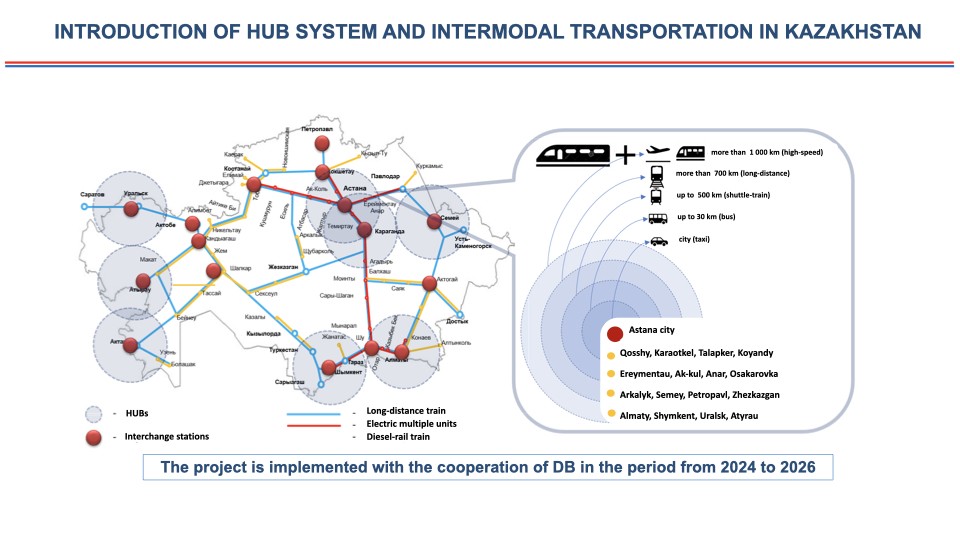
The hub system involves organizing passenger transport around connections of mainline and regional services in transport hubs. Each transport hub will connect not only trains but also other modes of transport, thus realizing a no less important project – intermodal passenger transportation.

The hub system aims to ensure rail passenger transport’s competitiveness and reduce operating costs, while contributing to environmental goals by encouraging people to choose public transport over private.

The hub model for passenger transport is being implemented via a cooperation framework between Passenger Transportation JSC and consultants from Germany’s DB Engineering & Consulting GmbH.

To better understand how this project will be implemented, The Times of Central Asia spoke with the executive director of the intermodal transportation project at Passenger Transportation JSC, Zhambul Baideldinov, and the director of intermodal transportation of DB Engineering & Consulting, Nikolai Sidorvs.

According to Baideldinov, the hub model of passenger transport in Kazakhstan is aimed at creating convenient, rapid transport links between the hubs of Astana, Almaty, and Shymkent, as well as regional transfer points. Such a model aims to develop hubs where passengers can comfortably transfer from one mode of transport to another, including rail and road and, in the future, air transport.

“Successful implementation of the project will allow us to solve the problem of seasonal shortages of seats in passenger trains, as well as expand the range of services provided,” explained Baideldinov.

According to Sidorvs, the regions and cities that will host the transport hubs were selected on the basis of several key factors. First, the geographical significance and the city’s role as a logistics center linking major traffic flows were considered. Second, current passenger traffic volumes and their future growth potential were analyzed. Priority was also given to cities with developed transport infrastructure that would allow for effective integration of different modes of transport.

“In the initial stage, the plan calls for creating a hub at the Nurly Zhol railway station in Astana. At subsequent stages, other hubs will be established in the cities of Shymkent, Semey, and Almaty,” explained Sidorvs.

The Nurly Zhol complex in the capital is expected to become an example for further projects.  Plans also call for modernizing transport infrastructure to create efficient and convenient transfer hubs in different regions of Kazakhstan. In addition to large hubs, such as Nurly Zhol, the establishment of regional hubs is planned.

Passenger Transportation JSC is currently setting up programs to develop regional transfer points. Within the framework of these initiatives, the national passenger carrier is also working closely with government agencies and local government leaders, making it possible to combine efforts and attract additional resources.

“A pilot project for intermodal transportation has already been implemented by the company. Passengers who purchase travel tickets for a number of railway destinations can already transfer from one mode of transport to another,” said Baideldinov.

According to him, as part of the project’s development over the past two years, Passenger Transportation JSC, in cooperation with road carriers, conducted a number of pilot projects providing for combined train + bus transport in Astana and Shchuchinsk. Also, in cooperation with the airline SCAT JSC, a pilot  train + plane project on the Kostanai-Astana-Shymkent route, was organized in 2024.

Dauren Moldakhmetov is the editor-in-chief of the Kazakhstan railway industry publication Trans-Express Kazakhstan and the business magazine Trans Logistics Kazakhstan.

Uzbekistan’s Financial Data Now Available on Bloomberg Terminal

Market data from the Uzbek Republican Currency Exchange (UZCE) is now accessible on the Bloomberg Terminal, marking a significant step toward integrating Uzbekistan’s financial market into the global economy. Bloomberg users can now analyze real-time pricing and indicators for Uzbekistan’s currency, money markets, state securities, and derivatives.

Expanding Accessibility

The UZCE, which includes 35 local commercial banks, six brokerage firms, and one foreign custodian bank, serves as Uzbekistan’s primary platform for liquidity. It offers trading in approximately 20 instruments across various market segments. In 2023, the UZCE reported a total trading volume of $81 billion.

By making this data available on Bloomberg, Uzbekistan aims to attract foreign investors by providing them with the tools to understand its financial market and assess trends more effectively. This transparency simplifies risk assessment and enhances decision-making for global market participants.

Strengthening Market Confidence

Rashid Usmanov, Director General of the Central Bank of Uzbekistan, highlighted the impact of this partnership, stating:

“This partnership with Bloomberg will help participants in global markets to get up-to-date and accurate information from the UZCE in different segments of the exchange, thereby more effectively managing their assets. Increasing transparency and openness of data will strengthen market confidence and ensure an increase in liquidity.”

The Central Bank of Uzbekistan’s market data is available via Bloomberg’s data license and the “B-PIPE” channel, providing real-time market information. This collaboration enhances the global visibility of Uzbekistan’s financial sector, positioning the country as a more attractive destination for international investment.

Tajik Journalist Rukhshona Khakimova Faces Treason Charges Amid Controversy

Tajik authorities have charged journalist Rukhshona Khakimova, the niece of Shokirjon Khakimov, first deputy chairman of the Social Democratic Party of Tajikistan, with high treason under Article 305 of the Criminal Code. The charges are part of a larger investigation into an alleged coup attempt, according to sources cited by Radio Ozodi.

The case, initiated in July, took a significant turn on November 22 when the indictment against Rukhshona and Shokirjon Khakimov was formally presented in court. The trial, held behind closed doors, has limited access to details, leaving the public and media in the dark.

The Allegations
Sources suggest that Rukhshona Khakimova’s charges stem from her involvement in conducting a politically sensitive poll about China’s influence in Tajikistan. The survey reportedly included interviews with Saidjafar Usmonzoda, a political figure stripped of parliamentary immunity and later arrested, and her uncle, Shokirjon Khakimov, who is also implicated in the case.

It remains unclear how this survey forms the basis of a high treason charge. The secrecy surrounding the trial further obscures the connection.

Background on Khakimova
Rukhshona Khakimova, 31, is a graduate of the National University of Tajikistan with a career that spans investigative journalism for prominent outlets, including Youth of Tajikistan and several international publications. She is also a mother of two young children, the youngest being just five months old.

Due to her family situation, Khakimova is under house arrest. Both her domestic and foreign passports have been confiscated, restricting her movements. She and her lawyer have declined to comment on the case, adhering to its classified nature.

A Broader Context
The trial, which began on November 14, involves multiple defendants, including well-known politicians and public figures accused of conspiring against the government. Held in a detention facility in Dushanbe, the closed proceedings exclude the participation of family members and the press, fueling speculation and concern among observers.

As the case unfolds, it raises critical questions about press freedom, political dissent, and judicial transparency in Tajikistan.

Satellite Data Reveals High Methane Emissions in Turkmenistan’s Oil and Gas Fields

The Environmental Defense Fund (EDF) has released the first images from MethaneSAT, a cutting-edge satellite designed to monitor methane emissions globally. The data reveals significant leaks from key fossil fuel production regions, including the United States, Turkmenistan, and Venezuela.

Initial findings indicate methane emissions from North American and Central Asian production sites are substantially higher than earlier estimates based on ground-based monitoring. Both Turkmenistan and the U.S. are signatories to the Global Methane Pledge, which aims to reduce global methane emissions by 30% by 2030.

MethaneSAT is part of a new wave of satellite missions focused on holding major emitters accountable for curbing methane leaks. This comes amid alarming findings from a September study by Stanford University, which reported that global methane emissions are increasing at an unprecedented rate, driving atmospheric methane levels to their highest in 800,000 years. Without immediate intervention, researchers warn, the planet could face a temperature rise exceeding 3 degrees Celsius by 2100.

Methane, a greenhouse gas over 80 times more potent than carbon dioxide in the short term, is primarily released through fossil fuel production, agriculture, and waste decomposition. In 2020, human activities were responsible for 65% of methane emissions, with agriculture and waste contributing two-thirds and fossil fuels accounting for one-third. While agricultural emissions are harder to mitigate, initiatives like the Methane Pledge prioritize reducing methane leaks in fossil fuel production, which are more readily addressed.

The MethaneSAT mission highlights the urgency of reducing emissions and pressuring major fossil fuel producers to take swift action. The Global Methane Pledge accommodates different national circumstances, allowing countries like New Zealand, where fossil fuel emissions are minimal, to focus on reducing methane from agriculture and waste.

With atmospheric methane levels reaching critical thresholds, MethaneSAT and similar initiatives aim to catalyze a global effort to combat this potent driver of climate change.