• KGS/USD = 0.01144 0%
  • KZT/USD = 0.00196 -0%
  • TJS/USD = 0.10899 -0%
  • UZS/USD = 0.00008 -0%
  • TMT/USD = 0.28490 0%
  • KGS/USD = 0.01144 0%
  • KZT/USD = 0.00196 -0%
  • TJS/USD = 0.10899 -0%
  • UZS/USD = 0.00008 -0%
  • TMT/USD = 0.28490 0%
  • KGS/USD = 0.01144 0%
  • KZT/USD = 0.00196 -0%
  • TJS/USD = 0.10899 -0%
  • UZS/USD = 0.00008 -0%
  • TMT/USD = 0.28490 0%
  • KGS/USD = 0.01144 0%
  • KZT/USD = 0.00196 -0%
  • TJS/USD = 0.10899 -0%
  • UZS/USD = 0.00008 -0%
  • TMT/USD = 0.28490 0%
  • KGS/USD = 0.01144 0%
  • KZT/USD = 0.00196 -0%
  • TJS/USD = 0.10899 -0%
  • UZS/USD = 0.00008 -0%
  • TMT/USD = 0.28490 0%
  • KGS/USD = 0.01144 0%
  • KZT/USD = 0.00196 -0%
  • TJS/USD = 0.10899 -0%
  • UZS/USD = 0.00008 -0%
  • TMT/USD = 0.28490 0%
  • KGS/USD = 0.01144 0%
  • KZT/USD = 0.00196 -0%
  • TJS/USD = 0.10899 -0%
  • UZS/USD = 0.00008 -0%
  • TMT/USD = 0.28490 0%
  • KGS/USD = 0.01144 0%
  • KZT/USD = 0.00196 -0%
  • TJS/USD = 0.10899 -0%
  • UZS/USD = 0.00008 -0%
  • TMT/USD = 0.28490 0%
08 December 2025

Kyrgyz Government Adopts Strategic Task to Construct Eco-City

On October 14, Kyrgyzstan’s President Sadyr Japarov signed a Decree to construct the eco-city “Asman” near the village of Toru-Aigyr on the northern shore of Lake Issyk-Kul, the country’s  main region for tourism and recreation.

Spanning 4,000 hectares, some 200km southeast of the capital Bishkek and dubbed a “smart city”, Asman aims to become the country’s new economic and tourist hub and home to modern business, recreational and sports facilities, hi-tech parks, and financial institutions. It will also provide homes for around  500,000 residents. From a bird’s eye view, Asman (the Kyrgyz word for “sky”) will resemble a komuz, a traditional Kyrgyz string musical instrument and one of Kyrgyzstan’s national symbols.

According to Kyrgyz officials, the new city financed by foreign investors, will be built over the next 7-10 years but although the capsule-laying ceremony took place in June 2023, construction has yet to begin.

Speaking at the ceremony, President Japarov remarked that “the city of Asman will become a financial hub connecting East and West, North and South.”

As reported by the presidential press service, the construction of the eco-city is a “strategic task” for the country’s Cabinet of Ministers and local authorities of the Issyk-Kul region, with a key objective to protect the biosphere territory adjacent to the lake.

According to the decree, the Cabinet of Ministers should develop and approve a concept for the construction of Asman by March 1, 2025, ensuring the preservation and protection of the environment during the city’s construction.

It has also been recommended that a ban be placed in the city on hydrocarbon-fueled (gasoline, diesel, gas) transport in preference for electric transport and bicycles. For this purpose, the decree orders the creation of electric transport infrastructure and charging stations, as well as necessary conditions for the use of bicycles to ensure mobility of the city’s population.

In addition, the decree orders the use of energy-saving solutions and smart home technologies in the construction of buildings, and compliance with the World Health Organization’s environmental standards for greening cities and introducing an environmentally safe waste management system.

The realization of such a mega project has inevitably raised questions regarding finance, with construction costs currently estimated at around $20 billion.

The Asman project shares similarities to the city of Arkadag in Turkmenistan. Unveiled in June 2023, the “smart” city of Arkadag was built from scratch 30 km south of Turkmenistan’s capital, Ashgabat. Designed to accommodate a population of  70,000, it cost billions of dollars to construct.

Murder and Arson in Talgar: Kazakhs Fear Rising Tide of Organized Crime

On the night of October 4, 16-year-old Sherzat Bolat was killed in the town of Talgar, located in Almaty Oblast near the city of Almaty. The father of the victim blamed the incident on a gang – allegedly operating in Talgar and the surrounding area for many years – with connections to the government and law enforcement agencies. Later, unknown people burned down the family’s house, and National Guard troops were brought into Talgar. The situation brings to mind the darkest pages of recent history, when criminal groups held cities and entire neighborhoods in a state of fear.

The Talgar tragedy

Sherzat Bolat was murdered in front of his father and mother after an incident occurred involving young people who entered the store the Bolat family rented. As stated by the boy’s father, the customers refused to pay for a can of beer, and a fight broke out. According to other relatives, the group had knives and firearms. Sherzat’s uncle was also injured during the fight and is recovering in hospital.

Police initially claimed that all those involved in the incident had been detained, but the parents of the deceased later said that only seven had been arrested, while there were many more attackers. Fearing that the perpetrators would not be brought to justice, on October 7 Sherzat’s relatives and concerned citizens of Talgar staged a rally at which Sherzat’s father, Karzhaubai Nurymov, claimed that the so-called “Khutorskie” group was responsible for the boy’s death.

According to multiple reports, the Khutorskie have been terrorizing Talgar and its surroundings areas for many years. Businessman Hasan Kasymbayev allegedly runs the group, whilst sources also mention his brothers, including Yerzhan Kasymbayev, who was sentenced to 14 years for the murder of customs officer Medet Zhamashev, and Aslan Kasymbayev, head of the Talgar district Akim’s (mayoral) office. In addition, the Kasymbayevs are said to be related to an official who once held high positions in law enforcement agencies. According to concerned residents of Talgar, the perpetrators of the boy’s murder may be able to avoid justice due to their connections.

In a statement, the acting head of the regional police department denied the involvement of any organized crime groups in the murder; the investigation has now been taken over by the Ministry of the Internal Affairs, which has dispatched a team to the scene of the crime. In an interview, Hasan Kasymbayev, who posted controversial photos on social networks, categorically denied his involvement in the murder of the teenager and any participation in an organized crime group.

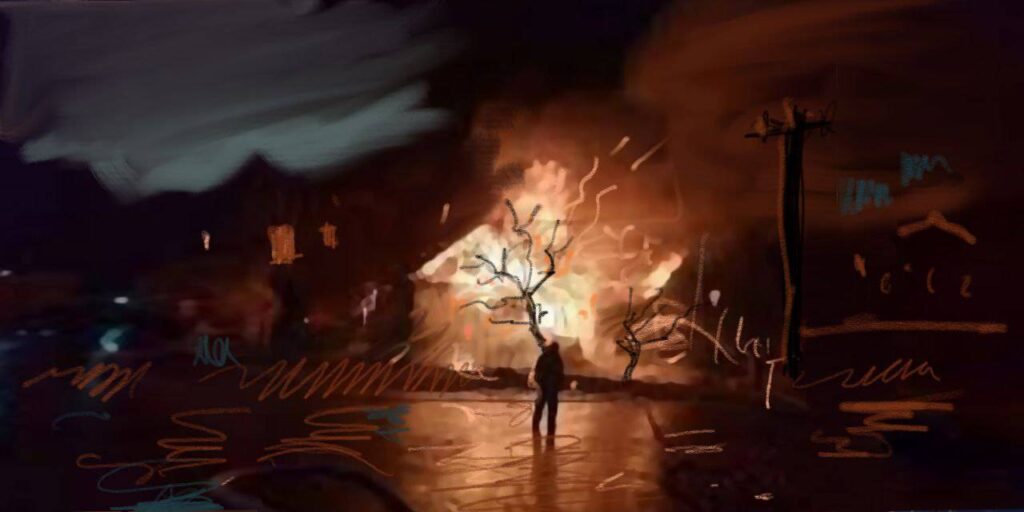
Despite assurances from officials, on October 12, the house of Sherzat’s family in the village of Azat, Yenbekshikazakh district, Almaty region, was burned down. Police opened a criminal case and took the murdered teenager’s family into protective custody. The house was empty at the time of the fire.

The murder and arson have caused a sharp reaction in Talgar and led to a wider reverberations throughout Kazakhstan. Former Minister of Education and Mazhilis deputy, Askhat Aimagambetov, stated on social networks that “the whole country is shocked by the tragedy that happened in Talgar… This cruel, cynical, and unjust crime has shaken each of us. It is a challenge not only to law enforcement agencies, but also to our entire society. Police and prosecutors must ensure that no one escapes accountability. This crime should be a turning point for systemic reforms in law enforcement. This is a legal requirement, and a duty to society.”

On October 13, residents of Talgar reported seeing military equipment and soldiers in the streets. The Ministry of Internal Affairs confirmed that National Guard units had been brought into the town to maintain order. The investigation continues, whilst near the Sherzat family’s store where the murder took place, residents of Talgar have erected a memorial.


A challenge to the authorities

Addressing the crimes, children’s rights ombudsman of the Almaty Oblast, Aigul Yesimbekova, asked, “What else needs to happen for law enforcement agencies to take timely action? Yesterday I met with Sherzat’s mother; I saw her frozen eyes, which reflect all the pain in her soul, the frozen cry for help, her powerlessness, hopelessness,” Yesimbekova continued. “Her soul and body are wounded; her hands are bruised she was held with such force while her son was killed in front of her eyes… Today, the house burned down. It is good that no one was hurt, but now there is a fear for the safety of this family.”

Yesimbekova also recalled frequent cases of the extortion of schoolchildren by criminals in the Almaty Oblast, cases in which the perpetrators were rarely brought to justice or were swiftly released despite hard evidence.

According to political scientist Gaziz Abishev, “In Talgar, the house of the family of Sherzat Bolat, who was killed for a can of beer, burned down. The father of the deceased had previously said that he was threatened. It looks like someone is challenging the Kazakh state, saying, ‘we know that you, the state, are worthless, do not command respect, are incapable of maintaining law and order, and are falling apart piece by piece.’ Today, the house of the murder victims was burned down. Tomorrow, will there be showdowns with judges, commissioners, and other officials, like in films about the Italian mafia. In the coming weeks, we will see how right the murderers and arsonists are in their assessments of the efficiency of the Kazakh state security apparatus.”


Fear of bandit terror

The killing of Sherzat Bolat and the subsequent arson attack have evoked memories of the 1990s in Kazakhstan, the years when, following the collapse of the USSR, many cities and regions fell under the control of criminal gangs. In Almaty and its suburbs, racketeering, murders, and shootings became commonplace. By the beginning of the 2000s, however, the authorities had managed to curb crime, and many well-known gangsters either died in criminal disputes or were convicted. Similar processes took place in almost all of the CIS countries.

With fear of a return to criminality rife, a high-profile case which residents on the streets of Talgar are comparing their predicament to is the case of the Tsapk gang, who terrorized the village of Kuschevskaya in the Krasnodar region of Russia for decades. Murders, racketeering, robberies, and hundreds of rapes went unpunished because the police acted as a krysha (cover, or literally “roof”) for the gang, who in 2010 brutally murdered twelve people, including several children, in the home of a farmer who refused to pay tribute to them. The perpetrators were subsequently sentenced to long prison terms.

Writing about the tragedy in Talgar, Chinese political scientist and scholar Adil Kaukenov recalled “The City of Darkness” in Kowloon, in Hong Kong, China.

“Talgar has become the most discussed city this week in Kazakhstan because in it, as it turned out, organized crime rules with impunity, can kill children in front of their parents, burn the houses of victims preparing for funerals, and all residents live in fear of becoming a victim of criminal activity,” Kaukenov stated. “So I will tell you how in the history of China, there was also a city completely controlled by gangster groups which became known as ‘The City of Darkness.’  Cut off by the sea from the big land of China, but not falling under the rule of England, Kowloon found itself in a power vacuum, which bandits gradually filled. In addition, the ‘gray zone’ began attracting those unable to establish themselves and escape debts or legal troubles. The city grew chaotic, resulting in a ghetto, with buildings so close together that it became one huge house and courtyards that never saw sunlight. Inside the narrow passages of this monstrous house-city, banditry, human trafficking, prostitution, drug trafficking and the law of the strong flourished, where the leaders of the triads took leadership.” Only in the 1990s did the authorities manage to disarm the gangs, forcibly resettle the neighborhood, and demolish the City of Darkness.


Fresh on the trail

On October 15, at a briefing in Konayev, the administrative center of Almaty Oblast, the deputy head of the Investigation Department, Police Colonel Samat Aisovs showed footage of the fight outside the store, which then appeared online as this story was being prepared for publication. The video purportedly shows the deceased throwing the first punch, whilst his father appears to go outside brandishing a knife. A representative of the Ministry of Internal Affairs stated that the conflict did not occur “over a can of beer,” but later when Sherzat and a customer went outside.

It has also come to light that the Akim (mayor) of Talgar, Bakhyt Kurishbekov, and Deputy Akim, Sagyndyk Matan, have been relieved of their posts due to the “improper performance of their duties.”

First Deputy Minister of the Ministry of Internal Affairs, Bauyrzhan Alenov confirmed that a criminal case has been opened as to how the video ended up on social media. “All the people you saw in the video are under investigation,” Alenov stated.

Uzbekistan Joins International Agreement on Space Exploration

On October 10,  President Shavat Mirziyoyev signed a law sealing Uzbekistan’s agreement on the activities of states on the exploration and use of outer space, including the Moon and other celestial bodies.

The Outer Space Treaty was signed on January 27, 1967, by London, Moscow, and Washington. Since then, 115 countries have joined this agreement, and a further 22 have yet to ratify it.

According to the CIS countries’ rules, the Interstate Space Council chair is transferred among the participating countries in alphabetical order. Following Tajikistan, Uzbekistan will take the lead from 2024 to 2025.

To this end, the Uzbekkosmos agency has announced a series of events in celebration of World Space Week, scheduled to take place in Uzbekistan in collaboration with NASA. This global event, commemorated in nearly 100 countries, was established by a UN General Assembly resolution in 1999 in recognition of the importance of space exploration.

UAE Player Fails to Attend World Cup Qualifiers Due to Fake Uzbekistan Passport

On October 15 , Uzbekistan’s national football team will compete against the UAE in the 3rd round of the 4th round of the World Cup Qualifiers.

According to a report  issued by the Uzbekistan Football Federation, Fabio de Lima, a Brazilian player in the UAE, will not be joining his team in Uzbekistan for personal reasons.

It transpires that although Fabio de Lima received citizenship in Uzbekistan in 2013 and was registered as an Asian legionnaire in the UAE Championship, his documents were fake.

Uzbek football specialist Alisher Nikibayev however, claims there is no legal reason preventing the player from entering Uzbekistan: “They are asking if Fabio can come to Uzbekistan. I don’t see any legal obstacle to it; it is unlikely that a criminal case was opened against him. In addition, it is necessary to check the statute of limitations for such violations. Don’t forget that Fabio, as a citizen of Uzbekistan, has never seen his ‘passport’ and, of course, has never used it anywhere. This fake document was only needed to enter the Emirates Championship. Why is he not coming? He fears the case is still open and doesn’t want to take any chances. As for his UAE passport, everything is legal in the Emirates.”

Taliban Asks Uzbekistan to Prohibit Music at Border Market

Taliban officials have asked Uzbekistan to cancel concerts and musical programs at the joint border market in Termez. According to Atlas Press, Afghan citizens will not be allowed to enter this market if the programs continue.

The recently reopened Afghanistan-Uzbekistan joint border market in Termez stages music concerts with performances by Uzbek artists but according to the publication’s sources, the Taliban have now asked the Uzbek government to discontinue such programs. To date, neither the Taliban nor Uzbek officials have officially commented on the issue and it remains unclear as to whether Uzbekistan will respond positively to the Taliban’s request.

In an agreement between the Taliban and Uzbekistan, Afghan citizens can visit and trade in the international Termez market in the Surkhandarya region of Uzbekistan for 15 days without a visa.

However, as stated in the report, “It seems that the Taliban are trying to implement their controversial laws outside of Afghanistan. This recently announced law, in addition to playing and listening to music, also imposes other severe restrictions on Afghan citizens, especially women, and has faced international condemnation.”

Previous protests issued by the Taliban include the detention of Afghan military aircraft in Uzbekistan.

“A Punitive Decision To Scare Journalists”: Bolot Temirov Hits Back at Bishkek Court

After almost a year of proceedings, the Lenin District Court in Bishkek has convicted journalists Makhabat Tazhibek Kyzy and Azamat Ishenbekov of the Temirov Live project. Both were sentenced for calling for “mass disorder;” a verdict which the media project founder, Bolot Temirov, considers revenge for their professional activities.

According to the court ruling, Makhabat Tazhibek Kyzy (head of Temirov Live) was sentenced to six years in prison, and journalist Azamat Ishenbekov, to five years. Two journalists, Aktilek Kaparov and Ayka Beishenalieva, were sentenced to three years of probation, whilst the remaining seven project employees were acquitted.

On January 16, 2024, law enforcers searched the office of Temirov Live and seized all editorial equipment in the interest of the investigation. Eleven employees of the publication were searched and detained. Later, the Kyrgyz Interior Ministry said they had studied Temirov Live and Ait Ait Dese’s content on social networks and that results of the forensic examination had shown that the employees of the editions had called for mass riots. A criminal case was initiated under Article 278 of the Criminal Code of the Kyrgyz Republic, “Calls for active disobedience to the lawful demands of representatives and mass disorder.” Two months later, most of the participants in the trial were released under house arrest, leaving four  journalists in detention.

In an interview with the state news agency Kabar, Kyrgyz President Sadyr Japarov said two of the eleven defendants were professional journalists but emphasized that the “others are said to have education only to an 11th-grade level. How can you deny they were paid some money to sit on social networks and spread false messages calling for unrest? Once again, false information calling for unrest is not freedom of speech.”

The detention of the journalists had been earlier criticized by the UN Human Rights Office and other international organizations.

Bolot Temirov, husband of convicted journalist Makhabat Tazhibek Kyzy and founder of the Temirov Live project, whom Kyrgyz authorities expelled from the country in 2022 and stripped of his Kyrgyz citizenship, told The Times of Central Asia that he disagreed with the court’s verdict. He claimed the decision was political and that his wife was convicted only to blackmail him: “This is a punitive decision to scare journalists and our citizens. I regard (the court’s verdict) as revenge against me personally…. Why were some convicted and others not? I have no idea what’s going on in their heads. Based on the law, there is no single offense. There was no call for mass riots, disobedience to the authorities, or any violence against citizens.”

Temirov said he was especially shocked by the harsh sentence served on his wife, and the court’s refusal to grant a reprieve until his 12-year-old son came of age. The Bishkek Leninsky Court ruled that the child be handed over to the guardianship authorities and transferred to an orphanage. According to Temirov, the court should have appointed him as guardian since no one had deprived him of parental rights, or alternatively, appointed the boy’s grandmother with guardian status.