• KGS/USD = 0.01144 0%
  • KZT/USD = 0.00213 0%
  • TJS/USD = 0.10456 0.19%
  • UZS/USD = 0.00008 0%
  • TMT/USD = 0.28490 0%
  • KGS/USD = 0.01144 0%
  • KZT/USD = 0.00213 0%
  • TJS/USD = 0.10456 0.19%
  • UZS/USD = 0.00008 0%
  • TMT/USD = 0.28490 0%
  • KGS/USD = 0.01144 0%
  • KZT/USD = 0.00213 0%
  • TJS/USD = 0.10456 0.19%
  • UZS/USD = 0.00008 0%
  • TMT/USD = 0.28490 0%
  • KGS/USD = 0.01144 0%
  • KZT/USD = 0.00213 0%
  • TJS/USD = 0.10456 0.19%
  • UZS/USD = 0.00008 0%
  • TMT/USD = 0.28490 0%
  • KGS/USD = 0.01144 0%
  • KZT/USD = 0.00213 0%
  • TJS/USD = 0.10456 0.19%
  • UZS/USD = 0.00008 0%
  • TMT/USD = 0.28490 0%
  • KGS/USD = 0.01144 0%
  • KZT/USD = 0.00213 0%
  • TJS/USD = 0.10456 0.19%
  • UZS/USD = 0.00008 0%
  • TMT/USD = 0.28490 0%
  • KGS/USD = 0.01144 0%
  • KZT/USD = 0.00213 0%
  • TJS/USD = 0.10456 0.19%
  • UZS/USD = 0.00008 0%
  • TMT/USD = 0.28490 0%
  • KGS/USD = 0.01144 0%
  • KZT/USD = 0.00213 0%
  • TJS/USD = 0.10456 0.19%
  • UZS/USD = 0.00008 0%
  • TMT/USD = 0.28490 0%

Uzbek Chess Player Apologizes to Indian Opponent After Handshake Stir

A chess grandmaster from Uzbekistan who declined to shake hands with his Indian female opponent ahead of their game and later cited “religious reasons” has kicked up debate and criticism of his conduct on Indian social networks and media.

Nodirbek Yakubboev, a Muslim, later tried to atone for what had looked like a snub by giving flowers to grandmaster Vaishali Rameshbabu in a filmed street encounter on Jan. 30 after she had beaten him days earlier at the 2025 Tata Steel Chess Masters, in Wijk aan Zee, Netherlands.

“I’m sorry,” Yakubboev, 23, said in the video posted by ChessBase India. “It’s very understandable. I didn’t take it that way,” replied Vaishali, who is also 23. She was accompanied by her brother Praggnanandhaa, 19, who is also a grandmaster and went on to win the Masters category in Wijk aan Zee. The tournament there ended on Sunday.

The polite exchange among the three chess players, who were bundled against the cold, might have been the end of it. But some Indians felt that Vaishali had been disrespected, and they said so on social media, while also reveling in Vaishali’s fourth-round victory over the Uzbek in the tournament’s Challengers category. Vaishali was playing with the black pieces.

“You absolute queen,” one admirer said.

The Hindustan Times said Vaishali had the “last laugh” by winning and that the video of Yakubboev’s apology was “like a Bollywood movie,” but The Times of India thought the apology was “heartfelt.”

A few online commentaries mused on the interaction between sports and religion, in particular the display of religious faith or symbols during competition. International chess luminaries also gave their opinions. One perspective came from Hungary-born Susan Polgar, who was the women’s world chess champion for several years in the 1990s.

“This is my opinion: I have less of an issue with the religious excuse. Others may disagree,” Polgar said on X. “BUT, he could have informed the organizers, chief arbiter, and/or his female opponents in advance. This is NOT an Open Swiss event. This is a prestigious invitational when he knew in advance that he would face 4 female opponents. If he wanted an exception then be proactive. Otherwise, he has to expect criticism.”

In the ChessBase India video, Yakubboev is interviewed about what he acknowledged was an awkward situation.

“I didn’t shake her hand because of religious reasons,” he said. “It was my fault that I could not inform her or the arbiter” before the game.

Yakubboev was asked about a 2023 incident in Abu Dhabi in which he shook the hand of another Indian female opponent, Divya Deshmukh. Photos of that handshake circulated online in the last week, prompting comments that the Uzbek grandmaster was inconsistent in encounters with women facing him across the chess board.

Yakubboev clarified that, starting in 2024, he began “following the rules of my religion” and that he now considered it wrong for him to shake the hands of other women. He said the fallout since his game with Vaishali had been negative and “unpleasant” but that “everything is OK” now.

The Uzbek chess player had posted an explanation on X, but appeared to have later taken down his account. In screen grabs of his written comments that circulated online, he said his decision not to shake the hands of women was personal and that he doesn’t insist that other people do the same, or demand that women wear the hijab or burqa.

Prospects for the Development of Kazakhstan’s Maritime Trade Gateways

A container hub will be built in the Aktau seaport. The maritime harbor is expected to become a center for cargo consolidation and distribution, facilitating Kazakhstan’s deeper integration into the global trade and transport system. How will this impact port operations, regional development, and the global supply chain through the Caspian Sea?

The project in Aktau will primarily allow for the formation of a container park on its territory, serving Kazakhstan, Caspian region countries, and Central Asia. It will provide a full range of services, including container transshipment and warehousing. The hub’s construction marks a new phase in the port’s development, establishing it as a major logistical center. The hub can become not only a component of Kazakhstan’s transportation system, but a key link in the regional and global transport chain.

For this project, investment has been secured from Lianyungang Port Group Co. Ltd., which operates one of China’s largest ports, with a corresponding agreement having been signed with the company.

Growth Projections and Capacity Expansion

According to many industry experts, Kazakhstan needs to actively develop container cargo transport. Currently, the country’s containerization level is quite low, standing at only about 7%.

As Abay Turikpenbayev, Chairman of the Board of the Aktau International Sea Commercial Port public company, explained to TCA, oil and containers are ideal cargo for the harbor due to their swift transport, quick unloading, and rapid railcar turnaround.

“It’s a different matter when bulk cargo arrives at the port. Bulk materials take longer to unload and congest the port infrastructure, preventing the acceptance and accumulation of a large number of railcars. The use of containers allows for an increased cargo flow,” Turikpenbayev stated.

According to Turikpenbayev, unloading bulk cargo takes 2-3 days, and an additional 2-3 days is required for loading. In contrast, container unloading and processing take less than 24 hours.

According to World Bank estimates, by 2030, cargo volumes transported via the Trans-Caspian International Transport Route through the Caspian Sea will reach 11 million tons. The new container hub is expected to help handle these volumes and attract additional cargo flows, increasing the port’s container transshipment capacity to 140,000 TEUs per year.

Addressing the Caspian Sea Water Level Decline

A critical issue that deserves attention is the declining water levels in the Caspian Sea. According to the Caspian Sea Hydrometeorological Research Department of RSE Kazhydromet, since 2006, the level of the Caspian Sea has dropped by approximately two meters. This decline has significantly affected navigation in the region. To address this, dredging work is planned in the Aktau port this year. Turikpenbayev stated that around 1.6 million cubic meters of heavy sediment will be removed from the harbor’s waters.

“The dredged material will be used to create new territories and extend the port area southward. This will allow the port’s land area to expand from 60 to 100 hectares in the future,” Turikpenbayev explained.

In addition to the construction of the container hub, further port expansion plans include building an additional berth for bulk cargo, restoring oil terminal infrastructure, upgrading and expanding the transshipment fleet, and reconstructing two berths which will allow for the simultaneous reception of up to four 140-meter-long vessels

Kazakhstan’s maritime transport infrastructure on the Caspian Sea, including the Aktau and Kuryk seaports, plays a crucial role in developing the country’s export, import, and transit potential.

Exploring What’s Behind Iran’s Push in Tajikistan

As Turkey increases its influence among Turkic Central Asian nations, Tajikistan – the only Persian-speaking country in the region – is looking to Iran as a potential strategic partner. Dushanbe is aiming to significantly strengthen bilateral ties with Tehran, hoping that such a move will have a positive impact on its economy; but what are the Islamic Republic’s interests in Tajikistan?

On January 15, Iranian President Masoud Pezeshkian paid an official visit to Dushanbe, where he met with his Tajik counterpart Emomali Rahmon. The fact that he led a delegation of the Iranian business community suggests that Tehran plans to increase its economic presence in the landlocked Central Asian state.

In 2024, the two nations increased their trade volume by nearly 50% compared to 2023. The problem, however, is that their total trade turnover reached “only” $378 million, which is rather modest compared to the $1,12 billion trade volume achieved by Tajikistan and Russia in the first seven months of 2024.

From 1995 to 2013, the Islamic Republic actively invested in the economy of Tajikistan, which led to the construction of the Sangtuda-2 Hydroelectric Power Plant and the tunnel at the Anzob Pass. However, between 2013-2021, economic relations between Tehran and Dushanbe deteriorated significantly. Now, Tajikistan hopes to see more Iranian investments in its economy.

“Trade and the economy are among the priority areas of our bilateral relations. We voiced our interest in developing investment cooperation with the Islamic Republic of Iran,” Rahmon said at a press conference after talks with Pezeshkian.

As a result of their summit, Tajikistan and Iran significantly deepened their bilateral ties by signing 23 memoranda of understanding in sectors such as trade, energy, infrastructure, cultural exchange, and security. Since Daler Juma, Tajikistan’s Minister of Energy and Water Resources attended the meeting between Tajik and Iranian delegations, it is almost certain that energy was one of the main topics that was discussed.

For Dushanbe, it is crucial to secure funding for the completion of the Rogun Hydroelectric Power Plant, the Istiklol tunnel (also known as the Anzob Tunnel), where the Iranian company Farob is engaged in the construction, as well as a number of small and medium-sized projects. For Tehran, the economic aspect of cooperation with Tajikistan is undoubtedly very important, although it seems to have other ambitions in the Central Asian state as well.

“Iran’s primary interest in Tajikistan is related to cultural and religious bonds, as it sees the country as part of its Persian-Iranian-Islamic civilization,” Fereshteh Sadeghi, a Tehran-based journalist who has worked with Iran’s Press TV and Al Jazeera English, told The Times of Central Asia.

In her view, by maintaining a good political relationship with Dushanbe, the Islamic Republic can significantly strengthen these cultural connections.

“Tajiks speak Farsi, love Farsi literature, and are said to be able to recite poems by Persian or Farsi-speaking poets from memory more easily than Iranians themselves can,” she explained, pointing out that religious aspect also plays an important role in Tajik-Iranian relations.

Although Tajikistan is a secular country, the post-Soviet era has seen a marked increase in religious practice in the Central Asian nation, where Sunni Muslims make up around 95% of the population.

“We know there aren’t many Twelver Shia in Tajikistan, but there are Sevener Shia, mostly known as Ismailis. Iran views them as a potential audience for its ideology,” Sadeghi said, emphasizing that the Islamic Republic fears that Tajikistan could become a “breeding ground for Takfiri ideology,” exporting it to neighboring Afghanistan and subsequently to Iran.

“Tehran thinks that by boosting security cooperation with Tajikistan, it can thwart such a project,” Sadeghi concluded.

For Mohsen Solhdoost, the Iranian-born Assistant Professor at the Department of International Studies at Xi’an Jiaotong-Liverpool University, Tehran’s ambitions to strengthen its influence in Tajikistan are related to the Islamic Republic’s strategy of preserving political stability at home.

“By foregrounding language, cultural heritage, and tangible economic development, Iran stands to gain much-needed domestic legitimacy and popular support, even as it navigates ongoing sanctions and continues to weigh its security commitments in the Middle East,” Solhdoost told The Times of Central Asia.

“For the Iranian government, boosting ties with a culturally kindred, Persian-speaking country like Tajikistan can serve as a strategic and symbolic recalibration of its foreign policy. Beyond simply diversifying its regional partnerships, such a move can help align Iran’s external engagement with the preferences of a significant portion of its domestic population, one increasingly critical of costly commitments to proxy groups in Arab states,” he stressed.

It is unlikely to be pure coincidence that Iran, amid strategic defeat in Syria and Lebanon, is looking to increase its presence in the Persian-speaking Tajikistan. The problem for Tehran, however, is that Dushanbe, despite being Russia’s ally in the Collective Security Treaty Organization, does not seem willing to join the Russian-Iranian “axis of the sanctioned.”

Although the CRINK nations (China, Russia, Iran, and North Korea), in their regional strategies, have made substantial inroads in Central Asia (including Tajikistan), the United States, under Donald Trump, is expected to position itself as a counterweight to their influence in the strategically important region. Fully aware of that, Tajikistan will likely seek to balance its ties with the CRINK nations – where Iran plays an important role – and its ambitions to improve relations with the West.

EU Sanctions Envoy’s Kazakh Visit Signals Rising Stakes

On January 30, David O’Sullivan, the European Union’s Special Envoy for Sanctions, made his fourth visit to Kazakhstan. Following the visit, he gave a briefing in Astana, where he discussed the new sanctions package, which could theoretically include Kazakh companies that assist Russia in circumventing restrictions.

What O’Sullivan Said 

According to O’Sullivan, only companies with indisputable evidence against them of involvement in violations will added to the sanctions list.

“We are currently working on preparing a new, 16th package of sanctions. It is possible that Kazakh companies may be added to the list, but no decision has been made yet. We conduct a detailed analysis of companies, examine their trade relations, and review the goods they have previously traded. Of course, we prefer to work with governments to find a systematic solution rather than simply adding individual companies to the list. However, when there is no other option, we do add them,” O’Sullivan explained.

The EU Sanctions Envoy reiterated that the EU remains one of Kazakhstan’s key economic partners, with mutual trade turnover reaching nearly 40 billion euros per annum. The EU accounts for 38% of Kazakhstan’s exports and 55 billion euros in direct foreign investments.

Highlighting the importance of economic ties, O’Sullivan stated that the EU fully respects Kazakhstan’s position on sanctions, but urged authorities to take strict measures against third-party entities using the country’s trade channels.

“We have concerns that unscrupulous actors may try to use Kazakhstan as a platform to circumvent our sanctions,” O’Sullivan warned, pointing to the import of high-tech goods such as microchips, sensors, and circuits, which have been found in Russian drones, missiles, and artillery shells.

O’Sullivan noted that these goods, listed in an open “common high-priority list” of 50 codes, are not produced in Kazakhstan but are allegedly being re-exported from EU and G7 countries through Kazakh intermediaries. While they make up less than 1% of Kazakhstan’s total trade volume, O’Sullivan emphasized that these are “lethal products that kill innocent Ukrainian civilians.”

The special envoy recalled that in 2024, the EU blacklisted two Kazakh companies and issued a warning that this list could be expanded. He noted that particular attention is being given to companies that emerged immediately after the invasion of Ukraine and the start of the new sanctions regime.

“These are usually not well-established, well-known companies with a long history of trading. The fact that a company was created right after the invasion and the imposition of sanctions suggests that its sole purpose may be to evade sanctions,” he stated while stressing that merely registering after 2022 is not sufficient grounds for inclusion on the sanctions list.

Strategically Important Central Asia

Given the statistics cited by O’Sullivan, there was no pressing need for his fourth personal visit to Kazakhstan. The blacklisting of two Kazakh companies last year went largely unnoticed by the country’s general public. However, his visit highlights the mechanisms of international politics set in motion following Donald Trump’s return to the White House and the opening gambits of his administration, such as his ambitions to buy or seize Greenland and his desire to shift the burden of the war in Ukraine onto Europe.

In the emerging architecture in the new paradigm of global politics, it seems that Central Asian countries are being assigned a special role, and O’Sullivan’s visit is closely tied to these developments.

A confirmation of this growing interest in the region comes from as far afield as Tokyo. Recently, it was announced that Akihisa Nagashima, a special advisor to Japanese Prime Minister Shigeru Ishiba, had embarked on an 11-day tour across the five Central Asian countries which will continue until February 8, with Kazakhstan being the first country on his agenda. Nagashima is also scheduled to visit Tajikistan, Kyrgyzstan, Turkmenistan, and Uzbekistan for high-level discussions aimed at “exchanging views on strengthening” cooperation.

Japan’s Ministry of Foreign Affairs explained this interest by noting that Central Asia, a strategically significant region bordering Russia and China, is “rich in resources such as natural gas.” Highly dependent on energy imports, Japan is therefore seeking to strengthen economic ties with the region.

In August 2024, the former Prime Minister of Japan, Fumio Kishida, had planned to visit Central Asia, but the trip was ultimately canceled due to warnings of an increased risk of a major earthquake along Japan’s Pacific coast. Kishida was due to hold the first-ever forum with Central Asian leaders with a view towards adopting a joint statement on “economic cooperation.”

At the same time, Russian Prime Minister Dmitry Mishustin also visited Kazakhstan to participate in the Eurasian Intergovernmental Council. Some Russian analysts believe the Kremlin will attempt to prevent Kazakhstan from pivoting toward the West. For instance, Vitaly Danilov, director of the Center for Applied Analysis of International Transformations at RUDN University, noted that Moscow does not fully comprehend Kazakhstan’s intentions.

“We have joint projects aimed at creating a common Eurasian space, we cooperate within the CSTO, and we work on consolidating post-Soviet nations. Yet at the same time, we see Astana moving toward the West, and this policy remains largely inexplicable to the Russian side,” Danilov stated.

It appears that in response to Trump’s reshaping of world politics, the major economies of the so-called ‘Global West’ are increasingly searching for a foothold and new allies in Central Asia.

Japanese Musician Mashu Komazaki Named “Ambassador of Uzbek Culture”

Japanese singer and musician Mashu Komazaki has been awarded the title of “Ambassador of Uzbek Culture,” becoming the first Japanese citizen to receive this distinction, Uzbekistan’s Ministry of Culture has announced.

As an Ambassador of Uzbek Culture, Komazaki will work to promote Uzbekistan’s traditional music and arts in Japan. The Ministry of Culture has pledged full support for her activities, providing national costumes, musical instruments, and other cultural materials.

Komazaki has a close connection to Uzbek music, having previously volunteered as a music teacher in Bukhara. She plays the dutor, a traditional Uzbek stringed instrument, and has performed at major cultural festivals in Uzbekistan. Speaking at the award ceremony, she expressed gratitude for the honor and shared her passion for introducing more Japanese audiences to Uzbek music.

“When I perform Uzbek music, many in Japan tell me it creates a vivid image of a mysterious land along the Silk Road. Some even say they want to visit Uzbekistan because of the music,” she said.

The “Ambassador of Uzbek Culture” title is part of a new initiative under a presidential resolution aimed at recognizing foreign citizens who actively promote Uzbekistan’s cultural heritage. Those granted the status receive cultural materials and may even be recommended for state awards based on their contributions.

Komazaki plans to organize concerts and educational events in Japan to further showcase Uzbekistan’s rich musical traditions.

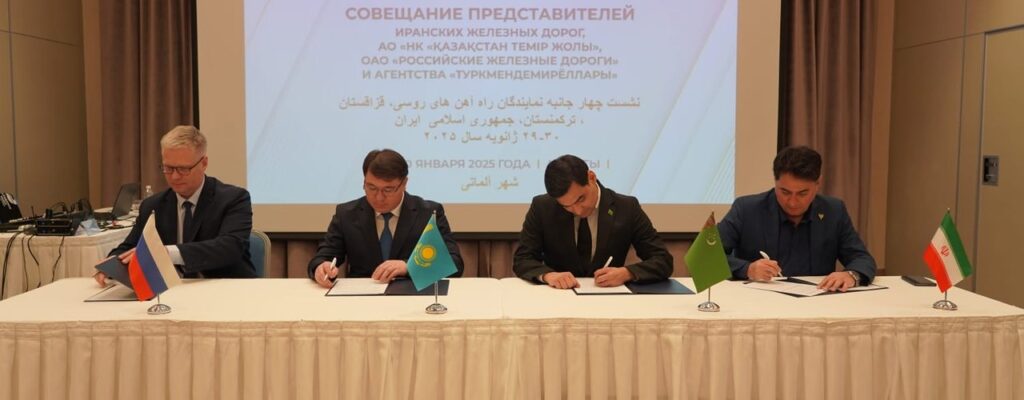
Kazakhstan, Turkmenistan, Russia, and Iran to Boost Cargo Transport Along North-South Corridor

Kazakhstan, Turkmenistan, Russia, and Iran have reaffirmed their commitment to increasing cargo transportation along the North-South transport corridor.

Representatives of national railway companies from the four countries met on January 30 in Almaty to discuss ways to enhance the corridor’s attractiveness and establish favorable end-to-end tariffs for shipments passing through Russia, Kazakhstan, and Turkmenistan to Iran’s Bandar Abbas port.

According to Kazakhstan Temir Zholy (KTZ), the country’s national railway company, the meeting also addressed cargo transportation across Kazakhstan, particularly through the Bolashak rail station, located on the border between Kazakhstan and Turkmenistan. In 2024, 1.6 million tons of cargo was transported via this station.

The North-South corridor, linking Russia, Kazakhstan, Turkmenistan, and Iran, has an annual capacity of 10 million tons of cargo.

In July 2024, Kazakhstan hosted its first international meeting on the North-South transit and trade corridor, bringing together delegations from Azerbaijan, Armenia, Afghanistan, Kazakhstan, Russia, Belarus, Turkmenistan, the UAE, Iran, Iraq, Oman, and Uzbekistan.

During that meeting, Kazakhstan, Iran, Turkmenistan, and Russia signed a roadmap for the eastern route of the corridor. The plan aims to expand the corridor’s capacity to 15 million tons annually by 2027 and 20 million tons by 2030.

By connecting Russia and Belarus to Iran’s Persian Gulf ports, with further access to India, the North-South corridor is expected to enhance trade opportunities and further solidify Kazakhstan’s role as a key transit hub in the region.