• KGS/USD = 0.01144 0%
  • KZT/USD = 0.00212 0%
  • TJS/USD = 0.10456 0%
  • UZS/USD = 0.00008 0%
  • TMT/USD = 0.28490 0%
  • KGS/USD = 0.01144 0%
  • KZT/USD = 0.00212 0%
  • TJS/USD = 0.10456 0%
  • UZS/USD = 0.00008 0%
  • TMT/USD = 0.28490 0%
  • KGS/USD = 0.01144 0%
  • KZT/USD = 0.00212 0%
  • TJS/USD = 0.10456 0%
  • UZS/USD = 0.00008 0%
  • TMT/USD = 0.28490 0%
  • KGS/USD = 0.01144 0%
  • KZT/USD = 0.00212 0%
  • TJS/USD = 0.10456 0%
  • UZS/USD = 0.00008 0%
  • TMT/USD = 0.28490 0%
  • KGS/USD = 0.01144 0%
  • KZT/USD = 0.00212 0%
  • TJS/USD = 0.10456 0%
  • UZS/USD = 0.00008 0%
  • TMT/USD = 0.28490 0%
  • KGS/USD = 0.01144 0%
  • KZT/USD = 0.00212 0%
  • TJS/USD = 0.10456 0%
  • UZS/USD = 0.00008 0%
  • TMT/USD = 0.28490 0%
  • KGS/USD = 0.01144 0%
  • KZT/USD = 0.00212 0%
  • TJS/USD = 0.10456 0%
  • UZS/USD = 0.00008 0%
  • TMT/USD = 0.28490 0%
  • KGS/USD = 0.01144 0%
  • KZT/USD = 0.00212 0%
  • TJS/USD = 0.10456 0%
  • UZS/USD = 0.00008 0%
  • TMT/USD = 0.28490 0%

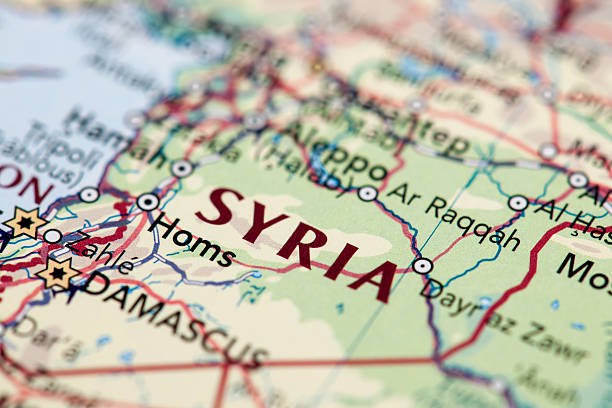
Over 5,700 ISIS Detainees Transferred from Syria to Iraq, Including Central Asians

A total of 5,704 ISIS detainees have been transferred from prisons in northeastern Syria to Iraq, including dozens of citizens from Central Asian countries, according to data from Iraq’s Ministry of Justice shared by journalist and Iraqi Observatory for Human Rights founder Mustafa Saadoun on X.

The figures, issued by the Iraqi Correctional Service under the Ministry of Justice, detail the number of inmates held at Al-Karkh Central Prison by nationality. Among them are 36 citizens of Uzbekistan, 63 of Tajikistan, 42 of Kyrgyzstan, and four of Kazakhstan. The list also includes 165 individuals identified as “Turkestan,” 130 from Russia, and 3,544 Syrians, who make up the largest group.

Saadoun told Shafaq News that the transfer of ISIS detainees from camps and detention centers in northeastern Syria could place “extreme pressure” on Iraq’s already overcrowded prison system. He warned that overcrowding levels could exceed 300% if facilities are not properly equipped to absorb the influx.

“The success of the transfer depends primarily on the prisons’ ability to absorb detainees through modern isolation and classification mechanisms,” Saadoun said. He urged authorities to develop rehabilitation and reform programs that uphold the rule of law and prevent ideological spillover caused by the improper mixing of prisoners.

He also described deteriorating infrastructure inside detention facilities. “Inmates are often forced to sleep in shifts in narrow, poorly ventilated corridors without sunlight,” he said, adding that such conditions create breeding grounds for contagious diseases, including scabies and tuberculosis.

Last month, United States Central Command announced it had begun a “safe and systematic” transfer of around 7,000 ISIS detainees from northeastern Syria to what it described as secure facilities in Iraq, in coordination with Iraqi authorities. However, Reuters later reported that fewer than 500 detainees had been transferred in the initial phase after Baghdad requested a slowdown to negotiate with foreign governments over the repatriation of their nationals and to prepare additional detention capacity.

Iraqi officials have cautioned that accepting the full number of detainees could overwhelm the judicial system, particularly as many foreign fighters may face the death penalty under Iraqi law.

Central Asian governments have previously faced challenges repatriating their citizens from conflict zones in Syria and Iraq, conducting special operations in recent years to return women and children, while cases involving male detainees have remained more complex.

Turkmenistan Effectively Bans Passengers from Taking Food Abroad

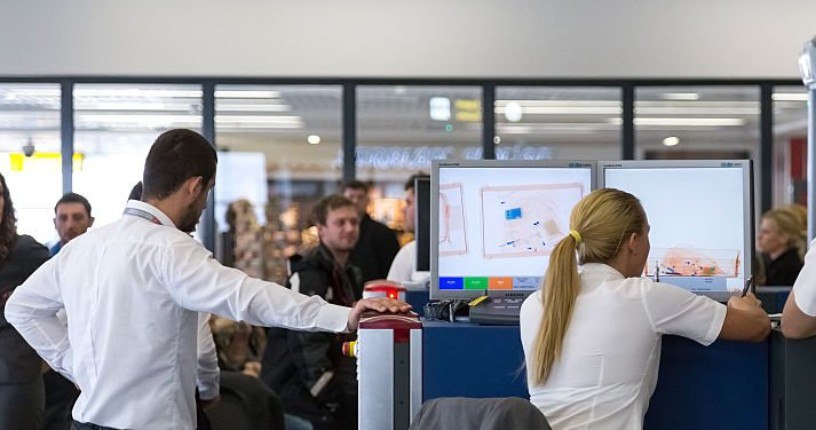
Since February, passengers departing from Turkmenistan’s capital Ashgabat have effectively been prohibited from taking food products out of the country. The restrictions reportedly apply to meat and fish products, canned goods and even bread. No official explanation has been provided.

According to turkmen.news, a ban on the export of most food items was introduced at Ashgabat International Airport in February. The measures affect passengers flying to Turkey, the United Arab Emirates and other destinations.

Controls are reportedly carried out before the main customs inspection, in the oversized baggage area. Only after this additional screening are travelers allowed to proceed to standard border control procedures. However, few passengers reportedly pass the initial check without issue.

Eyewitnesses cited by the outlet say that many passengers are found carrying canned kaurma (meat preserved in fat), as well as sausages, smoked and salted fish, canned meat and fish, condensed milk, homemade preserves, vinegar and bread.

Confiscated products must be left behind. Passengers accompanied by relatives are reportedly allowed to hand over the food to them. Those traveling alone are said to ask taxi drivers to return the items to their homes, while some leave bags on airport benches.

There has been no official statement clarifying the situation. The Customs Service of Turkmenistan has not published any formal ban on the export of food products, except for sturgeon. Food items are also not listed among prohibited exports on the website of Turkmenistan Airlines.

Sources cited by turkmen.news suggest that the tightened controls may be linked to cases in which Turkmen food products were confiscated at foreign airports, particularly in Istanbul and the Russian city of Kazan. In early February, more than 10 kilograms of honey and over 53 kilograms of meat were reportedly seized from Turkmen citizens in Kazan.

A year earlier, turkmen.news reported increased scrutiny of passengers carrying food. At that time, checks were described as less systematic and, according to sources, were often accompanied by alleged demands for bribes rather than consistent enforcement of formal regulations.

For many Turkmen students studying abroad, food brought from home is not only a matter of preference but also an economic necessity. Preserved products such as canned goods and kaurma can be stored for extended periods and significantly reduce living expenses. Turkmen food products are generally cheaper than comparable goods in Turkey, Russia or the United Arab Emirates.

Researchers Name Abdukodir Khusanov Fastest Center Back in Champions League

Uzbekistan national team defender Abdukodir Khusanov has been ranked the fastest central defender currently competing in the UEFA Champions League, according to new data released by the CIES Football Observatory.

The Switzerland-based research group published its latest Weekly Post featuring exclusive Gradient data on running speeds among players whose clubs remain in the competition. The report analyzed maximum speeds and distance covered across different speed categories for five positional groups.

Khusanov, who plays for Manchester City, recorded a top speed of 35.8 kilometers per hour, placing him first among center backs. He finished ahead of Tottenham Hotspur defender Micky van de Ven in the same category.

The CIES report also highlighted the fastest players in other positions. Among full-backs, Achraf Hakimi and Nuno Mendes led the rankings, while Archie Gray topped the central midfield category. Anthony Gordon was the fastest among wide midfielders and wingers, and Kylian Mbappé led among center forwards.

The data further examined how players distributed their movement across different speed ranges. Among the 100 players analyzed, Mbappé, Victor Osimhen, and Luis Suárez covered the highest proportion of distance at walking pace, defined as below 7 kilometers per hour. In contrast, central midfielders Häkon Evjen, João Simões, and Lucas Bergvall recorded the lowest share of walking distance.

Earlier this month, the 21-year-old Khusanov was named Manchester City’s Player of the Month for January after winning a fan vote by a wide margin. The club praised his composure and tactical discipline, noting that his decision-making under pressure stood out during seven appearances across competitions.

Opinion: Mirziyoyev in Washington – New Deals Expected Amidst Peace Diplomacy

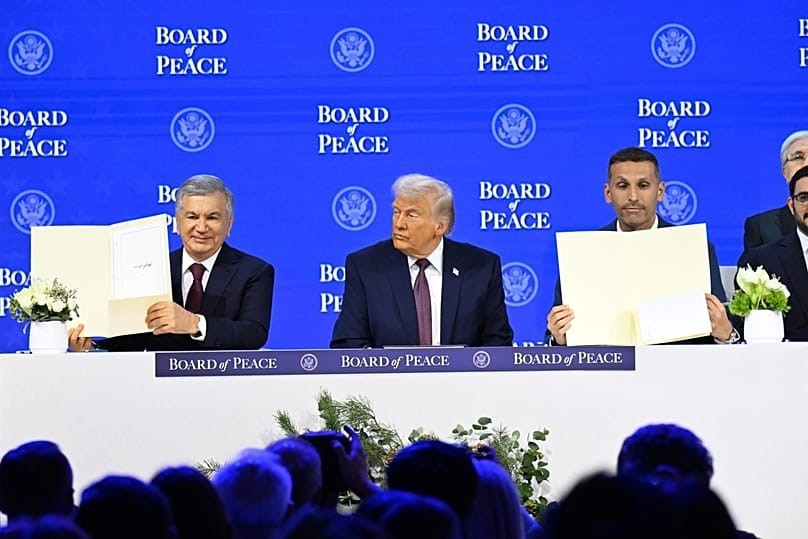
The President of Uzbekistan, Shavkat Mirziyoyev, has arrived on a working visit to Washington to participate in the inaugural meeting of President Trump’s Board of Peace on February 19, 2026, alongside the Presidents of Kazakhstan, Azerbaijan, and other heads of state. Against a backdrop of deep geopolitical tensions and raging conflicts across the world, Mirziyoyev’s second visit to the White House in less than four months suggests that U.S.-Uzbekistan relations are at their strongest in decades.

Mirziyoyev will be joined by Uzbekistan’s Foreign Minister, Minister of Investments, Industry and Trade, and other high-ranking officials. Uzbek Ambassador to the U.S. Sidikov and his team have been working around-the-clock for over two weeks, gearing up for the Trump–Mirziyoyev meeting.

President Mirziyoyev’s objective will be to elevate U.S.-Uzbek relations from a constructive relationship to a fully functional, deal-oriented partnership with a focus on capital flows and bilateral trade.  In addition to his desire for regional stability in West Asia, his signing up for the Board of Peace should be understood as indicating his desire to advance trade and investment and flows into Uzbekistan.

The Uzbeks are keen to nail down new money and capital guarantees to fund infrastructure along the U.S.-brokered “Trump Route for International Peace and Prosperity,” aka, the Zangezur Corridor between Armenia and Azerbaijan (TRIPP) – a roughly 27-mile-long piece of land that links Europe to Central Asia and beyond through the Caucasus.

TRIPP matters to Trump because it advances two goals at once: stabilizing the South Caucasus while more fully integrating U.S. trade with Uzbekistan and the Trans-Caspian International Transport Route (TITR)—a multimodal, 4,000 km transport network connecting China and East Asia with Europe via Kazakhstan, the Caspian Sea, Azerbaijan, Georgia, and Turkey.

Apart from the issues on the Board of Peace agenda, Mirziyoyev will push for ironclad U.S. commitments and cold, hard cash for transport corridors and their downstream beneficiaries.

Two big reasons driving Mirziyoyev ‘s thinking: first, Uzbekistan is one of only two double-landlocked countries in the world, the other being Liechtenstein—and second, Trump’s desire to nail down a peace agreement between Armenia and Azerbaijan, thereby resolving a long-standing territorial dispute that has taken thousands of lives. Mirziyoyev knows that Trump sees TRIPP as a path to lasting peace and regional prosperity across the broader region, which fits into the Board of Peace narrative.

Trump has referenced TRIPP repeatedly over the past year, and Mirziyoyev is well aware of this.  At UNGA last September 23, 2025, Trump said: “President Mirziyoyev is a terrific leader, and with this TRIPP corridor, Uzbekistan is going to see massive trade flowing through – it’s going to connect them directly to new markets without all the old hassles.”

And as Trump said on November 7, 2025, at the C5+1 Summit in Washington: “I’ve got great respect for President Mirziyoyev – he’s doing amazing things in Uzbekistan. The Trump Route, i.e., the TRIPP, is perfect for them; it’s going to cut transit times and costs, making Uzbekistan a powerhouse in regional trade.” Mirziyoyev is paying close attention to these remarks.

Mirziyoyev will build on Trump’s interest and love of deal-making, which shone through in these remarks by the U.S. President: “I am thrilled to announce an incredible Trade and Economic Deal between the United States and Uzbekistan. Over the next three years, Uzbekistan will be purchasing and investing almost $35 billion, and, in the next 10 years, over $100 billion in key American sectors, including critical minerals, aviation, automotive parts, infrastructure, agriculture, energy and chemicals, information technology, and others. I want to thank Uzbekistan’s Highly Respected President, Shavkat Mirziyoyev. We look forward to a long and productive relationship between our Countries.”

Vice President J.D. Vance

No doubt Mirziyoyev and his Ambassador to Washington have also been tracking Vice President Vance’s statements during his visits to Yerevan and Baku. Take, for example: “I think there is actually a lot of capital interested in this particular project. There are a lot of people across the world who think they can make a good return on investment by investing in Armenia and this TRIPP project.” Mirziyoyev will make every effort to win Vance over to his priorities.

Interagency Meetings

While in Washington, Mirziyoyev’s team should be meeting with the U.S. International Development Finance Corporation, the U.S. Department of Commerce, the U.S. Department of Transportation, and the Export-Import Bank of the United States, alongside investment banks, multilateral institutions, and the United States Congress.

As this process unfolds, Uzbekistan’s vision will remain to build a strong bridge between Central Asia and the South Caucasus, creating a space of unified cooperation that strengthens strategic ties and stability across the region.  At any rate, that’s the long-term game plan.

Concerning the Board of Peace, the results will most likely pass out of the news cycle in Uzbekistan within a day or two.  How news of the Uzbek head of state’s visit to Washington resonates in West Asia is a separate and still unfolding question.

It is clear, however, that if Mirziyoyev returns to Tashkent with fresh U.S. agreements and President Trump’s continued backing, which is expected, this will catalyze more win-win investments, neutralize the risks associated with Uzbekistan’s double landlocked status, and give significant impetus to more robust economic growth across the region.


The views expressed in this article are those of the author and do not necessarily reflect the official policy or position of the publication, its affiliates, or any other organizations mentioned.

Kyrgyzstan to Introduce One-Year Temporary Licenses for New Drivers

Kyrgyzstan plans to introduce a one-year temporary driver’s license for driving school graduates in an effort to ensure that new motorists develop sustainable skills for safe and responsible behavior on the road, according to a draft resolution of the Cabinet of Ministers of Kyrgyzstan currently undergoing public discussion.

The training period at driving schools in Kyrgyzstan has recently been extended from 2.5 months to 10 months. Under the proposed resolution, students demonstrating excellent academic performance would be eligible to take exams after four months of training and receive a temporary driver’s license valid for one year and restricted to use within the country.

According to the draft’s explanatory note, a temporary license would allow new drivers to assess their practical skills under real road conditions. If, during the one-year period, they do not commit serious traffic violations or cause traffic accidents, they would be issued a permanent driver’s license.

If a driver holding a temporary license commits serious traffic violations or is found responsible for an accident within one year, the temporary license would be annulled, and the driver would be required to return to driving school to complete the remaining six months of the standard training program.

The initiative is intended to improve discipline among new drivers and help reduce road accidents.

The proposed measure is part of a broader set of reforms aimed at strengthening driver education and lowering accident rates. In a related move, Kyrgyz authorities have suspended all private driving schools until August 30, 2026. During this period, driver training will be limited to state-run institutions. The length of training has also been extended from 2.5 months to 10 months. Officials say the reforms are designed to eliminate corruption and ensure that drivers are properly prepared before receiving licenses.

Additionally, Kyrgyzstan has introduced stricter traffic enforcement measures aimed at curbing repeat violations and improving road safety. Under the new rules, drivers who commit three serious traffic violations within a 12-month period are required to retake the traffic rules examination.

The reform follows concerning national road safety data. In 2025 alone, Kyrgyzstan recorded 8,456 traffic accidents, resulting in 900 deaths and 12,169 injuries. Over the past decade, more than 75,000 accidents have claimed over 9,000 lives.

Kazakhstan Increases Export Revenues from Processed Agricultural Products by One-Third

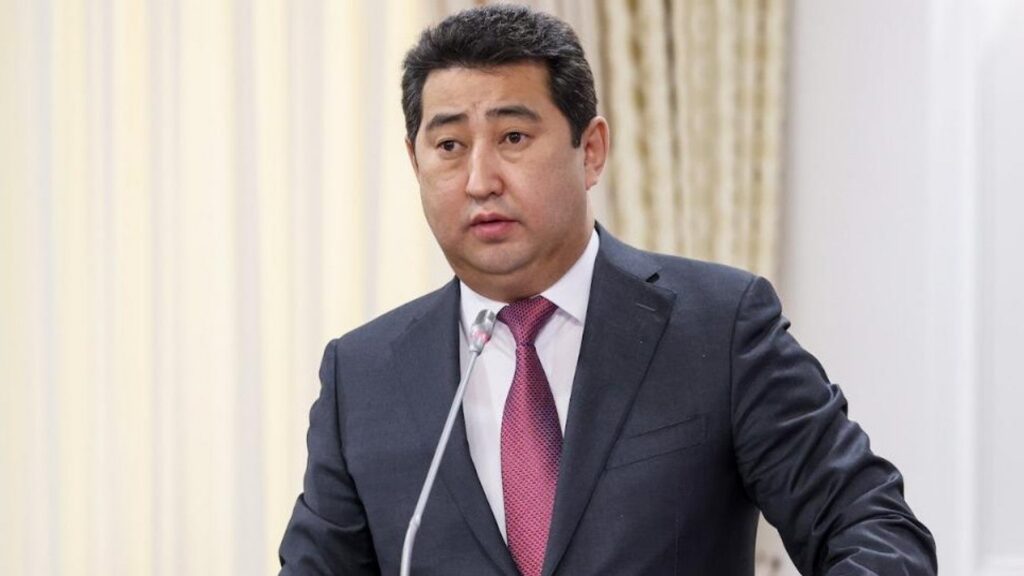
Kazakhstan significantly increased exports of high value-added agro-industrial products in 2025. Revenue from exports of processed agricultural goods rose by nearly one-third compared to the previous year, according to Minister of Agriculture Aidarbek Saparov.

By the end of 2025, food production reached $8.1 billion, an 8.1% increase year-on-year. Exports of processed agricultural products totaled $3.2 billion for the first 11 months of 2025, marking a 33.8% increase compared to the same period in 2024. By contrast, total exports of high value-added products in 2024 stood at $2.7 billion, with annual growth not exceeding 15%.

The share of processed goods in total agro-industrial exports reached 52% in 2025. According to the Ministry of Agriculture, this reflects a systematic policy aimed at diversifying agricultural exports and shifting toward products with greater added value.

The expansion of processing capacity has also increased the sector’s investment appeal. Investments in fixed capital in agriculture doubled, reaching $791.5 million. The structure of exports is also evolving. Previously, Kazakhstan exported raw lentils and imported processed groats at higher prices. Today, domestic processing and packaging facilities enable the country to fully supply the domestic market and export finished products. Kazakhstan ranks sixth globally in lentil exports and retains further growth potential.

The oilseed segment has become one of the key drivers of profitability in crop production. In 2025, the oilseed harvest reached 4.9 million tons, up 48% year-on-year. Sunflower oil exports increased to 600,000 tons, placing Kazakhstan eighth globally in export volumes.

To support this trend, four major projects were launched in 2024-2025 to expand and modernize oil processing plants. The projects have a combined capacity of approximately 1 million tons and a total investment value of $117 million. A lecithin production line, supplying the food and cosmetics industries, has been launched in the East Kazakhstan region. A similar facility is planned in the North Kazakhstan region.

Deep grain processing is also developing. Three enterprises with a combined capacity exceeding 500,000 tons are already operating, producing gluten, bioethanol and starch products. Six additional investment projects worth $3.8 billion are scheduled for implementation over the next three years. These projects involve the production of amino acids, including glutamate, threonine, leucine and lysine, and will be located in the Turkestan, Zhambyl, Akmola and Kostanay regions, as well as in Astana.

As previously reported by The Times of Central Asia, Kazakhstan has set a strategic objective for the agricultural sector to become one of the world’s three largest exporters of sunflower oil and to increase total exports of oil and fat products to $1 billion by 2028.