• KGS/USD = 0.01144 0%
  • KZT/USD = 0.00196 -0%
  • TJS/USD = 0.10899 -0%
  • UZS/USD = 0.00008 -0%
  • TMT/USD = 0.28490 0%
  • KGS/USD = 0.01144 0%
  • KZT/USD = 0.00196 -0%
  • TJS/USD = 0.10899 -0%
  • UZS/USD = 0.00008 -0%
  • TMT/USD = 0.28490 0%
  • KGS/USD = 0.01144 0%
  • KZT/USD = 0.00196 -0%
  • TJS/USD = 0.10899 -0%
  • UZS/USD = 0.00008 -0%
  • TMT/USD = 0.28490 0%
  • KGS/USD = 0.01144 0%
  • KZT/USD = 0.00196 -0%
  • TJS/USD = 0.10899 -0%
  • UZS/USD = 0.00008 -0%
  • TMT/USD = 0.28490 0%
  • KGS/USD = 0.01144 0%
  • KZT/USD = 0.00196 -0%
  • TJS/USD = 0.10899 -0%
  • UZS/USD = 0.00008 -0%
  • TMT/USD = 0.28490 0%
  • KGS/USD = 0.01144 0%
  • KZT/USD = 0.00196 -0%
  • TJS/USD = 0.10899 -0%
  • UZS/USD = 0.00008 -0%
  • TMT/USD = 0.28490 0%
  • KGS/USD = 0.01144 0%
  • KZT/USD = 0.00196 -0%
  • TJS/USD = 0.10899 -0%
  • UZS/USD = 0.00008 -0%
  • TMT/USD = 0.28490 0%
  • KGS/USD = 0.01144 0%
  • KZT/USD = 0.00196 -0%
  • TJS/USD = 0.10899 -0%
  • UZS/USD = 0.00008 -0%
  • TMT/USD = 0.28490 0%
08 December 2025

The World Nomad Games: Capturing a Sense of the Great Steppe

The 5th World Nomad Games, set to be hosted in Astana from September 8-13, is Central Asia’s largest national sports competition and, complemented by unique cultural and scientific programs, attracts participants and spectators from throughout the world. As reported by TCA, there is a distinctive festive fizz in the air as the city prepares to welcome visitors, with streets, shopping centers, public spaces and even buses already festooned with flags and colorful decorations.

Ablai Kondybaev, the Deputy Head of the Directorate responsible for preparing and organizing the 5th World Nomad Games, spoke to The Times of Central Asia about how the event allows visitors to experience the spirit of the Great Steppe.

TCA: The geographical scope of the Nomad Games is steadily expanding worldwide. How many countries will participate this year and how many tourists and spectators are expected to attend?

AK: The Games have a ten-year history. Having originated in Kyrgyzstan in 2014, they have since been held three times in the Kyrgyz city of Cholpon-Ata and on the shores of Lake Issyk-Kul. Over the relatively short period since it began, the event has grown dramatically. The first Games attracted participants from 19 countries mainly from Central Asia where there is a historic nomadic culture, whereas the 4th Nomad Games hosted by Iznik, Turkey, in 2022, saw athletes competing from 81 countries.

It’s very interesting to track the geography of engagement. In previous Games, for example, countries such as New Zealand and Madagascar participated. Superficially, they have nothing to do with nomadic culture, yet consider themselves descendants of nomads. Such things bring us closer together; in the distant past, all humanity was nomadic. To date, we have received applications for participation from 89 countries to compete in this year’s event.

The Nomadic Games are a new and interesting phenomenon, offering unique and highly engaging spectacular sports, unfamiliar and exotic to European and Western audiences. As such, the Games are becoming increasingly popular abroad. Today’s geographical representation of athletes is expansive, with countries including Venezuela, Ireland, Gambia, and Brunei participating for the first time. For ten years, countries from literally all continents have joined the event and perhaps in the future, we will reach a point where interest in our national sports is on a par with the Olympics or soccer championships.
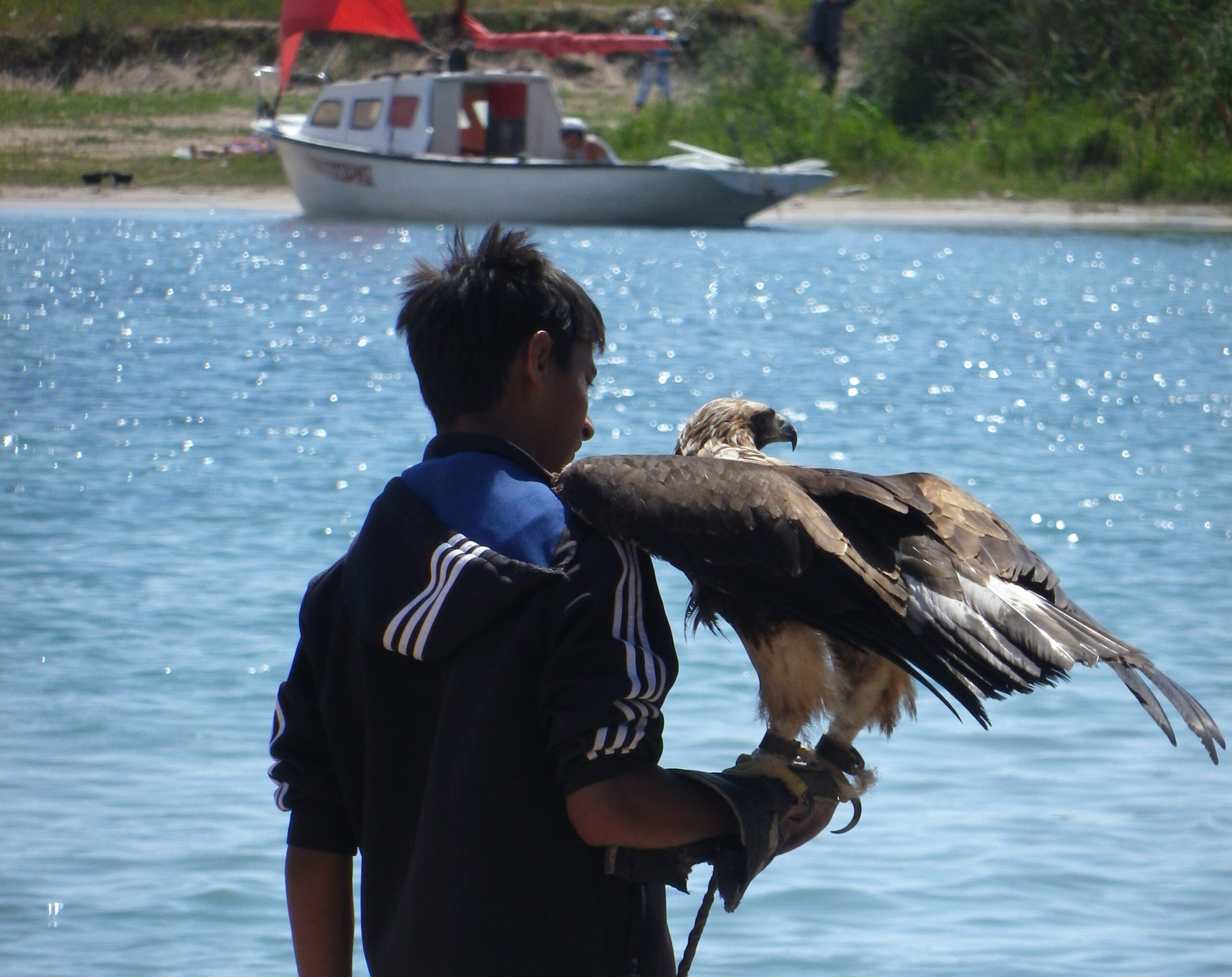
Falconry in Cholpon-Ata, Kyrgyzstan; image: Stephen M. Bland


TCA: Is it significant that the month of September was chosen for the Games?

AK: Absolutely. September is when nomads traditionally celebrate the completion of the migration with their caravan of yurts and animals from their summer to winter camp with a toi ; an event comprising  feasts, rituals, games and competitions.

TCA: Which competitions generate the most excitement amongst spectators: Horse racing, archery, wrestling?

AK: Nomadic life is directly related to horses, and year on year we observe how people who know nothing about steppe culture are particularly fascinated by our equestrian sports. Always spectacular and challenging, they take the audience’s breath away. But to single out some separate competitions is very difficult; they are all interesting. Each is unique, and each has its audience and fans. Nevertheless, according to ticket sales, it is obvious that horse races – baige – are extremely popular.

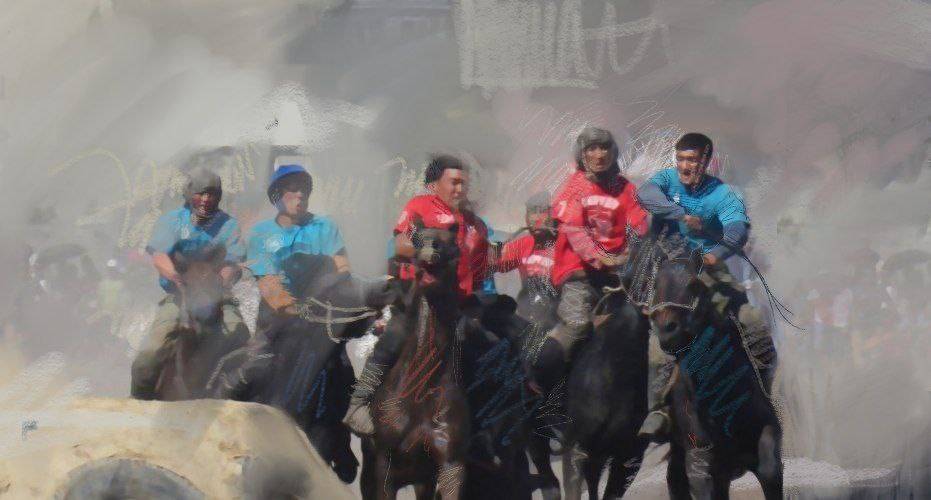
Kazakhs have long held horse races at major events and competitions. We have seven courses in the program. Three are flat races, similar to those held worldwide and in particular, in England, Arab countries and Japan. The other four, Kunan baige, Alaman baige, Top baige, and Ұshkyr baige, are traditional nomadic races over different distances and terrains.  There are also equestrian team competitions, the most famous of which are  Kokpar and Kokboru; traditional games akin to polo played with sheep or goat carcasses. Long popular among Turkic people, especially in Central Asia, these fast and furious competitions attract record numbers of spectators. According to forecasts, the finals of Kokpar and Kokboru will be held between Kazakhstan and Kyrgyzstan.

I should also mention Zhamby Atu, a mesmerizing and highly skilled competition involving horseback archery traditionally played by warriors on festive occasions. Other riding events include Audaryspak and Tehre Ilu, in which  the rider must pick up a bag of coins whilst on the gallop.

Equestrian events aside, the Games feature traditional wrestling events – Kazakh Kuresi , Kyrgyz Alysh, as well as Tatar and Uzbek forms of the sport – alongside contests of strength and power, such as weightlifting sports developed in Scandinavian countries, and, of course, competitions in traditional archery. Competitions in hunting with birds of prey, are always of great interest and in high demand amongst foreign guests.

Another sport which never fails to delight audiences is Arkan tartys, an emotionally charged tug-of-war, and Asyk Atu , a game of dice; both familiar to everyone’s childhoods. Intellectual sports also feature, but unfortunately, chess tournaments and board games such as  Togyzkumalak from Kazakhstan, Owari from West Africa, and Mangala from Turkey, are not open to spectators.

TCA: What distinguishes the Nomad Games from traditional sporting competitions and how do they impact on interest in Kazakhstan and nomadic culture?

AK: Thanks to the Games, ethno-sports are developing all over the world. The World Nomadic Games contribute to the establishment of common rules of competitions historically conceived in nomadic countries. One of our key tasks is to systematize the rules and adjust the details to reach a common understanding and give impetus for further development. Of course, first and foremost is attracting spectators. Given the high volume expected from Kazakhstan and Central Asian regions and because travel agencies, as in the UK, sold out tickets for the Games within six months, we anticipate audience numbers to reach 100,000. This figure will also be swelled by the recent announcement that Kazakhstan’s most famous singer, Dimash Kudaibergenov will perform at the Games on 13-14 September.
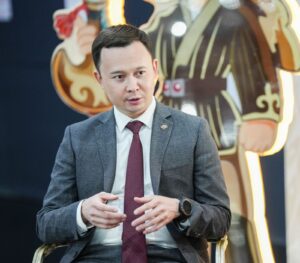
Ablay Kondybayev, the Deputy Head of the Directorate responsible for preparing and organizing the 5th World Nomad Games

TCA: What can you tell us about the activities offered by the ethno-aul, created within the framework of the Games on a ten-hectare site close to the Kazanat hippodrome?

AK: The Games consist of three areas – sport, culture, and science. The ethno-aul is the main site for cultural events, which follows the concept that the Nomad Games includes participation by of all Kazakhstan’s regions to allow visitors to immerse themselves in the the country’s heritage.

The ethno-aul will be launched on the first day of the Games with  Shattyk kerueni, a grand parade showcasing the cultural heritage of the Kazakh people, and thereafter, host evening performances by artistic ethno-collectives, concerts, regional competitions of  aytys  (folk poetry), exhibitions of unique work by some 200 master craftspeople, fairs and bazaars selling souvenirs and jewelry, masterclasses for visitors , children’s playgrounds, and of course, national cuisine. General admission is free.

Special attention is being paid to the younger generation, as one of the goals of the Games is to pass on traditions and revive national sports and national culture. We can already see a growing interest amongst young people in archery. Equestrian sports have become particularly popular, and to meet demand clubs are opening in Almaty and Astana. Reduced rates have been set for children attending the Games and to further develop sport amongst young people, we have signed a memorandum with UNICEF on several areas of cooperation.

TCA: What level of service awaits participants and tourists alike?

AK: We are currently putting the finishing touches in place. I think that everyone who attends the opening ceremony at the Astana Arena will be pleasantly surprised by the work of Kazakh producers and directors and moreover, get a true sense of our country’s hospitality and an authentic experience the nomadic spirit.
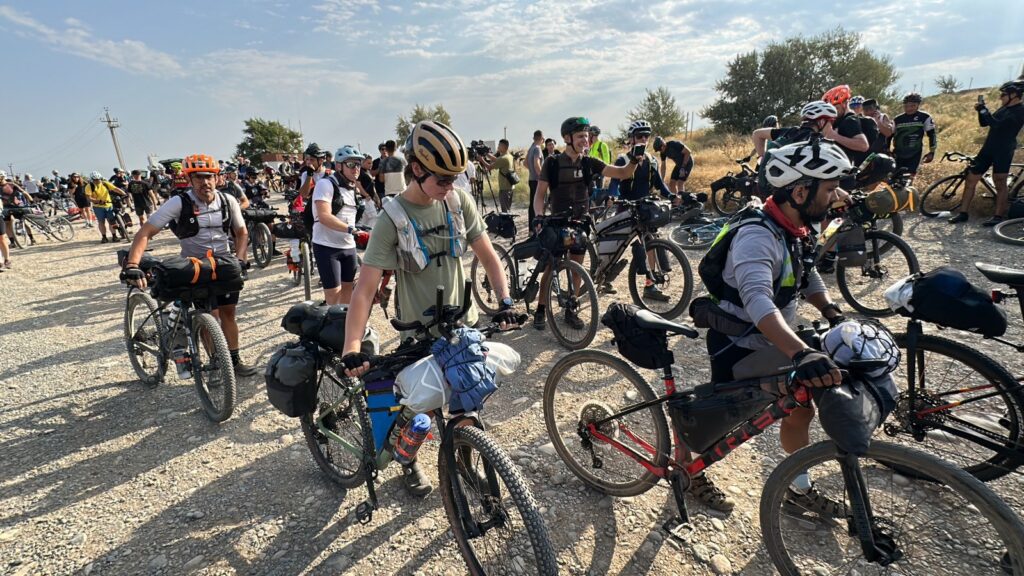

International Cyclists Take on Kyrgyz Peaks in Silk Road Mountain Race

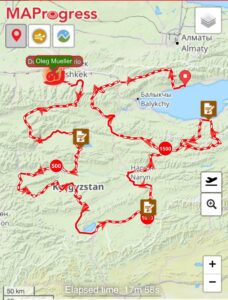
More than 170 athletes from 40 countries are participating in Kyrgyzstan’s annual Silk Road Mountain Race. The route this year will take competitors over many of the country’s dramatic mountain passes, and past the largest lakes of Son-Kul, Chatyr-Kul, and Issyk-Kul.

Riding 1,938 kilometers in total, cyclists will have to traverse 14 mountain passes, and part of the route will be at an altitude of more than 3,500 feet. The race started in Bishkek, and will end in a few weeks’ time in Cholpon-Ata. Competitors must carry everything they need with them, such as tents and sleeping bags, food, water, and spare bicycle parts.

“This is the best advertisement for our tourism potential. It is gratifying that its popularity and the number of participants, including among Kyrgyz people, is growing yearly,” said Edil Baisalov, deputy chairman of the Kyrgyz Cabinet of Ministers.

Baisalov said that hundreds of thousands of people worldwide are watching the race.

The Silk Road Mountain Race is a multi-day bicycle race in inaccessible mountainous terrain. Athletes compete on endurance, riding through mountain passes and old trails. The marathon route changes every year, but the goal remains the same.

Tajik President: Accelerated Melting of Glaciers Threatening Central Asia’s Water Resources

Over the past few decades, more than a thousand of Tajikistan’s 13,000 glaciers have completely melted—a threatening trend given that Tajikistan’s glaciers are the main source of up to 60% of Central Asia’s water resources. Tajik President Emomali Rahmon announced this on August 17 at the third Voice of Global South Summit, which was held virtually under the chairmanship of Prime Minister of India, Narendra Modi.

In his speech, Rahmon said that Tajikistan’s initiative to declare 2025 the International Year of Glacier Preservation has received the full support of the international community. According to a UN General Assembly resolution, March 21 will be celebrated annually as World Glaciers’ Day from next year.

Based on this resolution, in 2025, Tajikistan will host the International High-Level Conference on Glaciers’ Preservation.

President Rahmon continued that with 93% of its territory covered by mountains, Tajikistan is considered one of the most vulnerable countries of the Global South in terms of adverse climate change impacts. Every year, the country faces floods, landslides, avalanches, and other natural disasters that cause great material damage, and, in many cases, human casualties. Earlier this month TCA reported that the head of Tajikistan’s committee for emergency situations and civil defense, Rustam Nazarzada, said at a press conference that the economic damage caused by natural disasters in the country this year has amounted to over $12 million.

The government of Tajikistan is therefore implementing a National Strategy for Adaptation to Climate Change until 2030, with the goal of reducing the negative impacts of climate change on the country’s social and economic spheres.

Regarding green energy production, Rahmon stated that Tajikistan currently produces 98% of its electricity from hydropower. “We have decided to increase this figure to 100% by 2032, that is, to produce electricity entirely from green energy resources, and to turn Tajikistan into a ‘green country’ by 2037,” the Tajik leader stated.

UN General Assembly Adopts Uzbekistan-Initiated Resolution on Forest Management

The UN General Assembly last week adopted Uzbekistan’s proposed resolution on “Fostering sustainable forest management, including afforestation and reforestation, in degraded lands, including drylands, as an effective solution to environmental challenges.”

The resolution is based on the concept of Uzbekistan’s nationwide program, Yashil Makon (Green Space), which aims to preserve and restore biodiversity through the greening of urban and rural areas. Launched by Uzbekistan’s President Shavkat Mirziyoyev in November 2021, the Yashil Makon initiative allows the planting of one billion trees and shrub saplings across the country over five years.

The resolution reflects the key proposals on effectively countering climate change and combating land degradation, voiced by Mirziyoyev during the 78th session of the General Assembly and the 28th UN Climate Change Conference.

The resolution discloses the economic, social, and environmental benefits of sustainable forest management and tree planting, emphasizing their contribution to increasing biodiversity, mitigating the effects of climate change and air pollution, and achieving the Sustainable Development Goals, including poverty eradication and food security.

The resolution gives specific recommendations to UN member states regarding tree planting to preserve and increase biodiversity using nature-saving and ecosystem methods.

Tajikistan-Kyrgyzstan Border Demarcation Completed

Tajikistan and Kyrgyzstan have completed negotiations to demarcate their common border, which had been disputed for many years. The final meeting of the two countries’ topographic-legal working groups was completed in the town of Batken in Kyrgyzstan on August 11-17. This has been reported by the State Committee for National Security of Tajikistan.

“During this meeting, the parties continued the discussion and exchanged proposals on the description of the passage of the Tajik-Kyrgyz state border line in the remaining sections,” the Committee commented.

At the end of June, The Times of Central Asia reported that 94% of the borderline between Tajikistan and Kyrgyzstan had been fully delineated.

The conflict was caused by uncertainties regarding the exact demarcation of the border between the two republics, which spans some 980 kilometers. With its scant natural resources and dwindling water supplies, the border between Kyrgyzstan and Tajikistan has been the scene of numerous armed conflicts.

This situation arose after the collapse of the USSR – the parties could not agree on the ownership of dozens of disputed territories. The borderless areas have become a zone of conflict between the local population and the border troops of the other country. The last major conflict took place on September 16, 2022, as a result of which hundreds of people were killed and injured on both sides. Huge material damage was caused to the infrastructure of the border areas of the regions of Sogd (Tajikistan) and Batken (Kyrgyzstan).

Kyrgyzstan Lacks Cement Amid Booming Construction

Kyrgyzstan is experiencing a cement shortage as new high-rise residential buildings and thousands of one- and two-story houses are being erected nationwide. This booming construction requires a large amount of cement, which has caused huge demand for the product. Local media quoted Syrgak Omorov, a representative of the Anti-monopoly Regulation Service, as saying that domestic producers are not capable of meeting the growing need.

The Kant cement plant, the country’s largest cement producer, typically produces 600,000 tons of cement annually, but this year the production volume has already exceeded a million tons. According to Omorov, the Kant cement plant can produce up to 4,000 tons daily, but market demand is 5,000 tons. The official attributes the shortage to the unprecedented scale construction of housing and social facilities, such as schools.

Earlier this month, the Chairman of the Cabinet of Ministers of the Kyrgyz Republic, Akylbek Japarov, announced that the number of new schools and residential buildings constructed in Kyrgyzstan has exceeded Soviet-era figures. Japarov cited data from the National Statistical Committee, saying that 1.560 million square meters of residential housing were built in Kyrgyzstan when it was part of the Soviet Union in 1990. In 2023, independent Kyrgyzstan constructed 1.587 million square meters of housing.

The highest numbers of secondary schools were built in 1968 and 1987 — 50 in each of those years, while in 2023, Kyrgyzstan built 105 new schools.

Last week, TCA reported that Kyrgyzstan is also suffering from a shortage of laborers, with the head of the construction agency in the Kyrgyz Republic stating that the construction industry alone urgently needs at least 10,000 workers.