• KGS/USD = 0.01144 0%
  • KZT/USD = 0.00212 0%
  • TJS/USD = 0.10432 -0.29%
  • UZS/USD = 0.00008 0%
  • TMT/USD = 0.28490 0%
  • KGS/USD = 0.01144 0%
  • KZT/USD = 0.00212 0%
  • TJS/USD = 0.10432 -0.29%
  • UZS/USD = 0.00008 0%
  • TMT/USD = 0.28490 0%
  • KGS/USD = 0.01144 0%
  • KZT/USD = 0.00212 0%
  • TJS/USD = 0.10432 -0.29%
  • UZS/USD = 0.00008 0%
  • TMT/USD = 0.28490 0%
  • KGS/USD = 0.01144 0%
  • KZT/USD = 0.00212 0%
  • TJS/USD = 0.10432 -0.29%
  • UZS/USD = 0.00008 0%
  • TMT/USD = 0.28490 0%
  • KGS/USD = 0.01144 0%
  • KZT/USD = 0.00212 0%
  • TJS/USD = 0.10432 -0.29%
  • UZS/USD = 0.00008 0%
  • TMT/USD = 0.28490 0%
  • KGS/USD = 0.01144 0%
  • KZT/USD = 0.00212 0%
  • TJS/USD = 0.10432 -0.29%
  • UZS/USD = 0.00008 0%
  • TMT/USD = 0.28490 0%
  • KGS/USD = 0.01144 0%
  • KZT/USD = 0.00212 0%
  • TJS/USD = 0.10432 -0.29%
  • UZS/USD = 0.00008 0%
  • TMT/USD = 0.28490 0%
  • KGS/USD = 0.01144 0%
  • KZT/USD = 0.00212 0%
  • TJS/USD = 0.10432 -0.29%
  • UZS/USD = 0.00008 0%
  • TMT/USD = 0.28490 0%

Kyrgyzstan Ready to Act as a ‘Gateway’ for Tajik Goods to EAEU and EU Markets

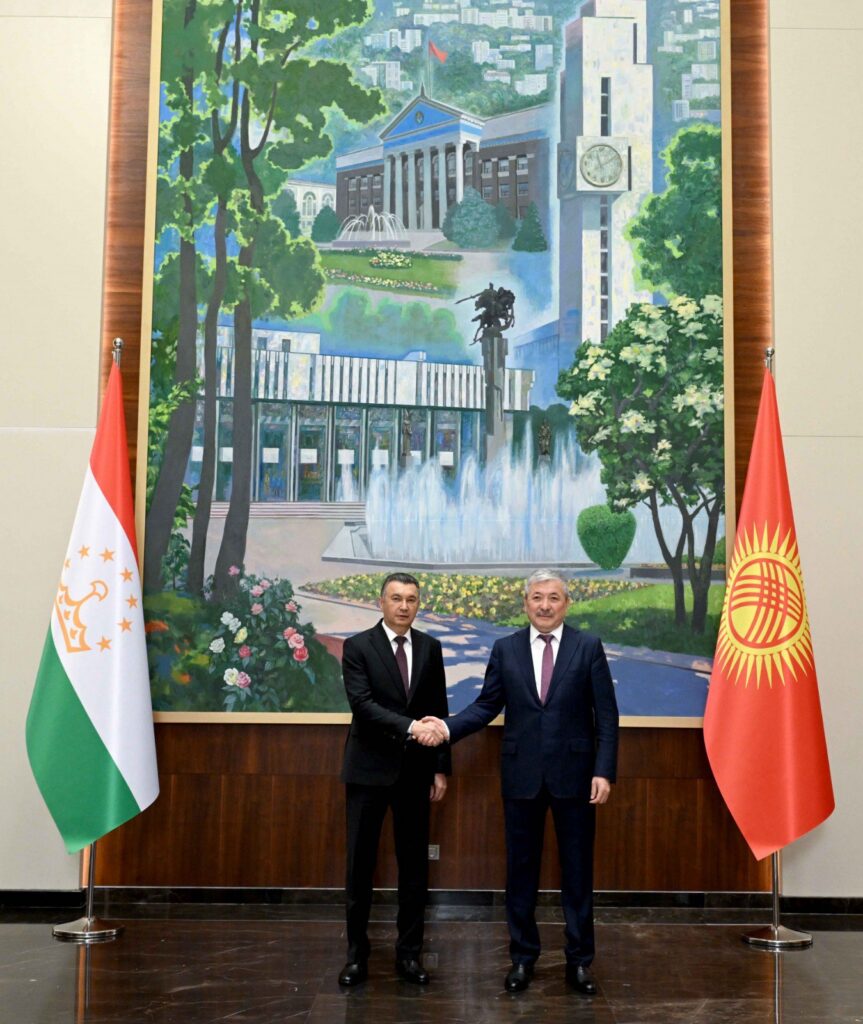
On February 13 in Bishkek, Chairman of the Cabinet of Ministers of Kyrgyzstan Adylbek Kasymaliev and Prime Minister of Tajikistan Kokhir Rasulzoda held the first meeting of the Kyrgyz-Tajik Intergovernmental Council.

Opening the session, Kasymaliev said that 2025 marked a historic milestone in bilateral relations, citing the completion of the delimitation process of the Kyrgyz-Tajik border. He described the agreement as “a decisive factor in strengthening security and stability not only in our countries but also in the entire region.”

Addressing trade and economic cooperation, Kasymaliev stated that Kyrgyzstan is ready to expand supplies of meat and dairy products, clothing and textiles, coal, glass, and sugar to Tajikistan.

According to official figures, bilateral trade turnover reached $36 million in 2025, representing a nearly 24-fold increase compared to 2024. Both sides have set a target of increasing annual trade to $500 million.

In the field of transport and logistics, Kasymaliev emphasized the need to improve border infrastructure and enhance the efficiency of checkpoints. Proposed measures include modernizing existing border crossings, expanding capacity, developing logistics and cargo terminals, and introducing digital solutions in customs and border administration.

“Kyrgyzstan is ready to act as a trade gateway for Tajik goods to the markets of the Eurasian Economic Union (EAEU), as well as the European Union through the Generalised Scheme of Preferences Plus (GSP+),” Kasymaliev said.

He also highlighted the strategic China-Kyrgyzstan-Uzbekistan railway project, which he said would significantly increase Kyrgyzstan’s transit potential and strengthen its role as a logistics hub in Eurasia. According to the Kyrgyz prime minister, the new transport corridor will create additional opportunities for Tajikistan.

Kasymaliev further noted positive dynamics in tourism cooperation. In 2025, 86,000 tourists from Tajikistan visited Kyrgyzstan, a 12-fold increase compared to 2024.

Kyrgyzstan reaffirmed its interest in developing joint tourism initiatives, including the possible introduction of a unified visa for third-country nationals traveling across Central Asia.

Rasulzoda stated that Tajikistan places particular importance on good-neighborly relations and mutually beneficial cooperation with Kyrgyzstan, confirming readiness to further strengthen the partnership.

As part of his visit to Bishkek, Rasulzoda toured a recently opened waste-to-energy plant constructed by a Chinese company. He described the facility as a promising example of modern waste recycling and expressed Tajikistan’s interest in implementing similar projects.

Uzbekistan’s Umarov Appointed to Board of World Motorsport Body

Otabek Umarov, the First Deputy Chairman of Uzbekistan’s National Olympic Committee, has become the first ever Central Asian to join the Senate of the Fédération Internationale de l’Automobile (FIA) – the governing body for motorsport and the federation for mobility organizations.

Umarov’s appointment to the FIA Senate ensures that there will be a Central Asian voice at the highest level of the motorsport industry. The FIA’s Senate controls the overall governance of the FIA and oversees the Federation’s financial and administrative matters, covering both sport and mobility. 

Umarov is married to Shakhnoza Mirziyoyeva, the youngest daughter of President Shavkat Mirziyoyev. He has spent several years as Deputy Head of the Uzbek State Security Service.

In addition to his role at Uzbekistan’s Olympic Committee, Umarov is the Vice President of the Olympic Council of Asia (OCA). In recent years he has led the modernization of the country’s sports infrastructure, which will bring major international events to Uzbekistan this year. Samarkand will host the World Triathlon Championship Series (25-26 April) and the 46th Chess Olympiad (15-28 September), while the World Aquatics Swimming World Cup will be held in Tashkent on 8-10 October. Uzbekistan has also been named host of the 2029 Asian Youth Games.

The country’s athletes are currently competing at the Winter Olympic Games in Milan.

Taxing the Gig Economy in Kazakhstan

Beginning in 2026, Kazakhstan plans to introduce enhanced oversight of citizens’ mobile transfers. Officially, the measure is framed as part of efforts to combat tax evasion. In practice, however, it represents a large-scale fiscalization of the gig economy, which employs hundreds of thousands of taxi drivers and couriers.

The primary focus of the campaign is workers on digital platforms, including ride-hailing and delivery services. The authorities classify them as individual entrepreneurs who underreport or conceal income. Yet the economic reality is more complex: for many, this is less a shadow economy than a form of concealed unemployment operating under the label of “self-employment.”

Hidden Unemployment Rather Than a Shadow Economy

In recent years, the gig economy in Kazakhstan has become structurally significant. Industry estimates suggest that hundreds of thousands of people now work through digital platforms, and the number continues to rise.

For most drivers and couriers, this is not supplementary income but their principal, and often only, source of earnings. The drivers of this trend are well known: limited job opportunities in many regions and a persistently high household debt burden. Elevated levels of consumer lending have compelled many citizens to seek fast, accessible sources of income, even where margins are thin.

At the same time, tax authorities treat these workers as entrepreneurs who deliberately avoid taxation. However, they lack core characteristics of independent businesses: they do not set tariffs, generate demand, or accumulate capital. Their status more closely resembles digitally mediated wage labor without corresponding social protections.

Tax on Turnover, Not Profit

Platform-based work is highly sensitive to additional costs. Digital aggregators typically retain commissions of 20-25% on each order. The remainder is not net profit but gross turnover, from which drivers must cover fuel, maintenance, depreciation, and other operating expenses.

Industry assessments indicate that a taxi driver’s net income after expenses rarely exceeds 40-50% of the order value. It is from this turnover that taxes are now expected to be withheld.

Under the proposed model, platforms would act as tax agents, automatically deducting payments from each transaction. Options under discussion include a flat 4% rate or a system combining fixed social contributions with a 1% income tax. These measures are presented by officials as simplifying compliance and reducing administrative burdens.

The central issue, however, is that taxation would occur before expenses are accounted for. For businesses with substantial profit margins, this may be manageable. For drivers operating on minimal profitability, it could prove critical.

Digital Control as a Point of No Return

Previously, some workers partially offset costs by accepting direct mobile transfers, operating in what officials describe as a “gray zone.” This avenue is set to narrow significantly.

Under the current financial monitoring framework, if an individual receives transfers from 100 or more different senders over three consecutive months, the information is automatically transmitted to tax authorities.

For taxi drivers, this threshold may be reached within days of active work. As a result, opportunities for informal adjustment are effectively disappearing.

Who Ultimately Bears the Cost

Digital platforms are unlikely to absorb the additional fiscal burden by lowering commissions. Their business models are tightly calibrated, leaving little room for voluntary margin reductions.

Consequently, the burden is likely to be redistributed in two primary ways: some drivers and couriers may exit the market, while prices for end consumers may rise. Both trends have been observed during previous periods of regulatory tightening.

Dynamic pricing algorithms respond to supply shortages by increasing fares. When the number of available drivers declines, prices tend to rise sharply rather than proportionally. In practical terms, this can make a standard trip or delivery one-and-a-half to two times more expensive.

Social Risks of Fiscalization

The social profile of gig workers heightens potential risks. Many are men aged 18-35, often with higher education, who have relocated from economically depressed regions to major cities. For them, platform work functions as a critical social and economic buffer.

A significant decline in real incomes among this group could accelerate marginalization. Previous instances of courier strikes, and driver protests demonstrate that these communities are capable of rapid mobilization.

Formalizing the gig economy is, in principle, a logical and necessary step. However, in its current configuration, the reform risks functioning as a tax on subsistence-level earnings.

Aggregators retain their commissions. Workers operating on minimal margins may leave the market. The ultimate costs may be borne by consumers through higher prices and inflationary pressure in the service sector.

Absent a more calibrated tax model that accounts for actual expenses and profit levels, fiscalization may generate socio-economic consequences that outweigh the anticipated budgetary gains.

Ten Years On, Kazakhstan’s Digital Experiment Moves Closer to Citizens

On a snowy afternoon in Taldykorgan, a group of university students reacts with excitement at the mention of the words “smart city.”

“Finally!” one of them says, but they struggle to define what it actually means. Artificial intelligence? Cameras? Faster internet? It doesn’t really matter. For them, the concept signals something simple: progress.

That expectation has accompanied Kazakhstan’s digital strategy for nearly a decade. When the government adopted the “Digital Kazakhstan” program in 2017, the goal was to modernize public administration and infrastructure through data. Astana and Almaty were the first testing grounds.

But the real challenge began elsewhere. To scale the model nationally, authorities turned to medium-sized towns and small urban centers, places where infrastructure gaps were sometimes more visible than innovation. In some regions, electricity supply remains unstable. In others, sidewalks, heating networks, or waste management systems require urgent upgrades.

Aqkol: The Laboratory

Aqkol, a town of around 13,000-14,000 residents located 100 kilometers north of Astana, became the country’s first official pilot in 2018. The project, developed in partnership with Kazakhtelecom JSC, Tengri Lab, and the Eurasian Group, aimed to create a “conceptual model” of an intelligent city. Around 3,000 sensors and 150 cameras were installed to monitor everything from traffic flows to air quality.

In theory, Aqkol became a data-driven microcosm. In practice, the transformation was uneven.

During winter, some residents of Aqkol contend with poor street lighting and snow-covered roads; image: TCA, Manon Madec.

At first glance, Aqkol does not immediately appear transformed. On the main avenue, two heated bus stops operate through the winter. Nearby, smart benches equipped with Wi-Fi and charging ports stand mostly unused. A seventy-year-old resident waiting for his bus acknowledges that “the city has become more comfortable.”

In Aqkol, residents are waiting for more “smart” bus stops; image: TCA, Manon Madec.

Yet a few streets away, there are no sidewalks and limited street lighting. “Children walk home from school in the dark,” says Nadejda, a resident in her thirties. Zeinolla, a taxi driver native from Aqkol, questions whether the investment reached the entire town.

To understand the project, one has to step inside the Smart Aqkol control room. In a small office, screens display live environmental and security data. Air quality is measured every ten minutes. During winter evenings, coal-burning households generate visible emission peaks on the graphs.

“With these systems, we see exactly when pollution increases,” explains Asylbek Baiboranov, deputy director of the Smart Akmola regional program. “We can identify patterns and respond faster.”

On one of the large LED screens, a woman’s portrait appears alongside a live video feed of her entering what looks like a post office. The system matches faces in real time. “The surveillance cameras are equipped with facial recognition technology,” Baiboranov explains. Since their installation, recorded offences have fallen by roughly 20%, according to him.

Taldykorgan: more security, more environmental considerations

Taldykorgan already has an extensive camera network. Ameer, a student, supports further expansion. A smart city, he believes, would make Taldykorgan “more convenient, safer, and more modern.” But he draws a line: “Surveillance in public places is acceptable if it truly ensures safety. Data must be stored securely and not used for personal or illegal purposes.”

For local journalist Sandu Duseinova, cameras are only part of the equation. “If they were installed near rubbish bins, people would stop throwing garbage everywhere,” she says. For her, the promise of a smart city lies as much in environmental improvement as in security.

This is precisely the direction in which policymakers claim to be heading. In December 2025, French IoT company Actility signed a partnership with Kazakh telecom operator ASTEL. Thousands of sensors are expected to be deployed across roads, buildings, and transport networks. Authorities aim to regulate traffic flows, monitor air pollution in real time, detect heat loss during winter, and anticipate summer droughts. The objectives are framed in measurable terms: reducing congestion, improving energy efficiency, optimizing water use, and strengthening environmental monitoring.

Cameras and environmental sensors are expected to help reduce traffic congestion; image: TCA, Manon Madec

Aqkol 2.0

Back in Aqkol, Asylbek Baiboranov ensures the program acknowledged the weaknesses of the pilot and is now ready for upgrades. “Technology evolves quickly. We have to follow,” Baiboranov says. Older sensors are being replaced with newer models. Data processing systems are being modernized.

More than tangible infrastructures, digital services are at the forefront of the new strategy. In Aqkol, low-income residents will be able to present QR codes in supermarkets to receive discounts on essential goods. At the local hospital, patients can consult specialists via video, and their medical records are stored digitally. From tax payments to school schedules and administrative procedures, almost everything passes through online platforms.

This expansion of digital infrastructure has exposed risks. Over the past two years, Kazakhstan has recorded dozens of major data leaks. Last summer, a breach reportedly exposed personal data belonging to more than 16 million citizens. Beibit Birzhanov, Deputy Head of the Interior Ministry’s Department for Combating Cybercrime, reported more than 40 major data breaches in the first half of 2025 alone.

“The country is building national data centers so data remains inside Kazakhstan,” Baiboranov says. Data security, he insists, is now a priority within digitalization programs.

The smart city model has expanded quickly and is no longer confined to the city limits. In Kokshetau, north of Aqkol, the Smart Akmola headquarters looks less like a municipal office than a control hub. Young IT engineers sit in front of code. “Smart” bus stops are old news here. Their next playground is agriculture, or “smart fields.”

At the Smart Akmola office, digitalization is moving from pilot projects to a regional scale; image: TCA, Manon Madec.

Under the pilot program “Dihan Plus,” artificial intelligence is being used to analyze crop performance and detect where yields are lost. An audit of 1,800 farms narrowed the field to four pilot enterprises where precision farming tools are now being tested. Algorithms monitor soil data, productivity patterns, and input efficiency. Estimated savings could reach 250 million tenge ($500,000), says Baiboranov.

On the top floor of the building of Smart Akmola, a small incubator hosts students imagining Kazakhstan’s future urban and rural ecosystems.

Kazakhstan’s smart cities are not a finished model. If the first decade of the strategy built the infrastructure, the next will test whether targeted digital services can deliver tangible benefits without weakening data protection.

Central Asia and Azerbaijan on Board as the Gaza Peace Effort Gets Underway

As the Trump Administration is trying to drag the world toward the reconstruction of Gaza, an undertaking fraught with security, political, and economic challenges, a gap is emerging between the “old” Europe, skeptical of Trump, and nation-states seeking to expand cooperation with Washington. Central Asian and Caucasian “middle powers” are among the emerging allies in the Trump Administration’s latest diplomatic gambit for peace.

Kazakhstan took a leadership position as the first Muslim-majority state outside the Middle East to join the Abraham Accords in November 2025. President Kassym-Jomart Tokayev, an experienced diplomat, former Foreign Minister, and high-level U.N. official, represented his country at the Board of Peace inauguration during the January 2026 session of the World Economic Forum in Davos, Switzerland. So did Ilham Aliev, President of Azerbaijan, and his First Lady and First Vice President, Mehriban, both of whom met with Trump in Davos.

The attendance and participation of leaders of other majority-Muslim states outside the Middle East are also noteworthy. President Shavkat Mirziyoyev of Uzbekistan, Prabowo Subianto of Indonesia, Vjosa Osmani-Sadriu of Kosovo, and Prime Minister Mian Muhammad Shehbaz Sharif of Pakistan signed the Charter on behalf of their respective nations.

Those who chose not to participate are equally noteworthy. France, the United Kingdom, Belgium, Portugal, Canada, and Australia, which publicly announced or reaffirmed recognition of a State of Palestine around the U.N. General Assembly in September 2025, each determined not to attend the signing ceremony at Davos, despite the fact that the establishment of the Board was officially welcomed by the UN Security Council in November 2025. This underscores the challenges that will arise as Trump’s Comprehensive Plan to End the Gaza Conflict enters its second phase, which foresees Hamas’ disarmament.

Similarly, differences in policy toward Israel among the Muslim-majority countries that signed the Charter speak to the complexity of the Board’s task. Kazakhstan, Uzbekistan, and Azerbaijan have longstanding diplomatic and trade relations with Israel. This contrasts with the complex and often hostile stances of Qatar, long ruled by the Al Thani family, and Turkey under Recep Tayyip Erdoğan, both of which support the Muslim Brotherhood and shelter Hamas terrorists.

Then there are countries like Indonesia and Pakistan, which have never had diplomatic relations with Israel. Indonesia, under Subianto, continues to condition recognition of Israel on the creation of a Palestinian state. Pakistan has been officially hostile since its founding, and is particularly fearful of Jerusalem’s increasingly close relations with India, though it does have a history of covert information sharing and unofficial cooperation. Once again, navigating the political agendas and moving the reconstruction project forward will require a multi-dimensional chess game.

Nevertheless, the Trump White House is working on the Board of Peace’s first meeting, set for February 19th. Currently, there is no official word about whether the leaders of Kazakhstan and Uzbekistan will attend, while other leaders plan to, such as President Aliyev, who just signed a Strategic Partnership Charter during a visit by U.S. Vice President J.D. Vance to Azerbaijan, and PM Nikol Pashinyan of Armenia, who also signed a $9 billion nuclear cooperation agreement with the U.S. during Vance’s visit.

Attendees will also include President Javier Milei of Argentina, PM Viktor Orban of Hungary, and President Subianto, whose country is reported to be readying 8,000 troops to deploy to Gaza to focus on medical and engineering roles. These troops are the first to be committed to the International Stabilization Force (ISF), led by Major General Jasper Jeffers, envisioned under the 20-point Comprehensive Plan to End the Gaza Conflict.

Astana, Tashkent, and Baku are viewed as potential candidates to provide personnel for the ISF, although Azerbaijan earlier stated it would not do so.

What Happens in the Middle East Doesn’t Stay in the Middle East

The inclusion of Kazakhstan and Uzbekistan in the Board of Peace marks a significant shift in the diplomatic landscape of Central Asia. With the future of the Iranian regime and the consequences of Russia’s war in Ukraine still unpredictable, one thing is clear. The world is in the throes of a systemic, prolonged, and fundamental geo-strategic change. Central Asia will be affected and is also seeking the ability to influence its pace and direction. While Russia and China remain powerful, nuclear-armed neighbors and business partners, this global transformation requires a good working relationship with the U.S.

Although the White House has made it clear that “boots on the ground” are out of the question in Iran for now, it has taken an assertive approach to developments in the Middle East and is increasingly involved in Central Asia and the South Caucasus after a lengthy period of low-profile, rather selective engagements, often dictated by external events, such as the war in Afghanistan. Azerbaijan and Turkmenistan, bordering troubled Iran, have a direct interest in deepening their ties with the U.S. to bolster their security, as evidenced by the recent visit to the “permanently neutral” country of Turkmenistan by U.S. Central Asia Special Envoy Sergio Gor and Secretary of the Army Daniel Driscoll.

Costs, Dangers, and Opportunities

While there is no cost to join the Board of Peace, countries that choose to become permanent members will reportedly pay $1 billion during the first year post the Charter. However, that pales in comparison with the estimated $70 billion needed to reconstitute Gaza, including the indispensable reconstruction of Gaza’s infrastructure, as discussed earlier.

Then there is the thorny question of what to do about Hamas, which is tightening its grip on the territory in Gaza it has left, while its leaders loudly proclaim that they refuse to leave or disarm.

As the February 19th meeting approaches, the world will be watching to see if the “high-wire act” held together by American willpower can compel the confidence, resources, and determination to bring a new dawn to Gaza and, through it, increased opportunities for those who came to the effort early, including in Central Asia and the South Caucasus.

Kazakh Startup Higgsfield AI: From “Unicorn” to Racism and Sexism Scandal

In October 2025, the Kazakh startup Higgsfield AI officially joined the ranks of “unicorns” – companies valued at more than $1 billion. The rapid growth continued: by early 2026, the platform had surpassed 15 million users, and its annual revenue approached $200 million.

From the outset, the project targeted the international market. Although its headquarters is registered in San Francisco, Kazakh engineers play a significant role in its development, and the startup is a participant in the Astana Hub program.

For many observers, the emergence of the first Kazakh “unicorn” symbolized the country’s transition to a new stage of technological development, attracting the attention of global investors and stimulating the domestic IT sector.

However, the company’s rise was soon overshadowed by controversy. By early 2026, Higgsfield found itself at the center of an international scandal. Media reports and social media discussions cited allegations of aggressive advertising, opaque subscription practices, and, more worryingly, promotional content containing racist and sexist messages.

Approximately 85% of its users were marketers utilizing the service to create advertising videos, a factor that significantly contributed to its rapid scaling.

In Kazakhstan, the development was widely presented as a national achievement. However, questions soon emerged regarding the company’s business practices.

Shortly after achieving unicorn status, Higgsfield faced a wave of user complaints, primarily concerning subscriptions and refunds.

During major promotional campaigns, including “Black Friday” discounts of up to 65%, reducing the monthly price to $25, customers were promised unlimited access to advanced models. However, many users later reported a sharp decline in video generation speed after payment. According to these accounts, the application became difficult to use without purchasing additional credits, despite advertised “unlimited” access.

The company attributed the disruptions to bot attacks, stating that tens of thousands of fake accounts had been blocked, and that approximately $1.35 million had been refunded to legitimate users due to service issues.

In December 2024, the situation escalated when users reported widespread account suspensions without prior notice. The peak occurred on December 25-26, when clients with Russian IP addresses were reportedly restricted. Affected users lost not only access to paid services, but also the ability to download previously created content.

Initially, the company did not publicly comment. It later stated that the suspensions were linked to suspicious payment activity and anti-bot measures.

Additional criticism focused on alleged “dark patterns” in subscription management. Users claimed that payments were processed instantly, while subscription cancellation was difficult or technically inaccessible. On social media platforms, users compiled complaints alleging unfair practices, and warning others about what they described as a problematic business model.

Under mounting pressure, Higgsfield reinstated certain accounts and issued refunds.

Controversial Marketing: Racism and Sexism Allegations

Particular criticism targeted the company’s marketing strategy. In early 2026, reports emerged that Higgsfield’s marketing team had distributed ready-made promotional materials to content creators, including videos that allegedly contained racist and sexually explicit language inserted into the voices of well-known cartoon characters.

According to media reports, some clips included racially charged phrases and statements widely perceived as discriminatory. Critics also alleged that the company used deepfake technology to create content featuring well-known public figures, including actors Sydney Sweeney and Zendaya, as well as Donald Trump and Elon Musk, without authorization. Some of the content was described as sexualized.

Observers further argued that certain marketing materials reflected sexist undertones, relying on provocative imagery that many viewers considered degrading toward women.

Some commentators compared the strategy to “rage marketing,” a tactic based on deliberate provocation to generate attention. However, in Higgsfield’s case, critics argue that the international scale of distribution magnified reputational risks, potentially affecting perceptions of Kazakhstan’s technology sector abroad.

Amid intensifying criticism, co-founder Alexander Mashrabov publicly acknowledged operational shortcomings. In a statement on social media, he said that rapid scaling had created “real challenges” and “failures in internal processes,” adding: “Our internal processes and external communications did not always keep pace with our values, and we made mistakes. We take full responsibility and are actively correcting our course.”

Despite these assurances, the controversy has damaged Higgsfield’s reputation. Allegations concerning subscription practices, the use of deepfakes, and claims of racist and sexist content may complicate the company’s relationships with partners, regulators, and investors.