• KGS/USD = 0.01144 0%
  • KZT/USD = 0.00212 0%
  • TJS/USD = 0.10456 0.19%
  • UZS/USD = 0.00008 0%
  • TMT/USD = 0.28490 0%
  • KGS/USD = 0.01144 0%
  • KZT/USD = 0.00212 0%
  • TJS/USD = 0.10456 0.19%
  • UZS/USD = 0.00008 0%
  • TMT/USD = 0.28490 0%
  • KGS/USD = 0.01144 0%
  • KZT/USD = 0.00212 0%
  • TJS/USD = 0.10456 0.19%
  • UZS/USD = 0.00008 0%
  • TMT/USD = 0.28490 0%
  • KGS/USD = 0.01144 0%
  • KZT/USD = 0.00212 0%
  • TJS/USD = 0.10456 0.19%
  • UZS/USD = 0.00008 0%
  • TMT/USD = 0.28490 0%
  • KGS/USD = 0.01144 0%
  • KZT/USD = 0.00212 0%
  • TJS/USD = 0.10456 0.19%
  • UZS/USD = 0.00008 0%
  • TMT/USD = 0.28490 0%
  • KGS/USD = 0.01144 0%
  • KZT/USD = 0.00212 0%
  • TJS/USD = 0.10456 0.19%
  • UZS/USD = 0.00008 0%
  • TMT/USD = 0.28490 0%
  • KGS/USD = 0.01144 0%
  • KZT/USD = 0.00212 0%
  • TJS/USD = 0.10456 0.19%
  • UZS/USD = 0.00008 0%
  • TMT/USD = 0.28490 0%
  • KGS/USD = 0.01144 0%
  • KZT/USD = 0.00212 0%
  • TJS/USD = 0.10456 0.19%
  • UZS/USD = 0.00008 0%
  • TMT/USD = 0.28490 0%

Casinos in Kyrgyzstan To Open in State Buildings

The Kyrgyz parliament has passed legislation permitting gambling in state-owned facilities. This new law allows for casino activities within buildings owned by the state or enterprises with government stakes, and aims to attract investment, generate employment, and boost tax revenues.

Developed by the Ministry of Economy and Commerce and presented to the Cabinet of Ministers, the law overturns previous restrictions by permitting casinos in state-owned hotels to enhance tourism and global competitiveness. Revenues from these casinos will support the development of tourist infrastructure.

Historically, gambling was banned entirely in Kyrgyzstan in 2012, but a 2022 law reintroduced it under strict conditions, allowing only foreign nationals to participate. Kyrgyz citizens remain barred from casino entry, and the State Service for Regulation and Supervision of the Financial Market closely oversees operations to ensure compliance.

Kazakhstan Hosts Meeting of Council of Foreign Investors

Astana’s Palace of Independence hosted the 36th meeting of the Foreign Investors Council.

Kazakhstan’s President Kassym-Jomart Tokayev and Prime Minister Olzhas Bektenov attended the event. This year’s central theme was “Kazakhstan’s New Investment Cycle.” The meeting discussed strategies for the new investment cycle and the development of Kazakhstan’s attractiveness to investors.

Citing data from the International Institute for Management Development (IMD), Tokayev emphasized that Kazakhstan has become one of the world’s top 35 competitive countries.

“We set ourselves a rather ambitious goal: to attract $150 billion of foreign direct investment by 2029. To realize this goal, the Investment Headquarters under the Government is endowed with expanded powers to solve emerging problems promptly,” said the president.

Tokayev noted the merits of international oil companies, which have played an essential role in the country’s development.

“Foreign investors have invested capital and provided advanced technologies and highly skilled labor. Their investments have contributed to the growth of our energy industry: over the past 30 years, oil production has tripled. Thanks to this, Kazakhstan has become one of the five countries with the highest oil production growth rates. Speaking about the future, we set a goal to overcome the threshold of 100 million tons per year,” he said.

The meeting focused on increasing investment attractiveness in the “clean energy” sector. Specific agreements were reached with world companies such as Total, Svevind, ACWA Power, and Masdar on realizing 43 GW of “green” projects in Kazakhstan. In addition, Kazakhstan has a vast potential for developing nuclear energy, so creating an international consortium to realize the NPP construction project is under consideration.

Kazakhstan focuses on the work of the Astana International Financial Center to strengthen cooperation in the financial sector. Tokayev spoke of the importance of continuing the dialog between the Council members and government agencies to improve the country’s investment climate and implement new initiatives and specific projects.

The meeting also included Odile Renaud-Basso, President of the EBRD; Nurlan Dosymbekov, Deputy Prime Minister and Minister of National Economy; Zhang Daowei, Chairman of the Board of the Kazakh Association “Baibazarov” and the Yerstanign Investors; Nikolai Podguzov, chairman of the EDB; Andrew Deleoni, president of Alstom for Africa, the Middle East, and Central Asia; and Vadim Vorobyov, Chief Executive Officer of PJSC Lukoil.

Established in 1998, the Council of Foreign Investors is a platform for foreign investors and the government of Kazakhstan to discuss strategic objectives and find solutions to improve the business climate.

From the Kazakhstani side, the Council is attended by government members and heads of several national companies and development institutions. Foreign participants include representatives of major international corporations and organizations, underscoring the global interest in investing in Kazakhstan.

Last year’s 35th Plenary Meeting of the Foreign Investors Council was also chaired by President Tokayev. The main topic of the meeting was “Digital Transformation of the Economy.” At the time, Tokayev emphasized that digitalization is a tremendous technological breakthrough and opportunity. The growth of digitalization is already dramatically impacting economic development and changing the game’s rules in various sectors. Kazakhstan actively seeks to develop digital technologies and considers them a factor of the country’s competitiveness on the world stage.

Kazakhstan To Establish Special Commission on NPP Construction

A special government commission will be formed in Kazakhstan to manage the nuclear power plant construction project, according to Energy Minister, Almasadam Satkaliyev. As stated by the minister, the commission will engage in an open, competitive dialog with potential bidders. Preliminary consultations have already been held, including visits to China and South Korea, where critical requirements for future contractors were discussed.

Among the main selection criteria are power cost, budget and construction time-frame, mandatory safety guarantees, social commitments, financing, and localization of fuel production. As part of this process, the commission will formulate proposals for further consideration at a meeting of the Energy Council under the President of Kazakhstan. In addition, consultants will analyze the project’s financial, economic, legal, and technical aspects.

As The Times of Central Asia previously reported, a referendum on nuclear power in Kazakhstan was held on October 6. More than 70% of Kazakhstanis voted in favor of the construction of a nuclear power plant. Potential participants in the project are now being discussed. Among the countries being considered as partners are Russia, China, France, and South Korea. These states have set out their proposals, and the authorities in Kazakhstan are considering them. In addition, the United States has expressed its willingness to participate. President Tokayev has expressed his preference for an international consortium to realize the project. The final decision will be made based on technical and financial conditions, with the preliminary cost estimated at $5 billion.

Car Multimedia System Plant Launched in Almaty

The opening ceremony of the Kazakhstan Mobility Engineering Plant took place on October 30 in Almaty, Kazakhstan’s largest city. The new production facility is part of Astana Motors, Kazakhstan’s major automobile distribution and manufacturing company.

In April last year, Astana Motors signed a memorandum of cooperation with South Korea’s Motrex Co Ltd., receiving the right to produce multimedia devices in Kazakhstan using the Korean partner’s technology. The plant was launched in September 2024, and the first batch of its audio and video multimedia systems has already been delivered to the Hyundai Trans Kazakhstan plant for installation on Tucson and Elantra cars.

Speaking at the opening ceremony, Minister of Industry and Construction of Kazakhstan, Kanat Sharlapayev, emphasized that multimedia systems are high-precision production requiring first-class specialists’ competencies in digital technologies. “Our key goal is to create a production cycle with a high share of [production] localization [inside Kazakhstan]. And we will make maximum use of domestic raw materials and components. That is why Kazakhstan Mobility Engineering is important for the country.”

Motrex CEO Junseon Kim also stressed the importance of local production: “Our goal is to closely cooperate with our partners to increase local production of components and leadership in the assembly of multimedia devices. The partnership will allow us to respond quickly to local needs, create jobs, and support Kazakhstan’s economic growth.”

The Kazakhstan Mobility Engineering plant is part of the Astana Motors Engineering Technopark, constructed in the Industrial Zone of Almaty to produce automobile components. The technopark will also open a car seat manufacturing plant, a rubber and plastic products manufacturing plant, and a logistics hub. Its products will be supplied to the Hyundai Trans Kazakhstan plant and other automobile plants in Kazakhstan.

Astana Motors has also signed a memorandum with Sanico Electronics, a South Korean manufacturer, to obtain the right to produce motherboards and cases for multimedia systems.

In other news, Kazakhstan’s national company, Kazakh Invest, and KIA Qazaqstan discussed projects to produce original South Korean auto components for KIA cars in Kazakhstan.

The parties considered cooperating with South Korean companies SJG Sejong and Seoyon E-Hwa, the original manufacturers of seats, bumpers, mufflers, and other components for KIA cars. Representatives of the companies expressed interest in implementing investment projects in Kazakhstan, emphasizing the strategic importance of localizing the production of automotive components in the country.
A full-cycle plant to produce KIA cars is currently under construction in Kazakhstan’s Kostanay. The new plant will cost about $200 million and have a production capacity of 70,000 vehicles annually. This project is KIA’s first direct investment in a joint venture to construct a plant outside Korea.

At a government meeting on October 29, Minister of Industry and Construction Sharlapayev said that from January to September 2024, Kazakhstan produced more than 82,000 cars.

Turkmen Business Prepares for WTO Integration

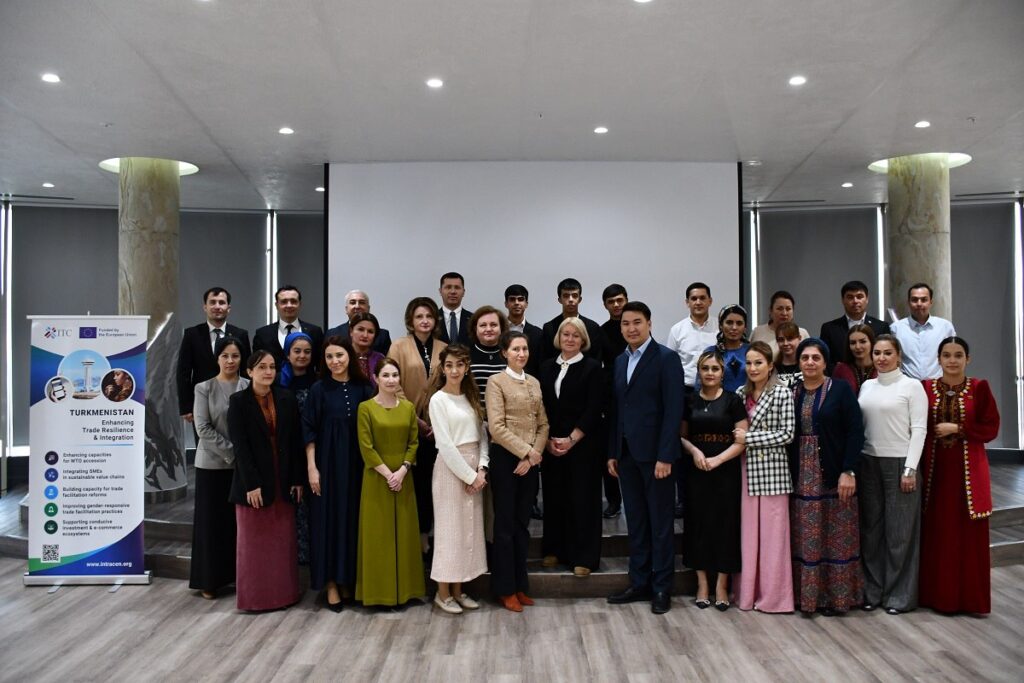
Ashgabat recently hosted a two-day seminar on Turkmenistan’s prospects for joining the World Trade Organization. The event, organized by the Ministry of Finance and Economy and the International Trade Center (ITC), brought together representatives of the country’s private sector and government agencies.

ITC international experts Daria Karman, Alyson Hook, and Nurlan Kulbatyrov shared practical integration experience into the global trading system with the participants. Special attention was paid to Kazakhstan, whose path to the WTO can serve as an illustrative example for Turkmenistan.

Among the key topics of discussion were the need to adapt legislation to international standards, reform trade policy, and modernize mechanisms for regulating foreign economic activity.

For Turkmen entrepreneurs, accession to the WTO opens access to world markets and creates favorable conditions for increasing exports. However, this will require a significant increase in local enterprises’ competitiveness and the introduction of modern production technologies.

According to the event organizers, the active discussion of integration processes testifies to Turkmen business’s serious attitude toward international cooperation.

Such seminars are part of Turkmenistan’s comprehensive preparation for accession to the WTO. In the future, this should create additional incentives for entrepreneurship and increase the country’s export potential.

Representatives of government agencies and the business community actively participated in the seminar, which confirmed Turkmenistan’s interest in deepening integration processes and expanding international trade cooperation.

Tajik-Born Artist Sabina Rosas Found Dead in U.S. Hotel

Sabina Rosas, a 33-year-old artist also known as Sabina Khorramdel, was found murdered in a hotel room in the Hamptons in the state of New York, according to the British tabloid the Daily Mail. Born in Tajikistan, Rosas moved to the U.S. in 2009. Her body was discovered on October 28 by staff at the Shou Sugi Ban House spa hotel.

Police suspect her partner, 56-year-old Thomas Gannon, in the murder. Gannon was later found dead at his Pennsylvania home, with authorities confirming he had died by suicide. The couple had been seen together at a spa in Water Mill, where CCTV captured Gannon leaving alone. Suffolk County police have described Rosas’s murder as a domestic incident.

In 2023 Rosas co-founded Ruyò Journal, a platform to support Central Asian cultural dialogue and community. Just before her birthday, she started a fundraiser to travel to Portugal, where she planned to host her first artist residency in November. She hoped it would provide a beautiful and inspiring space for creating new work.

Announcing her plans, she had said: “I will also launch my artist website to create the perfect digital space to showcase my art.”

“As I am about to turn 33, I can’t help but laugh at the fact that 33 is often associated with the age of Jesus when he made his final sacrifice. Although I don’t plan on doing anything dramatic, I consider this year a turning point in my life,” Sabina wrote shortly before her death.