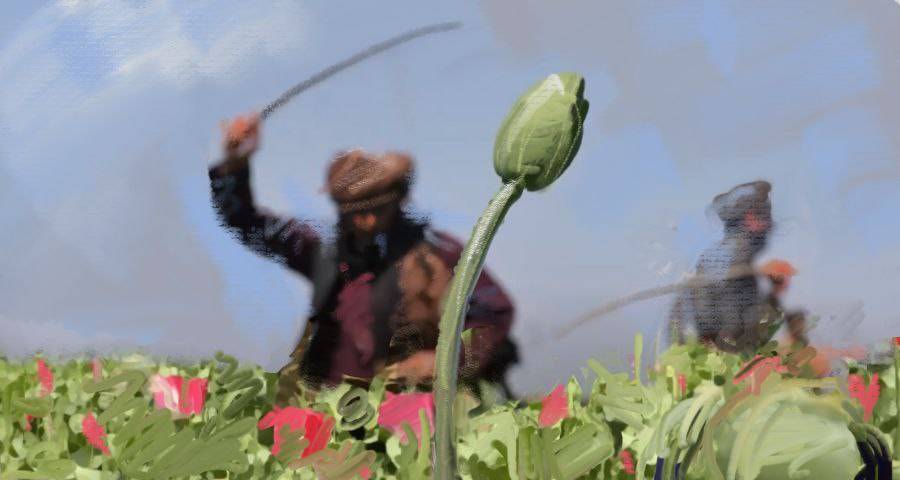
The International Crisis Group, an NGO focused on analyzing conflicts, has reported that “After the Taliban’s severe restrictions on women’s rights made the regime odious to much of the outside world, the narcotics ban offers a rare opportunity to work with the new authorities on a pressing issue for the benefit of all sides.”
Drugs from Afghanistan are a universal problem affecting all regions of the world except for Latin America, with Central Asia remaining one of the main routes for Afghan drugs on their way to Russia and Europe.
The so-called “Northern Route” passes through Tajikistan and Uzbekistan, then to Kyrgyzstan and Kazakhstan before reaching the Russian and European markets. Turkmenistan also plays an important role as a transit country for drugs, but on the “Balkan route.”
The drug threat from Afghanistan to the five Central Asian republics is not simply a political narrative used by the governments of these republics for their own political purposes. There is a risk of political instability, criminality, corruption, social degradation, and damage to human health as a result of drug trafficking from Afghanistan. Additionally, the elimination of Afghan drug production and trafficking is a key issue in the fight against terrorism, primarily against the Islamic State, as drugs are one of the main sources of income for these groups.
In April 2022, hopes for a resolution to this problem appeared following the ban on opium poppy cultivation imposed by the Taliban. Papaver somniferum, commonly known as the opium poppy, has been cultivated in Afghanistan since at least the early twentieth century. The history of opium production is detailed in the Global Illicit Drug Trends report by the United Nations Office on Drugs and Crime (UNODC). Besides the history of opium production, the report provides an overview of measures taken by states in their attempts to regulate and control the drug.
Opium began to dominate world drug markets in the early 1980s, after the “April Revolution” and the Soviet invasion of Afghanistan, when the state began to lose control of rural areas, and agriculture itself began to decline. As the UNODC points out, by 1989, opium production was firmly established as the country’s main source of income – Afghanistan had become a narco-state. The civil war continued, and the opium economy became firmly entrenched in the country during the 1990s. The first fall of the Taliban in 2001 and the formation of a republican government failed to change the situation due to the newly formed state still having no control over the regions. As a result, its counter-narcotics measures were not effective.
It should be noted that only the Taliban managed to reduce drug production. According to the UN, since the Taliban’s 2023 ban, opium crops in Afghanistan have declined by 95%, and opium prices have reached record levels.
However, many experts wonder if Afghanistan will be able to continue with its chosen policy. Can the new Afghan authorities alone continue to confront the drug threat, and what should be the role of the international community? These and other questions are addressed by the authoritative think tank, International Crisis Group (ICG), in its report, “Trouble In Afghanistan’s Opium Fields: The Taliban War On Drugs.” Its main contentions are as follows:
Trouble In Afghanistan’s Opium Fields: The Taliban War on Drugs
On April 3, 2022, the de facto Afghan authorities declared a ban on the cultivation, consumption, and trade of all types of drugs. This announcement received little international attention, in part because the news was overshadowed by another decision: the Taliban’s announcement of its infamous ban on secondary education for girls.
In fact, the two decisions may have been related. Taliban sources told the ICG that they were made at the same meeting of top leaders in March 2022. Taliban insiders, meanwhile, speculate that the Emir made the two decisions simultaneously to demonstrate the Taliban’s independence and willingness to make hard choices, whether they earned international approval or condemnation.
The significant decline in opium production in Afghanistan has hit villagers hard. The UN estimates that the opium ban has affected the earnings of nearly seven million Afghans. These people are unlikely to find other jobs in a stagnant economy burdened by sanctions. Farmers are losing $1.3 billion annually, or 8% of GDP in 2023. Yet agricultural labor has been and remains the largest source of employment for Afghan women. The economic shock has been compounded by the Taliban’s limited ability to offer farmers and other rural workers alternatives. Many have switched to growing wheat or cotton, but are struggling to make ends meet.
The economic impact of the Taliban’s war on drugs is mounting, and the future of this prohibition is uncertain. Some experts predict that its economic consequences will force the Taliban to change its mind. Others note that Taliban supporters, including wealthy landowners and dealers, thrive under prohibition and therefore support it, at least for now. The reality, however, is that a drug-free agricultural sector will not provide enough jobs. Therefore, a focus on non-agricultural employment is needed. The ICG therefore recommend that regional countries should support Afghanistan’s integration into transport networks and trade agreements for their own benefit, as well as the stabilization of their neighbor.
Foreign and international donors should support the transition to a legitimate economy, alleviating the acute poverty crisis the country currently faces, the report states. However, effective support will require working with the Taliban regime, which is politically difficult and, for many Western policymakers, unpalatable. Nevertheless, it will help Afghan civilians, especially rural women.
The issue with the rights of women and girls has made the Taliban regime politically toxic to Western countries that have historically funded counter-narcotics and rural development programs. Nevertheless, some donors have come forward in support. For example, the European Union has channeled €26 million through WHO and UNODC for drug rehabilitation in Afghanistan; these funds are in addition to the €79 million allocated for food security projects. Such assistance is welcome, but it is a far cry from the investment needed to rebuild the agricultural sector, which employs about half of the working population, including 70% of working women. However, when the Taliban came to power, donors abandoned more than $2.8 billion worth of infrastructure projects.
Western donors have good reasons to make investments which will support the Taliban’s anti-drug measures, if only for their security. First, Afghan drugs often find their way into Western markets. Second, Western governments, especially in Europe, want to stem the flow of migration from Afghanistan, and farmers losing their livelihoods may well decide to emigrate in search of a better life. The best way to avoid this would be to support the Afghan economy. This could involve a return of previous funding, albeit in smaller amounts, for the completion of infrastructure projects abandoned in 2021.
International support could focus on rural development first and foremost. Farmers can immediately receive technical assistance in water-saving techniques, such as drip irrigation and rainwater harvesting. Pilot studies of alternative crops supported by international organizations could play a role in identifying viable pathways for farmers.
However, efforts to improve the lives of farmers are unlikely to be a panacea. Afghanistan’s limited farmland is being strained by the combined numbers of unemployed people who used to work in the opium fields, returnees forced back home from Pakistan and Iran, and a rapidly growing population. According to one expert, the country is already faced with a “surplus” rural population, with insufficient arable land to provide employment for the people living on it, forcing residents to migrate to cities and out of the country. To create enough jobs in the long run, the country needs a development plan focused on non-agricultural employment and a shift towards industrialization.
The first steps towards such a shift were recommended in a UN review and endorsed by the Security Council in December 2023. However, most Western donors remain reluctant to heed the review’s recommendations. They confine themselves to humanitarian aid labeled as “basic needs assistance.” “Everyone is funding their pet projects without looking at the bigger picture,” an international official acknowledged. Given Afghanistan’s extreme poverty, it is logical for global financial institutions to work with national authorities on a multi-year development plan, but such cooperation remains difficult under the Taliban.
Countries in the region will face a plethora of consequences due to the Taliban’s drug ban. These could include illegal migration, or reduced water flows in trans-boundary rivers as the Taliban tries to irrigate new fields. These risks should prompt international players to support Afghanistan’s integration into regional economic plans by opening trade and building transportation links that would contribute to regional stability and social change in the long term. The Afghan people would benefit from closer ties with their neighbors, and farmers would be able to find markets for their crops.
However, the ICG believes that any possible action by the international community will take time. Until the country makes the painful transition away from an illicit economy, the Taliban should show some leniency. The regime must stop its harsh counter-narcotics methods. Adopting softer methods, including “turning a blind eye” to small garden plots of poppies and cannabis, will give the poorest farmers a better chance of survival in the coming years. Farmers selling tiny amounts of opium at prices hundreds of times higher than those paid for other crops will give them a lifeline without jeopardizing the overall goals of prohibition.
The ICG concludes that the implementation of drug prohibition is evidence that the new administration in Kabul has power. This distinguishes the Taliban from many of Afghanistan’s rulers in the last century, when kings and presidents did not usually assume that their power extended to the most remote areas.
Large segments of the rural population, especially women, could be pushed further into poverty if the ban on drug cultivation continues to be strictly enforced. The Taliban may not fully realize the suffering caused by their policies because their traditional supporters, especially in the south, tend to suffer less, thanks to their opium stockpiles. Nevertheless, the new authorities would do well to deal with the severity of the economic turmoil that still reverberates through the country as a result of their decrees and adopt a more realistic approach to reducing unemployment. For their part, regional and international actors should work with the Taliban to support a legitimate Afghan economy. This would help combat international drug trafficking and curb migration in the short term, as well as provide an opportunity to support rural women.




 Sergey Kwan