Turkish President Recep Tayyip Erdoğan’s visit to Kazakhstan comes as Astana is trying to give the Organization of Turkic States a more practical economic role, linking trade, investment, transport, digital development, and business financing across the Turkic world.
The visit centered on three connected events: Erdoğan’s official visit to Astana, the sixth meeting of the Kazakhstan-Turkey High-Level Strategic Cooperation Council, and the informal summit of the Organization of Turkic States in Turkistan. Erdoğan arrived in Astana ahead of talks with President Kassym-Jomart Tokayev, while Turkish media reported that the agenda included transport links through the Middle Corridor, Caspian transit routes, energy security, logistics, defense industry cooperation, trade and investment.
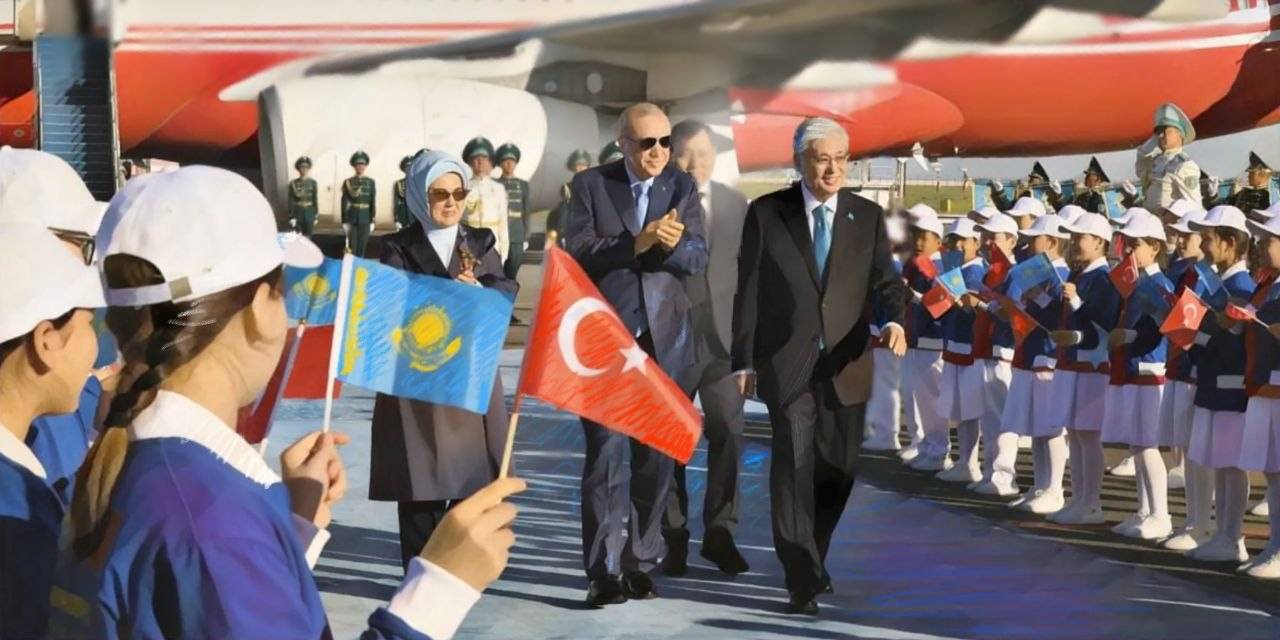
The visit also carried strong symbolic staging. According to Akorda, Erdoğan’s aircraft was escorted by Kazakh Air Defense fighter jets after entering Kazakhstan’s airspace. At Astana airport, he was greeted by an honor guard, children waving the flags of Kazakhstan and Turkey, and military helicopters displaying the national symbols of both countries. Erdoğan later said the welcome had brought his delegation “enormous joy,” adding, “We certainly will not forget this.”
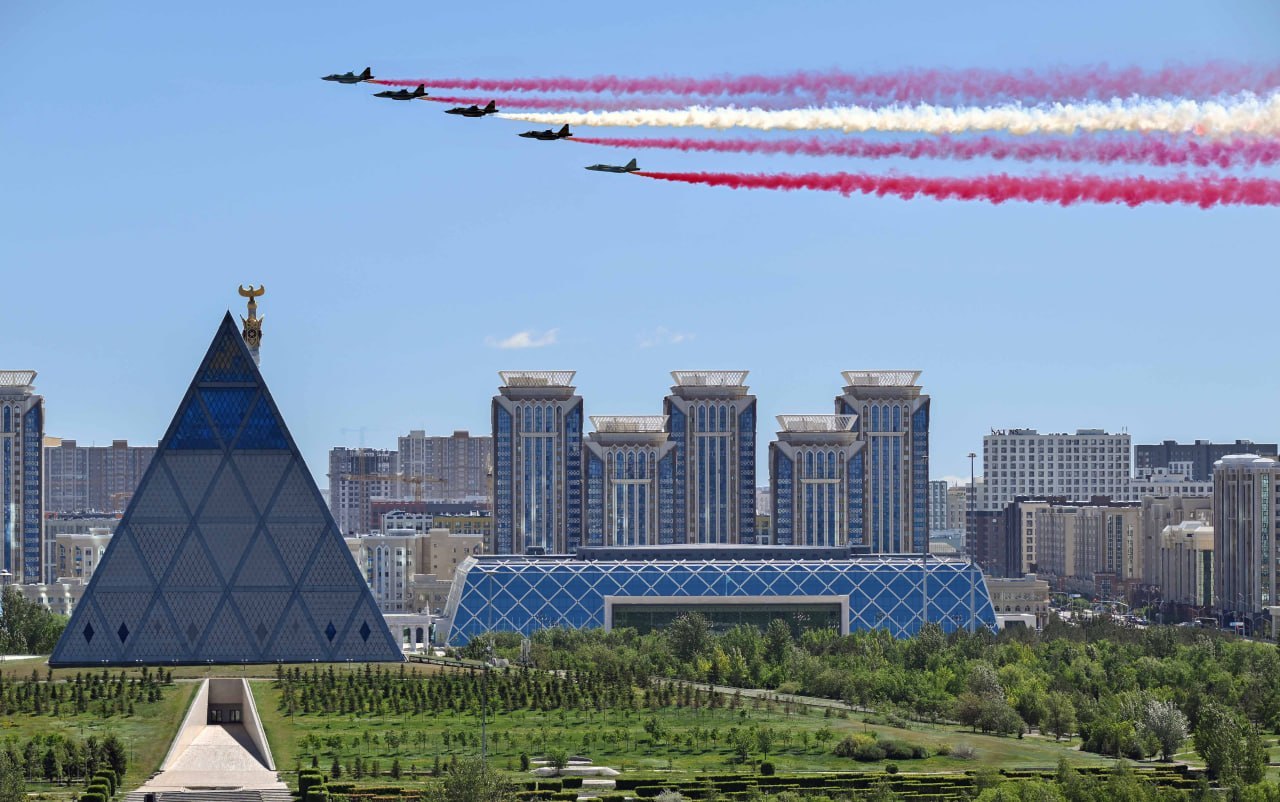
Kazakh aircraft fly over Astana during the ceremonial welcome for Erdoğan. Image: Akorda
The OTS summit is being hosted by Kazakhstan on May 15 in Turkistan under the theme “Artificial Intelligence and Digital Development.” According to the organization, the summit is intended to advance cooperation on artificial intelligence, digital innovation, emerging technologies, public services, sustainable economic growth, and regional connectivity.
The digital theme reflects Kazakhstan’s effort to give the OTS a more practical economic role, beyond its cultural and diplomatic foundations. Ahead of the summit, Astana hosted a business forum on May 13 under the title “Economic Integration and Cooperation of the OTS Countries: New Opportunities in Industry, Agro-Industrial Complex, Logistics and Digitalization.” Kazakhstan’s prime minister’s office said the forum brought together state bodies, financial institutions, chambers of commerce, international organizations, and business representatives from OTS countries.
Kanat Sharlapayev, chairman of the Union of Chambers of Commerce and Industry of Turkic States and of the presidium of Kazakhstan’s Atameken National Chamber of Entrepreneurs, urged Turkic countries to move toward deeper industrial and digital integration. He said the task was to create a unified digital environment, reduce the distance between producers and consumers, increase transparency, and speed up transactions.
The forum also discussed plans for joint industrial facilities and manufacturing zones along transport corridors, an idea that would push OTS cooperation beyond transit toward processing and value-added production.
Deputy Prime Minister and Minister of National Economy Serik Zhumangarin used the forum to frame OTS cooperation as one of Kazakhstan’s foreign economic priorities. He said the OTS countries form a market of more than 170 million people and have significant industrial, transport, agricultural, and human potential. He also said the main task was to move from declarations to joint projects, new production, technology alliances, and mutual investment.
Silk Way TV reported that Murat Karimsakov, chairman of the Kazakh Chamber of International Commerce, said trade turnover among OTS countries increased by more than 36% in 2025, while direct investment from Turkic states into Kazakhstan reached nearly half a billion dollars. Karimsakov also said Turkish investment in Kazakhstan had exceeded $6 billion over the past 20 years.
The trade target remains ambitious. At the council meeting in Astana, Erdoğan said Kazakhstan and Turkey had reaffirmed their goal of raising bilateral trade turnover to $15 billion. He also emphasized the importance of implementing the action plan adopted at the 14th meeting of the Joint Economic Cooperation Commission, held in Astana on April 15. The April commission meeting had already pointed to the practical areas behind the new trade push. The Times of Central Asia previously reported that Kazakhstan was seeking to expand agricultural exports to Turkey, with the two sides discussing trade in grain, oilseeds, livestock products, sugar, confectionery, and processed foods.
Tokayev placed the investment relationship in similar terms, stating that Turkish investment in Kazakhstan had reached $6 billion, while Kazakh investment in Turkey had approached $2.5 billion. He also described Turkey as one of Kazakhstan’s top five trading partners and said the two countries would sign a Declaration on Eternal Friendship and Expanded Strategic Partnership.
The business forum gave that political language a more practical layer. Kazakhstan’s Atameken National Chamber of Entrepreneurs signed an agreement with the Turkic Investment Fund aimed at expanding investment cooperation and supporting joint projects. A separate memorandum was signed between the Union of Chambers of Commerce and Industry of Turkic States, Kazakhstan’s Foreign Trade Chamber, and the National Association of Cooperatives and Other Economic Communities.
The Turkic Investment Fund is central to that effort. Kazakhstan views the fund as one of the main financial mechanisms for supporting joint OTS projects. Zhumangarin said the fund was ready to allocate at least $20 million at the initial stage for co-financing projects, and that talks were underway on possible participation in financing infrastructure development at Almaty International Airport.
For Kazakhstan, the OTS connects bilateral ties with Turkey to a wider regional corridor. The organization’s members are Turkey, Azerbaijan, Kazakhstan, Kyrgyzstan, and Uzbekistan. Its observer states are Hungary, Turkmenistan, and the Turkish Republic of Northern Cyprus, while the Economic Cooperation Organization has observer organization status.
This gives the OTS a geographic logic that is increasingly economic as well as cultural and political. It links Central Asia with Azerbaijan and Turkey across the Caspian, overlapping with Kazakhstan’s long-running effort to expand the Trans-Caspian International Transport Route, often called the Middle Corridor. Azerbaijan is the pivotal Caspian link in Kazakhstan’s westward corridor to the South Caucasus and Europe, with Astana also pursuing Caspian fiber-optic and power-cable projects alongside transport cooperation.
Zhumangarin separately highlighted the importance of sustainable transport routes, including the modernization of rail and port infrastructure to expand transit and trade between East and West.
Transport and logistics remain the key test. Kazakhstan wants more reliable export and transit options across the Caspian, while Turkey wants to strengthen its role as the western gateway for goods moving between Central Asia, the Caucasus, and Europe. The business forum’s focus on logistics shows the OTS economic agenda is now being tied directly to corridor development rather than solely to identity politics or diplomatic language.
Energy is part of the same corridor question, with energy security expected to feature prominently in the discussions. Any increase in Caspian-linked exports depends not only on political will, but also on port capacity, rail connections, pipeline standards, financing, and predictable customs procedures.
The visit also carries a cultural and humanitarian layer. Qazinform, citing Akorda, reported that Kazakhstan has built a school named after Khoja Ahmed Yassawi in Turkey’s Gaziantep province, which was affected by the 2023 earthquake. The two sides also agreed to open Maarif Foundation schools in Astana and Almaty. Around 14,000 Kazakh students are currently studying in Turkey, while about 260 Turkish students are studying in Kazakhstan.
Tokayev also said the newly established Khoja Ahmed Yassawi Order would be awarded to Erdoğan in recognition of his contribution to strengthening bilateral cooperation. The award reinforces the symbolic side of the visit, particularly because the OTS summit is being held in Turkistan, a city closely associated with Yassawi’s legacy.
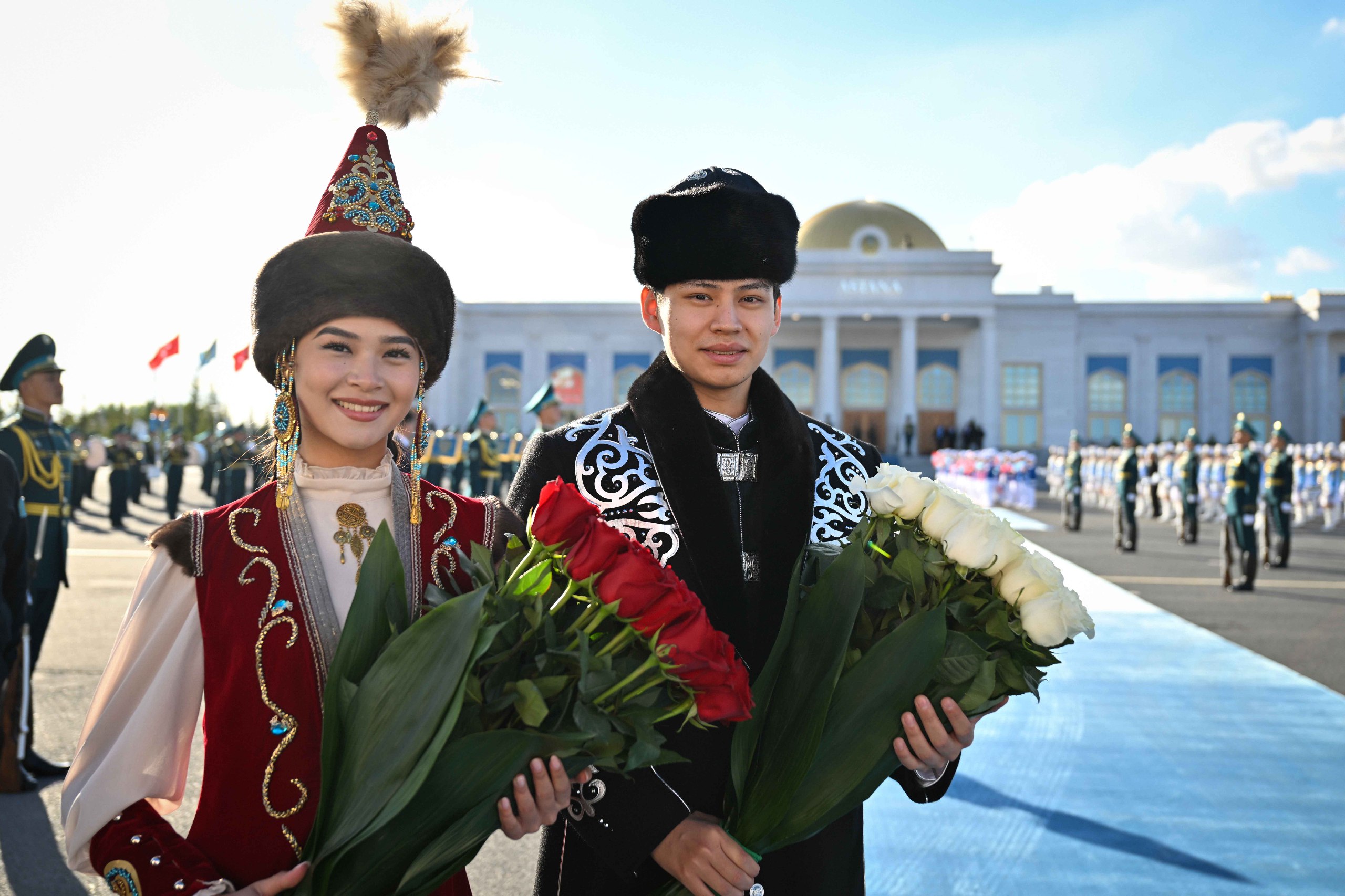
Ceremonial welcome for Erdoğan in Astana. Image: Akorda
The symbolism of the visit carries weight, but the larger question is whether the organization can turn shared identity into a working economic infrastructure. For Kazakhstan and Turkey, that means fewer declarations and more usable routes, financing tools, customs links, and projects that businesses can actually rely on.
Erdoğan’s visit does not settle that question, but it shows where Astana wants the OTS to go. The organization is being framed less as a cultural club and more as a platform for trade, transit, investment, and digital cooperation. Whether that platform can deliver will depend on what follows after the summit: signed projects, funded corridors, and simpler movement of goods across the Caspian.