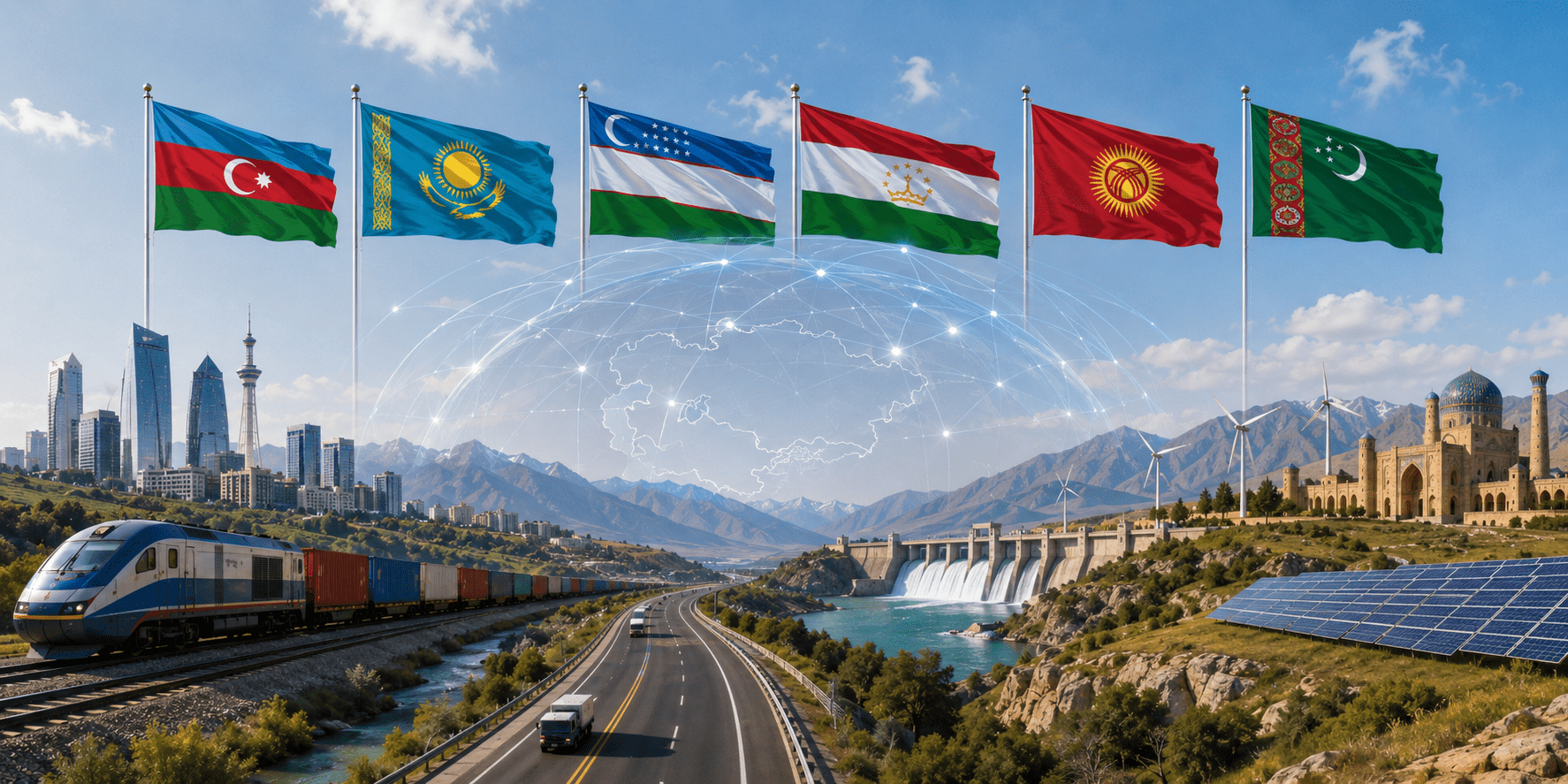
Against the backdrop of growing global fragmentation and the weakening of universal international institutions, the role of so-called middle powers is increasing. These are states able to influence regional agendas without possessing great-power status. In this changing system, Central Asia is gradually moving beyond its long-standing image as a geopolitical periphery and is beginning to act more like a region with shared interests.
For decades, the region was viewed mainly as a space where the interests of external powers, including Russia, China, the U.S., and others, intersected. Today, that paradigm is beginning to shift. Central Asia is showing greater signs of agency through what may be described as a cluster effect: individually, the countries have limited influence, but collectively they form an important transit hub between Europe and Asia, a growing market, a significant resource base, and a strategic security zone. This creates the conditions for a more coordinated regional position, even if a single regional voice is still emerging rather than fully formed.
C5+Azerbaijan as a Foundation for Regional Architecture
The institutional foundation of this process is the Central Asian leaders’ consultative format, which is now expanding through Azerbaijan’s participation. That is turning what was once a C5 dialogue into a looser C5+Azerbaijan, or C6, framework focused on transport, energy, and practical cooperation.
Within this framework, the countries of the region are learning to act in a more coordinated manner without supranational pressure. In practice, this process is developing through three main areas.
The first is transport and logistics. Azerbaijan’s participation has strengthened efforts to make the Middle Corridor more coherent, though the route still faces bottlenecks in capacity, customs coordination, and Caspian crossings. Through tariff coordination, simplified border procedures, and investment in port and rail infrastructure, Central Asia and the Caucasus are increasingly functioning as parts of a single transport artery. That gives the region a faster option for cargo between China and Europe, even if it remains far smaller than traditional maritime routes.
Shipping goods via the Suez Canal or the northern route can take between 35 and 45 days, whereas the Middle Corridor can reduce transit times to around 13-21 days under favorable conditions. According to forecasts cited by BCG, shipping volumes along the route could increase three- to fourfold during the current decade.
Beyond logistics, the project is creating a new economic framework for the region. Its status as a crossroads is attracting investment in transport hubs and manufacturing facilities along the route, with the potential to turn transit corridors into zones of economic growth. This gives participating countries not only transit revenue but a stronger basis for long-term strategic resilience.
The second major area is energy integration, where historical disputes over water and fuel resources are increasingly being supplemented by models of joint development. The Kambarata HPP-1 hydropower project in Kyrgyzstan, being developed with Kazakhstan and Uzbekistan, has created an important precedent for shared management of water and energy interests. The project is expected to support cleaner electricity generation while helping stabilize irrigation flows for farmland across the region.
Azerbaijan, in turn, serves as a strategic gateway, providing Central Asian resources with access to wider markets. Agreements on laying a deep-sea cable across the Caspian Sea and integrating regional power grids could support future exports of renewable electricity from Kazakhstan and Uzbekistan toward European markets, with green hydrogen sometimes discussed as a longer-term possibility. As a result, a broader energy hub is gradually taking shape, linking the Caspian region with the European Union through existing and planned infrastructure.
Such cooperation offers long-term strategic benefits. The region is no longer merely a supplier of raw materials, but is increasingly positioning itself as a participant in the global energy transition. Joint investment in renewable energy and transit infrastructure can create a mutually reinforcing system in which the interests of exporters and transit states are more closely aligned.
The third key factor is the transformation of the region into a larger investment destination. The C5+Azerbaijan format brings together a market of around 94 million consumers and a combined GDP exceeding $650 billion, based on recent international GDP estimates. For international investors, the region is gradually presenting itself as a more coherent economic space with a growing capacity to coordinate priorities in negotiations with major global actors.
Further harmonization of customs rules, tariffs, digital documentation, and investment procedures could reduce risks for investors. Coordinated policies could also help regional states attract investment for large-scale projects ranging from manufacturing to petrochemicals and transport infrastructure. Azerbaijan’s integration into this process gives Central Asia more direct access to financial instruments and investment hubs in the Caspian region and Europe, creating a broader synergy effect.
Ultimately, such consolidation could contribute to long-term strategic stability. A more coordinated investment space would help shield the region from external pressure and the volatility of individual markets. It could also encourage technology transfers and the creation of higher-skilled jobs, positioning the C5+Azerbaijan framework as one of the more dynamic emerging centers of economic influence in Eurasia.
A Comparative Perspective: Between Flexibility and Coordination
Comparing Central Asia’s trajectory with international examples helps illuminate its distinctive path. The region is not copying foreign models, but adapting selected elements to create its own framework for cooperation.
The experience of the Association of Southeast Asian Nations, or ASEAN, demonstrates that an effective united voice on the international stage can emerge without rigid supranational structures, relying instead on consensus and the primacy of national sovereignty. Central Asia appears to be following a similar approach by developing flexible mechanisms that allow countries to coordinate on key issues without sacrificing political independence. This pragmatic convergence, based on mutual benefit, is gradually producing a more integrated regional economic configuration capable of defending its interests in dialogue with major global powers.
The Cooperation Council for the Arab States of the Gulf offers another relevant example of how shared challenges and similar economic models can accelerate coordination, particularly in areas such as security and resource management. For the C5+Azerbaijan framework, this experience is especially relevant in the context of protecting critical infrastructure and developing a common energy strategy. Deeper cooperation in this sphere would strengthen Central Asia’s role as a zone of relative stability.
At the same time, the European Union represents a contrasting model of deep institutional integration based on strong supranational institutions. Unlike the EU, Central Asian states currently show little interest in transferring any sovereignty to a central authority, making a classic European model unlikely. Instead of creating a complex bureaucracy, the region’s evolving framework relies on network-based cooperation, in which economic integration is advanced through direct intergovernmental agreements while political independence is preserved.
Toward a Eurasian Model of Soft Regionalism
Central Asia is likely to move toward its own model of regional cooperation, which could best be described as soft regionalism or coordinated pluralism. In this framework, national sovereignty remains paramount, while the absence of rigid supranational institutions is offset by deeper coordination in practical sectors. Shared challenges, including instability in Afghanistan and Iran, climate change, water scarcity, and competition over transport corridors, are making regional cooperation not simply desirable, but increasingly necessary.
This does not mean Central Asia is becoming a bloc in the European Union sense, or that the region speaks with one voice on every major issue. The five states still have different foreign policy priorities, economic structures, and relationships with Russia, China, the European Union, and the United States. Water, border management, energy pricing, and transit competition remain sensitive. Yet the trend is toward more frequent coordination where practical interests overlap.
At the same time, Kazakhstan serves as a system-defining state in the region because of the scale of its economy, its infrastructure, and its active diplomacy. However, Astana’s role is less about dominance than about facilitating connectivity and dialogue among regional actors.
Regional dynamics remain highly sensitive to any attempt by a single state to assert leadership. As a result, inclusivity and equality are likely to remain essential conditions for the long-term sustainability of the C5+Azerbaijan framework. That makes equality among the participants not a diplomatic courtesy, but the condition on which any durable regional voice will depend.