The release of Bakhytzhan Baizhanov, a cousin of former Kazakhstan Economy Minister Kuandyk Bishimbayev, following an amnesty has renewed public attention to one of the country’s most pressing social problems: domestic violence.
The trial of Bishimbayev and Baizhanov attracted widespread attention in Kazakhstan and abroad. Bishimbayev was convicted of torturing and murdering his common-law wife. The proceedings were broadcast online and closely followed by journalists and the public.
Bishimbayev was sentenced to 24 years in prison, while Baizhanov received a four-year sentence for concealing the crime.
Amid the public outcry, Kazakhstan adopted legislation strengthening penalties for domestic violence. The legislation is commonly known as “Saltanat’s Law,” after the victim, Saltanat Nukenova. Observers say the new provisions allow tougher sanctions to be imposed on domestic abusers.
However, the legislation was only a first step. Kazakhstan still needs effective mechanisms to prevent violence and better support services for victims.”
The Country Followed the Trial
Saltanat Nukenova died on November 9, 2023, at Bau, a restaurant inside the Gastro Center complex in Astana. Baizhanov was the director of the establishment. Bishimbayev was detained that day.
An Astana court delivered its verdict on May 13, 2024. Bishimbayev was found guilty of murder committed with particular cruelty and of torture. Baizhanov was convicted of concealing the crime.
Bishimbayev was sentenced to 24 years in a maximum-security prison. The court treated the fact that he had minor children as a mitigating circumstance. Aggravating circumstances included dangerous recidivism and intoxication at the time of the crime.
In 2018, Bishimbayev had been sentenced to 10 years in prison for corruption offenses but was later pardoned. Baizhanov was sentenced to four years in a medium-security prison.
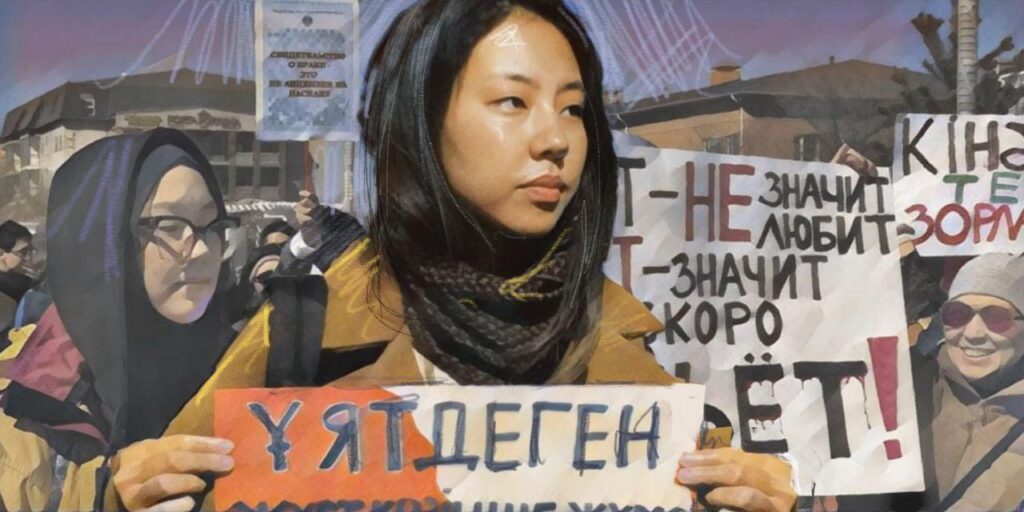
The proceedings prompted a strong public response. Activists held demonstrations in Kazakhstan and abroad, while foreign correspondents attended the hearings. Kazakhstani and international media covered the case extensively.
Public interest remains high. Many people in Kazakhstan continue to watch closely for any indication that Bishimbayev could be released before completing his sentence. Relatives of both Nukenova and Bishimbayev have also continued to make public statements.
Baizhanov Disputed the Verdict
Baizhanov’s early release under an amnesty has drawn mixed reactions. During the trial, he said he had not known how seriously Nukenova had been injured and denied that he was guilty of concealing the crime.
His sentence had previously been reduced by one-third, and he had been expected to leave prison in November 2026.
However, on July 22, his lawyer said the Stepnogorsk City Court had applied an amnesty act and ordered his immediate release.
Baizhanov will remain under probation supervision following his release. He has also been placed under administrative supervision for six years.
New Law, Old Problems
On April 15, 2024, Kazakhstan adopted legislation amending several laws concerning women’s rights and children’s safety.
Although the legislation had been drafted before Nukenova’s murder, the public attention surrounding her death and Bishimbayev’s trial led to it becoming informally known as “Saltanat’s Law.”
The law expanded legal protections for women and children. Battery and the intentional infliction of minor bodily harm were once again classified as criminal offenses. Penalties for domestic violence were also increased.
Kazakhstan’s Criminal Code introduced a separate provision covering stalking, defined as the persistent and unwanted pursuit of another person.
Domestic violence nevertheless remains one of Kazakhstan’s most serious social problems.
According to the Interior Ministry, the number of registered criminal offenses related to domestic violence increased by 16.2% in 2025. Following the legislative changes, police began registering every report, regardless of whether it came from the victim, a relative, a neighbor, or a bystander. Cases reported through social media and news publications are also registered.
Police have also increased efforts to hold domestic offenders administratively liable. In 2024, 86,518 people were held liable for unlawful conduct in the domestic sphere. The number rose to 96,194 in 2025, an increase of 11.2%. More than 29,000 offenders were placed under arrest.
The increase in recorded offenses does not necessarily indicate a corresponding rise in violence. It may also reflect more comprehensive registration of complaints and changes in how police handle reports.
Domestic violence remains a serious concern, and new high-profile cases continue to emerge.
In June 2025, Aizat Zhumanova was killed in front of her children in the Aksu district. Her husband was accused of the killing. The case prompted widespread outrage because of the alleged brutality of the crime. Zhumanova’s relatives said her husband had beaten her. They also alleged that he tied her to a horse and dragged her along the ground.
In July 2025, an Astana court sentenced former diplomat Saken Mamash to six years in a medium-security prison for torturing his former wife. The court heard that Mamash had beaten her over several years, including while he was posted to the United Arab Emirates.
After the victim spoke publicly about the abuse, Mamash was recalled to Kazakhstan. He was also stripped of his diplomatic rank of first-class counselor.
These are among the cases that have received widespread publicity, while reports of domestic violence continue to emerge regularly.
Civil society activists argue that tougher penalties alone are insufficient. They say Kazakhstan needs systematic public education promoting respectful family relationships and rejecting violence.
The country also continues to face a shortage of crisis centers and other support services for women and children affected by abuse. The adoption of tougher legislation was an important step, but its effectiveness will depend on consistent enforcement by the police and courts. Victims must also be able to obtain protection, while the state must do more to prevent repeated violence.
The Times of Central Asia previously reported that Kazakhstan had made some progress in combating domestic abuse one year after the adoption of the legislation known as “Saltanat’s Law.” However, victims continued to face barriers when seeking help, while enforcement of the new provisions remained uneven.